 HIPAA Compliant
 ISO 27001 Certified
AI in Clinical Trials: How It Is Changing Study Design and Patient Recruitment
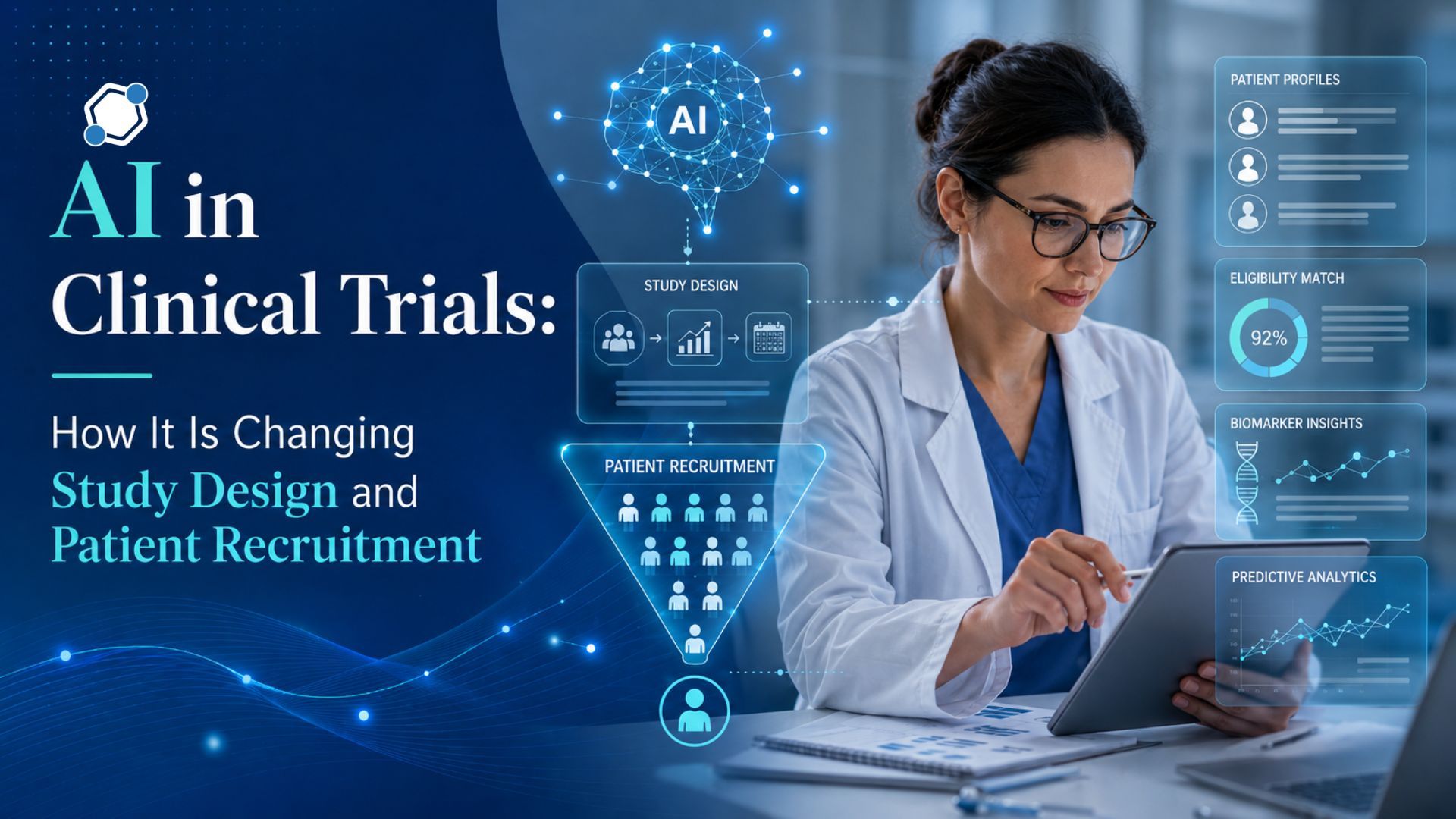
Artificial intelligence has moved from the margins of clinical research into the operational core of how trials are designed and how patients are recruited. The shift is not a forecast about what AI might do in the next decade. It is visible in protocol simulations that test eligibility criteria before a study opens, in matching algorithms that surface candidates from electronic health records, and in pre-screening workflows that reduce coordinator burden. For sponsors, CROs, and research sites navigating recruitment pressure and rising trial costs, AI in clinical trials is no longer a buzzword. It is a working capability with concrete trade-offs.
This article looks at where AI is reshaping study design, where it is changing patient recruitment, and where it falls short. The aim is practical: a working view of what the technology actually does and what an AI-enabled trial workflow looks like in industry settings today.
Why AI Has Moved Into Clinical Trial Operations
The recruitment side of clinical research has been under pressure for years. A large share of trials miss enrollment targets, and the cost of each additional month of delay compounds across the development timeline. The structural causes are well documented: overly restrictive eligibility criteria, fragmented patient identification, inconsistent site performance, and downstream attrition between consent and the first dose. These problems have proven resistant to the conventional toolkit of advertising spend, additional site activations, and longer enrollment windows. The ongoing challenge of clinical trial recruitment has pushed sponsors and CROs to look for tools that change the underlying mechanics rather than throw more resources at the same workflow.
AI has gained traction because it operates on the parts of the workflow that are bottlenecked by data volume and pattern recognition, not by clinical judgment. Identifying candidates across millions of patient records, scoring sites for likely recruitment performance, and modeling how a change to inclusion criteria will affect the eligible pool are all tasks where the computational lift exceeds what human teams can do at scale. The result is that AI is not replacing clinical decisions. It is producing the data and the candidate pipeline that clinical decisions can act on faster.
How AI Is Reshaping Study Design
The first place AI shows up in a modern trial is before recruitment begins. Protocol design has historically relied on a mix of medical-monitor judgment, prior-trial precedent, and feasibility surveys from candidate sites. AI tools are now layered into that process to test design choices before the protocol is locked.
Eligibility-criteria refinement is one of the more visible applications. A study team can run a draft protocol against de-identified patient databases and see how many patients would meet each individual inclusion and exclusion rule. Criteria that look reasonable in isolation often interact in ways that shrink the eligible population to a fraction of the disease-prevalent population. Modeling these interactions before the protocol is locked lets sponsors loosen criteria that do not affect safety or scientific validity and tighten the ones that do.
Endpoint selection and statistical-design support follow a similar pattern. Simulation tools test how proposed endpoints behave under different population assumptions and how various adaptive-design rules would have played out in historical data. The output is a wider range of scenarios examined under the constraints of the actual study population, which is more than a static feasibility survey can produce.
Site-feasibility modeling is the other major design application. Selecting sites has traditionally combined relationships, historical performance, and country-level enrollment expectations. AI models add patient-density data, competing-trial activity, and operational metrics from past studies to score sites on likely recruitment yield for the specific protocol. Sites that look strong on a generic feasibility questionnaire can look weaker when the protocol's specific population is modeled against their catchment.
Most recruitment failures are protocol failures: criteria too narrow, endpoints too burdensome, sites selected on relationships rather than data. AI does not eliminate those problems, but it surfaces them before the protocol is signed. For teams thinking about how to design trials that can actually enroll, patient-centric protocol design is the broader frame this work fits into.
How AI Is Changing Patient Recruitment
Once a protocol is locked, AI shifts into the recruitment workflow itself. The most common application is matching: algorithms that read electronic health records, registry data, and structured intake forms to surface candidates whose profile fits a study's criteria. Modern matching engines combine structured fields (age, lab values, diagnosis codes) with natural-language processing of clinical notes to identify patients who would not show up in a simple database query. A patient whose history mentions a relevant prior treatment in narrative form can be flagged for review even if no structured field captures it.
Pre-screening automation is the next layer. AI-driven pre-screening tools work through a protocol's inclusion and exclusion criteria with a candidate, capturing responses and routing the results to the site team. The goal is not to make an eligibility determination, which sits with the research team, but to filter out candidates who clearly do not meet criteria and to prepare a structured record for the ones who do. Sites that adopt these workflows report meaningful reductions in coordinator hours spent on candidates who were never going to be eligible. The downstream effect is fewer screen failures and a higher conversion rate from referral to consent. Sites looking at this layer of the workflow specifically can read more about pre-screening smarter with technology.
Recruitment analytics is the third area. Predictive models flag sites trending behind their forecasted enrollment, recommend reallocation of outreach spend toward channels with higher screening-eligible yield, and forecast dropout risk based on patient-reported and visit-completion data. The analytics do not replace operational judgment. They give the recruitment team a continuously updated view of where the funnel is leaking and what is likely to happen if no action is taken.
Across all three areas, the through-line is that AI compresses the time between data collection and operational response. A traditional recruitment workflow waited for monthly reports before redirecting resources. An AI-enabled workflow surfaces the same pattern in days, sometimes hours.
What AI Cannot Do Alone
The applications above are real, but the limits are equally real and worth naming.
Data quality is the first limit. Matching algorithms are only as good as the records they read. Health systems with incomplete documentation, inconsistent coding, or fragmented EHR deployments produce candidate lists with high false-positive rates. The fix is not better algorithms. It is better data infrastructure, and that is a slower and more expensive problem than buying a matching tool.
Regulatory expectations are the second. The FDA has published guidance on the use of AI and machine learning in drug development that emphasizes transparency, bias evaluation, and the credibility of any model used to support a regulatory decision. Models that influence which patients are screened, which sites are activated, or how endpoints are measured face scrutiny on training-data representativeness and on validation against the populations the model is being used on. Teams adopting AI tools need to be able to answer those questions, not assume the vendor has.
Human oversight is the third. AI matching does not consent patients. AI pre-screening does not confirm eligibility. A registered nurse or coordinator still walks the candidate through the protocol's specifics, captures context that a structured tool cannot, and makes the call about whether the candidate is appropriate for full screening at the site. AI makes sure the right people reach that conversation; it does not replace it.
Integration is the fourth. Recruitment tools that produce a candidate list but cannot push those candidates into the site's CTMS, the IRB-approved consent workflow, or the sponsor's enrollment dashboard create new work rather than removing it. The platforms that deliver real efficiency are the ones that surface candidates and connect them to the downstream systems that act on them. The sponsor-side view of this is where dashboards that transform sponsor oversight come in: visibility across the recruitment pipeline is what lets the analytics layer translate into operational change.
Building the AI-Enabled Recruitment Workflow
The practical question for sponsors, CROs, and sites is not whether to use AI in clinical trials. It is which specific applications are mature enough to deliver value on a current study and which are still vendor pitches. Three filters help separate them.
The first filter is whether the application has a defensible data source. A matching engine running on real EHR access through validated partnerships is different from one scraping publicly available registries. The first produces candidates a site can actually screen; the second produces a list that decays quickly.
The second filter is whether the workflow has a human checkpoint. Tools that route candidates to a clinician or nurse for review before they hit the site team are operationally safer and easier to defend to regulators than tools that push raw matches into a coordinator's queue. The checkpoint is not friction. It is the layer that prevents the site from being buried in unqualified referrals.
The third filter is whether the platform integrates with the systems already in use. Sponsors evaluating recruitment platforms increasingly look at how the tool plugs into the CTMS, the EDC, and the trial-level reporting layer. A guide to what sponsors should look for in a recruitment platform covers these evaluation criteria in more detail.
DecenTrialz is a participant recruitment and pre-screening platform serving sponsors, CROs, and research sites in the United States. The platform uses AI-assisted matching to identify candidates whose profile fits a study, and a registered nurse completes an initial pre-screening review before referral to the site research team.
Trial-level dashboards give sponsor, CRO, and site teams visibility into pipeline progress, screening conversion, and source-attributed enrollment. Final eligibility verification, informed consent, and enrollment are always handled by the study team responsible for the trial.
The shift AI is creating in clinical trials is not a leap to autonomous recruitment. It is a steady redistribution of work: machines handle the pattern-matching and the data assembly, clinical teams handle the judgment and the patient-facing care, and the workflow that connects them becomes faster and more visible at every stage. For sponsors planning the next protocol and for sites running the next study, that redistribution is the operational change worth designing around.
Was this article helpful?

Similar Blogs

What is the FDA's draft AI guidance for sponsors?
In January 2025, the FDA released its first draft guidance dedicated to artificial intelli...
 Mahesh Upadrista
Predictive feasibility in clinical trials: what sponsors should check before committing to enrollment targets
Feasibility assessments decide who runs a study, where it runs, and how quickly it can enr...
Paramraj
Clinical Trial Patient Matching: Why Do Sponsors Need More Than a Public Registry Listing?
Every applicable clinical trial conducted in the United States must be registered in the f...
Swaroop ESDStay Informed. Stay Connected.
Get updates on verified clinical trials, emerging treatments, and research breakthroughs directly in your inbox. No spam, just science that matters.
