 HIPAA Compliant
 ISO 27001 Certified
DecenTrialz Explained: How to Search, Read, and Apply for Clinical Trials
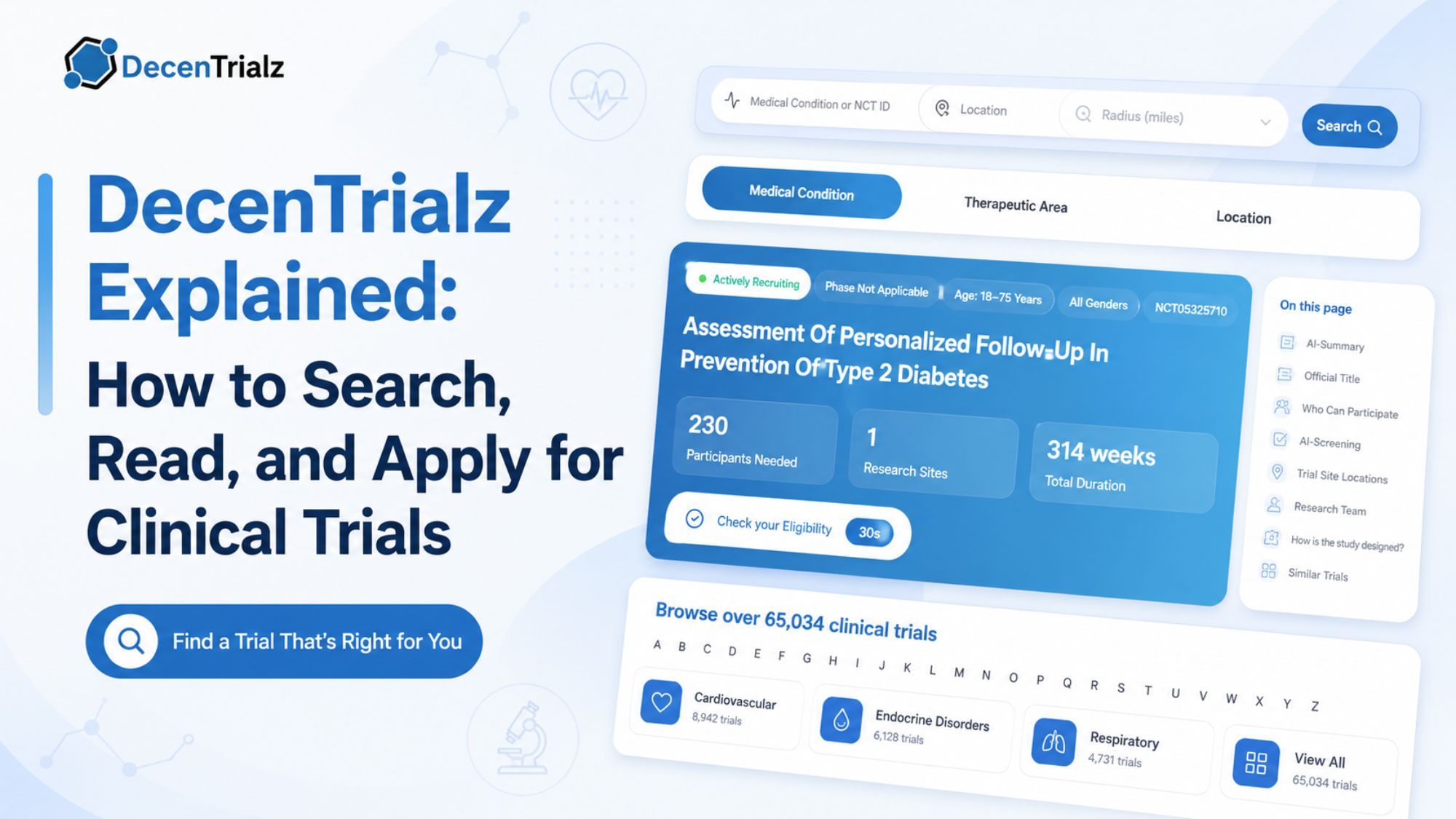
Searching for a clinical trial can feel like reading a foreign language. The listings on most registries use protocol numbers, drug codes, and inclusion criteria written for researchers, not for the people considering whether to take part. DecenTrialz was built to change that experience. It is a U.S.-based clinical trial matching platform that helps patients and volunteers find studies, understand what each one involves, and decide whether to move forward with a research site.
This guide walks through what DecenTrialz is, how to search for clinical trials on DecenTrialz, how to read a trial listing field by field, what eligibility actually means, and what happens after you find a study you are interested in. If you are new to clinical research altogether, the Clinical Trial Volunteers Guide: Your First Step Into Clinical Trials covers the basics before you start.
What Is DecenTrialz and How Does It Work?
DecenTrialz is a clinical trial matching platform based in the United States that connects patients and volunteers with research studies looking for participants. It is not a hospital, a sponsor, or a treatment provider. It does not run trials itself. Instead, it acts as a bridge between people who may want to take part in research and the authorized research teams running those studies.
A clinical trial is a research study where volunteers help researchers test new ways to prevent, detect, or treat a health condition. Trials follow strict rules set by ethics committees and regulators, and every study on DecenTrialz has been approved by an Institutional Review Board (IRB), which is the independent committee responsible for protecting the rights and safety of participants.
The platform currently lists over 65,000 approved clinical trials across the United States. It is built around four core features:
- Trial information presented in plain language rather than research jargon
- AI-assisted matching, where AI stands for artificial intelligence, that identifies studies fitting your condition, location, and basic profile
- Initial pre-screening conversations handled by a nurse from the DecenTrialz Care Center
- Strict data-privacy standards including HIPAA compliance, where HIPAA is the Health Insurance Portability and Accountability Act, the U.S. law that protects personal health information
Together, these features turn what is usually a multi-step research process (finding a registry, reading through dense protocol descriptions, contacting sites individually, sharing the same information through multiple intake forms) into a single guided experience. The role of DecenTrialz ends at the referral stage. Final eligibility verification, the informed consent conversation, and enrollment itself are always handled by the research site running the study.
How to Search for Clinical Trials on DecenTrialz
Searching on DecenTrialz starts on the Find Trials page, where you can enter a condition, a location, or both. You can type a diagnosis such as type 2 diabetes, rheumatoid arthritis, or depression, or a broader category such as cancer or mental health. You can also enter a city or ZIP code to find studies sorted by distance.
The platform supports two search paths. The first is a direct keyword search through the database of registered trials. The second is a guided matching experience: you answer a few questions about yourself, and the AI-assisted matching system returns trials whose criteria suggest a possible fit. Both paths land you on the same trial listing pages, but the matching experience surfaces studies more quickly when you are not sure which condition or keyword to start with.
If you want to understand how AI-assisted matching works across the broader research industry, Digital Pathways: How AI and Virtual Tools Are Changing Clinical Trial Enrollment explains how these systems decide which trials to surface and why they are becoming standard.
Two practical search tips. First, if your initial search returns too many results, narrow by adding the trial phase you are interested in or by tightening the location radius. Second, if your search returns no results, broaden the condition keyword or expand the geography. Some studies recruit nationally and accept participants regardless of location, while others recruit only within driving distance of a specific site.
How to Read a Clinical Trial Listing on DecenTrialz, Field by Field
Once you click into a trial, you will see a structured listing with the same set of fields on every study. Knowing what each one means is the difference between scrolling past a study and recognizing one that fits you.
Trial Title and NCT Number
Every clinical trial registered in the United States is assigned a unique identifier called an NCT number, short for National Clinical Trial, in the format NCT followed by eight digits. This number is the trial's permanent reference across every registry that lists it. If you want to look up the same study elsewhere or share it with your doctor, the NCT number is what you reference.
Phase
Clinical trials run in four numbered phases. Phase 1 tests a treatment in a small group, mainly to check safety and dosing. Phase 2 expands the group and looks for early signs of effectiveness. Phase 3 enrolls hundreds or thousands of participants to confirm whether the treatment works compared with current options. Phase 4 happens after a treatment is already approved and continues monitoring it in everyday use. Some listings show combined phases such as 1/2 or 2/3 when a study covers more than one stage. If you are unfamiliar with the phases, the Clinical Trials Explained: Simple Guide for Beginners walks through them in more detail.
Conditions
This field lists the medical condition or conditions the trial focuses on. Some studies target a single diagnosis. Others recruit across related conditions, which is common in oncology and rare disease research.
Lead Sponsor and Collaborating Sponsors
The lead sponsor is the organization responsible for the trial. This is often a pharmaceutical company, a biotech, a university, a government agency, or a hospital system. Collaborating sponsors are additional organizations contributing funding, expertise, or resources. Knowing the sponsor gives you a sense of who is funding the research and who stands behind the protocol.
Eligibility (Gender and Age)
The high-level eligibility line tells you which genders the study accepts and the age range. A line that reads All genders, Above 18+ means the study is open to adults of any gender. This is the quick filter that lets you decide within seconds whether the study could even consider you.
Participant Compensation
Some trials reimburse participants for time and travel. Others do not. This line tells you what to expect. A value of N/A means the trial has no listed compensation, which is common for studies where standard care is part of the protocol or where the trial is funded by a non-commercial sponsor.
Patients Enrolled
This is the trial's enrollment target or current participant count. It gives you a sense of the study's scale. A trial enrolling fifteen participants is usually an early-phase or rare-disease study. A trial enrolling several thousand is typically a later-phase study testing a treatment closer to approval.
Who Can Join a Clinical Trial? Eligibility, Inclusion, and Exclusion Explained
Every clinical trial has detailed rules about who can join. On DecenTrialz, these appear in two sections on the listing: Inclusion and Exclusion.
Inclusion criteria are the characteristics a participant must have to join the trial. They typically cover age range, diagnosis details, stage or severity of the condition, prior treatment history, and certain lab values or test results. To be considered for that specific trial, you generally need to meet every inclusion criterion.
Exclusion criteria are the characteristics that disqualify someone from joining. These often relate to other medical conditions that could complicate the study, medications that could interfere with the intervention being tested, pregnancy or breastfeeding, or specific lab results outside a defined range. Exclusion criteria are not a judgment about you as a person. They exist to protect participant safety and to keep the study's results clean enough to learn from.
The reason eligibility criteria can feel narrow is that researchers need to study a defined group to draw reliable conclusions. A trial testing a new heart-failure treatment for adults under 75 with no kidney disease is not designed for someone outside that profile, even if the treatment might one day help them. The same principle applies to a depression study limited to participants without current substance use, or to a rheumatoid arthritis trial restricted to people who have already tried at least two specific medications. Eligibility Explained: Why Not Everyone Qualifies for a Trial covers why these criteria are written the way they are and what to do if you do not qualify for one specific study.
If you read through the inclusion and exclusion criteria and are not sure whether you meet them, that is normal. Many criteria use clinical language or reference test results you would not have memorized. The pre-screening step is where this gets sorted out.
What Happens After You Find a Trial: Pre-Screening, Locations, and Next Steps
When you find a trial on DecenTrialz that interests you, the next step is pre-screening. You share some basic information about yourself, and a nurse from the DecenTrialz Care Center reviews your responses and may follow up by phone, SMS, email, or web chat. The nurse is not making the final eligibility decision. The research site does that. The nurse's role is to confirm whether your situation fits the trial's high-level criteria well enough to refer you to the research team.
If pre-screening goes well, DecenTrialz refers you to the research site running the trial. From that point on, the site team takes over. They will walk you through informed consent, which is the formal process where they explain the study's purpose, procedures, risks, potential benefits, and your rights as a participant. You are never obligated to enroll, even after pre-screening, and you can withdraw from a trial at any point during the study without giving a reason.
The Locations section on the listing shows where the trial is running and lets you search by ZIP code to see distance from where you live. Some studies require in-person visits at a research site. Others use a decentralized model where some or all visits happen remotely through telehealth, home nursing visits, or wearable devices. The Locations section, combined with the trial description, tells you what to expect for travel and time commitment.
Joining a clinical trial is a meaningful decision, both for your own care path and for the broader research effort. How Clinical Trials Advance Medicine and Change Lives explains how participants contribute to the treatments that eventually reach the wider population.
DecenTrialz is designed to make the search and pre-screening steps as clear and supportive as possible, with the actual study decisions resting where they should: with you, your doctor, and the research team running the trial. You can start a search at decentrialz.com.
Was this article helpful?

Similar Blogs

Why is my blood pressure still high on medication? Resistant hypertension explained
Blood pressure that stays high after treatment has already started is more common than mos...
 Vamshi Kantoju
What is insulin resistance and how does it affect blood sugar?
Insulin resistance is a condition in which muscle, liver, and fat cells respond weakly to ...
Swaroop ESD
Mini-stroke symptoms: how to recognize a transient ischemic attack before a full stroke
A transient ischemic attack, often called a mini-stroke, is a short episode of stroke symp...
Deeksha GittaStay Informed. Stay Connected.
Get updates on verified clinical trials, emerging treatments, and research breakthroughs directly in your inbox. No spam, just science that matters.
