 HIPAA Compliant
 ISO 27001 Certified
Tokenization in clinical trials: how CROs link real-world data
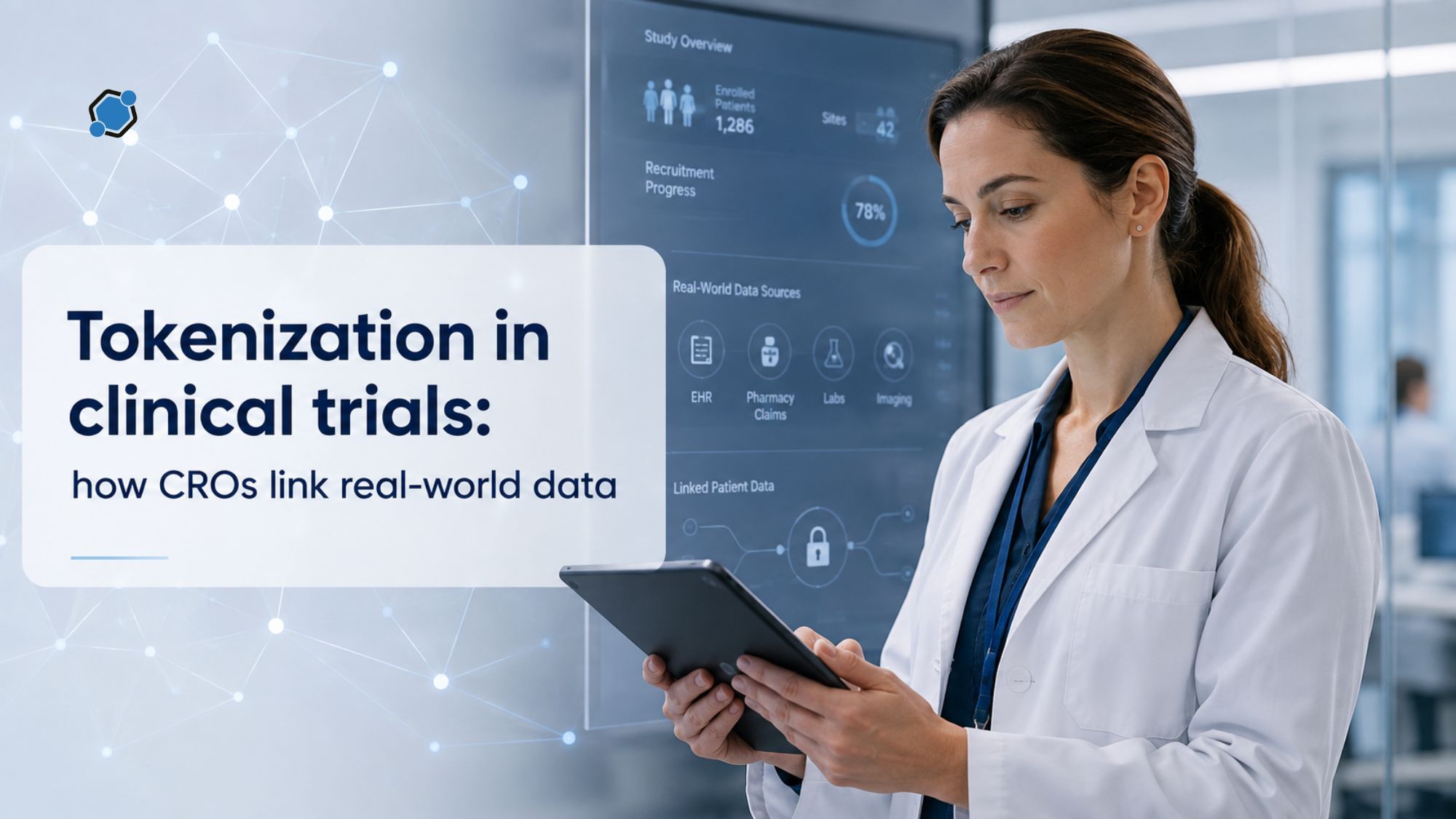
Tokenization has moved from research curiosity to operational plumbing in the clinical trial industry. For contract research organizations (CROs), the technical hashing that produces a token is now largely commoditized and handled by specialist vendors. The valuable work has shifted to everything around the hashing: choosing which real-world data sources fit the research question, writing consent language participants can understand, training sites, orchestrating vendors, governing the data, and analyzing the linked dataset once it exists.
Tokenization is not a product a CRO buys off a shelf and installs. It is a workflow that touches every part of a study, from protocol design to close-out, and the CRO is usually the party best positioned to make it run.
What is tokenization in clinical trials
Tokenization is a privacy-preserving method for linking records across separate datasets without moving personally identifiable information (PII) between them. In a clinical trial context, it converts a participant's identifiers, typically first name, last name, date of birth, and gender, into an irreversible cryptographic token. Because identical inputs produce an identical token wherever the calculation happens, the same participant's records can be matched across a trial dataset and an outside real-world data (RWD) source without either party exchanging the underlying identifiers.
Vendors typically generate several tokens per participant, each built from a different combination of identifier fields. Using multiple tokens improves match accuracy, particularly when one identifier is missing or entered inconsistently in one source.
Artificial intelligence and data-integration tooling have accelerated adoption, and the broader technology landscape helps position tokenization within a wider operational strategy. AI Tools for CROs & Sponsors: Streamlining Clinical Trials covers that landscape.
Is a token the same as de-identified data?
No. A token is de-identified in itself, but a dataset that combines trial data with tokenized RWD is not automatically compliant with the Health Insurance Portability and Accountability Act of 1996 (HIPAA), the U.S. federal law that governs the privacy of health information. Compliance still requires an independent pathway, either the removal of specified identifiers under HIPAA Safe Harbor or a formal Expert Determination that the risk of re-identification is very small. Confusing the token with the linked dataset is one of the most common and most consequential misreadings of this technology.
How tokenization differs from de-identification
Traditional de-identification strips or masks identifiers to protect privacy. That approach works, but it destroys the ability to later link a participant's data to any outside source. Once identifiers are gone, there is no reliable way to reconnect a trial record to that same person's electronic health records (EHR), claims history, or mortality data.
Tokenization solves that problem by replacing identifiers with a deterministic token rather than removing them. Two datasets holding the same participant produce the same token independently, which means matching happens on tokens alone. The identifiers never leave the systems that generated them, and the researchers analyzing the linked dataset never see the identifiers at all.
A trusted third party or honest broker often sits between the site and the analysis team. This intermediary holds the identifiers, performs token generation, and passes only the tokenized output forward. Its role is a firewall: no single downstream party can reconstruct who a participant is from what they receive. Patient Privacy in the Digital Age: Safeguarding Data in Research offers plain-language explanations site teams can share with participants.
Can a token be reversed to identify a patient?
Not through the token itself. The hashing function used to produce a token is one-way, meaning the mathematical operation cannot be run backward to recover the input identifiers. Re-identification risk enters through a different route: if the linked dataset contains enough rare or specific data points about a single person, statistical inference can sometimes narrow that person's identity. That is why the re-identification risk analysis, not the token itself, is the true safeguard.
How CROs link real-world data to trial data
The workflow that produces a tokenized, linked dataset involves several handoffs, and the CRO usually coordinates all of them.
Sites collect participant identifiers into a secure portal kept separate from the study database. A tokenization engine, run by the CRO's vendor or by a trusted third party, converts those identifiers into tokens and returns them along with each participant's study identifier. The CRO attaches the token to the primary trial data. Separately, the RWD vendor generates the same token on its own dataset using the same algorithm and identifier fields. Matching then happens on tokens alone, and the linked dataset arrives at the CRO for analysis.
Several RWD sources are commonly linked this way. Electronic health records add clinical context. Medical claims data reveals healthcare utilization patterns. Pharmacy data shows medication history. Laboratory data adds results outside the trial visit schedule. Disease-specific and natural history registries add background rates and outcomes. Mortality data, sourced from national records, extends follow-up beyond the last scheduled trial visit.
Selecting the right sources is the CRO's most important early contribution. Not every RWD source fits every research question, and buying access to a poor-match dataset wastes both time and budget. The Role of Real-World Data in Decentralized Clinical Trials explains how sources map to study questions.
Planning tokenization before a trial starts
Tokenization is far cheaper and cleaner when it is planned into the protocol from the beginning. Retrofitting it after enrollment has begun creates consent complications, workflow disruption, and lower opt-in.
Three planning decisions carry the most weight. The first is which RWD sources will be linked, because that decision drives contracting, budget, and vendor selection. The second is the consent language, because participants must understand and agree to tokenization and downstream linkage, and the language must cover intended purposes, retention periods, and withdrawal. The third is the site workflow, because sites need to know when in the participant journey identifiers are collected, who touches them, and how the token flows out of the site.
Evidence from CROs already running this at scale points to a simple rule: capture tokenization authorization inside the main informed consent form (ICF) at enrollment, not as a separate later addendum. Opt-in rates are materially higher when the request is part of the primary consent conversation. Building this into the protocol and institutional review board (IRB) submission early prevents rework and keeps the study on timeline. Integrating Real-World Evidence into Clinical Studies covers the design considerations behind these early decisions.
When should tokenization consent be collected?
At the time of main informed consent, alongside the other authorizations the participant is being asked to give. Presenting tokenization consent as a natural part of the enrollment conversation produces the highest opt-in and the cleanest downstream workflow. Late requests, whether by phone or portal, tend to fail more often and complicate the analysis.
Does tokenization require IRB approval?
Yes. Any use of participant identifiers to generate tokens, and any linkage of trial data to outside sources, requires review by the IRB overseeing the study. The protocol, the ICF language, the data flow diagram, and the vendor agreements all fall within scope. Early IRB engagement is faster than late IRB engagement.
What CROs use tokenization and RWD linkage for
The use cases have expanded quickly. Tokenization now supports several trial designs that were difficult or impossible to run with traditional data linkage.
External control arms are one prominent application. When a randomized concurrent control is impractical or ethically difficult, as often happens in rare disease and single-arm oncology studies, RWD can provide a comparator population matched to the trial's inclusion criteria. Long-term follow-up is another. Cell and gene therapy studies often require follow-up spanning many years, and passive linkage to EHR and claims data can extend that window without asking participants to return for extra visits. Pragmatic designs and trial emulation studies use similar mechanics.
Tokenization also supports post-approval commitments and Phase IV work, safety signal detection across broader populations, and natural history augmentation for rare disease programs where the disease is too uncommon to study through a single trial. Post-Approval Commitments: Conducting Phase IV and Safety Studies shows how these obligations fit into a sponsor's broader regulatory strategy.
Can tokenized RWD support an external control arm?
Yes, when the data is fit for purpose. The RWD source must contain the variables that define the study's endpoints, use compatible coding standards, cover a population that resembles the trial cohort, and reach adequate match rates against the trial participants. Regulatory acceptance of an external control arm depends heavily on the quality of that fit, so this is a decision that benefits from early conversation with the reviewing agency.
Operational challenges in RWD linkage
Tokenization workflows are more mature than they were a few years ago, but the system is still evolving, and several friction points recur.
Data quality varies across RWD sources. Completeness, timeliness, and coding practices differ, and the linked dataset inherits those inconsistencies. Match rates also vary. A token match depends on identifier completeness and accuracy in both the trial data and the RWD source, and low match rates can shrink the analytical sample or introduce bias if matching succeeds differentially across participant subgroups. Consent language is a persistent challenge, because participants need enough information to make an informed decision without being overwhelmed by technical detail. Contracting with multiple data vendors is slow, and governance frameworks including data use agreements must be executed before any linkage happens.
Site training is a separate reality. Sites often encounter tokenization for the first time on a specific study, and clear plain-language materials help participants avoid confusing tokenization with unrelated technologies such as blockchain.
What is a token match rate and why does it vary?
A token match rate is the share of trial participants whose tokens successfully match against records in the RWD source. It varies with the completeness and accuracy of identifiers on both sides, the age and freshness of the RWD source, and the demographic composition of the study population. Planning for match-rate variability, and analyzing whether unmatched records look different from matched ones, is part of a robust study design.
Where CROs add the most value
DecenTrialz supports CRO recruitment with AI-assisted participant matching and registered nurse-led pre-screening, so more of the participants sites see are already aligned with study eligibility. DecenTrialz pre-screens only; the research site team handles walk-through, eligibility, consent, and enrollment. That clean handoff frees CRO clinical operations teams to focus on higher-value tokenization and RWD linkage work. Learn more about how DecenTrialz supports CRO recruitment workflows.
The CRO's most valuable contribution to a tokenization project is judgment, not code. Choosing fit-for-purpose RWD sources, drafting consent language participants understand, training sites on identifier handling, managing vendor relationships, analyzing linked datasets while accounting for match-rate bias, and engaging early with regulators on RWD strategy: these are the skills that separate a well-run program from a costly one. A recruitment and pre-screening layer that consistently delivers eligible participants to sites is the foundation that lets those higher-value activities happen at all.
Does tokenization work for global trials under GDPR?
The picture is more nuanced outside the United States. The European Union's General Data Protection Regulation (GDPR) treats tokenized or pseudonymized data as personal data in many circumstances, so tokenization alone does not remove GDPR obligations. Recent case law has begun clarifying when a recipient of pseudonymized data may treat it as non-personal, but the safer assumption for global studies is that GDPR obligations apply and the study team plans accordingly.
Was this article helpful?

Similar Blogs

How CROs validate AI recruitment tools
Contract Research Organizations, known as CROs, run the day-to-day operations of clinical ...
 Vamshi Kantoju
Clinical Trial Patient Matching: Why Do Sponsors Need More Than a Public Registry Listing?
Every applicable clinical trial conducted in the United States must be registered in the f...
Swaroop ESD
DecenTrialz vs traditional recruitment platforms: how does full-service matching differ from self-service trial search?
Comparisons between DecenTrialz and traditional recruitment platforms usually come down to...
Vamshi KantojuStay Informed. Stay Connected.
Get updates on verified clinical trials, emerging treatments, and research breakthroughs directly in your inbox. No spam, just science that matters.
