 HIPAA Compliant
 ISO 27001 Certified
Bone adhesive clinical trials: understanding the science behind biodegradable bone glue
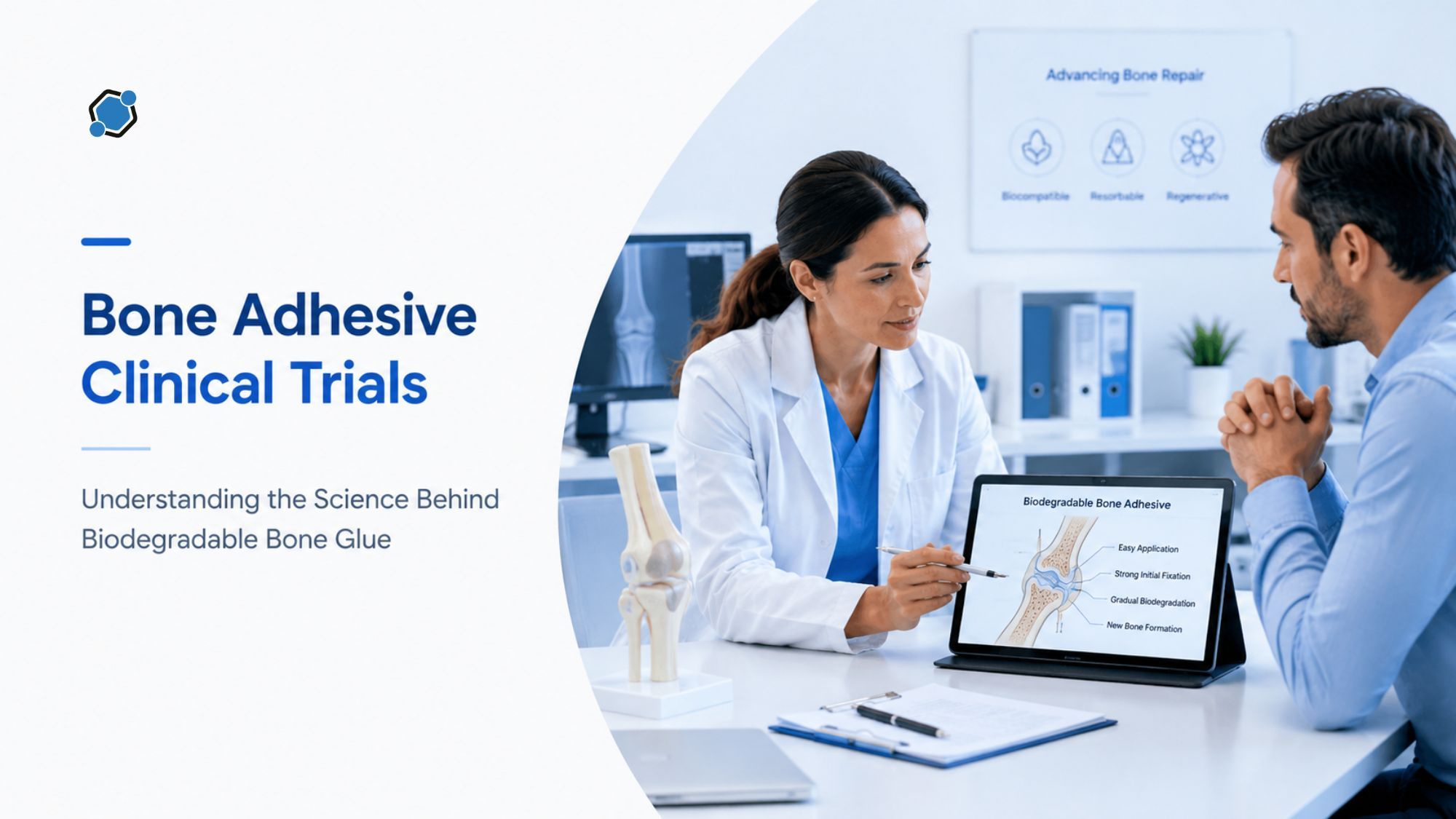
Every year, tens of millions of people around the world break a bone. For most of them, the standard fix has looked roughly the same for decades: an operation, followed by metal plates, screws, or pins holding the fragments in place while the bone heals. A new class of material, often called bone adhesive or bone glue, is being studied as an alternative. Recent news coverage of a Chinese bio-adhesive named Bone-O2 has brought this idea into the mainstream, but the science behind it goes back much further, and the clinical trials that will decide whether it becomes standard care are still in their early stages.
This article explains what a bone adhesive is, why researchers are interested in it, what Bone-O2 actually is, and how the clinical trial process determines whether a promising new material becomes something a surgeon can reach for in the operating room.
What a bone adhesive actually is
A bone adhesive is a medical material designed to hold broken pieces of bone together while the body heals itself. In simple terms, it is a biological glue engineered to work inside the human body. Unlike the everyday glues used to repair a broken cup, a bone adhesive has to meet a much harder set of requirements. It needs to stick to wet, slippery bone surfaces, because the inside of the body is not a dry environment. It needs to be strong enough to hold bones together while a person moves, walks, or bears weight. And it needs to be biodegradable, meaning the body can slowly break it down into harmless substances over time as the natural bone heals.
The word bio-adhesive is often used to describe these materials. The prefix bio simply signals that the material is designed to interact safely with living tissue. Researchers have been studying bio-adhesives for bone repair for more than thirty years, and interest has grown as new formulations have become stronger and safer. To understand where this research fits in the broader picture of clinical studies, it helps to first understand how trials work. Clinical Trials Explained: Simple Guide for Beginners walks through the basics.
Why researchers are looking beyond metal plates and screws
Traditional fracture fixation, meaning the surgical process of holding broken bones in place, has served medicine well. Metal plates, screws, and pins are strong, reliable, and predictable. But they come with a set of trade-offs that motivate the search for something better.
Surgery to install metal hardware often takes a long time. Surgeons have to move soft tissue out of the way, drill precise holes into the bone, and secure each piece of hardware. Longer operations mean more blood loss, more time under anesthesia, and a greater window for infection. In many cases, the hardware also needs to be removed in a second surgery once the bone has healed, particularly in younger patients or in bones that will keep growing.
Metal fixation also does not work equally well for every kind of break. Fractures that shatter into many small pieces, or that cross a joint surface, are especially difficult to repair with plates and screws. A material that could hold these smaller fragments in place, then quietly disappear as the bone regrows, would fill a real gap in orthopedic care. That is the promise driving bone adhesive research, and it is part of a longer story about How Clinical Trials Advance Medicine and Change Lives.
Bone-O2: the oyster-inspired adhesive making headlines
In late 2025 and early 2026, a research team in China published early results from a bio-adhesive called Bone-O2 in the peer-reviewed journal Annals of Medicine and Surgery. The project was led by Dr. Lin Xianfeng, an orthopedic surgeon at Sir Run Run Shaw Hospital. The team drew inspiration from an unlikely source: oysters. Oysters produce a natural cement that lets them cling firmly to wet rocks, even in moving seawater. That ability to stick under wet conditions is exactly what a bone adhesive needs to do inside the body.
Bone-O2 is described as an organic-inorganic hybrid material. In plain terms, it combines a hard, mineral-based component similar to the calcium compounds found in shells and bones with a softer, protein-based component that acts as the sticky matrix. Laboratory tests reported bonding strength exceeding 400 pounds of tensile load, which is the pulling force the material can withstand before separating. The adhesive is applied through a small incision of about 2 to 3 centimeters, sets within roughly three minutes, and is designed to be gradually absorbed by the body over approximately six months as the bone heals.
Published reports describe results from more than 150 patients in China. In one documented case, a complex wrist fracture was fixed in about three minutes without any traditional metal implants, and the patient showed full recovery at a three-month follow-up. Coverage of Bone-O2 has been widespread, but the researchers themselves have been clear that these are early findings. The idea of using clinical research to expand access to promising new approaches is a theme explored in Hope in Research: How Clinical Trials Are Transforming Rare Disease Treatment.
What clinical trials still need to prove
The published letter describing Bone-O2 is refreshingly honest about what is not yet known. The 150 or so patients treated so far represent a relatively small group. There are no long-term outcomes reported at one, two, or five years. And there are no large, multicenter randomized controlled trials directly comparing the adhesive to standard metal fixation.
A randomized controlled trial, often shortened to RCT, is a study design in which participants are randomly assigned to receive either the new intervention being tested or the current standard of care. Randomization helps make sure the two groups are similar in every way except for the treatment they receive, so any difference in outcomes can be attributed to the intervention itself. A multicenter trial is one that runs at several hospitals or clinics at once, which helps confirm that results are consistent across different patient populations and different medical teams, not just at a single site.
The current evidence on Bone-O2 is also concentrated in simpler cases, particularly certain wrist fractures. The material has not yet been tested in the harder scenarios where a bone adhesive would arguably be most useful, such as highly fragmented fractures, breaks that involve joint surfaces, or fractures in long bones like the thigh or shin that bear significant weight. Understanding these study design questions matters for anyone thinking about participating in research. Clinical Research Basics: What Every Trial Participant Should Understand Before Enrolling covers the essentials.
How a new material moves from a pilot study to standard care
The path from a promising early result to a material that a surgeon uses routinely is long, and it exists for good reason. Early studies, often called pilot studies, involve small numbers of patients and are designed mainly to answer two questions: is the intervention safe, and does it appear to work? The 150-patient Bone-O2 experience sits in this stage.
The next step is larger studies, usually in the hundreds of participants, that measure specific outcomes such as time to bone healing, complication rates, and how patients function months and years later. These studies typically involve randomization and multiple hospital sites. If those results hold up, regulators like the U.S. Food and Drug Administration or the European Medicines Agency review the full body of evidence before authorizing the product for use. Even after authorization, long-term follow-up studies continue to track outcomes over years.
For patients and families curious about early-stage research like this, one of the biggest challenges is simply knowing that relevant studies exist. Trial matching platforms like DecenTrialz use AI-assisted matching along with registered nurse-led pre-screening to help connect potential participants with research teams working on new approaches, so that people who might be a fit have a chance to learn about their options. Final eligibility decisions, informed consent, and enrollment are always handled by the research site team running the study.
What this could mean for patients in the future
If larger clinical trials confirm the early findings on bone adhesives, the potential benefits for patients are significant. Surgeries could become shorter and less invasive, with smaller incisions and less soft tissue damage. Recovery times could shrink. The need for a second surgery to remove hardware could disappear entirely for the fractures that bone adhesives can address. Complications tied to metal implants, such as long-term irritation or hardware failure, would no longer apply.
None of these benefits are guaranteed. Early results in a small group of patients do not always translate to the same results in larger, more diverse populations. Bone adhesives may end up being appropriate for some kinds of fractures and not others. The exact indications, the surgical technique, and the long-term safety profile will only become clear through the years of careful study that lie ahead. For now, patients who break bones will continue to be treated with the well-established methods that have decades of evidence behind them. Anyone interested in following or joining research on new fixation approaches can start by reading How to Find and Enroll in a Clinical Trial: A Step-by-Step Guide.
Finding and joining a clinical trial
Clinical trials for new materials like bone adhesives are how promising ideas move from the laboratory into everyday medical care. Every step of that journey depends on volunteers who share information about their health, meet with a nurse for pre-screening, and, if they are a match, connect with a research site team that walks them through what participation involves.
If you are curious about clinical trials that may be relevant to you or someone you care about, DecenTrialz can help you share your information and get matched with studies that fit your profile. A registered nurse handles the pre-screening call, and if there is a potential fit, the research site team takes over from there for eligibility determination, informed consent, and enrollment. Learning what trials are available is the first step toward being part of the research that decides whether the next generation of medical materials, from bone adhesives to beyond, actually works.
Was this article helpful?

Similar Blogs

Health Unit Coordinator Day: the behind-the-scenes team that helps clinical trials run
Every August 23, the United States recognizes Health Unit Coordinator Day. The date honors...
 Paramraj
Home nursing visits in clinical trials: what participants can expect
Clinical trial visits are starting to look different. In a growing number of studies today...
Vamshi Kantoju
World Mosquito Day 2026: How clinical trials are advancing mosquito-borne disease prevention
Mosquitoes are often described as the deadliest animal on the planet, and the reason is no...
Mahesh UpadristaStay Informed. Stay Connected.
Get updates on verified clinical trials, emerging treatments, and research breakthroughs directly in your inbox. No spam, just science that matters.
