 HIPAA Compliant
 ISO 27001 Certified
How Sponsors Find the Real Cause of Slow Clinical Trial Enrollment
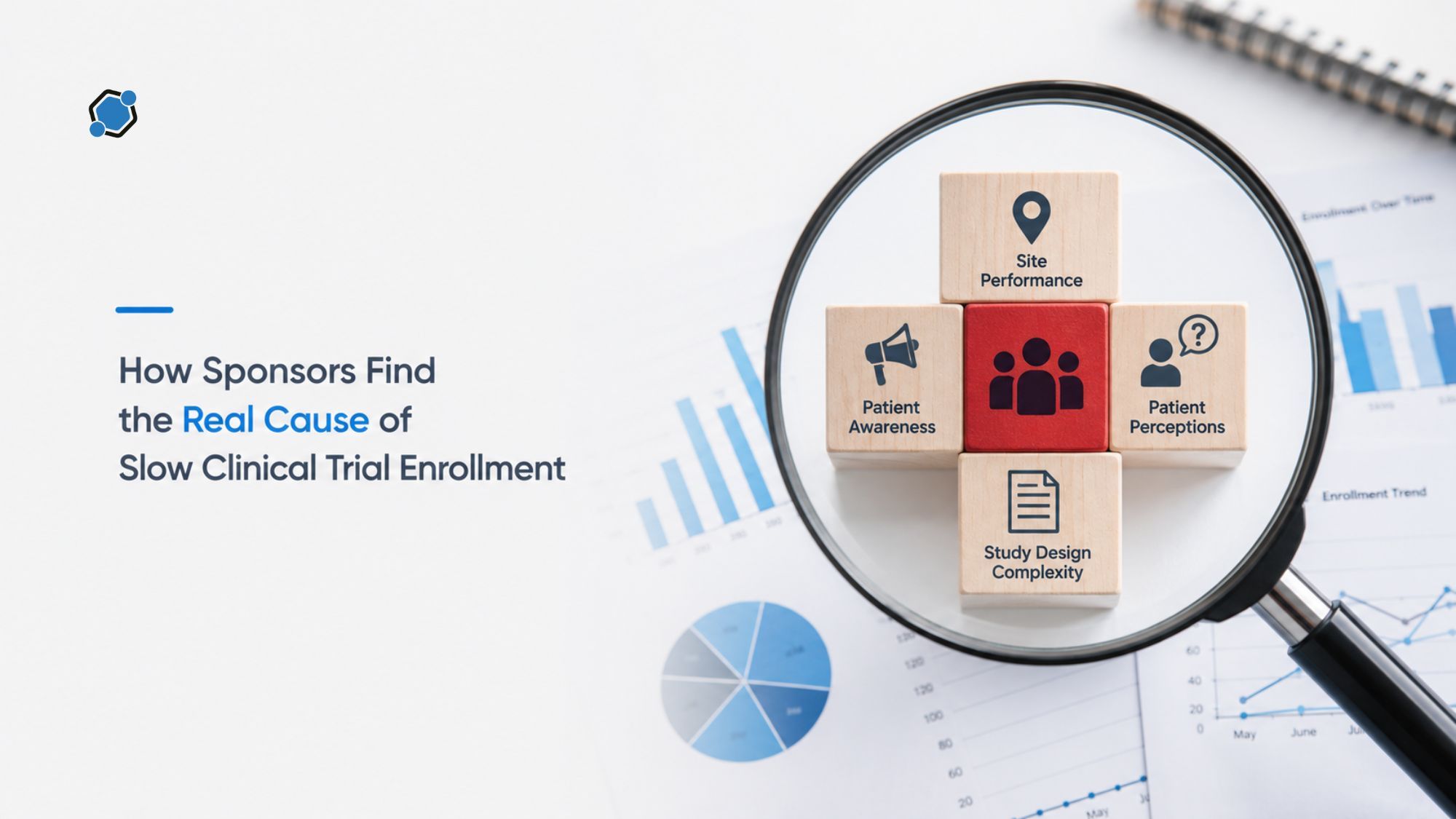
Slow enrollment rarely announces itself with a single cause. It appears first as a slipping monthly number, then as a widening variance against the plan, and eventually as a schedule change that carries a cost through the rest of the program. By the time the delay is priced in, the underlying problem has usually been visible in the data for weeks. The instrument that surfaces it is the recruitment funnel.
For sponsors, funnel diagnostics are the discipline of reading conversion between stages rather than looking only at the total number of participants enrolled. The distinction matters because two trials with identical enrollment shortfalls can be failing for entirely different reasons, and the corrective action for each is different.
What a recruitment funnel actually measures
A recruitment funnel tracks how many people move from initial awareness of a trial to the point of randomization (the moment a participant is formally assigned to a study arm). Each stage represents a conversion, and each conversion has a rate that reflects how well the workflow between stages is functioning.
The stages sponsors typically watch include outreach impressions, inquiries submitted, pre-screens completed, referrals delivered to a site, screening visits at the site, informed consent, and randomization or first dose. Each stage sits on a different part of the operational system. Outreach lives with the recruitment vendor or platform. Pre-screening lives with the platform or a nurse-led intake team. Screening, consent, and randomization live entirely with the research site team.
The funnel matters because the total enrollment number cannot tell a sponsor which of those handoffs is failing. A trial that is significantly behind plan could have too little top-of-funnel volume, or plenty of volume but a broken referral handoff, or a healthy referral pipeline but disproportionate screen failures. The corrective action for each scenario is different, and the wrong action makes the delay worse. For a deeper walk-through of the specific stage-by-stage metrics sponsors track, the companion piece on Pre-Screening Funnel Metrics: From Clinical Trial Participant to Enrollment covers the intake portion in detail.
Why slow enrollment is a symptom, not a cause
Top-line enrollment velocity is a lagging indicator. A monthly total that comes in below plan tells a sponsor that something is wrong, but it does not identify the stage where the problem sits. Weekly dashboards that report only aggregate enrollment can look acceptable for extended periods, hiding stage-level failures that compound over time.
The compounding is the trap. If a pre-screening step is losing substantially more candidates than the model assumed, the effect will not appear in the enrollment total until the pipeline has been running for weeks. By the time the deficit registers in the plan-versus-actual chart, it is large enough to affect Time-to-First-Patient (FPI): The Most Expensive Phase of a Clinical Trial and every downstream milestone that depends on it. Diagnostics run at the stage level surface the same signal much earlier because they compare conversion rates against the assumptions used to build the recruitment plan.
The bottleneck signatures sponsors learn to recognize
Each stage of the funnel produces a distinct failure pattern when it goes wrong. Recognizing the pattern quickly is what separates a short fix from a multi-month delay.
Low top-of-funnel volume points to an outreach problem. The audience the campaign is reaching may not match the eligibility profile, the condition prevalence in the targeted geography may be lower than the plan assumed, or the eligibility criteria (the specific inclusion and exclusion rules that determine who can join) may be narrower than the addressable population supports.
High inquiry-to-pre-screen drop-off points to friction in the intake experience. Long forms, delayed follow-up after a candidate raises a hand, or intake pathways that do not accommodate the health literacy of the population all reduce this conversion. Candidates who wait more than a day or two for a first meaningful response often disengage entirely.
High pre-screen-to-referral drop-off points to a mismatch between the pre-screening logic and the site's real eligibility interpretation. The platform may be marking candidates eligible on criteria the site later rejects, or the site may not have the capacity to absorb the volume of referrals coming in.
High referral-to-screening drop-off usually points to scheduling and access issues at the site: distance to the clinic, appointment availability, or protocol requirements that a candidate cannot meet in their current life circumstances.
High screening-to-consent and screening-to-randomization drop-offs point to protocol design constraints, including laboratory exclusions, biomarker requirements, or washout periods that reduce the number of otherwise willing candidates who can actually enroll. The article on The Hidden Cost of Screen Failures in Clinical Trials explores how these late-stage losses affect budget and timeline forecasts.
The instrumentation that makes early diagnostics possible
A funnel diagnostic is only as useful as the visibility the sponsor has into each stage. Aggregate weekly dashboards do not support diagnostics; stage-level dashboards do. The instrumentation sponsors look for includes real-time conversion rates at every stage, breakdowns by site and by referral source, cohort-based tracking that follows a group of candidates over time rather than reporting only totals, and comparative benchmarks that highlight sites and sources performing outside the expected range.
Referral source attribution is often the most underused piece of instrumentation. A trial pulling candidates from multiple channels (digital outreach, healthcare provider referrals, advocacy partnerships, and a matching platform) will see different conversion behavior from each. Aggregating them hides the diagnostic. Separating them shows which channels are producing candidates who progress through the funnel and which are producing volume without conversion. For a broader look at how modern sponsor dashboards enable this level of visibility, Data-Driven Decisions: How Dashboards Transform Sponsor Oversight covers the design principles involved.
If a sponsor cannot currently see where in the funnel candidates are being lost, that is itself a diagnostic finding. Platforms like DecenTrialz surface stage-by-stage conversion in real time and attribute drop-offs to the specific handoff where they occur.
What sponsors do once the bottleneck is identified
The corrective action depends entirely on where the bottleneck sits, which is the reason stage-level diagnosis matters before any intervention is chosen.
At the top of the funnel, the response is usually a change in outreach strategy: expanding channels, revisiting eligibility criteria where the protocol permits, or partnering with advocacy groups that reach the target population directly. Mid-funnel intake problems are typically addressed by augmenting the pre-screening layer, either through additional staffing, faster follow-up windows, or nurse-led triage that can qualify candidates more accurately before the referral reaches the site.
Site-stage bottlenecks require site-facing solutions: additional sites in higher-prevalence geographies, protocol amendments where feasible, transportation and scheduling support, or improved participant materials. Screen failure patterns that recur across sites often point back to protocol design rather than site execution, and the fix belongs in the amendment process rather than in site management. The article on 5 Reasons Patient Enrollment and Retention Are Failing Clinical Trials covers the range of root causes sponsors encounter and the trade-offs each response involves.
The common thread across these responses is that the earlier the bottleneck is identified, the smaller the corrective action needs to be. A funnel diagnostic run in week four of enrollment produces a different set of options than the same diagnostic run in month six.
How DecenTrialz supports funnel diagnostics for sponsors
DecenTrialz operates as a clinical trial matching and pre-screening platform. AI-powered matching identifies candidates whose profiles align with a study's eligibility criteria, and registered nurses conduct structured pre-screening conversations before any referral is sent to a site. Final eligibility determination, informed consent, and enrollment remain with the research site team.
For sponsors, the operational value sits in the visibility. Every candidate is tracked through the funnel with stage-level attribution, drop-off patterns are surfaced in real time, and referral source performance is separated so that channel-level decisions are grounded in conversion data rather than intuition. Bottlenecks become visible while there is still time to respond to them.
Sponsors evaluating recruitment options can review the platform and request a diagnostic walkthrough at decentrialz.com.
Was this article helpful?

Similar Blogs

Obesity and Sleep Apnea: How Weight Affects Breathing During Sleep
Excess body weight is the strongest modifiable risk factor for obstructive sleep apnea, a ...
 Paramraj
Primary vs secondary hypertension: what is the difference and why it matters
Nearly half of American adults live with high blood pressure, yet most cannot say whether ...
 Anish Teepireddy
Type 1 diabetes vs type 2 diabetes: how do the causes, symptoms, and treatments compare?
Diabetes is often described as a single disease with two flavors, but type 1 and type 2 ar...
ParamrajStay Informed. Stay Connected.
Get updates on verified clinical trials, emerging treatments, and research breakthroughs directly in your inbox. No spam, just science that matters.
