 HIPAA Compliant
 ISO 27001 Certified
Gamunex vs Privigen: Comparing IVIG Options for CIDP
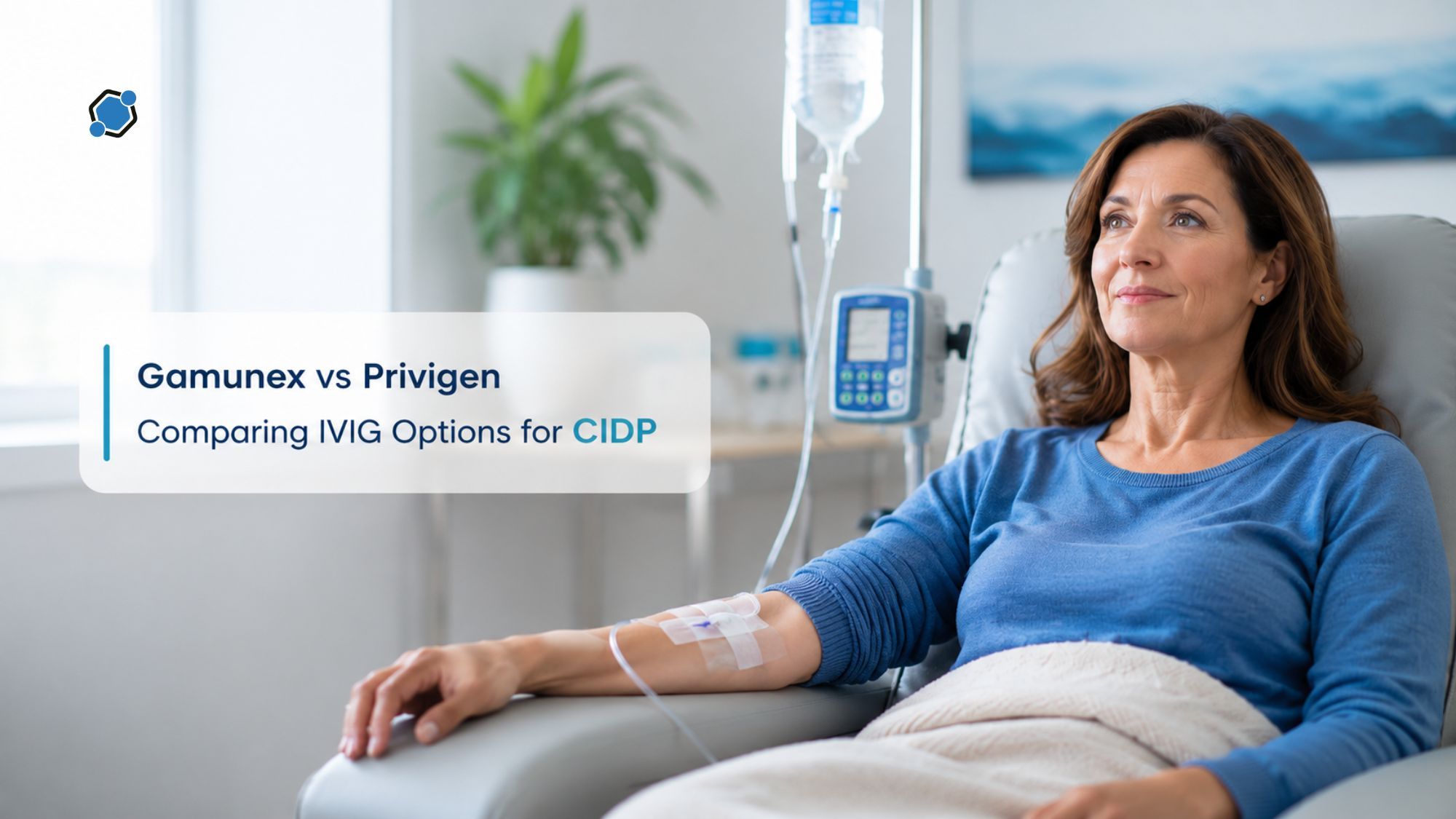
People living with chronic inflammatory demyelinating polyneuropathy, usually shortened to CIDP, are often treated with a therapy called IVIG. Many patients are surprised to learn that IVIG is not a single product. Several brands exist. Two of the most familiar names are Gamunex and Privigen. In the ways that matter most, they are very similar, because both are the same broad type of treatment. They also differ in a few ways that can matter to the person receiving them. This article explains what these two options are, how they compare, and why the choice between IVIG brands is one that a care team makes with each patient.
What IVIG is and how it helps in CIDP
It helps to start with the treatment itself. The immune system normally defends the body against infection. In CIDP, it makes a mistake. It attacks the protective covering around the nerves. That covering works a little like the insulation around an electrical wire. When it is damaged, the signals that travel between the brain and the muscles become slow or weak.
This is what causes the numbness, tingling, and muscle weakness that many people with CIDP feel.
IVIG stands for intravenous immunoglobulin. It is made from antibodies, the tiny proteins the immune system uses to fight illness. These antibodies are collected and purified from the blood plasma of thousands of healthy donors. They are placed in a liquid and given slowly into a vein through an IV line. A single infusion usually takes several hours. Researchers do not fully understand every step of how it works. Still, current evidence indicates that IVIG can calm the misdirected immune activity that damages the nerves in CIDP. Many people with CIDP may respond to this treatment, although how much they improve can vary from one person to another.
IVIG is given again and again, often over months or years. Because of this, the specific product a person receives becomes a real part of daily life. That is where brands such as Gamunex and Privigen come in. A fuller walkthrough of what an IVIG course involves is available in the guide on IVIG for CIDP, which covers what to expect before, during, and after treatment.
Gamunex and Privigen are both IVIG, made differently
The most important point is simple. Gamunex and Privigen belong to the same family of treatment. Both are 10 percent immunoglobulin solutions. That means the strength of the antibodies is the same in each. Both are approved in the United States for treating CIDP in adults. Both are given by IV in a broadly similar way. On the questions that decide whether a treatment can help, the two have a great deal in common.
The differences come from how they are made. Different companies produce them, using different manufacturing recipes. A helpful way to picture this is to think of two brands of the same kind of pain reliever. They can share the same active ingredient yet differ in their inactive ingredients and in how a particular body handles them. IVIG brands work on the same idea. The antibodies do the work. The details around them are not identical.
What Gamunex is
Gamunex, sometimes written as Gamunex-C, is a 10 percent IVIG made by the company Grifols. It was approved by the Food and Drug Administration for treating CIDP in adults in September 2008. That made it one of the earlier IVIG products to carry that specific approval. It is also used for certain immune deficiencies and for a blood-platelet condition. It can be given into a vein, and for some other conditions, under the skin.
What Privigen is
Privigen is also a 10 percent IVIG. It is made by the company CSL Behring. It received Food and Drug Administration approval for treating CIDP in adults in September 2017, about nine years after Gamunex. Like Gamunex, it is used for certain immune deficiencies and a platelet condition as well as CIDP. It is given into a vein.
How Gamunex and Privigen differ
Most of the practical differences come down to how each product is prepared and stabilized. These details rarely change whether the treatment can work. They can, however, affect how comfortable a person feels during and after an infusion.
The stabilizer ingredient
Every liquid IVIG needs a stabilizer. This is an added ingredient that keeps the antibodies from clumping together while the product sits in storage. It is the clearest difference between the two brands. Gamunex uses a natural amino acid called glycine. Privigen uses a different natural amino acid called proline, written in full as L-proline.
For most people, the choice of stabilizer is not something they would ever notice. It matters in specific situations. Privigen contains proline, so it is not suitable for people with a rare inherited condition called hyperprolinemia. In that condition, the body cannot process proline properly. This is uncommon. Even so, it is a clear example of how one small ingredient can make one brand the wrong fit for a particular person, while the other brand remains an option.
How they are given
Both products are infused slowly into a vein through a dedicated IV line. Neither is meant to be mixed with other fluids or medications in the same line. The infusion usually starts at a slow rate. It is increased gradually if the person handles it well. The two products are prepared differently, so their exact infusion instructions, storage needs, and handling steps are not identical. This is one reason a change between brands is managed carefully by the care team, rather than treated as a simple swap.
Side effects and tolerability
Both Gamunex and Privigen share the general side effect profile common to IVIG. Reported reactions can include headache, fever, chills, higher blood pressure, nausea, and tiredness. These often appear around the time of an infusion. Like all IVIG products, both also carry warnings about less common but more serious risks. These include blood clots, kidney problems, and a reaction that affects red blood cells. Such warnings are part of why IVIG is given under medical supervision.
What is harder to predict is how one person tolerates one product. Two people with CIDP can have very different experiences on the same brand. The same person can feel different on one brand than on another. This kind of individual variation, alongside the wider range of CIDP symptoms a person may have, is central to the next point.
Why IVIG brands are not automatically interchangeable
It might seem reasonable to assume that two 10 percent IVIG products, both approved for the same condition, could be swapped freely. In practice, they are not treated that way. IVIG products differ in how they are made, purified, and stabilized. Because of this, a person who reacts badly to one product may do well on another. For this reason, IVIG products are generally seen as non-interchangeable. A change from one to another is treated as a real clinical decision.
Real-world patterns support this careful approach. Large studies of treatment records in the United States have found that about a quarter of people on IVIG moved to a different therapy within two years. The rate of switching was not the same across products. Put simply, staying on one brand over time is common, but switching is far from rare. The product a person does best on is not always the first one tried.
What patients consider when a brand is switched
A change in IVIG brand can happen for several reasons. Knowing them can make the process feel less unsettling. One common reason is tolerability. If someone has bothersome reactions on one product, a care team may want to try another. Supply is another factor. IVIG is made from donated human plasma, so availability can shift over time. Insurance coverage and the policies of a particular infusion center can also affect which product is used.
When a switch does happen, it is usually introduced with care. The care team may lower the infusion rate at first. They may watch closely during the early infusions on the new product. They may also check how the person responds over the following weeks. The goal is to find the option that gives a meaningful response with the fewest bothersome effects for that individual. Decisions about starting, continuing, or changing any CIDP treatment rest with the treating clinician. That clinician can weigh the full medical picture that a general article cannot. The factors behind that choice are explored in more detail in the overview of how an IVIG is chosen.
Ongoing research into IVIG for CIDP
IVIG has been a core CIDP treatment for many years. Research into how best to use it continues. Studies have looked at different concentrations and infusion approaches. They have also looked at ways to make treatment more convenient and easier to tolerate. Alongside this, researchers keep working to understand why individual responses vary so much. This ongoing work continues to shape how the treatment is understood and used.
This kind of ongoing work is part of why the treatment landscape does not stand still. The products available today, including Gamunex and Privigen, reflect decades of refinement. Continued study may shape the options available in the years ahead.
This kind of ongoing work is part of why the treatment landscape does not stand still. The products available today, including Gamunex and Privigen, reflect decades of refinement. Continued study may shape the options available in the years ahead.
Frequently asked questions
Are Gamunex and Privigen the same medication?
They are the same type of medication, but not the same product. Both are 10 percent intravenous immunoglobulin, or IVIG, approved for CIDP in adults. Both rely on purified antibodies from donated plasma. They are made by different companies, using different processes and different added ingredients. That is why they are treated as separate, non-interchangeable products.
What is the main difference between Gamunex and Privigen?
The most noticeable difference is the stabilizer. This is the ingredient that keeps the antibodies from clumping in storage. Gamunex uses the amino acid glycine. Privigen uses the amino acid proline. Both products are 10 percent IVIG, so the antibody strength is the same, and both are given by IV.
Can a person switch from one IVIG brand to another?
Yes. Switching between IVIG brands does happen, and it is not unusual. It may be prompted by side effects, by product supply, or by insurance and infusion-center factors. Because the products are prepared differently, a switch is managed by the care team. They usually monitor the first infusions on the new product closely, rather than treating the change as a simple substitution.
Is one brand safer than the other?
Both share the general safety profile of IVIG. That includes common effects such as headache, fever, and tiredness. It also includes less common but more serious risks, such as blood clots and kidney problems. Neither is universally safer. What matters more is how one person tolerates one product, which is why the decision is made case by case. There is one clear exception. Privigen is not suitable for people with the rare inherited condition hyperprolinemia, because of its proline stabilizer.
Why did a doctor choose one brand over the other?
A care team weighs several factors. These include a person's medical history, other health conditions, how well they tolerate a product, and practical matters such as availability and coverage. Because responses and tolerance vary between people, the same reasoning can lead to different choices for different patients. The treating clinician is the right person to explain the reason behind any specific choice.
Weighing IVIG options for CIDP
Gamunex and Privigen are two brands of the same core treatment for CIDP, intravenous immunoglobulin. Both are 10 percent solutions approved for adults with the condition. Both work through the same purified antibodies drawn from thousands of donors. Their main differences lie in who makes them and how they are prepared. The most visible difference is the stabilizer each one uses, glycine in Gamunex and proline in Privigen. Those differences are usually invisible to the person receiving treatment. Still, they help explain why the two are not considered interchangeable, and why some people do better on one than the other. The right choice is an individual one. It is made by a care team that can weigh a person's medical history, tolerance, and response over time.
Was this article helpful?

Similar Blogs

Clinical Nurse Specialist Recognition Week 2026: What Is a CNS and Why Does the Role Matter?
September 1 is the birthday of Hildegard Peplau, an American nurse and theorist who argued...
 Vamshi Kantoju
Breast Cancer Stages: What Stage 0 to Stage 4 Mean and How Doctors Determine Them
Stage is one of the first facts a person learns after a breast cancer diagnosis, and it sh...
Paramraj
World Sexual Health Day 2026: What Is It, and Why Does Sexual Health Research Matter?
Sexual health covers considerably more ground than most people assume. The World Health Or...
Mahesh UpadristaStay Informed. Stay Connected.
Get updates on verified clinical trials, emerging treatments, and research breakthroughs directly in your inbox. No spam, just science that matters.
