 HIPAA Compliant
 ISO 27001 Certified
National Immunization Awareness Month: what vaccines, clinical trials, and community immunity mean for you
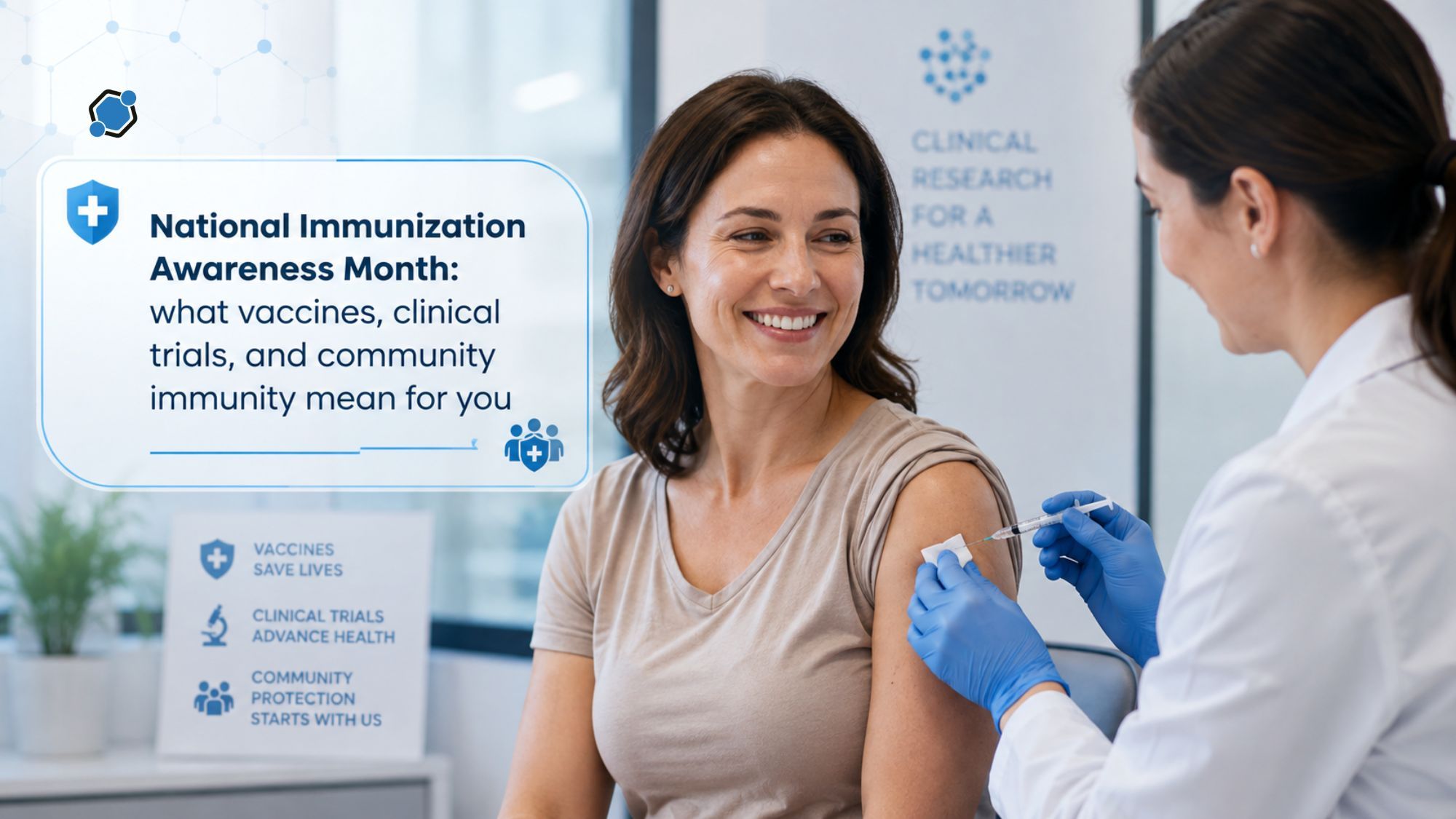
What National Immunization Awareness Month is
August marks a longstanding public health observance in the United States focused on the role of vaccines across the human lifespan. National Immunization Awareness Month is coordinated by the Centers for Disease Control and Prevention (CDC), the federal agency responsible for tracking and responding to public health threats, through its National Center for Immunization and Respiratory Diseases. The August timing is deliberate. It aligns with back-to-school preparation, when families review childhood and adolescent vaccine records, and with the run-up to respiratory virus season in the fall and winter.
The observance is a coordinated period during which federal agencies, state health departments, healthcare professionals, and community organizations share information about routine immunization, catch-up schedules, and the research that makes vaccines possible. For members of the public, it is a useful moment to review personal records, ask questions of a healthcare provider, and understand how vaccines are developed and monitored.
How vaccines work in the body
A vaccine introduces a harmless component of a germ, called an antigen, to the immune system. The immune system, which is the body's defense network against infection, recognizes the antigen as foreign and produces protective proteins called antibodies. It also creates memory cells, which are specialized immune cells that recognize the same germ if it appears again and mount a faster, stronger response.
Two related terms are often used interchangeably but describe different things. Vaccination is the act of receiving a vaccine, usually through an injection, nasal spray, or oral dose. Immunization is the broader process by which a person becomes protected against a disease, whether through vaccination or through prior infection. Immunity from vaccination is called active immunity because the body does the work of building the response. Passive immunity, by contrast, involves borrowed antibodies, such as those a mother passes to a baby before birth, and is immediate but temporary. Active immunity from vaccination takes longer to develop but can last for many years.
Understanding this mechanism helps explain why some vaccines require more than one dose. Multiple doses give the immune system repeated opportunities to build a strong, durable memory response. For readers new to how research supports these findings, Clinical Trials Explained: Simple Guide for Beginners offers a plain-language starting point.
The main types of vaccines
Modern vaccines are built on several different scientific platforms, each with its own strengths.
Live attenuated vaccines use a weakened version of the germ. Because the immune response is strong, one or two doses often provide long-lasting protection. Examples include the vaccines against measles, mumps, rubella, and chickenpox.
Inactivated vaccines use germs that have been killed. The immune response tends to be less robust than with live vaccines, so multiple doses or periodic boosters are usually required. Most injectable flu vaccines and the hepatitis A vaccine are inactivated.
Subunit, recombinant, conjugate, and polysaccharide vaccines use only specific pieces of a germ, such as a protein or sugar. These vaccines have a strong safety profile and are used against hepatitis B, human papillomavirus (HPV), whooping cough, and shingles, among others.
Toxoid vaccines target diseases caused by bacterial toxins rather than by the bacteria themselves. They contain an inactivated version of the toxin. Diphtheria and tetanus vaccines are examples.
Viral vector vaccines use a harmless virus, unrelated to the disease being targeted, to deliver genetic instructions into cells. The cells then produce a harmless piece of the target germ, which trains the immune system.
Messenger RNA (mRNA) vaccines deliver genetic instructions directly to cells, which then produce a harmless piece of the target germ. A common misconception is that mRNA vaccines change a person's DNA. They do not. Messenger RNA does not enter the part of the cell that contains DNA, and it is broken down by the body shortly after doing its job.
Community immunity and why coverage matters
When enough people in a community are immune to a disease, its ability to spread from person to person is interrupted. This concept, sometimes called community immunity or herd immunity, protects individuals who cannot be vaccinated, including newborns and people with weakened immune systems. The share of the population that must be immune to interrupt spread varies by disease. Highly contagious diseases require a very high level of coverage to prevent outbreaks. Less contagious diseases can be controlled at lower thresholds.
In recent years, coverage for several routine childhood vaccines in the United States has slipped, and vaccine-preventable diseases have returned in greater numbers. Measles, which was declared eliminated from the country in 2000, has resurged with case counts not seen in decades. Whooping cough, also known as pertussis, has reached its highest levels in many years. Public health authorities attribute these trends to a combination of gradually declining coverage, waning immunity in some populations over time, and pockets of unvaccinated individuals within otherwise well-covered communities.
The lesson is straightforward. Individual vaccination decisions have community consequences, and community coverage protects individuals. The broader public health role of research is explored in How Clinical Trials Contribute to Public Health.
How a vaccine becomes available: the clinical trial process
Every vaccine used in the United States passes through a structured research and review process before it reaches the public. That process is designed to answer, in stages, whether a candidate vaccine is safe, whether it produces an immune response, and whether it prevents disease.
Research begins in laboratories and animal studies, called the preclinical phase. If the results are promising, the sponsor, which is the organization running the study, files an Investigational New Drug application with the U.S. Food and Drug Administration (FDA), the federal agency responsible for approving vaccines and other medical products.
What each phase looks for
Phase 1 studies enroll a small group of healthy adult volunteers. The goal is to assess basic safety and to understand how the body responds to different doses. Phase 2 studies expand to a larger group, often several hundred people, and continue to evaluate safety, immune response, and dosing. Phase 3 studies are the largest, involving thousands or tens of thousands of participants across many sites. These studies compare the candidate vaccine to a placebo or to a currently available option and provide the primary evidence of whether the vaccine prevents disease.
If a vaccine performs well in Phase 3, the sponsor files a Biologics License Application with the FDA's Center for Biologics Evaluation and Research, which reviews vaccine data for safety, purity, and potency. After approval, Phase 4 studies continue to monitor the vaccine in the general population, tracking long-term safety and effectiveness under everyday conditions.
How long does vaccine development take?
Traditional vaccine development often spans many years, and some vaccines have taken more than a decade. The unusually fast timeline for the first COVID-19 vaccines was made possible by parallel manufacturing, prior research on related coronaviruses, and emergency regulatory pathways. Standard timelines remain long, and each phase must generate strong evidence before the next begins. Additional background on what participants encounter is available in Clinical Research Basics: What Every Trial Participant Should Understand Before Enrolling.
How vaccine safety is monitored after approval
Approval is not the end of scrutiny. It is the beginning of a new monitoring phase. Several complementary systems track the safety of vaccines once they are in use.
The Vaccine Adverse Event Reporting System (VAERS) is co-managed by the CDC and the FDA. Anyone, including patients, families, and clinicians, can submit a report about a health event that occurs after vaccination. VAERS is a signal-detection system. A report in VAERS does not, by itself, prove that a vaccine caused the reported event. Its purpose is to help identify unusual patterns that warrant closer investigation.
When VAERS identifies a possible signal, other systems take over to test it. The Vaccine Safety Datalink links vaccination records to medical records in participating healthcare systems, allowing researchers to compare rates of specific outcomes among vaccinated and unvaccinated populations. The Clinical Immunization Safety Assessment network conducts detailed clinical evaluations of specific cases. Together, these systems create multiple layers of oversight that continue for the entire life of a vaccine. Long-term monitoring is described further in Phase IV Trials: Post-Approval Studies and Ongoing Safety.
What vaccine research looks like today
Vaccine research is one of the most active areas in medicine. Several directions stand out.
Researchers are working toward broader influenza vaccines that would protect against a wider range of flu strains and reduce the need for annual reformulation. Messenger RNA platforms, first widely deployed against COVID-19, are being adapted for other infectious diseases and for certain cancers. Early studies are exploring vaccines against tuberculosis, the human immunodeficiency virus (HIV), and other long-standing challenges in global health.
One notable recent success is the arrival of vaccines against respiratory syncytial virus (RSV), a common cause of serious illness in older adults and young infants. For decades, RSV vaccines were considered scientifically out of reach. Vaccines for older adults, together with a maternal vaccine given during pregnancy to protect newborns, became available in recent years. The field has also expanded into personalized cancer vaccines, which are tailored to features of an individual patient's tumor and are being evaluated in ongoing studies.
These are areas of active investigation, and outcomes are not guaranteed. What they demonstrate is that immunization research continues to evolve well beyond the routine schedule.
Why representative participation matters
Vaccine trials work best when the people who participate reflect the people who will eventually receive the vaccine. Immune responses can vary by age, sex, ancestry, and underlying health conditions. If a trial enrolls a narrow slice of the population, the results may not apply cleanly to everyone else.
Historically, some groups have been underrepresented in clinical research, including older adults, pregnant individuals, people from certain racial and ethnic communities, and residents of rural areas. The FDA has issued formal expectations that sponsors submit diversity plans for pivotal trials and take active steps to enroll representative populations.
Decentralized and hybrid trial models help. When some study visits can happen at home, at a local clinic, or through virtual visits, participation becomes possible for people who could not travel to a distant academic center every few weeks. Broader participation improves the quality of the evidence and helps ensure that a licensed vaccine works well for the full range of people who will use it.
How DecenTrialz supports the participant side of vaccine research
DecenTrialz is a United States-based clinical trial recruitment and pre-screening platform. It uses artificial-intelligence-assisted matching to surface studies that appear relevant to an individual's health history and preferences, and it uses registered-nurse-led pre-screening to have a preliminary conversation with interested participants before referral to a research site.
DecenTrialz pre-screens only. The research site team handles the study walk-through, final eligibility determination, informed consent, and enrollment. Every medical decision remains with the site's clinical staff and the participant.
For individuals interested in vaccine research or any other therapeutic area during National Immunization Awareness Month, DecenTrialz offers a straightforward way to learn what studies are actively recruiting and to have an early conversation without commitment. Explore recruiting studies on DecenTrialz.
Explore clinical trial opportunities during National Immunization Awareness Month
National Immunization Awareness Month is a good moment to think about the broader picture of vaccine research and public health. Vaccines are among the most studied medical products in modern history, and the systems that support them, from Phase 1 trials to long-term safety monitoring, exist to protect the people who receive them.
Members of the public play a real role in this system. Every approved vaccine reflects the participation of volunteers who took part in earlier studies. Anyone considering that path can begin with a simple conversation. Find a clinical trial that fits you on DecenTrialz.
Was this article helpful?

Similar Blogs
What is insulin resistance and how does it affect blood sugar?
Insulin resistance is a condition in which muscle, liver, and fat cells respond weakly to ...
 Swaroop ESD
Mini-stroke symptoms: how to recognize a transient ischemic attack before a full stroke
A transient ischemic attack, often called a mini-stroke, is a short episode of stroke symp...
Deeksha Gitta
Breast Biopsy Procedure, types, and what to expect
A breast biopsy is a diagnostic step, not a diagnosis. When a mammogram, ultrasound, MRI, ...
Vamshi KantojuStay Informed. Stay Connected.
Get updates on verified clinical trials, emerging treatments, and research breakthroughs directly in your inbox. No spam, just science that matters.
