 HIPAA Compliant
 ISO 27001 Certified
How CROs use predictive feasibility modeling to select clinical trial sites
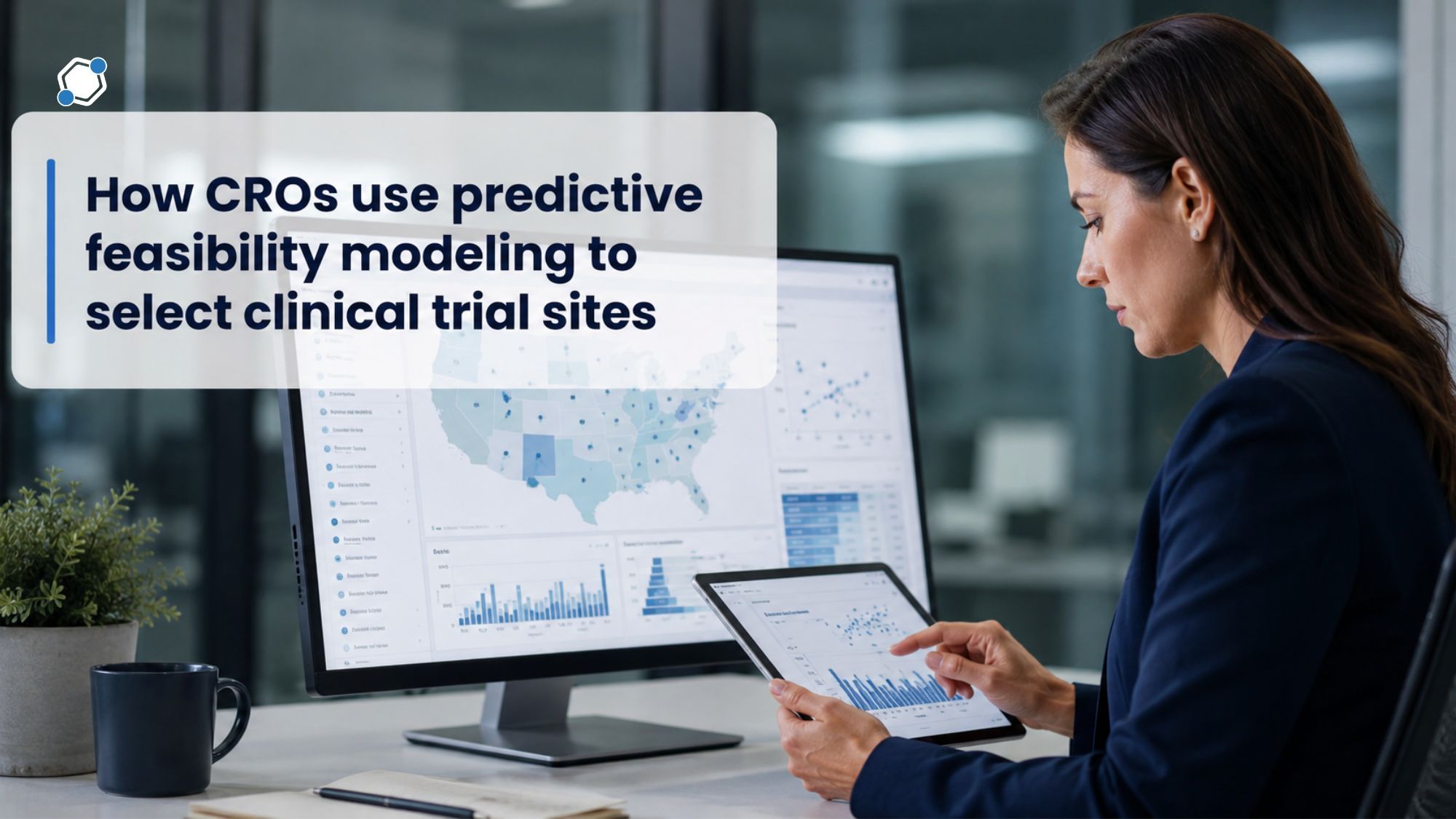
Predictive feasibility modeling has moved from a data science experiment to an increasingly standard step at data-mature contract research organizations. The idea is straightforward: instead of relying on self-reported questionnaires and investigator relationships to guess which sites will enroll on time, CROs pull historical trial data into a statistical model and let the model rank candidate sites by likely performance. The output supports faster start-up, tighter enrollment forecasts, and more defensible bids to sponsors.
This guide explains what predictive feasibility modeling actually is, what data drives it, how CROs turn model outputs into a site selection decision, and where the approach still needs human judgment. The language stays plain, and clinical terms are defined at first use.
What predictive feasibility modeling means in plain terms
Feasibility, in a clinical trial context, is the pre-study assessment of whether a proposed protocol can realistically enroll enough eligible participants at a given site or country within the planned timeline. Traditional feasibility runs on a site feasibility questionnaire, a document sent to each candidate site asking about patient volumes, staffing, equipment, and prior experience with the therapeutic area. Sites answer, the CRO reads the answers, and a selection team decides who receives a study. The data is self-reported, which is a well-recognized limitation, and sites tend to overestimate their recruitment potential.
Predictive feasibility modeling adds a data layer under that process. A model built on historical trial records, real-world evidence, and site operational metrics estimates the probability that each candidate site will meet enrollment targets on time. The model does not replace the questionnaire, but it changes the questionnaire's role. Instead of collecting most of the decision-making information, the questionnaire confirms or challenges what the model already predicts.
CROs already familiar with strategic site selection can treat predictive modeling as an evolution rather than a replacement. A related discussion of how site selection is changing under decentralized and hybrid designs appears in Strategic Site Selection in the Age of Decentralization.
Which historical inputs actually drive the model
A predictive feasibility model is only as good as the data feeding it. CROs typically build the input set from four categories.
Site operational history
This layer includes past enrollment rate (participants enrolled per site per month), screen failure rate (the share of consented, formally screened candidates who did not meet full eligibility), time-to-first-patient (the interval between site activation and the first randomized participant), and study completion history. These are the strongest single predictors of future performance in the same therapeutic area.
Investigator and staff signals
Principal investigator experience with the specific indication, prior protocol deviations, and coordinator retention all show up in operational data. A site with a well-tenured coordinator team usually recruits faster than a site with high staff turnover, even when other metrics look similar.
Country and regulatory context
Regulatory startup timing varies by country, and the model needs to reflect that. Ethics committee turnaround, import license timelines for investigational product, and holiday cycles all shift the realistic activation window. Country-level real-world patient population data, drawn from claims databases or electronic health record aggregates, tells the model how many eligible candidates the model should expect the site to see.
Study congestion
A site that looks strong on paper may be running four competing studies in the same indication. Study congestion, meaning the number of active trials at a site targeting the same patient pool, dilutes recruitment capacity. Modern feasibility models pull competing trial data directly from public registries to adjust the forecast downward when congestion is high.
For CROs building or evaluating these input layers, the analytical function extends well beyond operations. The strategic value of recruitment analytics as a CRO offering is discussed in Recruitment Analytics: How CROs Can Add Value Beyond Operations.
How the model turns data into a site score CROs can act on
The model output is not a spreadsheet of raw numbers. It is a ranked list of candidate sites, each with a predicted enrollment rate and a confidence range. CROs use that ranked list in three ways.
The first is portfolio construction. Study planners test different combinations of sites and countries against the target enrollment window. A small, dense portfolio of high-scoring sites in a few countries may hit the number faster, but at higher risk if one site drops out. A larger, more distributed portfolio may be slower per site but more resilient. Scenario analysis in the model lets the study team compare these tradeoffs before contracts are signed.
The second is negotiation and contracting. When a candidate site pushes back on enrollment commitments, the CRO can reference the model output to anchor the conversation. Rather than an anecdotal argument, the negotiation moves onto historical data the site itself contributed to.
The third is start-up planning. The model helps prioritize which sites to activate first based on predicted time-to-first-patient and predicted enrollment velocity. Sites forecast to activate quickly but recruit slowly may still be worth an early activation to protect the sponsor timeline.
The specific metrics CROs use to convert predictions into a defensible site scorecard are explored in more depth in Which recruitment metrics decide site selection in clinical trials?.
What predictive feasibility modeling cannot do
A useful model is honest about its limits. Predictive feasibility modeling reflects the past, so any factor that has changed since the training data was collected can move the actual result away from the forecast. Four caveats matter most for CROs.
Protocol novelty is the first. When the study intervention, the eligibility criteria, or the required visit schedule departs significantly from prior trials in the same indication, historical enrollment patterns are less reliable predictors. The model can still rank sites relative to each other, but the absolute enrollment forecast carries more uncertainty.
Concurrent competition is the second. If several sponsors launch trials in the same indication within a short window, sites compete for a shared eligible population. Real-time market intelligence, layered over the historical model, becomes essential during start-up.
Data quality is the third. A model trained on inconsistent or partial data will produce inconsistent or partial predictions. CROs building predictive feasibility capability internally often find the data cleanup work is more resource-intensive than the modeling itself.
Human judgment is the fourth. A model does not know that a strong investigator has just given notice, that a hospital merger is disrupting operations, or that a site's referring physician network has shifted. Predictive feasibility modeling is a decision-support tool, not a replacement for the operational judgment CRO clinical operations teams bring to site selection.
Closing the loop after selection: pre-screening quality
Selecting the right sites is the beginning of enrollment performance, not the end. Even a high-scoring site underperforms if the pipeline of candidate participants reaching it is weak or poorly matched to the protocol's eligibility criteria. That is where pre-screening quality closes the loop.
Pre-screening is the process of evaluating potential participants against protocol criteria before they arrive at the site for formal screening. High-quality pre-screening reduces screen failure rates, protects site staff capacity, and keeps the model's predicted enrollment rate on track. When pre-screening is weak, the model can look wrong even when it was right about the site itself.
For CROs looking to reduce downstream screen failures once sites are selected, Reducing Screen Failures in Clinical Trials: How Sites Can Improve Eligibility Matching outlines what sites can do to tighten eligibility matching at the intake stage.
DecenTrialz supports this stage of the trial through an AI-assisted matching engine that ranks candidate participants against protocol criteria, followed by registered nurse pre-screening that confirms match quality before referral to the site. The platform handles the pipeline from interested participant to qualified referral. Eligibility determination, informed consent, and enrollment remain with the authorized research site and study team, which is where those decisions belong under regulatory oversight.
Frequently asked questions
How is predictive feasibility modeling different from a feasibility questionnaire?
A feasibility questionnaire asks a site to self-report. A predictive feasibility model draws on the site's historical performance across many past trials to forecast likely performance on this one. The two are complementary. The model narrows the candidate list; the questionnaire confirms site-specific factors the model cannot see.
What data does a CRO need before building a predictive feasibility model?
At minimum, the CRO needs multi-study historical records including site-level enrollment rates, screen failure rates, activation timelines, investigator identifiers, indication tags, and country context. Many CROs supplement internal data with cross-industry benchmarking data licensed from third-party analytics providers.
How often should predictive site scores be refreshed?
Leading predictive feasibility platforms refresh their underlying data continuously, often on a weekly or near-real-time basis, rather than on a fixed periodic schedule. Monitoring typically intensifies during start-up, when newly opened competing trials can shift the competitive layer quickly and change the enrollment forecast.
Does predictive feasibility modeling replace the site qualification visit?
It does not. The site qualification visit checks facilities, equipment, staff availability, and regulatory readiness at a specific site. The model informs which sites are worth qualifying, but the visit still validates the operational reality on the ground.
Where CROs go from here
Predictive feasibility modeling shifts site selection from a relationship-driven exercise to a data-informed one. For CROs, the benefit is measurable in enrollment speed, sponsor confidence, and the ability to defend site portfolio decisions against changing timelines. The approach works best when the historical data is clean, the model output is treated as decision support rather than decision automation, and downstream pre-screening quality keeps the enrollment pipeline aligned with the forecast.
CROs building this capability internally often pair the model output with a real-time operational view that tracks site-level performance against the forecast. The features CROs prioritize when evaluating that view are covered in 7 Features Every CRO Wants in a Cross-Site Recruitment Dashboard.
DecenTrialz partners with sponsors, CROs, and research sites on the participant recruitment and pre-screening stages that determine whether a well-selected site actually delivers the predicted enrollment. To see how the platform fits into a CRO's existing feasibility and start-up workflow, request a walkthrough at decentrialz.com.
Was this article helpful?

Similar Blogs
How CROs validate AI recruitment tools
Contract Research Organizations, known as CROs, run the day-to-day operations of clinical ...
 Vamshi Kantoju
Clinical Trial Patient Matching: Why Do Sponsors Need More Than a Public Registry Listing?
Every applicable clinical trial conducted in the United States must be registered in the f...
Swaroop ESD
DecenTrialz vs traditional recruitment platforms: how does full-service matching differ from self-service trial search?
Comparisons between DecenTrialz and traditional recruitment platforms usually come down to...
Vamshi KantojuStay Informed. Stay Connected.
Get updates on verified clinical trials, emerging treatments, and research breakthroughs directly in your inbox. No spam, just science that matters.
