 HIPAA Compliant
 ISO 27001 Certified
Why referral quality predicts clinical trial enrollment better than referral volume
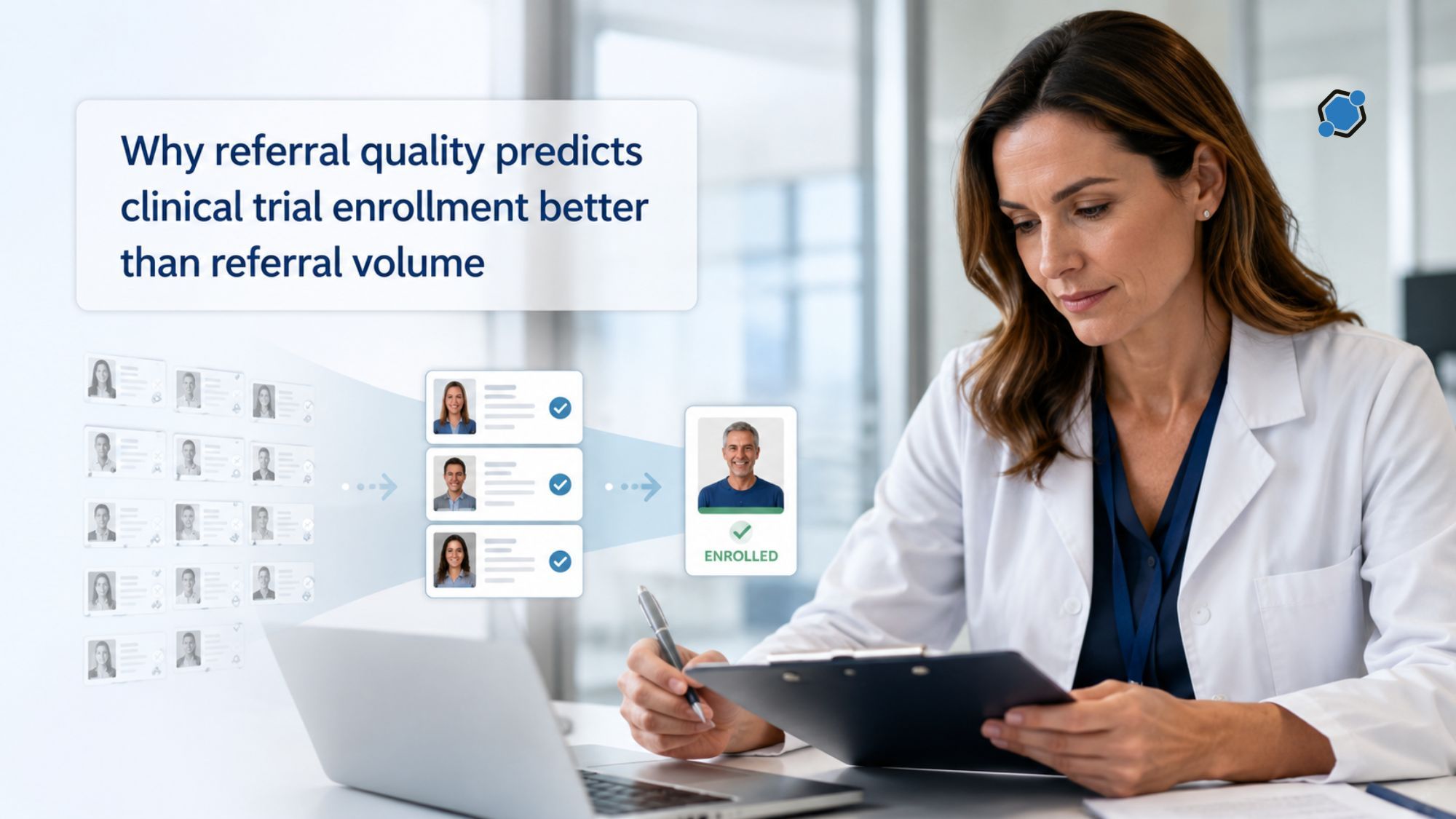
Recruitment reporting in clinical trials tends to lead with a single number: how many referrals came in this week. That number is easy to count, easy to compare, and easy to celebrate. It is also a poor predictor of whether a study will enroll on time. What actually determines timeline performance is how many of those referrals survive pre-screening, reach consent, and randomize into the study.
For a Contract Research Organization (CRO), a company that runs clinical trials on behalf of the sponsor developing a new medicine or medical device, the distinction between referral volume and referral quality is not academic. It shows up in coordinator workload, screen failure costs, and the timeline the sponsor is counting on. This article explains how the recruitment funnel defines quality, why volume-first outreach breaks down, and how a CRO can build partner scorecards and contracts around the metric that actually predicts enrollment.
How the recruitment funnel defines referral quality
The clinical trial recruitment funnel is a sequence of conversion gates. A referral enters the top, a randomized participant leaves the bottom, and every stage in between filters candidates out. Understanding that sequence is the starting point for defining quality.
A referral is any identified or interested candidate entering the funnel from any channel, whether a digital ad, a physician mention, or a call to an advocacy group hotline. Pre-screening, which is a preliminary eligibility check conducted by phone or online against a trial's inclusion and exclusion criteria (the specific medical and demographic conditions a person must meet to join a study), determines who advances. Screening is the formal on-site eligibility assessment performed after informed consent, and it usually involves laboratory work, imaging, and physical exams. Randomization, the assignment of an eligible, consented participant into a study arm, is the conversion that matters most to timelines. Retention is continued participation through follow-up visits.
Volume metrics count activity at the top of the funnel: raw referrals, form fills, ad clicks. Quality metrics measure survival through the gates: pre-screen pass rate, screen failure rate, randomization rate, retention. A recruitment source that produces high volume but low pass-through is filling the top of the funnel without moving the needle at the bottom. For a detailed walk-through of how each stage feeds the next, see Pre-Screening Funnel Metrics: From Clinical Trial Participant to Enrollment.
What separates a qualified referral from raw volume
A raw referral is anyone who clicked an advertisement or completed a form. The person may or may not have the condition under study, may or may not meet the eligibility criteria, and may or may not be reachable. A qualified referral is contactable, plausibly eligible based on structured pre-screening against protocol criteria, and willing to participate in the study.
The distinction matters because the two categories consume the same downstream resources. Every raw referral that reaches a research site consumes the same coordinator time, the same phone calls, and often the same screening procedures as a qualified one. When the raw referral fails at pre-screening or at the site visit, that resource investment produces no enrolled participant. The site is not measurably better off for having received the referral, and in busy studies it is measurably worse off, because the coordinator time spent chasing that candidate was not spent on the next qualified one.
A referral source is producing quality when the referrals it sends convert. The practical bar sponsors and CROs use is a referral that reaches screening and consent. A source whose referrals mostly stall at pre-screening is a volume source, regardless of how many leads it delivers. For a site-level view of how this plays out in daily operations, see How qualified participant referrals solve the site recruitment problem.
Why volume-first recruitment raises screen failure costs
Broad digital targeting is optimized for engagement, not eligibility. It draws attention from candidates who match a general profile but were never a close protocol fit. When pre-screening is limited to a short unstructured form, those candidates progress into the site's workflow, where they become screen failures (candidates who consent to screening but do not meet formal eligibility criteria after clinical assessment).
Screen failure rates are already high across the industry, and they are higher in specialties such as central nervous system studies and rare disease research, where protocol criteria are tight and the candidate pool is small. Every additional screen failure introduces cost the volume dashboard does not show: coordinator hours, screening procedures that yielded no enrollment, delayed randomization, and, at scale, timeline slippage that ripples into database lock and study readout.
Retention compounds the pattern. Candidates pulled in through cold, broad outreach tend to drop out earlier than candidates who arrive through a trusted clinical relationship or a structured pre-screening conversation. A referral source that looks strong on volume metrics can produce weak retention six months into the study, and that weakness usually traces back to how the participant entered the funnel in the first place.
The system is the source of the friction here, not the CRO project team. Fragmented recruitment channels, misaligned partner incentives, and contracts that pay per referral rather than per randomized participant all push behavior toward volume. For a fuller accounting of what these downstream costs look like across a study, see The Hidden Cost of Screen Failures in Clinical Trials.
Which quality metrics belong in a CRO partner scorecard
A CRO evaluating a patient recruitment agency or platform should look past the referral count and ask for the metrics that actually predict enrollment. A working scorecard covers six items. Pre-screen pass rate shows how many referrals survive the first filter. Referral-to-consent rate shows how many candidates progress from initial contact to signing informed consent. Screen failure rate, segmented by referral source, isolates which channels are producing eligible candidates and which are not. Randomization rate closes the loop between marketing activity and study enrollment. Retention through early visits catches candidates who consent but drop out before contributing meaningful data. Speed of site action on referrals shows whether the partner is delivering referrals fast enough for the site to act on them while the candidate is still interested.
Segmentation by source is what makes the scorecard useful. A high overall screen failure rate is a symptom. Segmenting by referral source tells the project manager whether one channel is misfiring or the protocol itself is filtering out too many candidates at a specific criterion. That distinction changes the corrective action from switching partners to renegotiating with the sponsor about a specific inclusion criterion.
A recruitment partner that cannot report these metrics, or reports only totals, is a signal in itself. Ask for the underlying data structure before signing a contract. For a checklist of what a modern cross-site dashboard should surface for a CRO, see 7 Features Every CRO Wants in a Cross-Site Recruitment Dashboard.
How structured pre-screening lifts referral conversion
The mechanism that converts volume into quality is structured filtering before the site visit. Two components matter, and they work in sequence.
The first is AI-assisted matching. The protocol's inclusion and exclusion criteria are parsed into structured, machine-readable rules, and each candidate is compared against those rules using structured information such as diagnosis history and reported medications. Candidates who clearly do not meet the criteria are filtered before a referral is created. The second is clinical pre-screening led by a registered nurse. The nurse verifies self-reported information against protocol criteria, checks for common exclusion factors that patients may not have thought to disclose, and confirms that the candidate is willing and able to participate.
The nurse pre-screens only. Final eligibility determination, informed consent, the study walk-through, and enrollment are always handled by the research site team. This division of labor is the operational point. The site receives fewer candidates but a higher share of them are worth screening, and the coordinator's time is spent on the people most likely to enroll.
Outsourcing pre-screening to a partner equipped with structured matching and clinical review is increasingly how sponsors and CROs push conversion rates up without inflating referral volume. For the reasoning behind that shift, see Why sponsors are outsourcing pre-screening in clinical trials.
How CROs diagnose cross-site referral quality variation
Referral quality is not uniform across the sites in a multi-site study. One site randomizes a high share of the referrals it receives, another site sees most of its referrals fail at pre-screening, and a third rarely actions its referrals at all. That variation is normal, but it is also diagnostic if the CRO has the data to see it.
The right dashboard exposes referral survival site by site and criterion by criterion. When a single site's screen failure rate diverges sharply from the study mean, the CRO can distinguish three root causes. A workflow issue means referrals are sitting unactioned in a queue. A training gap means the site is misinterpreting an eligibility criterion and discontinuing candidates who would qualify at another site. A referral source problem means one channel is sending poorly targeted candidates to that specific site.
Each root cause has a different remedy: a workflow escalation, a site retraining, or a targeting adjustment upstream. Without cross-site visibility, the CRO ends up applying the same generic corrective action to all three, which typically fails.
Cross-site visibility is also what allows a CRO to report to the sponsor with confidence rather than site-by-site anecdote. For a broader look at how CROs harmonize and report across sites, see Cross-site enrollment demographics: How CROs harmonize, aggregate, and report.
How contracts and incentives shape referral behavior
The reason volume-first recruitment persists even when everyone involved knows quality matters more is that contracts reward it. A partner compensated per referral is being asked, in effect, to maximize referrals. A partner compensated per randomized participant, or against a blended scorecard that includes retention, is being asked to send fewer, better-qualified candidates. The observed behavior follows the incentive.
A CRO negotiating a recruitment engagement can move the incentive by tying milestones to quality metrics rather than raw referrals. Referral-to-consent rate, pre-screen pass rate, and randomization rate are all measurable inside the study database. Retention thresholds can be added for studies with high dropout risk. This does not require reinventing contract structures; it requires specifying the metrics the partner is being paid to move, and then measuring them.
The other lever is transparency. Shared dashboards, where the CRO and the recruitment partner see the same referral-survival numbers at the same time, remove the argument about whose data is correct. That alone tends to shift partner behavior toward quality, because underperformance becomes visible early rather than at the end of the quarter.
The selection process matters as much as the contract terms. For a decision framework a CRO can use when choosing between candidate recruitment partners, see Choosing the right patient recruitment partner for your clinical trial.
How DecenTrialz supports CRO recruitment quality
DecenTrialz is a patient recruitment platform built around the shift from volume to quality. Its model combines AI-assisted participant matching, which compares each candidate against the study's inclusion and exclusion criteria before a referral is created, with registered nurse-led pre-screening, which adds a clinical human filter that verifies self-reported information and readiness to participate. Final eligibility determination, informed consent, the study walk-through, and enrollment always remain with the research site team.
For a CRO, the practical effect is a smaller stream of referrals with a higher conversion rate: candidates who reach the site are more likely to survive pre-screening, to consent, and to randomize. The platform also exposes referral survival, source performance, and cross-site variation in near real time, which is the visibility a project manager needs to run the study rather than only report on it after the fact.
To see how the model fits into a CRO's operating cadence, visit decentrialz.com.
Watching the right metric from day one
Referral volume will always be easier to count than referral quality. That is precisely why quality has to be built into the operating model deliberately, and early. The CROs that consistently hit enrollment timelines are the ones that instrument the funnel, contract on outcomes, and choose recruitment partners on the metrics that predict randomization rather than the ones that fill a weekly report.
To explore what quality-driven recruitment looks like inside a study, visit decentrialz.com.
Was this article helpful?

Similar Blogs

DecenTrialz vs traditional recruitment platforms: how does full-service matching differ from self-service trial search?
Comparisons between DecenTrialz and traditional recruitment platforms usually come down to...
 Vamshi Kantoju
RN-led pre-screening in clinical trials: what does nurse review add that AI matching cannot?
Artificial intelligence has changed how quickly clinical trial candidates can be identifie...
Deeksha Gitta
Clinical trial site selection: how historical data predicts site performance
Site selection has always been a CRO's highest-leverage decision. Pick the right investiga...
 Anish Teepireddy
Stay Informed. Stay Connected.
Get updates on verified clinical trials, emerging treatments, and research breakthroughs directly in your inbox. No spam, just science that matters.
