 HIPAA Compliant
 ISO 27001 Certified
RN-led pre-screening in clinical trials: what does nurse review add that AI matching cannot?
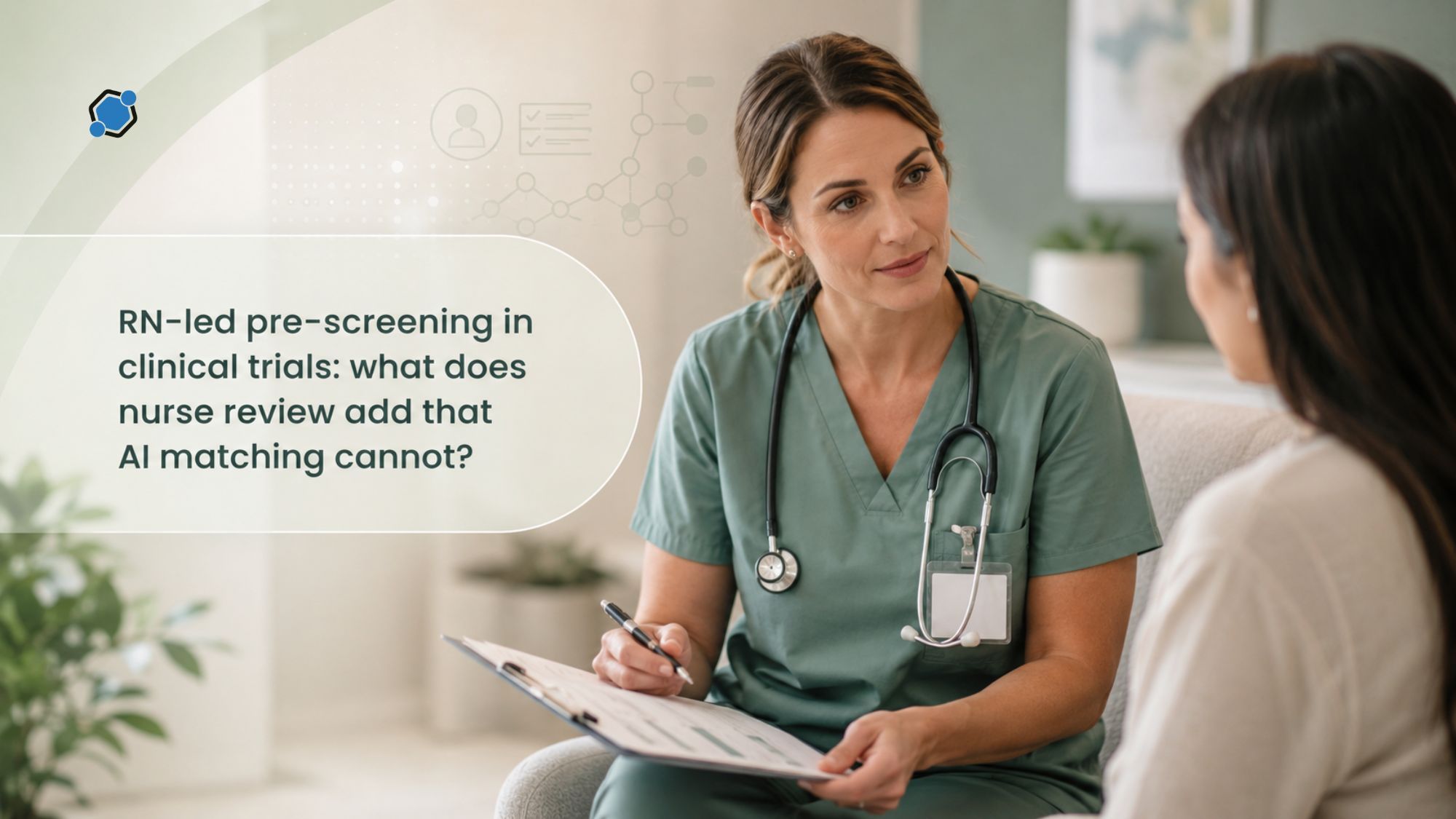
Artificial intelligence has changed how quickly clinical trial candidates can be identified. A matching model can read a protocol, convert its eligibility rules into computable logic, and rank large volumes of candidate records in a fraction of the time a coordinator would need to review a small batch by hand. Speed at the top of the funnel, however, does not establish that the people identified are able to start the study.
RN-led pre-screening addresses that gap. A registered nurse speaks with each candidate before a referral is released to a research site, verifies what the intake data claims, and clarifies the details that structured records rarely capture accurately. For sponsors and contract research organizations evaluating recruitment partners, the useful question is not whether AI matching works. The question is what happens between the model output and the site handoff.
What is RN-led pre-screening in clinical trials?
Pre-screening is the earliest stage of recruitment. It is an informal eligibility check, usually a structured questionnaire followed by a telephone or telehealth conversation, conducted before a candidate signs anything and before any study procedure takes place. Pre-screening is not enrollment, and it is not informed consent.
RN-led pre-screening means a registered nurse conducts that conversation rather than a call center agent or an automated form alone. The nurse works from an approved script, collects only the information relevant to eligibility and practical suitability, and documents what was discussed.
Four terms recur throughout this discussion and are worth defining precisely:
- Screening visit: the formal, on-site visit that takes place after informed consent has been signed, where the site performs protocol-required tests to confirm eligibility.
- Screen failure: a candidate who signed consent, attended the screening visit, and then turned out not to qualify.
- Referral: the handoff of a candidate to a research site so the site can pursue enrollment.
- Randomization: assigning enrolled participants to study groups by chance, so the comparison between groups remains fair.
The distinction between pre-screening and screening carries a direct financial consequence. A candidate who does not proceed past pre-screening costs a phone call. A candidate who fails at the screening visit costs consent time, coordinator hours, laboratory work, and a slot in the site calendar that another candidate could have used. Cost asymmetry of this kind explains much of the recent movement toward outsourcing pre-screening work to specialist partners rather than absorbing it at the site.
What AI matching does well, and where its data runs out
AI matching performs strongly on criteria recorded in a consistent, structured form. Age, diagnosis codes, prescribed medications, procedure history, and laboratory values sit in defined fields, and a model can evaluate them against protocol logic at scale. Natural language processing, which extracts meaning from free-text clinical notes, extends that reach into narrative records. Published work in this area also shows a secondary benefit: algorithmic review surfaces candidates who were never reached by conventional outreach, including candidates from groups that remain underrepresented in research.
The limitation is structural rather than technical. A matching model evaluates the record, not the person. When a criterion is true but was never documented, the model produces a false negative and an eligible candidate is missed. When documentation is incomplete, inconsistently coded, or split across unconnected health systems, accuracy degrades in ways that are invisible from the output alone. Models built on the population of one institution also tend to perform less reliably when applied to another.
Validation of the matching logic, transparency about which criteria the model can and cannot resolve, and a defined process for handling borderline cases are therefore central questions when evaluating an AI-assisted matching model. A vendor unable to answer them is reporting confidence rather than performance.
Which eligibility criteria require a human conversation?
Certain protocol requirements resist algorithmic resolution because the underlying information is either absent from structured data or inherently a matter of clinical judgment:
- Washout periods: a required gap during which a candidate must stop a prior medication before starting the study intervention. Confirming that the gap has been met requires an accurate, dated therapy history, which is frequently divided across several providers.
- Prior lines of therapy: counting how many previous regimens a candidate has received depends on records that are rarely complete within a single system.
- Concomitant medications: products taken alongside the study intervention. Conflicts can only be assessed against a full current list, including over-the-counter products and supplements that seldom appear in prescription data.
- Performance status: a graded measure of how well a person carries out ordinary daily activities, used heavily in oncology protocols. It is clinician-assessed and varies between raters.
- Comorbidity severity: two candidates can carry an identical diagnosis code while differing substantially in how advanced or how well controlled the condition is.
- Practical capacity: transportation, caregiver support, work schedules, and the ability to sustain a demanding visit calendar. These factors shape retention and appear in no structured field.
Self-report adds a further layer. Candidates omit medications, misremember dates, describe a diagnostic procedure as a diagnosis, or use everyday language that does not map onto the protocol term. None of this reflects bad faith. It reflects how difficult it is for a person without clinical training to summarize a medical history accurately in a web form. When these gaps are not resolved before the handoff, they surface at the screening visit instead, and the cost of screen failures lands on the site and the study timeline.
What nurse review adds before a referral reaches the site
The clinical interview is the mechanism. A registered nurse can reconcile the medication list a candidate submitted against what the candidate actually takes, including doses, timing, and recently discontinued products. Medication reconciliation, meaning a careful cross-check of reported medications against actual use, resolves a substantial share of washout and concomitant medication questions before a site opens the file.
Symptom clarification follows the same logic. When a candidate describes a symptom in lay terms, a nurse can ask the follow-up questions that establish onset, duration, severity, and whether the description matches the condition the protocol targets. A form cannot ask a second question.
Assessment of health literacy is the quieter contribution. Health literacy describes the ability of a person to understand and act on health information, and a large share of adults in the United States function below a proficient level. Using plain language and teach-back, where the candidate is asked to explain the study in their own words, a nurse can confirm that a candidate understands what participation would involve before a site invests time in a consent conversation.
Readiness and retention risk can also be surfaced early. A nurse can identify a candidate who qualifies on paper but has no reliable transportation to the site, no caregiver support for a procedure-heavy visit, or a work schedule incompatible with the protocol calendar. Identifying that candidate before referral protects both the study timeline and the candidate experience.
What a nurse does not do carries equal weight. Registered nurse scope of practice in the United States covers assessment, health teaching, care coordination, and documentation. It does not include medical diagnosis, final eligibility determination, or obtaining informed consent. Those responsibilities belong to the research site and the investigator in every case, and no pre-screening process should blur that line.
The output of this process is a referral already tested against the criteria most likely to fail. That is the practical reason referral quality predicts enrollment more reliably than referral volume.
How sponsors and CROs measure the difference
Recruitment vendor performance is increasingly assessed on downstream conversion rather than lead counts. The metrics that carry weight in a sponsor or CRO review include:
- Referral-to-screening conversion, meaning the share of referrals that reach a screening visit.
- Screening-to-randomization conversion, meaning the share of screened candidates who go on to enroll.
- Screen failure rate, and the documented reasons behind it.
- Time to first participant enrolled, and time from site activation to first enrollment.
- Cost per randomized participant, rather than cost per lead.
A partner producing high referral volume and low conversion has transferred work to the site rather than removing it. Reported alongside the reasons candidates did not proceed, these measures also indicate whether the matching logic itself needs reconfiguration for the protocol.
Oversight and documentation expectations
ICH E6(R3), the updated international Good Clinical Practice standard, emphasizes building quality into study design from the outset and applying oversight in proportion to risk. It also confirms that accountability for delegated activities stays with the sponsor, whichever party performs the work. Pre-screening carried out by a partner therefore needs an auditable trail: approved scripts, trained and credentialed staff, call documentation, and active quality monitoring. Sponsors assessing a recruitment partner against quality by design expectations should expect to see each element evidenced rather than described.
Two further requirements apply. Recruitment and pre-screening materials, including call scripts, require institutional review board approval before use, because an institutional review board is the independent ethics committee charged with protecting participants. Pre-screening data collection is separately governed by HIPAA, the United States law covering privacy and security of personal health information, which limits collection to the minimum necessary for the stated purpose.
Frequently asked questions about RN-led pre-screening
Is pre-screening the same as informed consent?
No. Pre-screening happens before consent and involves no study procedures. Informed consent is a formal process conducted by the research site, in which the study is explained in full and the candidate voluntarily agrees to take part.
Does nurse review make AI matching unnecessary?
No. The two functions address different problems. Matching solves the identification problem at scale, and nurse review solves the verification problem before handoff. Removing either one weakens the funnel.
Who makes the final eligibility decision?
The research site and the investigator. A pre-screening partner gathers and clarifies information, flags concerns, and documents the conversation. Determining eligibility against the protocol is a site responsibility that cannot be delegated to a recruitment vendor.
What should a sponsor ask a pre-screening partner to provide?
Nurse credentialing and training records, institutional review board approval of scripts, call auditing and quality monitoring procedures, the data handoff format used with site systems, protocol-specific configuration timelines, and conversion reporting at each funnel stage.
Where nurse review fits in a recruitment model built for conversion
Algorithmic matching and nurse review are complementary rather than competing. The model widens the top of the funnel and works faster than manual review can. The nurse conversation narrows that output to candidates who can realistically begin the study, and produces documentation the site and the sponsor can rely on. Keeping a licensed clinician between an algorithmic output and a clinical action is also the design principle that regulators and professional bodies increasingly expect wherever artificial intelligence informs decisions about people.
DecenTrialz is a clinical trial recruitment and pre-screening platform based in the United States. It combines AI-assisted participant matching with registered nurse-led pre-screening to deliver qualified referrals, supported by structured referral workflows and reporting for sponsors, contract research organizations, and research sites. Final eligibility determination, informed consent, the study walk-through, and enrollment remain with the research site team in every case.
Sponsors and CROs planning recruitment for an upcoming study can request a walkthrough of how matching logic, nurse review, and referral reporting operate in practice.
Was this article helpful?

Similar Blogs
How CROs Validate Digital Endpoints in Clinical Trials
Digital endpoint validation is one of the few areas in clinical operations where a technic...
 Paramraj
What is the FDA's draft AI guidance for sponsors?
In January 2025, the FDA released its first draft guidance dedicated to artificial intelli...
Mahesh Upadrista
How CROs validate AI recruitment tools
Contract Research Organizations, known as CROs, run the day-to-day operations of clinical ...
Vamshi KantojuStay Informed. Stay Connected.
Get updates on verified clinical trials, emerging treatments, and research breakthroughs directly in your inbox. No spam, just science that matters.
