 HIPAA Compliant
 ISO 27001 Certified
The 1983 Law That Changed Rare Disease Research, and What It Means for Patients Today
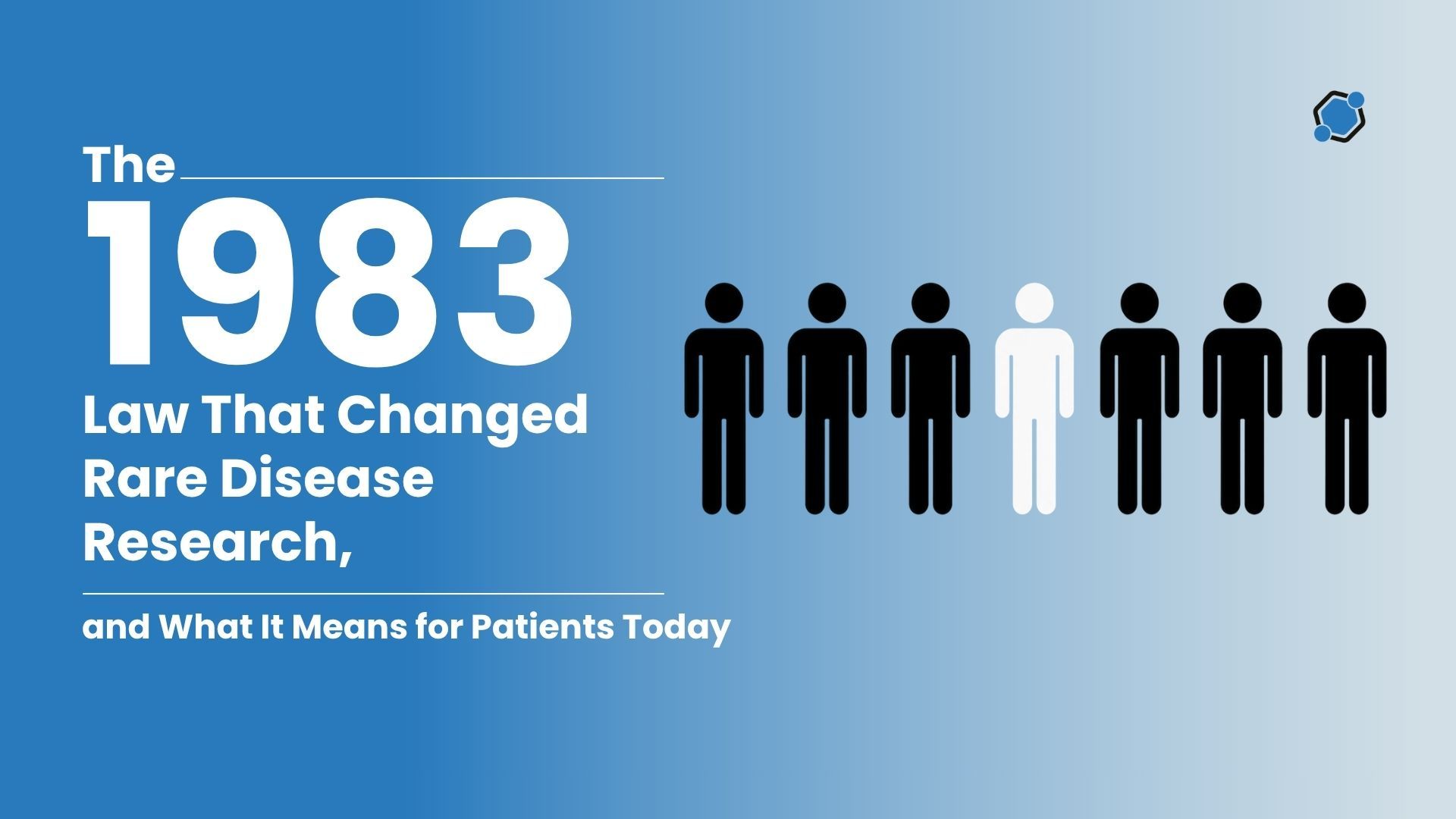
Someone newly diagnosed with a rare disease often discovers that treatment options are limited, and the few that do exist are described with unfamiliar terminology. Patients and families searching for information about clinical trials, reading patient assistance materials, or following news about new therapies repeatedly encounter one term in particular: orphan drug. The meaning is rarely explained in plain language, which leaves many people uncertain about what the term actually describes and why it matters.
An orphan drug is a medication, biologic, or other therapy developed to treat a rare disease or condition. In the United States, a disease is legally classified as rare when it affects fewer than 200,000 people nationwide. Because that patient population is small, pharmaceutical companies historically had little financial incentive to invest in research for these conditions. The Orphan Drug Act, passed in 1983, was designed to change that by providing sponsors with incentives to study and bring forward therapies for rare diseases.
What Makes a Drug an Orphan Drug?
Orphan drug status is a regulatory designation, not a category of medication. It applies to any drug, biologic, or gene therapy that meets specific criteria set by the U.S. Food and Drug Administration (FDA). To qualify, the therapy must be intended to treat, diagnose, or prevent a condition affecting fewer than 200,000 people in the United States, or one where the cost of developing and marketing the drug is unlikely to be recovered from U.S. sales.
The designation is granted by the FDA's Office of Orphan Products Development after a sponsor submits an application. Importantly, orphan designation is granted before a drug is approved, often well before clinical trials are complete. It is not the same as FDA approval. A drug can hold orphan designation and still be under active investigation, which means patients may encounter it during the clinical trial phase rather than after commercial availability.
Other countries operate parallel frameworks. The European Medicines Agency maintains its own orphan designation system, as do regulatory bodies in Japan, Australia, and elsewhere. The specific thresholds and incentives differ by jurisdiction, but the underlying purpose is the same: to encourage development of treatments for conditions that would otherwise be overlooked.
Why Rare Diseases Need a Different Approach to Drug Development
Developing a new medication is expensive. Bringing a single drug from early discovery through FDA approval typically requires many years of work and a substantial financial investment across preclinical research, clinical trials, regulatory submissions, and post-approval commitments. For common conditions, that investment can be recovered through sales to large patient populations. For rare diseases, the arithmetic does not work the same way. A therapy that treats a condition affecting a few thousand patients cannot generate the same return as one that treats millions.
This is the specific problem the Orphan Drug Act was created to address. Before 1983, relatively few treatments existed for rare diseases because the underlying economics discouraged investment. The Act introduced a set of incentives that change that calculation, including tax credits for qualifying clinical research, waived or reduced regulatory user fees, and a period of market exclusivity following approval during which competing products cannot be marketed for the same rare indication.
These incentives have produced a measurable change in what gets studied. Thousands of orphan designations have been granted since the Act took effect, and hundreds of orphan drugs have reached the market. For patients with rare diseases, that has meant access to therapies that would likely not exist otherwise.
How Orphan Drug Clinical Trials Differ from Other Trials
Orphan drug trials follow the same core phases as any clinical trial, moving through early safety studies, larger efficacy studies, and post-approval monitoring. The ethical, regulatory, and scientific standards are the same. What differs is the practical reality of running a trial when the potential participant pool is small.
Recruitment is the most visible difference. A trial for a common condition may enroll thousands of participants across dozens of sites. An orphan drug trial for a condition affecting a few thousand people nationwide may need to identify and consent nearly every eligible patient willing and able to participate. Investigators often work across multiple countries, rely heavily on patient advocacy organizations to reach potentially eligible families, and use disease registries to identify candidates. For a closer look at why small, specific patient pools make recruitment challenging, see Eligibility Explained: Why Not Everyone Qualifies for a Trial.
Trial design often reflects the constraints of small populations. Investigators may use adaptive designs that allow the protocol to be adjusted as data comes in. They may use natural history studies as comparators in place of traditional placebo controls, which is particularly common in serious genetic conditions where a placebo group would be ethically or practically difficult to assemble. Endpoints may rely on biomarkers, imaging, or patient-reported outcomes because the condition is too rare or too variable for standard clinical measures.
Timelines also tend to be longer. A trial that takes two years to enroll for a common condition may take considerably longer for a rare one, simply because there are fewer patients to find and confirm as eligible. Examples range across therapeutic areas: rare metabolic disorders, inherited retinal diseases, pediatric genetic conditions, and rare cancers all present variations of this same recruitment challenge.
What Orphan Drug Status Means for Patients and Families
For patients, orphan drug status is less a label to evaluate than a signal that research is under way for a condition that might otherwise be ignored. The designation itself does not guarantee that a drug will work, be approved, or eventually be accessible. It does mean that a sponsor has committed to studying a therapy for a rare condition and that regulatory incentives are supporting that work.
Patients and families considering participation in an orphan drug trial face most of the same questions that apply to any clinical trial: what the therapy is intended to do, what is known and unknown about its safety, what the visit schedule looks like, and what happens after the trial ends. For a thorough walk-through of what to ask before enrolling, see Top Questions to Ask Before Joining a Clinical Study.
Two factors come up more often in rare disease trials than in other trials. Travel is the first, because sites are fewer and participation may require visits to another city, state, or country. Long-term follow-up is the second, because natural history data is often being collected alongside efficacy data and follow-up periods may extend for years. Families should factor both into any decision about participation.
After approval, orphan drugs sometimes carry high prices because development costs are spread across a small patient population. Patient assistance programs, foundation grants, and disease-specific nonprofits commonly help families access approved therapies. These resources are separate from clinical trial participation but are part of the broader landscape that patients and caregivers navigate over time.
How to Find and Consider an Orphan Drug Trial
Finding a clinical trial for a rare disease is often harder than finding one for a common condition, but several paths exist. Disease-specific patient advocacy organizations typically maintain up-to-date information about active trials and can connect families to investigators. Treating physicians, particularly those at academic medical centers or designated centers of excellence for specific conditions, are often aware of trials in their specialty. Public registries of clinical trials are another source of structured information.
For a step-by-step walk-through of how to move from interest in a trial to enrollment, see How to Find and Enroll in a Clinical Trial: A Step-by-Step Guide.
DecenTrialz supports the matching side of this process. The platform uses AI-assisted matching to connect individuals with potentially relevant clinical studies based on their health information, then applies nurse-led pre-screening before referring qualified candidates to the research team managing the trial.
Next Steps
Patients and families who want to learn more about orphan drugs or explore trial options can take a few concrete steps. Identify the disease-specific advocacy organization for the condition, as these groups often track active research and maintain expert contacts. Ask the treating physician whether they are aware of current trials, or whether a referral to a specialty center would be useful. Use public clinical trial registries to search by condition and location, and consider working with a trial matching platform to broaden the search.
To explore whether current research may fit your situation or that of a family member, visit decentrialz.com.
Was this article helpful?

Similar Blogs
International Week of Deaf People 2026: how can clinical research become accessible to Deaf participants?
More than seventy million people around the world belong to signing Deaf communities, and ...
 Deeksha Gitta
Visceral Fat Health Risks: What Makes Belly Fat Different From Other Body Fat?
Body fat is usually discussed as a single quantity, weighed on a scale and summarized in o...
 Anish Teepireddy
Blood Pressure Numbers: What Do Systolic and Diastolic Actually Mean?
A blood pressure result contains two numbers, and most people are never told what either o...
ParamrajStay Informed. Stay Connected.
Get updates on verified clinical trials, emerging treatments, and research breakthroughs directly in your inbox. No spam, just science that matters.
