 HIPAA Compliant
 ISO 27001 Certified
SCIg vs IVIG: Weighing the Pros and Cons for CIDP
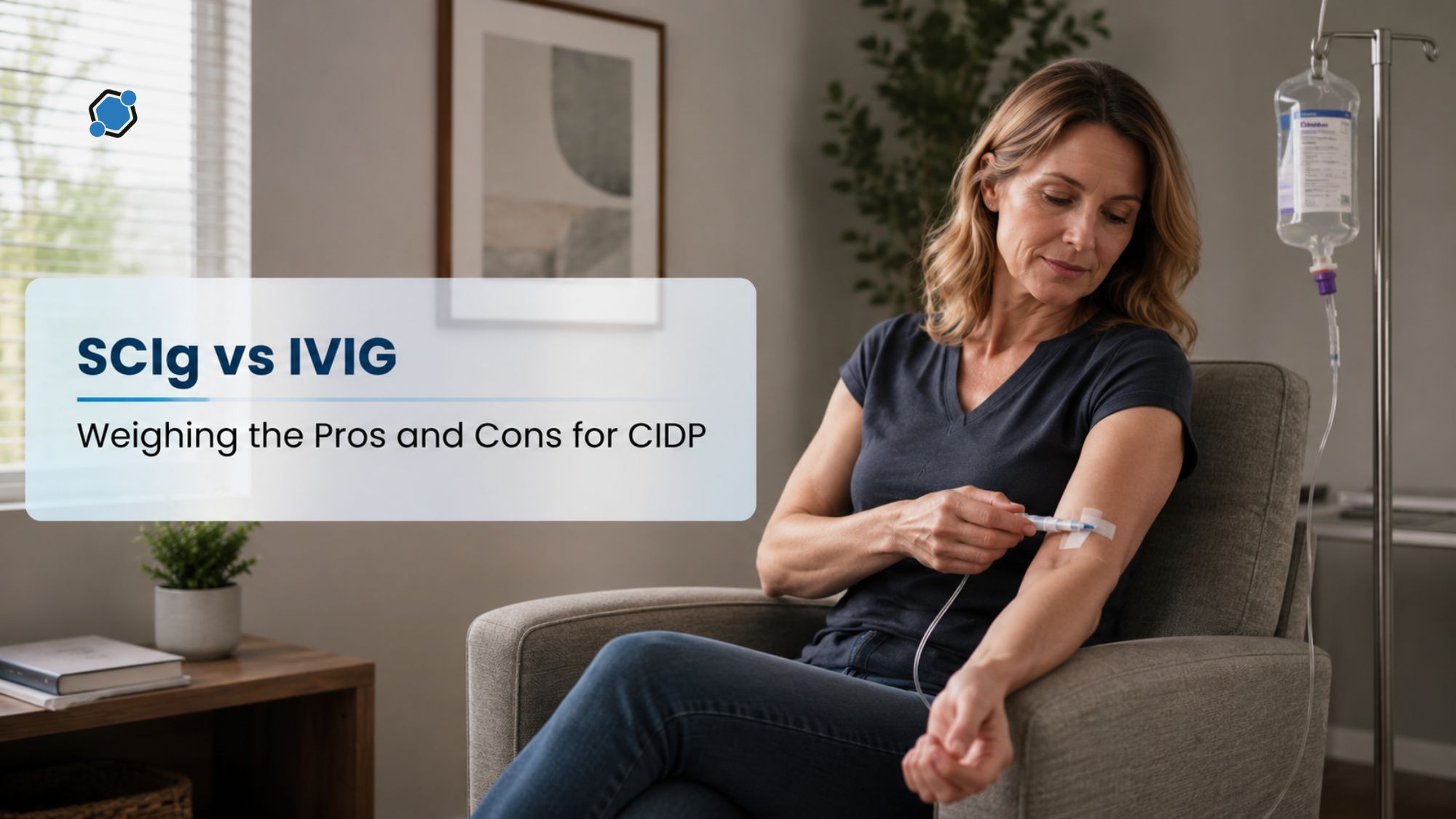
SCIg and IVIG are the two ways immunoglobulin therapy is given for CIDP, one under the skin and one into a vein. Both use the same general type of medication and work toward the same treatment goal, but the schedule, setting, and day-to-day experience of each are different. This guide compares the two directly: how each is given, how side effects differ, and the situations where one route tends to be favored over the other.
Not everyone with CIDP has a choice between the two, since SCIg is generally introduced after a person has already stabilized on another treatment. Some people do have a choice. Others simply want to understand what changes if a care team suggests switching. Either way, knowing exactly how the two routes compare helps make sense of the decision.
SCIg and IVIG Side by Side
Before the details, here is how the two routes compare on the basics.
- Setting. IVIG is given in a clinic or infusion center, occasionally at home under supervision. SCIg is designed for self-administration at home after training.
- Frequency. IVIG is typically given every few weeks. SCIg is typically given weekly, though some people use a biweekly schedule.
- Session length. IVIG usually takes two to five hours. SCIg usually takes about one to one and a half hours.
- Who gives it. IVIG is administered by a nurse or infusion specialist through an intravenous line. SCIg is self-injected once a person has been trained.
- Most common side effect type. IVIG is more often linked to systemic reactions such as headache and fatigue. SCIg is more often linked to mild, local injection-site reactions.
The sections below go into each of these differences in more depth.
How Administration Differs Between SCIg and IVIG
Here is a closer look at how the two are actually given, day to day.
- Setting. IVIG is usually given in an outpatient infusion center, hospital infusion unit, or occasionally at home under medical supervision. SCIg is designed for self-administration at home after training, though some people begin with supervised sessions first.
- Session length. A single IVIG infusion commonly takes two to five hours. The first treatment is often longer while the care team monitors the response closely. SCIg sessions are shorter, typically about one to one and a half hours.
- Frequency. IVIG is usually given every few weeks after an initial loading period spread over several days. SCIg is typically given weekly, though some people use a biweekly schedule with a larger combined dose.
- Who gives it. IVIG is given by a nurse or infusion specialist through an intravenous line placed at each session. SCIg is self-injected using a small pump or syringe, once a person has been trained to do it safely.
- Vein access. IVIG requires a new needle placement in a vein at each session. This can become more difficult for people with limited vein access over time. SCIg avoids repeated vein access altogether, since the injection goes under the skin.
- Training and support. Starting SCIg usually involves a training period with a nurse or infusion specialist. This covers injection technique, site rotation, and how to recognize a reaction. IVIG does not require this kind of hands-on training, since a clinical team manages the infusion directly.
- Missed or delayed doses. A delayed IVIG appointment typically means rescheduling through the infusion center. A missed SCIg dose can sometimes be given a few days later at home, though a care team should be consulted if a dose is delayed for more than a few days.
- Storage and supplies. SCIg requires home storage of medication, usually in a refrigerator, along with supplies such as needles, tubing, and a small infusion pump. IVIG does not require any home storage, since the medication is prepared and given on site.
- Travel considerations. IVIG infusions are typically scheduled at a fixed clinic location, which can complicate travel plans. SCIg supplies can often be packed and brought along, making it easier to maintain a treatment schedule while away from home.
SCIg is spread across smaller, more frequent doses. This tends to keep immunoglobulin levels in the body more steady between sessions, compared with the larger, less frequent doses typically used with IVIG.
How Side Effects and Tolerability Differ
Both IVIG and SCIg carry the same general warnings that apply to all immunoglobulin products, including a rare risk of blood clots, kidney problems, and aseptic meningitis, a temporary inflammation around the brain that can cause a severe headache. These risks are uncommon with either route. A care team screens for factors that raise the risk, such as kidney function and clotting history, before starting either treatment.
Where the two routes tend to differ is in the type of side effect that shows up most often.
IVIG is more often associated with systemic side effects, meaning reactions felt throughout the body, such as headache, fatigue, chills, mild nausea, and flu-like symptoms. These tend to happen because a comparatively large dose enters the bloodstream over a short period. Premedication, such as antihistamines or pain relievers before the infusion, is sometimes used to reduce these reactions.
SCIg is more often associated with local site reactions, such as redness, swelling, or mild discomfort where the injection is given. These reactions are usually mild and tend to decrease with continued use as the body adjusts. SCIg is absorbed more gradually, so systemic side effects occur less often. Some research comparing the two routes has found meaningfully fewer systemic reactions with SCIg, and premedication is less often needed.
With either route, certain symptoms call for prompt medical attention. These include difficulty breathing, chest pain, a severe headache unlike previous headaches, sudden neurological changes, or swelling and pain in a limb. Individual experience varies, and a person who tolerates one route poorly does not necessarily react the same way to the other. A full breakdown of managing IVIG side effects is available separately for anyone currently on IVIG.
Both routes typically involve periodic blood tests to check kidney function and overall response to treatment. The frequency of this monitoring is usually similar regardless of which route is used, though a care team may adjust it based on individual risk factors.
Who Tends to Prefer Each Option
There is no single right answer for every person with CIDP. The choice often comes down to lifestyle, treatment history, and how a person's body responds to each option.
IVIG may be favored by people who prefer fewer, less frequent appointments or who are not comfortable with self-injection. It may also suit those who need a higher dose delivered at once, or who do not have reliable support for home infusion.
SCIg may be favored by people who want more flexibility around work, travel, or caregiving schedules. It may also suit those who want to avoid repeated vein access, who prefer steadier immunoglobulin levels between doses, or who are comfortable learning to self-administer treatment. SCIg is currently approved as a maintenance treatment rather than a starting treatment. It is typically introduced after a person has already stabilized on another therapy, most often IVIG.
Cost, insurance coverage, and access to home nursing support can also factor into the decision. These vary widely from one insurance plan to another and are best worked through directly with an insurance provider and care team. The article on choosing an IVIG covers additional factors relevant to anyone still deciding on a starting treatment.
Caregiver involvement can also shape the decision. Some people value the built-in support of a clinical setting, while others prefer the independence and reduced travel that comes with home-based SCIg.
Physical factors can matter as well. Some SCIg products are available in pre-filled syringes, which can make self-injection easier for people with limited hand strength or dexterity. People with significant needle anxiety may also find the shorter, at-home SCIg injection easier to manage than a longer IVIG infusion, though others feel the opposite and prefer having a clinical team present.
Moving From IVIG to SCIg, or Back Again
Many people who use SCIg started on IVIG first. Once a person has stabilized on IVIG, a care team may calculate an equivalent SCIg dose based on the immunoglobulin amount already being used. That dose is then divided into weekly or biweekly injections. SCIg is usually started within about a week of the last IVIG infusion, so there is little to no gap in treatment.
During this early transition period, a care team typically monitors symptoms more closely to confirm the new dose is working as expected. Adjustments to the SCIg dose or schedule are common in the first few weeks.
Not everyone stays on SCIg long term. If symptoms are not adequately controlled on the current SCIg dose, a care team may first try adjusting the dose or schedule before considering a return to IVIG. Switching between the two is a clinical decision based on symptom control, side effects, and personal preference, not a one-way choice. A more detailed walkthrough of the transition process is covered in the guide on SCIg for CIDP.
Two Immunoglobulin Routes, One Goal
IVIG and SCIg are not two different medications. Both use purified immunoglobulin, the antibody-based part of blood plasma, to help regulate an overactive immune system. These antibodies are collected from thousands of plasma donors and processed to remove impurities before being used as medication. The difference is the route the medication takes to reach the body. It goes directly into a vein, or through a slow injection under the skin, usually in the abdomen or thigh. The route does not change the underlying medication, only how and how often it is delivered.
The underlying medication is similar, so many of the same treatment goals apply to both routes. These include reducing nerve inflammation, supporting muscle strength, and helping slow or stop symptom progression. What differs is the setting, schedule, and physical experience of treatment, along with a few differences in how the body responds to each delivery method.
A closer look at either treatment on its own, including infusion steps and side effects, is covered separately in the guides on IVIG for CIDP and SCIg for CIDP. Broader treatment context, including core CIDP treatment options and plasma exchange, is available in those guides as well. For background on the condition itself, see what CIDP is. Readers researching CIDP symptoms for the first time may find that guide useful too.
Frequently asked questions
What is the main difference between SCIg and IVIG?
The main difference is the route of administration. IVIG is delivered into a vein, usually every few weeks in a clinical setting. SCIg is injected under the skin, usually weekly at home. Both use the same general type of medication and work toward the same treatment goal in CIDP. The schedule, session length, and side-effect pattern differ between the two. Available evidence suggests the two are comparably effective for most people, though individual response can vary.
Can a person switch between IVIG and SCIg?
Switching is possible and is a clinical decision made with a care team, not something done independently. Many people move from IVIG to SCIg once their disease is stable, using a dose calculated from their prior IVIG regimen. Some people who do not respond well enough to a given SCIg dose return to IVIG. Switching in either direction is generally considered a treatment adjustment rather than a sign that either option failed.
Which option has fewer side effects?
Both carry the same rare, serious warnings that apply to all immunoglobulin products. Beyond that, the pattern of side effects differs. IVIG is more often linked to systemic reactions such as headache and fatigue, while SCIg is more often linked to mild, local injection-site reactions. Some research suggests fewer systemic side effects overall with SCIg, though individual results vary and either route can be well tolerated. Individual tolerance can generally only be determined by trying a treatment under medical supervision.
Is SCIg used for CIDP right from diagnosis?
Not usually. SCIg is currently approved as a maintenance treatment. It is typically used after a person has already responded to and stabilized on another therapy, most often IVIG. It is not generally used to start treatment in someone newly diagnosed with CIDP, though a neurologist makes that determination case by case.
Which option is better for someone who travels often or works full time?
SCIg is often considered more compatible with travel and work schedules. It can be self-administered at home in a shorter session, without a trip to an infusion center. IVIG can still work well for people with predictable routines, though the longer, less frequent appointments may require more schedule coordination. The better fit depends on individual circumstances and is worth discussing directly with a care team. Some people also switch approaches later if their circumstances change, such as a new job or a change in caregiving responsibilities.
Choosing Between SCIg and IVIG
SCIg and IVIG both aim to calm the immune activity behind CIDP, and neither is universally better than the other. IVIG offers a well-established, less frequent schedule with in-clinic monitoring. SCIg offers a shorter, more flexible routine that a person can manage largely on their own. Treatment history, side-effect tolerance, lifestyle, and comfort with self-administration all factor into which route makes more sense for a given person.
Both routes use similar underlying medication, so moving between them does not mean starting over. A neurologist or infusion care team can walk through the practical trade-offs. Together, they can help decide which option, or combination of adjustments, fits best at a given stage of treatment. Reassessing the choice periodically, especially after a relapse or a notable change in symptoms, keeps the treatment plan aligned with how CIDP is behaving at the time. Neither option is a lifetime commitment, since treatment plans can and often do change as circumstances shift.
Was this article helpful?

Similar Blogs

Clinical Nurse Specialist Recognition Week 2026: What Is a CNS and Why Does the Role Matter?
September 1 is the birthday of Hildegard Peplau, an American nurse and theorist who argued...
 Vamshi Kantoju
Breast Cancer Stages: What Stage 0 to Stage 4 Mean and How Doctors Determine Them
Stage is one of the first facts a person learns after a breast cancer diagnosis, and it sh...
Paramraj
World Sexual Health Day 2026: What Is It, and Why Does Sexual Health Research Matter?
Sexual health covers considerably more ground than most people assume. The World Health Or...
Mahesh UpadristaStay Informed. Stay Connected.
Get updates on verified clinical trials, emerging treatments, and research breakthroughs directly in your inbox. No spam, just science that matters.
