


What is bioequivalence, and how are generic drugs approved?
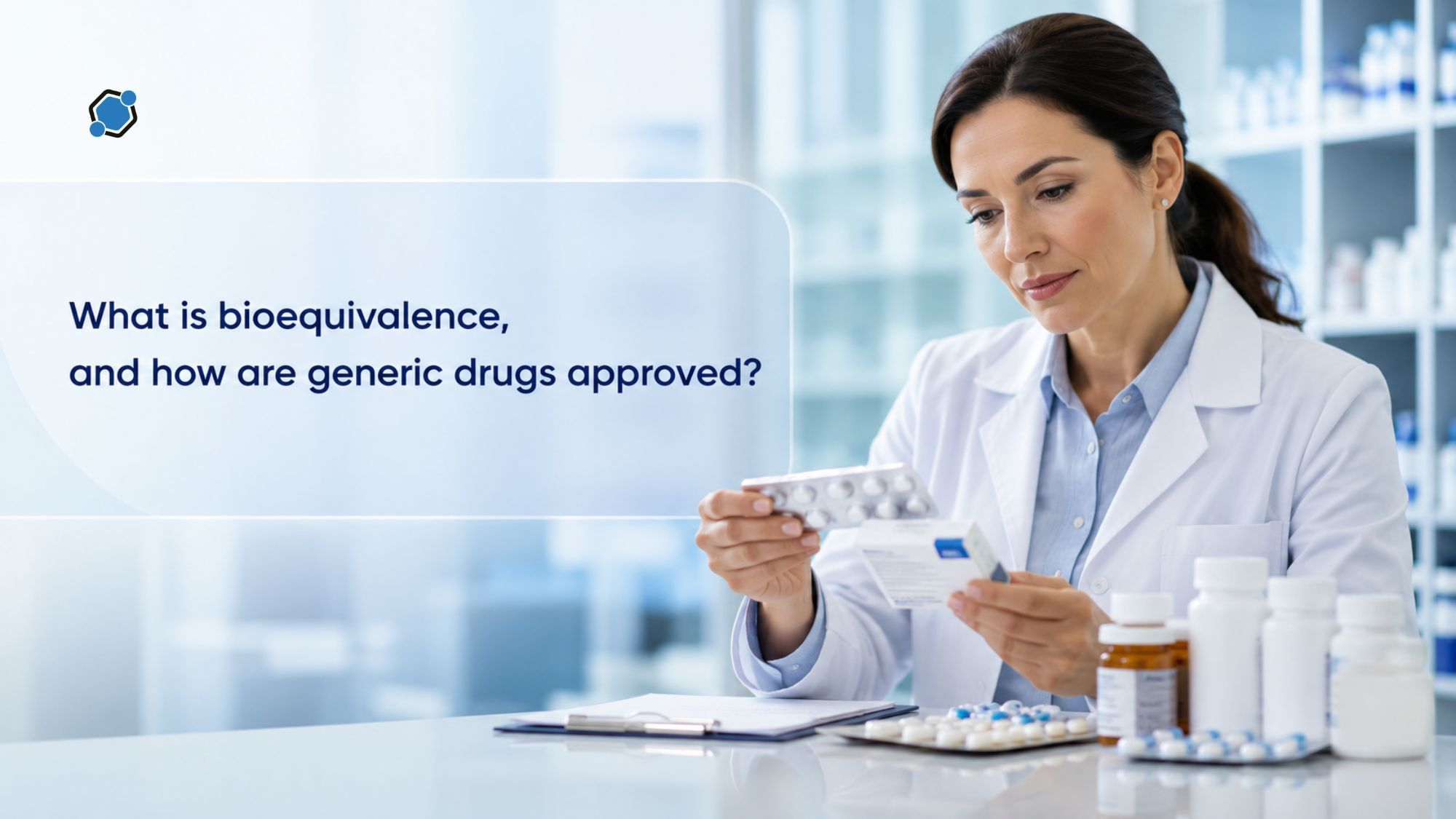
Most prescriptions filled in the United States are for generic drugs. Before any of those generics reach a pharmacy shelf, they must pass a specific scientific test called a bioequivalence study. That study is the reason a doctor or pharmacist can hand out a generic pill with confidence that it will work the same way in the body as the brand-name version.
Bioequivalence testing is a well-defined process, guided by the U.S. Food and Drug Administration (FDA). It involves careful study design, healthy volunteers, laboratory analysis, and strict statistical standards. Here is what actually happens, and why the results matter for anyone who takes a generic medication.
What bioequivalence actually means
Bioequivalence is the scientific standard used to show that a generic drug delivers the same amount of active ingredient into the bloodstream, at the same speed, as the brand-name product it copies. The brand-name product used for comparison is called the reference-listed drug, or RLD.
To prove bioequivalence, researchers measure how the drug behaves in the body over time. Three measurements do most of the work:
AUC (Area Under the Curve) measures the total amount of drug that reaches the bloodstream. It reflects how much medicine the body actually gets from a single dose.
Cmax measures the highest concentration the drug reaches in the blood. It reflects how strong the peak level is.
Tmax measures how long it takes to reach that peak. It reflects how quickly the drug is absorbed.
For a generic to pass, the results for AUC and Cmax must fall inside a tight range set by the FDA. The 90 percent confidence interval for the ratio between the generic and the brand must sit entirely between 80 percent and 125 percent. That sounds like a wide window, but in practice, approved generics land far closer to the brand than the outer limits. A large FDA review of more than 2,000 studies found the average difference in total absorption between generic and brand was about 3.56 percent.
Three related terms often get mixed up. Pharmaceutical equivalence means the two products contain the same active ingredient at the same strength in the same form, such as a tablet or capsule. Bioequivalence adds proof that the products behave the same way in the body. Therapeutic equivalence means both conditions are met and the products can be substituted for each other with confidence. Products that meet all three standards are listed in the FDA Orange Book with an “AB” rating. For readers who want a plain-language primer on clinical research overall, Clinical Trials Explained: Simple Guide for Beginners is a good starting point.
How bioequivalence testing is done
Bioequivalence studies are usually small, short, and precisely designed. The most common format is a crossover study. Each volunteer takes both the generic and the brand-name product, but on different occasions separated by a gap of time. That means every person acts as their own comparison, which reduces the effect of natural differences between individuals and requires fewer participants overall.
The order is randomized so that half the volunteers take the generic first and half take the brand first. Between the two doses, there is a washout period, typically one to two weeks, long enough for the first dose to completely leave the body before the second one is given. This prevents any leftover drug from affecting the next measurement.
Some studies are done after an overnight fast, others after a standardized meal, and often both. Food can change how a drug is absorbed, so regulators may require proof that the two products behave the same under both conditions. During each dosing period, staff draw a series of blood samples across many hours, sometimes for two or three days, so the drug’s rise and fall in the bloodstream can be plotted point by point. A highly sensitive laboratory method then measures the exact drug concentration in each sample, without the lab knowing which sample came from which product.
These studies are usually conducted in healthy adults rather than patients with the condition the drug treats. Healthy volunteers reduce the noise that comes from underlying disease, other medications, and differing physiology. That gives a cleaner comparison between the two products. A typical study enrolls somewhere in the range of 24 to 36 volunteers, though the exact number depends on how variable the drug is from person to person.
The regulatory route for a generic is called an Abbreviated New Drug Application, or ANDA. It is “abbreviated” because the generic maker does not repeat the large safety and effectiveness trials the brand already completed. Instead, the application relies on the bioequivalence data plus proof that the drug is made consistently to the same quality standards. This is a different question than whether a study uses Placebos and Controls: What It Means in Your Study, but the underlying idea is similar: careful comparison against a defined reference is what makes the results trustworthy.
Who volunteers, and why generic drug testing matters
The healthy volunteers who take part in bioequivalence studies are generally adults age 18 or older who pass a screening process. Screening looks a lot like a thorough annual physical. It usually includes a medical history review, a physical exam, blood and urine laboratory tests, and questions about current medications, tobacco use, and alcohol use. The purpose is to confirm that a candidate is healthy enough to participate safely and will produce clean, interpretable data.
Participation itself involves staying at a specialized research unit during the dosing periods so that meals, activity, sleep, and blood draws can be tightly controlled. Volunteers are monitored closely by clinical staff throughout. Blood draws are often taken through a thin flexible catheter placed once, so a single line can be used for multiple samples instead of separate needle sticks. Volunteers are compensated for their time, and the amount is tied to the length of the stay and the number of procedures involved.
Every study is reviewed and approved by an Institutional Review Board, or IRB, before it starts. The IRB is an independent group of scientists, clinicians, and community members responsible for confirming that risks are minimized and that the study is ethically sound. Before enrolling, every volunteer goes through informed consent, a documented conversation that explains what the study involves, what the known risks are, and what the alternatives are. Volunteers also keep the right to withdraw at any point, for any reason, without penalty.
The public health payoff is substantial. The FDA reports that 9 out of 10 prescriptions filled in the United States are for generic drugs. Generics reach the market at lower prices largely because bioequivalence testing replaces the need to repeat every large brand-name trial. That lower cost, in turn, expands access to essential medications for people who might otherwise skip doses or go without. Volunteers who participate in these studies play a direct role in that access, and their contribution ties into the broader story of How Clinical Trials Contribute to Public Health.
It is also worth clearing up a common worry. Generic drugs often look different from the brand because trademark law prevents identical appearance, but a different color, shape, or filler does not change how the medicine works in the body. The bioequivalence standard is designed to catch meaningful differences in absorption, and approved generics consistently fall well inside the acceptable range.
Finding clinical trials that need volunteers
Bioequivalence studies are one type of clinical research that relies on healthy volunteers. Many other types of studies, from research on new therapies to prevention research, also depend on people willing to take part. Anyone interested in learning about active studies can explore opportunities through DecenTrialz, a platform that uses AI-assisted matching and registered nurse-led pre-screening to connect potential participants with research teams. Final eligibility, informed consent, and study details are always handled by the research site running the study.
Was this article helpful?
Similar Blogs

What is a sponsor-investigator in clinical trials?
Most clinical trials involve two separate parties. A sponsor, usually a pharmaceutical or ...
 Mahesh Upadrista
Choosing an IVIG for CIDP: 7 Factors That Can Shape the Decision
Most adults with chronic inflammatory demyelinating polyneuropathy (CIDP) are treated with...
 Kantoju Harshavardhan
SCIg vs IVIG: Weighing the Pros and Cons for CIDP
SCIg and IVIG are the two ways immunoglobulin therapy is given for CIDP, one under the ski...
Kantoju Harshavardhan Stay Informed. Stay Connected.
Get updates on verified clinical trials, emerging treatments, and research breakthroughs directly in your inbox. No spam, just science that matters.
