 HIPAA Compliant
 ISO 27001 Certified
World Hypertension Day 2026: Theme, Importance, and Clinical Trials
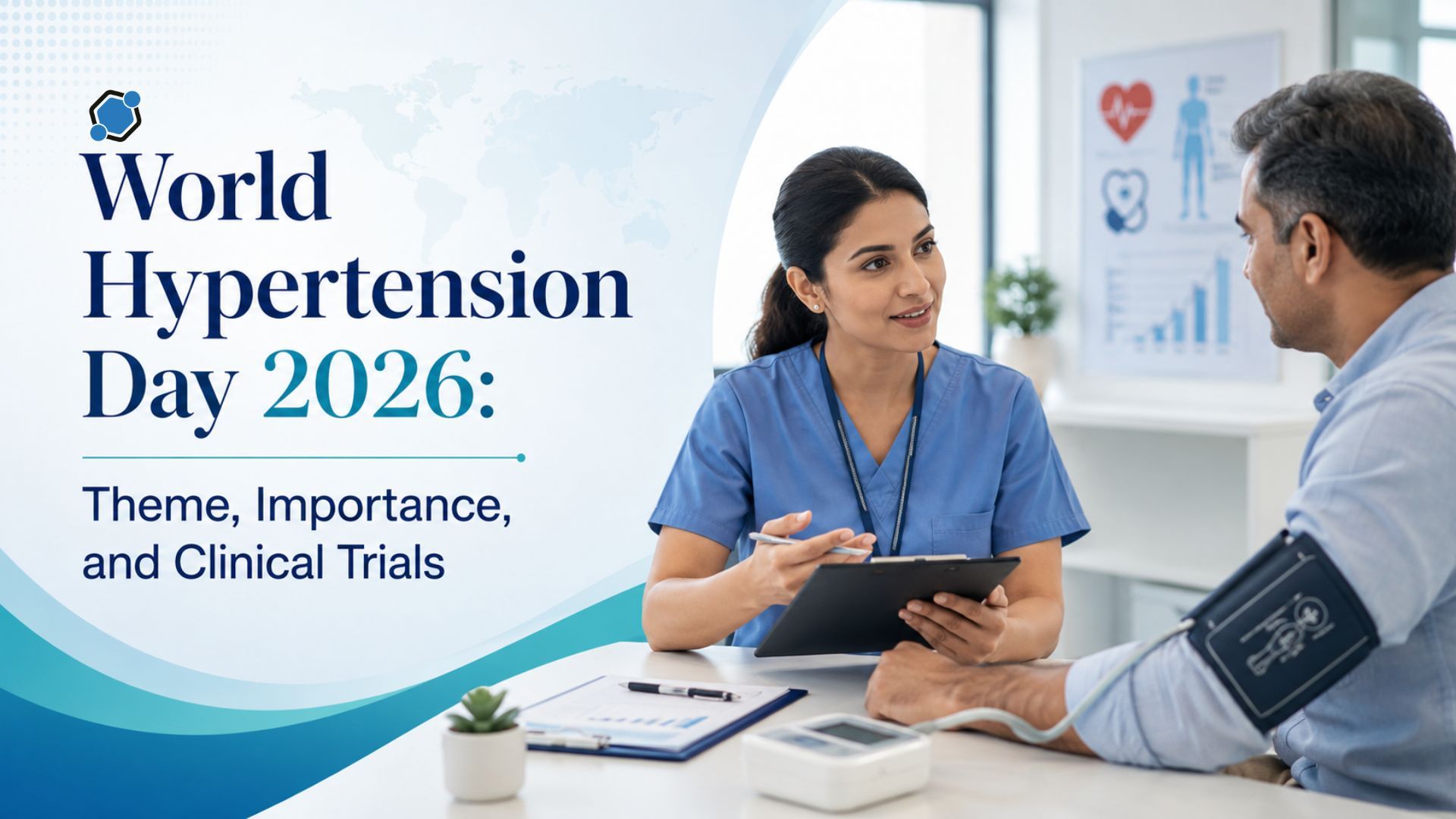
May 17, 2026, marks World Hypertension Day, an international awareness day held every year to draw attention to high blood pressure. The World Hypertension League, the international group that coordinates the day, has named "Controlling Hypertension Together" as the theme for 2026.
This article covers three things: what the 2026 theme actually asks of people, families, and the health system; why high blood pressure is one of the biggest health issues in the world; and where hypertension clinical trials fit into the picture.
What Is World Hypertension Day?
World Hypertension Day is observed every May 17. The goal is to draw attention to high blood pressure, encourage people to get their blood pressure measured accurately, and promote daily habits that reduce the risk of heart disease, stroke, and kidney disease. It is coordinated by the World Hypertension League (WHL), an international group made up of national heart and blood pressure societies, patient advocacy groups, and public health partners from more than 100 countries. The WHL describes the 2026 edition as its 21st celebration of the day.
The WHL focuses its messaging especially on low- and middle-income countries, where awareness of high blood pressure, regular access to diagnosis, and consistent access to medication are often hardest. Around May 17, member groups run blood pressure screening events at clinics and community centers, community walks and drives, media campaigns, and school and workplace education programs.
For readers who are new to the wider topic of clinical research, the Clinical Trials Explained: Simple Guide for Beginners is a useful starting point.
The 2026 Theme: Controlling Hypertension Together
The 2026 theme, "Controlling Hypertension Together," shifts the conversation. High blood pressure is often thought of as a private medical problem, something each person manages on their own with their doctor. The 2026 theme reframes it as a shared challenge that involves families, communities, healthcare workers, the wider health system, researchers, and policymakers all at once.
In practical terms, "together" means several things working in parallel. Individuals checking their blood pressure regularly, even when they feel fine. Families and workplaces supporting healthier eating habits, especially eating less salt. Pharmacies and community health workers are expanding the places where blood pressure can be measured accurately. Health systems are making blood pressure medications affordable and available without long gaps. Research teams continue to study how high blood pressure develops, how it can be prevented, and how care can be improved.
That last point connects to a kind of research designed to test new approaches in real-world conditions rather than only in tightly controlled hospital settings. Studies that work this way are sometimes called pragmatic trials. For more on how researchers think about real-world versus controlled trial designs, the What Is the Difference Between Pragmatic and Explanatory Clinical Trials? The article goes deeper.
Why Hypertension Matters: The Global Scale
Roughly 1.3 billion adults around the world have high blood pressure, according to the World Health Organization. That is close to one in three adults globally. Among them, nearly half do not know they have it, because high blood pressure usually does not cause any symptoms until serious problems appear.
The downstream consequences are large. High blood pressure is the single biggest risk factor contributing to deaths from heart disease and stroke worldwide. It also contributes to chronic kidney disease and is increasingly linked to certain forms of memory and thinking decline. In short, it is a condition that quietly drives a large share of serious illness and death.
That weight on public health is the reason for an annual awareness day in the first place. Awareness days are most useful when a problem is widespread, often missed in diagnosis, and responsive to action. High blood pressure fits all three. Country-wide and community-wide programs, from national policies that lower salt in packaged foods to community blood pressure screening drives, have improved the share of people whose blood pressure is well-managed in countries that have invested in them. For more on how research underpins those kinds of population-wide changes, the How Clinical Trials Contribute to Public Health blog covers that connection in depth.
Hypertension Clinical Trials in 2026: What's Being Studied
Clinical trial activity for hypertension is substantial. Based on a search of public trial registries in May 2026, roughly 1,170 hypertension clinical trials are actively looking for participants worldwide, with around 430 of those running in the United States. About 70 are in Phase 3, the late stage of testing that comes just before a medication is reviewed for approval by regulators like the U.S. Food and Drug Administration (FDA). These counts shift as trials open and close, so the exact numbers will look different a few months from now.
The research happening today spans several different directions. New medications are a major area. Some studies are testing whether classes of drugs originally developed for other conditions, especially diabetes and weight management, can also help reduce the risk of heart attacks and strokes in people whose high blood pressure overlaps with diabetes or obesity. Body weight is recognized as a major factor in many high blood pressure cases, and trials in this space often look at people whose high blood pressure and excess weight occur together. The companion piece What is BMI and Why is it Measured in Clinical Trials? explains why body weight shows up so often in the eligibility rules for hypertension and heart-related studies.
Device-based research is another active area. About 26 trials are studying a procedure called renal denervation, which uses heat or ultrasound to quiet down overactive nerves running between the kidneys and the brain. These nerves are involved in raising blood pressure, and quieting them can help lower it. This procedure is mostly studied for people whose blood pressure stays high even after they take several medications, a situation called resistant hypertension. About 57 trials currently focus on resistant hypertension specifically.
Digital and remote-monitoring approaches are also being studied. Around 59 trials involve some kind of digital element, such as video visits with doctors, home blood pressure cuffs that send readings to a clinic automatically, or AI tools that help doctors decide what to recommend. Around 93 trials are studying changes to diet and daily habits, especially eating less salt. High blood pressure during pregnancy, which can lead to preeclampsia (a dangerous pregnancy complication marked by very high blood pressure) and other problems for both parent and baby, is another active area, including studies of how to reduce heart and stroke risks in the months and years after pregnancy.
Taken together, the research shows that high blood pressure is being tackled from many directions at once. No single approach is expected to solve it. That, in part, is what "Controlling Hypertension Together" gestures at.
How to Learn More and Find a Trial
For someone interested in following or possibly joining a high blood pressure clinical trial, there are a few different paths.
DecenTrialz helps people in the United States find hypertension clinical trials that may be relevant to their condition, location, and basic eligibility details. After a person shares their information, the platform may identify trial options that appear to fit their profile. A registered nurse may then complete an initial pre-screening review before the person is referred to the research site or study team. Final eligibility, enrollment, and informed consent are always handled by the study team responsible for the trial. You can start a search at decentrialz.com.
A second path is to talk to your doctor. Doctors who treat high blood pressure are often aware of research happening at teaching hospitals or university medical centers in their area, and a referral conversation can surface options that match a specific situation.
Two concerns come up often for people thinking about joining a high blood pressure trial. The first is whether joining a trial means giving up the medications they already take. In most high blood pressure trials of adults who are already in care, the standard of care (the current accepted way of managing the condition) continues, and the trial tests something added to it or compared with it. The second concern is whether being assigned to a placebo (an inactive substitute given for comparison) means going untreated. Placebo-only designs are not common in high blood pressure trials where the participants have a meaningful disease, because leaving someone with high blood pressure without any care for a long time would not be ethical. Most trial designs compare a new option against current care, or a placebo added to current care.
For readers who are new to clinical research more broadly, the Clinical Trial Volunteers Guide: Your First Step Into Clinical Trials walks through what participation looks like from start to finish.
The next step on May 17, 2026, is straightforward. For anyone who does not know their own blood pressure, the day can be a useful reminder to consider getting it checked by a qualified professional or with a validated device. For anyone who already knows they have high blood pressure, the day is a useful reminder to speak with a healthcare professional about whether their current care plan is still appropriate, and to consider whether joining a hypertension clinical trial could be part of the path forward. You can begin a search at decentrialz.com.
Was this article helpful?

Similar Blogs
Why is my blood pressure still high on medication? Resistant hypertension explained
Blood pressure that stays high after treatment has already started is more common than mos...
 Vamshi Kantoju
What is insulin resistance and how does it affect blood sugar?
Insulin resistance is a condition in which muscle, liver, and fat cells respond weakly to ...
Swaroop ESD
Mini-stroke symptoms: how to recognize a transient ischemic attack before a full stroke
A transient ischemic attack, often called a mini-stroke, is a short episode of stroke symp...
Deeksha GittaStay Informed. Stay Connected.
Get updates on verified clinical trials, emerging treatments, and research breakthroughs directly in your inbox. No spam, just science that matters.
