 HIPAA Compliant
 ISO 27001 Certified

Why is my blood pressure still high on medication? Resistant hypertension explained
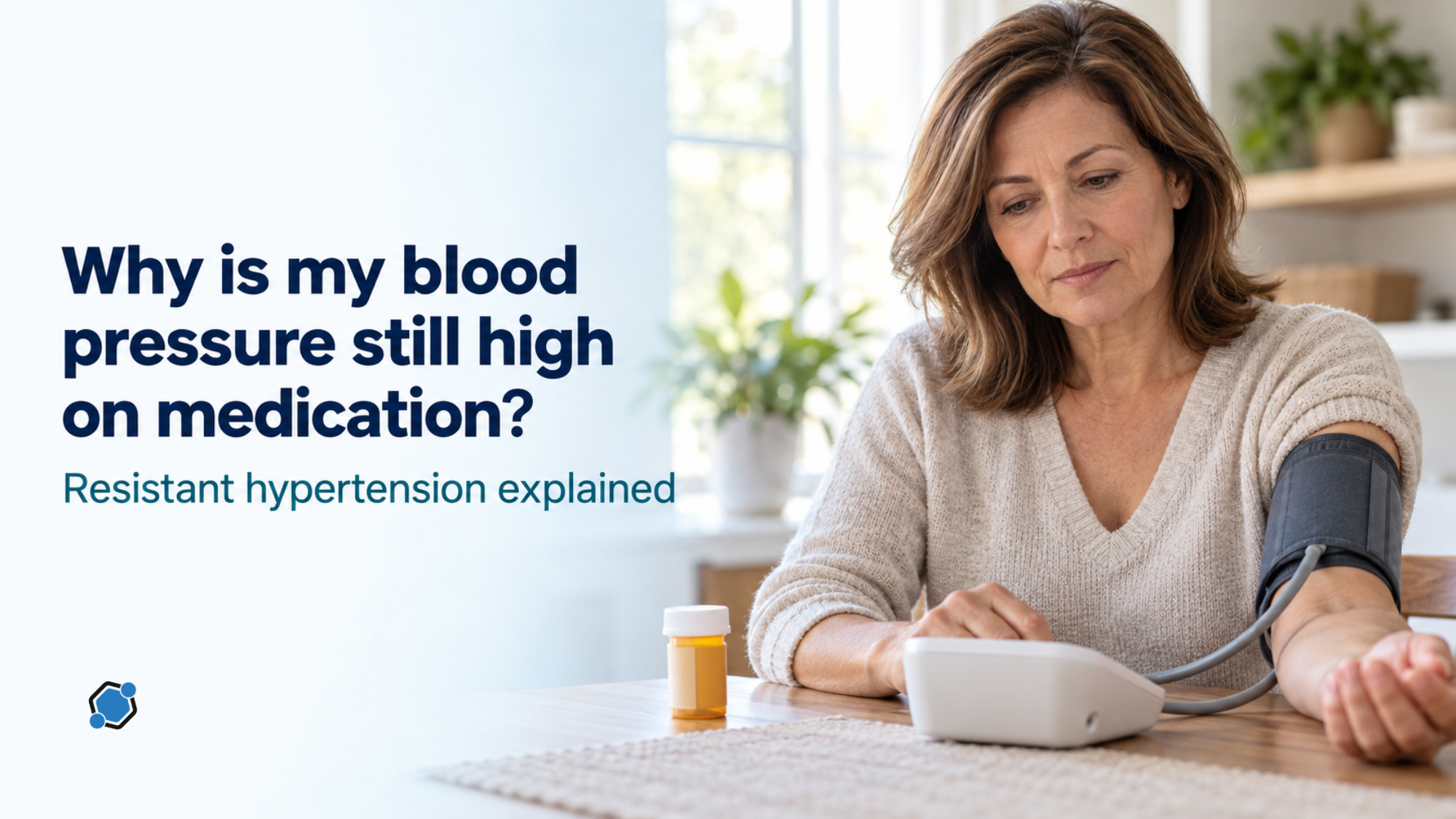
Blood pressure that stays high after treatment has already started is more common than most people assume. Clinicians have a name for it: resistant hypertension. The term does not mean treatment has failed, and it does not mean nothing further can be done. In most cases it means something measurable is still pushing blood pressure up and that cause has not been identified yet. Knowing what the label means, and what a care team checks next, turns a stubborn reading into the start of a more specific conversation.
What resistant hypertension actually means
Resistant hypertension has a precise definition. It describes blood pressure that stays at or above 130/80 mm Hg even though a person is taking three different types of blood pressure medication at the highest doses they can tolerate, with one of those being a diuretic, commonly called a water pill. The label also applies when blood pressure is controlled, but only because four or more medications are needed to keep it there.
Two details in that definition carry most of the weight. The first is "three different types." Three pills from the same family do not count, because medications that work the same way tend to run into the same ceiling. Treatment usually combines a drug that relaxes blood vessels, a drug that slows the movement of calcium into vessel walls, and a drug that helps the kidneys clear excess salt and fluid. If the three numbers on a prescription list are unfamiliar, it helps to start with what the two numbers in a reading mean.
The second detail is the diuretic. Many cases of stubborn blood pressure involve the body holding on to more salt and water than it should. Leaving a water pill out of the combination, or using a dose that is too low, is one of the most common reasons a regimen stalls.
Resistant hypertension is also not the same thing as uncontrolled high blood pressure. Most people whose readings sit above goal are taking fewer than three medications, or are still early in the process of finding the right combination. That is uncontrolled, not resistant. In United States national survey data, roughly one in five adults being treated for high blood pressure meets the technical definition of resistant hypertension, and a large share of those cases turn out to have a different explanation once they are examined closely.
Why medication alone is sometimes not enough
Before a care team accepts the resistant label, it works to rule out what clinicians call pseudo-resistance, meaning blood pressure that only appears resistant.
Measurement is the first suspect. Readings are sensitive to cuff size, arm position, back support, talking during the reading, and how long a person sat quietly beforehand. A cuff that is too small or an arm left unsupported can add several points. Some people also read consistently higher in a medical office than they do at home. Readings taken outside the clinic, either on a validated home monitor or on a 24-hour monitor worn during an ordinary day, are how a care team tells the difference.
Taking every dose as prescribed is the second suspect, and it accounts for more cases than most people expect. Blood pressure medication often has to be taken daily for years to treat a condition that rarely produces noticeable symptoms. Research in people with apparently resistant hypertension consistently finds that a substantial share are not taking all prescribed doses. Cost, side effects, complicated schedules, and ordinary forgetfulness all contribute, and each of those has a practical fix worth raising with a clinician rather than hiding.
Other substances can work against treatment quietly. Current United States guidelines now call for a careful review of everything a person takes, including:
- Over-the-counter pain relievers in the NSAID family, such as ibuprofen and naproxen
- Decongestants found in many cold and allergy products
- Some hormonal contraceptives
- Corticosteroids
- Stimulant medications
- Certain antidepressants
- Licorice and some herbal supplements
Daily habits raise the pressure that any regimen has to work against. High sodium intake, regular alcohol use, excess weight, physical inactivity, and poor sleep all make control harder to reach, and all of them are still relevant after medication has started.
The hidden causes a care team looks for
Once measurement, adherence, and interfering substances have been addressed, attention turns to secondary hypertension, meaning high blood pressure driven by an identifiable underlying condition rather than by the usual mix of genetics, age, and lifestyle.
The most important one is primary aldosteronism. Aldosterone is a hormone made by the adrenal glands, two small glands that sit above the kidneys, and its job is to tell the body to hold on to salt. When the adrenal glands make too much of it, the body retains salt and fluid, and blood pressure climbs in a way that standard medications struggle to control. This is not rare in resistant hypertension, and it often responds well to a specific type of medication or, in selected cases, a procedure.
United States guidelines now recommend screening everyone with resistant hypertension for primary aldosteronism, including people whose potassium levels look normal. Studies of real-world practice have repeatedly found that most eligible patients are never tested, which makes this a fair question for a person to raise directly at an appointment.
Other conditions a clinician may investigate include:
- Obstructive sleep apnea, in which breathing repeatedly pauses during sleep
- Chronic kidney disease
- Narrowing of the arteries that supply the kidneys
- Thyroid disorders
- Rare tumors of the adrenal glands
- Cushing syndrome, caused by excess cortisol
Several of these conditions travel alongside other metabolic warning signs, which is one reason a clinician may order a broader set of blood tests than a person was expecting.
Why resistant hypertension is taken seriously
Blood pressure that stays above goal for years places sustained strain on the arteries, the heart, the kidneys, the brain, and the eyes. Large population studies have found that people with resistant hypertension experience higher rates of stroke, heart failure, coronary heart disease, and kidney failure than people whose high blood pressure is easier to control. These findings describe patterns across large groups rather than predictions for any individual, and the size of the difference varies between studies.
The practical takeaway is about timing rather than alarm. A resistant label is a signal to look harder and sooner, not a verdict about what will happen. It is separate from the situation in which a reading at or above 180/120 mm Hg, combined with symptoms such as chest pain, shortness of breath, vision changes, or weakness on one side, becomes a medical emergency that calls for 911 rather than an appointment.
How resistant hypertension is evaluated and treated
The evaluation generally follows a sequence rather than jumping to a new prescription:
- Confirm the pattern with readings taken outside the clinic
- Review each medication, its dose, and how consistently it is being taken
- Review every other medication and supplement for effects on blood pressure
- Run blood and urine tests covering kidney function, potassium, and hormone levels
- Evaluate for sleep apnea when symptoms or risk factors point that way
Treatment usually starts by making the existing regimen work harder before anything is added. That often means correcting the diuretic, either by adjusting the dose or switching to a longer-acting one. When a fourth medication is needed, guidelines point to a drug that blocks the effect of aldosterone, which has outperformed other fourth-line choices in head-to-head research for this specific group.
Newer options exist for people who remain uncontrolled after that. Over the past three years, United States regulators have approved a medication that blocks a hormone which tightens blood vessels, a newer class that reduces how much aldosterone the body produces, and a catheter-based procedure that calms overactive nerves running to the kidneys. Specialists generally reserve these for confirmed cases after a standard four-drug combination has been optimized, and several further approaches are still under study and not yet approved.
Lifestyle change keeps its place throughout. In controlled research, reducing dietary sodium lowered blood pressure by an amount comparable to adding a common first-line medication, including among people already on treatment. Weight management, regular physical activity, limiting alcohol, and treating sleep apnea each add to that effect.
Questions people ask about resistant hypertension
Is resistant hypertension the same as uncontrolled high blood pressure?
No. Uncontrolled means any reading above goal, for any reason, including being on only one or two medications. Resistant means readings stay above goal despite three appropriate medications at maximum tolerated doses, including a diuretic. Most uncontrolled blood pressure is not resistant.
Can resistant hypertension be reversed?
Sometimes. If an underlying cause such as a hormone problem, sleep apnea, or an interfering medication is found and addressed, blood pressure can become much easier to control. Some cases also turn out to be pseudo-resistant once measurement and adherence are corrected. Outcomes differ from person to person and cannot be promised in advance.
What tests are usually involved?
Home or 24-hour blood pressure monitoring, blood tests for kidney function and potassium, hormone testing for aldosterone and renin, a urine test, and in many cases an evaluation for sleep apnea. Imaging of the kidneys or adrenal glands is added when results point that way.
Can lifestyle changes alone fix it?
Lifestyle changes help meaningfully, and sodium reduction in particular has a measurable effect even in people already taking medication. For most people with resistant hypertension, however, lifestyle change works alongside medication rather than replacing it. Stopping prescribed medication without medical guidance is not safe.
Which type of doctor treats resistant hypertension?
Primary care clinicians manage many cases. Referral to a cardiologist, nephrologist, endocrinologist, or a hypertension specialist is common when secondary causes are suspected or when readings stay high on four medications. Procedure-based treatment involves a multidisciplinary team.
Does resistant hypertension run in families?
Family history influences blood pressure generally, and certain secondary causes have inherited forms. A family history of high blood pressure beginning at an unusually young age is one of the signals that prompts a clinician to screen for an underlying hormonal cause.
What a stubborn reading means for the next appointment
Resistant hypertension is a defined clinical category with a defined response, and most of that response involves looking rather than adding. A person whose readings have stayed high on three medications has a reasonable basis for asking three questions at the next visit: whether out-of-office readings have confirmed the pattern, whether every other medication and supplement has been reviewed, and whether screening for primary aldosteronism has been done.
Clinical research is also part of the landscape here, because resistant hypertension is an area where current options do not work well enough for everyone. Studies continue across new medication classes, procedures, and approaches to long-term blood pressure management. Taking part is voluntary, eligibility is narrow and specific to each study, and participation is a decision to make with a clinician rather than on a reading alone.
DecenTrialz is a clinical trial recruitment and pre-screening platform. A person shares some information about their health, an AI matching process identifies studies that may be relevant, and a registered nurse reviews that information before a referral is sent to a research site team. The research site team makes the final eligibility determination, handles informed consent, and manages enrollment. For readers who want to understand how studies of this kind fit into the broader picture, our overview of how research protects the heart is a useful next read.
Was this article helpful?

Similar Blogs

What is insulin resistance and how does it affect blood sugar?
Insulin resistance is a condition in which muscle, liver, and fat cells respond weakly to ...
 Swaroop ESD

Mini-stroke symptoms: how to recognize a transient ischemic attack before a full stroke
A transient ischemic attack, often called a mini-stroke, is a short episode of stroke symp...
Deeksha Gitta
Breast Biopsy Procedure, types, and what to expect
A breast biopsy is a diagnostic step, not a diagnosis. When a mammogram, ultrasound, MRI, ...
Vamshi KantojuStay Informed. Stay Connected.
Get updates on verified clinical trials, emerging treatments, and research breakthroughs directly in your inbox. No spam, just science that matters.
