 HIPAA Compliant
 ISO 27001 Certified
World Mosquito Day 2026: How clinical trials are advancing mosquito-borne disease prevention
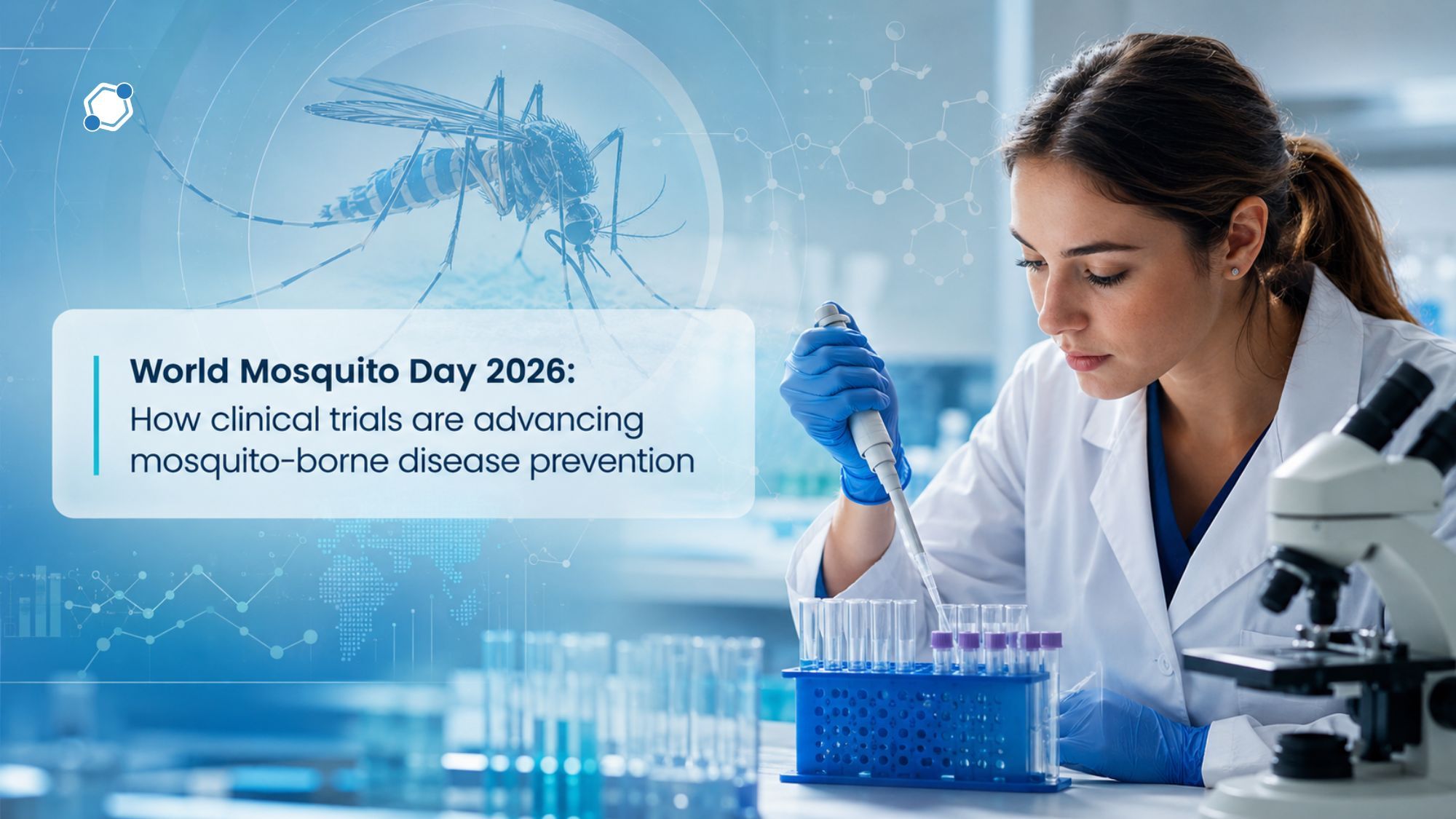
Mosquitoes are often described as the deadliest animal on the planet, and the reason is not the bite itself. It is what mosquitoes can carry. A single insect can transmit parasites and viruses that cause serious, sometimes life-threatening illness in people. World Mosquito Day, observed each year on August 20, is a reminder of that risk and of the scientific work still underway to reduce it. Behind that work sits the clinical trial: the carefully designed study that turns a laboratory idea into a shot, a pill, or a public health measure that can actually help a community.
This article explains what World Mosquito Day marks, why mosquito-borne disease still matters in the United States, and where clinical trial research stands. It also explains, in plain language, how people who join a clinical trial help move prevention forward.
What is World Mosquito Day, and why August 20?
World Mosquito Day commemorates a discovery made on August 20, 1897, when British physician Sir Ronald Ross found malaria parasites inside the stomach of a female mosquito in India. That finding, later recognized with a Nobel Prize, confirmed that mosquitoes transmit malaria to people. It also opened the door to modern mosquito-borne disease research, because knowing how a disease spreads is the first step to preventing it.
The date has been observed since the 1930s, when the Ross Institute began marking it in London. Today, universities, public health agencies, research institutes, and advocacy groups around the world use August 20 to draw attention to the ongoing burden of mosquito-borne disease and to the research working to reduce it. The observance is not owned by any single organization, which is part of why it has grown to include so many different scientific and community voices.
Understanding the day also requires understanding the tool at the center of that research. A clinical trial is a structured study that tests whether a new vaccine, medicine, or prevention method is safe and whether it actually works in people. Every mosquito-borne disease breakthrough of the past century has been shaped by clinical trials. How Clinical Trials Advance Medicine and Change Lives offers a broader view of that history.
Why mosquito-borne diseases still matter in the United States
For many people in the United States, mosquito-borne disease sounds like a problem of far-away places. That view is out of date. West Nile virus, spread by common backyard mosquitoes, is now the leading mosquito-borne illness in the continental United States and appears in outbreaks every summer. Dengue, once considered a travel disease, has caused local outbreaks in Florida, Texas, and Hawaii, and is endemic (regularly present) in several United States territories, including Puerto Rico. In 2023, a small number of people in Florida, Texas, and Maryland caught malaria without ever leaving the country, ending a two-decade streak of no locally acquired cases.
Climate, travel, and changing mosquito populations all play a role. Warmer and wetter conditions expand the areas where certain mosquitoes can survive, and international travel keeps introducing viruses that can find a foothold in local mosquito populations. That combination means the United States is not separate from the global mosquito-borne disease picture. It is part of it, and the research pipeline reflects that.
Public health depends on prevention, and prevention depends on studies that recruit real people. How Clinical Trials Contribute to Public Health explains that connection in more depth.
Malaria research: vaccines, antibodies, and next-generation prevention
Malaria is caused by a parasite spread by Anopheles mosquitoes and is still the largest mosquito-borne disease burden worldwide, with children in sub-Saharan Africa affected most severely. In the United States, malaria is uncommon and mostly linked to travel, but the parasite is a global public health problem that touches American medicine through diagnosis, prevention advice for travelers, and research.
Recent years have brought the first malaria vaccines ever recommended for children in high-burden regions. Both are recombinant protein vaccines, meaning they use a lab-made piece of the parasite to train the immune system. Neither offers complete or long-lasting protection, and research continues on next-generation designs, including messenger RNA (mRNA) vaccines, which deliver genetic instructions that teach cells to make a harmless piece of the parasite so the immune system can learn to fight it.
Another active area is passive immunization, where a person receives lab-made antibodies (proteins that recognize and block the parasite) rather than being asked to produce their own. Long-acting monoclonal antibodies designed to prevent malaria have shown promise in early studies and are being tested as a possible option for travelers, pregnant women, and young children.
Drug research is also active, driven by growing concern about parasites that no longer respond well to older medicines. Newer antimalarial study drugs, including single-dose options, are being tested in a mix of laboratory studies, field studies in endemic areas, and controlled human infection studies (a study design explained further below). People considering any of these studies can start by exploring the Clinical Trial Volunteers Guide: Your First Step Into Clinical Trials for a plain-language walkthrough of what participation involves.
Dengue research: rising cases and the search for broader protection
Dengue is a viral illness spread mainly by Aedes mosquitoes and has four related types, called serotypes. Infection with one serotype offers some protection against that specific type, but a second infection with a different serotype can raise the risk of severe illness. That biology is a big part of why a dengue vaccine has been harder to develop than a vaccine for many other viruses.
Cases have surged across the Americas in recent years, including a public health emergency declared in Puerto Rico in 2024. That surge, combined with sporadic outbreaks in mainland states, has made dengue research a higher priority for United States public health.
Two live-attenuated dengue vaccines (vaccines that use a weakened form of the virus) have been approved in various countries. One requires evidence of prior dengue infection before it can be used, which limits its role. Another, a single-dose live-attenuated candidate developed by a United States government research institute, has shown encouraging results in controlled studies and is moving through additional research. Newer trials are testing dengue vaccines and antibody products in people who have never had dengue and in people who have.
Eligibility for dengue studies often depends on prior exposure, geographic history, and age, which is one reason not every volunteer qualifies for every study. Eligibility Explained: Why Not Everyone Qualifies for a Trial explains how eligibility criteria work and why they exist.
Zika, West Nile, and chikungunya: where the research stands
Zika virus, spread mainly by Aedes mosquitoes, caused a major outbreak across the Americas in 2015 and 2016 and became widely known for its link to serious birth defects when infection occurs during pregnancy. Transmission has since fallen, but the virus has not gone away. Multiple vaccine candidates using different platforms, including mRNA, DNA, and inactivated (killed virus) designs, have passed early safety studies. Progress toward approval has slowed because when case counts drop, it becomes difficult to test whether a vaccine actually prevents disease.
West Nile virus, spread by Culex mosquitoes, is the mosquito-borne disease most likely to affect people in the continental United States. Most infections cause no symptoms, but a small share develop neuroinvasive disease, which is illness affecting the brain and spinal cord. Older adults are at highest risk. No licensed human vaccine exists yet. A next-generation inactivated whole-virus vaccine entered an early-phase United States trial in healthy adults in 2025, and other candidates are in development. The unpredictable, sporadic nature of West Nile transmission is one reason human research on it has moved slowly and why creative study designs are needed.
Chikungunya is a viral illness spread by Aedes mosquitoes and known for causing fever and long-lasting joint pain. The first chikungunya vaccine to reach approval anywhere in the world was authorized in the United States in late 2023, using a live-attenuated design. After approval, ongoing safety monitoring identified serious side effects in some older adults, and use of that vaccine in the United States was restricted and later suspended while the situation is reviewed. A second chikungunya vaccine, built on a different platform, has since been authorized in Europe. This sequence is a real-world illustration of why safety monitoring does not end when a vaccine is approved.
Rare but serious: EEE, Jamestown Canyon, and La Crosse virus research
Beyond the well-known mosquito-borne diseases, several rarer viruses circulate inside the United States and receive far less public attention. Eastern equine encephalitis, called EEE, is uncommon but one of the most severe mosquito-borne diseases in the country, with a high rate of death or lasting neurological effects among those who develop symptoms. Jamestown Canyon virus, most often reported in the upper Midwest and Northeast, has been detected more frequently in recent years. La Crosse virus, spread by tree-hole mosquitoes in parts of the Midwest and Appalachian region, is the most common mosquito-borne illness in United States children.
No licensed human vaccines exist for any of these three viruses. Because cases are rare, testing a vaccine for how well it prevents disease in a large trial is extremely difficult. Early-phase studies in healthy adults, small immunogenicity studies (measuring how well the immune system responds), and combination vaccine research are the main paths forward. That kind of research relies heavily on volunteers who are willing to take part in first-in-human or small-scale studies, which is a common route for rare disease research.
How research participation advances prevention
Every mosquito-borne disease listed above shares one thing: the science that leads to a licensed vaccine, medicine, or prevention tool depends on people volunteering to be part of the studies. Some studies observe participants after natural exposure. Others use a design called a controlled human infection model, where healthy adult volunteers are exposed to a carefully controlled version of the pathogen (the disease-causing organism) in a monitored setting, with immediate access to medical care and study procedures. That design has helped speed up decisions about which candidates are worth advancing.
Participation is bound by strong safeguards. Informed consent, which is the process of making sure a volunteer understands the study before agreeing to join, is required. Independent ethics review boards oversee the design. Independent monitoring groups watch the data during the study. Every participant has the right to withdraw at any time.
Prevention research also reaches beyond individual studies. Community-level research, such as studies of mosquitoes carrying naturally occurring Wolbachia bacteria (which reduces their ability to spread viruses like dengue), has produced strong evidence that some non-drug tools work. Spatial repellents, which release active ingredient into the air rather than being applied to skin, are being studied for how much protection they offer at the household or neighborhood level. Both approaches depend on rigorous field research to move from a good idea into public health use.
Finding a clinical trial and taking the next step
For someone interested in learning whether a mosquito-borne disease study, or any other clinical trial, might be a fit, the process starts with reliable information. ClinicalTrials.gov is a public United States government registry that lists studies, locations, and eligibility criteria. The National Institutes of Health lists studies at its Clinical Center. Speaking with a personal physician before contacting a study team helps put any option in the context of individual health history and current medications.
DecenTrialz supports that first step for people considering participation in a clinical trial. After a person shares some information, an AI-assisted matching process highlights studies that may be a fit, and a registered nurse completes an initial pre-screening review before referral to a research site. Final eligibility, informed consent, the full study walk-through, and enrollment are handled by the research site team, not by DecenTrialz. Anyone curious about how the matching process works can explore decentrialz.com for more detail.
World Mosquito Day is a useful moment to notice how much mosquito-borne disease science has already changed and how much remains open. New vaccines, antibodies, drugs, and vector-control tools are moving through research pipelines right now, and none of that progress happens without volunteers. For anyone thinking about clinical trial participation, decentrialz.com is a straightforward place to start.
Was this article helpful?

Similar Blogs
World Humanitarian Day 2026: Compassion, ethics, and clinical trial participation
On August 19, 2003, a bomb struck the United Nations headquarters in Baghdad. Twenty-two a...
 Paramraj
World Breast Cancer Research Day 2026: research, trials, and the people behind progress
August 18, 2026 marks World Breast Cancer Research Day, an observance built around a speci...
Vamshi Kantoju
What Happens to Clinical Trial Data After a Study Ends
Clinical trials generate a large amount of information. Blood tests, questionnaires, medic...
 Anish Teepireddy
Stay Informed. Stay Connected.
Get updates on verified clinical trials, emerging treatments, and research breakthroughs directly in your inbox. No spam, just science that matters.
