 HIPAA Compliant
 ISO 27001 Certified
World Breast Cancer Research Day 2026: research, trials, and the people behind progress
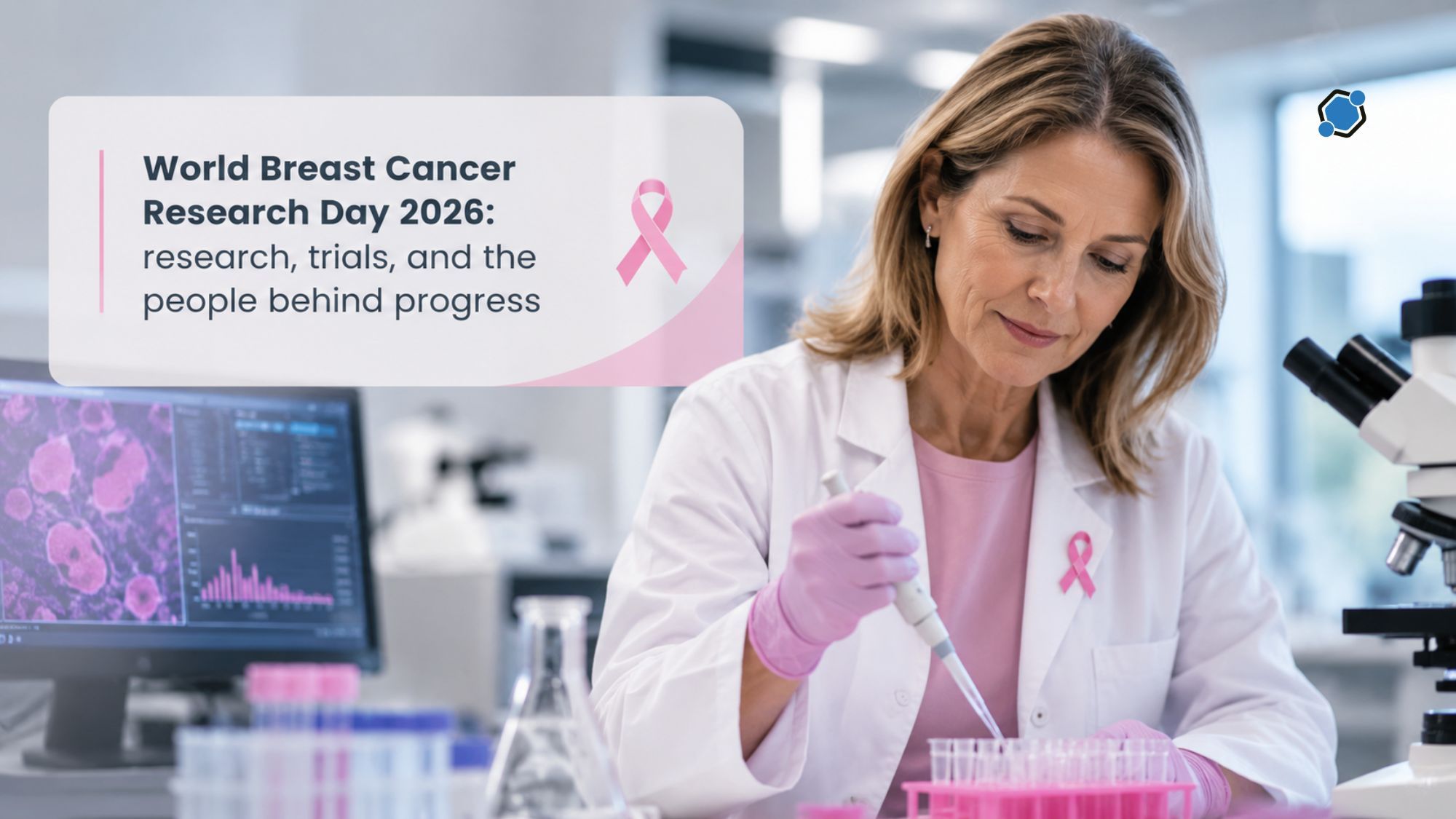
August 18, 2026 marks World Breast Cancer Research Day, an observance built around a specific idea: progress against breast cancer comes from science, and science depends on the people who take part in it. The date sits deliberately outside the pink campaigns of October, keeping attention on research, funding, and clinical trials during a quieter month. For anyone considering a clinical trial, or curious about what participation actually looks like, the day offers a useful lens on how discoveries reach the people who need them. This article explains what the observance is, why breast cancer research matters, what trials involve, and how a person can become part of the work.
What World Breast Cancer Research Day is, and why August 18
World Breast Cancer Research Day was founded in 2021 by the Dr. Susan Love Foundation for Breast Cancer Research, a nonprofit led by Dr. Susan Love, a breast surgeon and author whose work shaped decades of patient advocacy. Following Dr. Love's death in 2023, the Tower Cancer Research Foundation integrated the Love Foundation's work and assets in January 2024 and now stewards the observance.
The date carries meaning. Eight and eighteen echo the widely cited lifetime breast cancer risk figure for women in the United States, and the summer placement is deliberate. October already brings enormous attention to breast cancer through Breast Cancer Awareness Month. World Breast Cancer Research Day was designed to keep the spotlight specifically on science, trials, and research funding at a different point in the calendar, when awareness campaigns are not competing for attention.
The observance is not a substitute for awareness. It is a companion to it, focused on the engine that turns awareness into progress: the research process itself. A parallel case for how research-focused observances work through the year can be found in Why Does National Cancer Research Month Matter in 2026?.
Is World Breast Cancer Research Day the same as Breast Cancer Awareness Month?
No. Breast Cancer Awareness Month runs across October each year and centers general awareness, screening reminders, and support for people affected by the disease. World Breast Cancer Research Day is a single-day observance in August focused specifically on the research pipeline: funding, clinical trials, scientific priorities, and the participants and investigators who move the field forward. The two observances complement each other but serve different purposes.
Research is the reason today looks different from twenty years ago
Breast cancer outcomes in the United States have improved substantially over the past several decades. Deaths from the disease have fallen meaningfully since the 1970s, driven largely by earlier detection through mammography and by the development of better options across a range of subtypes. None of that progress happened by chance. Each option now considered standard of care began as a hypothesis tested in a clinical trial, refined based on what participants experienced.
The current research frontier is broad. Immunotherapy explores ways to help the immune system recognize and act on cancer cells. Targeted therapies are designed to act on specific molecular features of a tumor rather than affecting the body more broadly. Precision medicine, sometimes called personalized medicine, matches study interventions to the biological profile of an individual's cancer. Liquid biopsy, a blood test that looks for fragments of tumor DNA in the bloodstream, is being studied as a less invasive way to detect cancer and monitor changes over time. Artificial intelligence is under active study in mammography, where software supports radiologists in reading images. Disparities research examines why outcomes differ across communities and how to close those gaps.
None of these directions produces guaranteed results for any individual. Some will succeed, some will fail, and some will succeed for specific groups and not others. That uncertainty is what a clinical trial is designed to resolve. A broader view of how technology reshapes participation can be found in DecenTrialz Explained: How to Search, Read, and Apply for Clinical Trials.
What breast cancer clinical trials actually look like
Breast cancer research covers more territory than most people expect. Prevention studies look at whether a study drug, a lifestyle change, or a screening strategy can lower the chance that a person develops breast cancer or that a cancer returns. Screening and diagnostic trials evaluate better ways to find breast cancer earlier or describe it more accurately once found, including new imaging technologies and tissue-sampling methods.
Treatment-focused trials study interventions for people already diagnosed with breast cancer. These move through phases: early studies that focus on safety and dosing, mid-stage studies that examine whether an intervention works and for whom, and larger studies that compare it against current standards. Quality-of-life trials look at ways to manage side effects such as lymphedema, which is swelling that can develop after lymph node changes, or cognitive symptoms sometimes described as "chemo brain." Survivorship studies focus on long-term health after active care ends.
Not every study involves a study drug. Registries pool information from many people over time so scientists can study patterns. Biobanks store donated tissue and blood samples for future research. Observational studies simply watch what happens without changing a person's care. Newer trial designs group people by shared tumor features across multiple cancers, or study several interventions for a single cancer type based on molecular subtype. A closer look at trial design is available in Open-label vs blinded clinical trials: What the difference means for participants.
Do participants always receive an investigational study drug?
No. Many breast cancer studies do not involve any study drug at all. Registries, biobanks, and observational studies collect information or biological samples without changing what a person does day to day. Prevention and screening trials sometimes test devices, imaging methods, or behavioral programs rather than medications. The study protocol, which is the written plan for how a study is conducted, always describes exactly what participation involves before a person decides whether to take part.
Who can take part, and what participation involves
Breast cancer trials are not only for people who have exhausted other options. Studies exist for people newly diagnosed, for people currently in care, for survivors many years past active care, for individuals at higher risk based on family history or genetic factors, and sometimes for healthy volunteers who contribute to prevention or screening research. Family members may also be invited into genetic and tumor biology studies.
Eligibility criteria vary by study and are established for scientific and safety reasons. A trial that studies a specific subtype will only include people with that subtype. Determining whether a specific person meets a study's eligibility criteria is the job of the research site team, not of any matching platform. That determination happens through a structured screening process at the site.
Informed consent is the process by which the research team explains the study before a person agrees to take part. It covers the study's purpose, the procedures involved, known and possible risks, potential benefits, alternatives, and the participant's rights. Informed consent is a conversation, not just a signature. A participant can ask questions at any point and can decide to leave a study at any time, for any reason. Federal ethical and regulatory rules require ongoing safety monitoring by an institutional review board, the study team, and, in many trials, an independent data safety monitoring board. A detailed walkthrough of the paperwork itself is available in How to Read Your Informed Consent Form Before Joining a Clinical Trial.
What questions should someone ask before agreeing to take part?
Useful questions include: What is the purpose of this study? What procedures are involved, and how often? What are the known risks and possible benefits? What options exist outside this study? Who pays for what? What happens if a participant chooses to leave? How will personal health information be protected? The research site team is expected to answer these questions clearly, and taking time to consider the answers is part of the informed consent process, not a delay of it.
Why representation in breast cancer research matters for everyone
For a long time, the assumption in clinical research was that participation rates differed sharply across racial, ethnic, and demographic groups. Peer-reviewed evidence has since challenged that assumption. Studies show that when people are actually offered a trial, they choose to take part at broadly similar rates across groups. The persistent underrepresentation of certain communities is a story about a system that too rarely offers trials or makes them logistically hard to reach, not a story about patient disinterest.
That framing matters because it points to solvable problems: better matching, clearer communication, and screening processes that meet people where they are. Representation is not a symbolic concern. When a study's participants do not reflect the range of people who will eventually rely on the results, the science becomes less useful for everyone. Breast cancer illustrates this clearly. Men develop breast cancer too, though far less often, and have historically been excluded from studies, leaving evidence gaps in their care. People with metastatic breast cancer, which is cancer that has spread beyond the breast, benefit from trials that reflect the realities of advanced disease. Rarer subtypes such as triple-negative, inflammatory, and HER2-low breast cancer each need dedicated study, and the participants who help build that evidence base contribute to something that will outlast their own experience. A related perspective on how representation shapes what research can prove is available in National Minority Donor Awareness Month: why diverse donors and research participants matter.
Ways to support breast cancer research beyond joining a trial
Not everyone is in a position to join a clinical trial, and not everyone who wants to participate will be eligible for a study open in their area. That does not close the door on contribution. Research registries collect health information over time and help scientists study patterns that no single trial could capture. Biobanks accept tissue and blood samples that support future studies not yet designed. Patient advisory roles bring lived experience into study design, consent materials, and research priorities. Community education, advocacy, and support for research funding all shape the environment in which trials can succeed. These contributions are essential parts of the research ecosystem, recognized as such by the researchers who depend on them.
How DecenTrialz helps people find the right study
DecenTrialz is a clinical trial recruitment and pre-screening platform based in the United States. It uses AI-assisted matching to compare a person's information against studies that may be a fit, and registered nurse-led pre-screening to walk through key questions and help people understand what a potentially matched study involves. The goal is to reduce the friction that keeps people from ever seeing a trial they might want to consider.
Final eligibility determination, informed consent, study walk-through, and enrollment always rest with the research site team, never with DecenTrialz.
For anyone thinking about breast cancer research as a possibility, or simply wanting to see what studies exist, exploring a matching platform is a straightforward first step. On World Breast Cancer Research Day, the invitation is the same one the observance was built around: research moves forward because people choose to be part of it. To see what breast cancer studies may be a fit, start with DecenTrialz.
Was this article helpful?

Similar Blogs

ADHD Awareness Month 2026: adult diagnosis, the gap in women, and research shaping better care
Millions of adults in the United States are being recognized with Attention-Deficit/Hypera...
 Swaroop ESD
Breast Cancer Awareness Month 2026: Signs, Types, and Why Research Still Matters
Before the ribbon was pink, it was peach. In the early 1990s, a grandmother in California ...
Paramraj
HER2 positive and HER2 negative breast cancer explained: testing, treatment, and what HER2 low means
A breast cancer pathology report contains a great deal of information, and HER2 status is ...
Swaroop ESDStay Informed. Stay Connected.
Get updates on verified clinical trials, emerging treatments, and research breakthroughs directly in your inbox. No spam, just science that matters.
