 HIPAA Compliant
 ISO 27001 Certified
Americans with Disabilities Act: Access, Accommodations, and Clinical Research
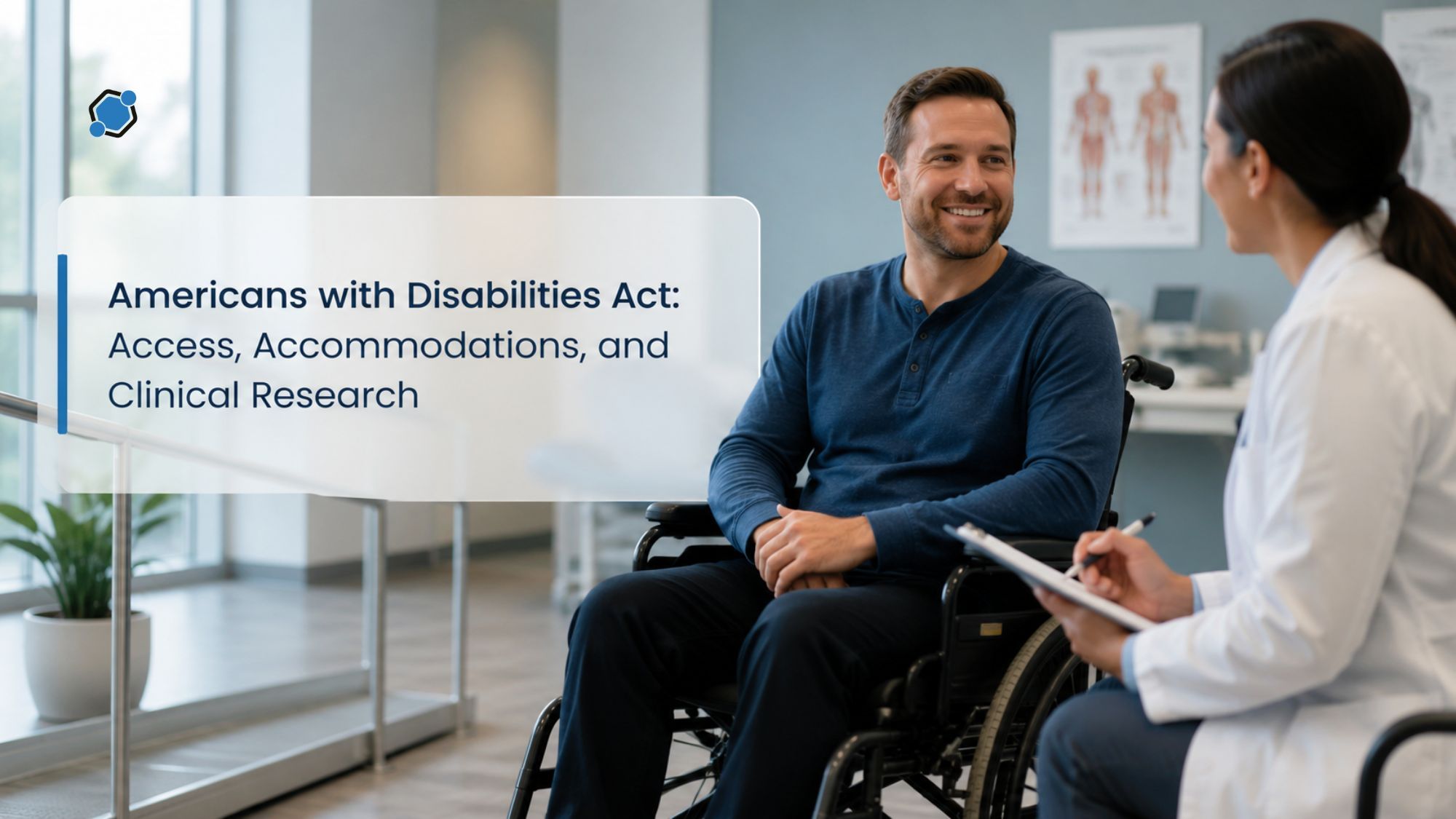
The Americans with Disabilities Act was signed into law on July 26, 1990. This year marks its 36th anniversary. The law is a civil rights statute. It protects people with disabilities from discrimination and requires that public spaces, employers, transportation, telecommunications, and services be accessible.
Most public discussion of the law focuses on physical spaces such as ramps, curb cuts, and elevators. The law reaches further. It shapes how doctors' offices treat patients. It shapes how hospitals deliver care. And it shapes, though less visibly, who is included in the clinical research studies that determine how medicine is practiced.
This article explains what the Americans with Disabilities Act protects, how it applies to healthcare access, why disability inclusion in clinical research matters, and what accommodations can support participation in a study.
What the Americans with Disabilities Act protects
The Americans with Disabilities Act, often shortened to the ADA, was signed by President George H.W. Bush. It was modeled on the Civil Rights Act of 1964. Its central purpose is equal opportunity and full participation in American life for people with disabilities.
Under the law, a person has a disability if that person has a physical or mental impairment that substantially limits one or more major life activities, has a record of such an impairment, or is treated by others as having such an impairment. This definition was broadened by the ADA Amendments Act of 2008, which directed that the term "disability" be interpreted broadly.
The law is organized into five main sections known as titles. Title I covers employment. Title II covers state and local government programs. Title III covers businesses open to the public, a category that includes doctors' offices and hospitals. Title IV covers telecommunications. Title V contains general provisions, including protection from retaliation for people who assert their rights under the law.
A related concept is the reasonable accommodation. A reasonable accommodation is a change or adjustment to a job, a service, or an environment that allows a person with a disability to participate on an equal basis. Examples include a sign language interpreter at a medical appointment, a written document in large print, or extra time to complete a task. Whether a person can actually access a clinical trial or a routine medical service often depends on whether accommodations like these are in place.
How the ADA shapes access to medical care
Doctors' offices, hospitals, clinics, and other healthcare settings are covered by the Americans with Disabilities Act. Section 504 of the Rehabilitation Act and Section 1557 of the Affordable Care Act add further protections for federally funded providers and health programs. Together, these laws require full and equal access to medical care.
Physical access is one part. A patient who uses a wheelchair should be able to reach an examination table that lowers to a safe transfer height. A patient with limited mobility should be able to use a weight scale that accommodates a wheelchair. A patient having a mammogram or an X-ray should be able to complete the exam without being required to stand.
Federal rules issued in 2024 adopted enforceable standards for accessible medical diagnostic equipment. These rules set specific compliance deadlines in 2026 for many federally funded and state or local government healthcare providers. General practices must make a share of each equipment type accessible. Facilities that specialize in conditions affecting mobility must make a larger share accessible.
Communication access is another part. Healthcare providers are required to furnish auxiliary aids and services when needed to communicate effectively with patients who have disabilities. Examples include a qualified sign language interpreter, real-time captioning, Braille, large-print documents, and accessible electronic records. The cost of these aids cannot be charged to the patient.
Digital access is a newer part. A federal rule issued in 2024 applies web and mobile accessibility standards to state and local government services and, through a related rule, to federally funded healthcare providers. Compliance deadlines are staged into 2027 and 2028 following an extension in 2026. These rules mean that appointment portals, patient education, and study information posted online should be readable and usable with assistive technology such as screen readers. Digital pathways in clinical trial enrollment also benefit from these accessibility requirements, because online portals and virtual visits reach a wider group of patients when they are designed to be accessible from the start.
Why disability inclusion in clinical research matters
A clinical trial is a research study that tests whether a new intervention, such as an investigational product, a procedure, or a change in care, is safe and works as expected in people. The people who join a clinical trial are called participants. What is learned from a trial shapes the care that later becomes available to everyone.
People with disabilities have historically been left out of clinical research. Reviews of study protocols have found that participation is frequently restricted based on psychiatric conditions, cognitive or intellectual disabilities, sensory disabilities, mobility disabilities, and other categories, often without a scientific reason tied to the study question. In many trials, protocols give investigators broad discretion to exclude people, and the reasons are not always documented.
This exclusion has real consequences. When a large share of the American population is missing from the evidence base, the findings of a study may not fully apply to that group. Dosing, side effects, and outcomes can differ. An investigational product that is later approved may not have been tested in the people most likely to use it.
Recent federal action has begun to shift the picture. In 2023, the National Institutes of Health, the primary federal research agency in the United States, formally designated people with disabilities as a health disparity population. This designation recognizes that people with disabilities experience worse health outcomes than the general population and directs research resources toward understanding and addressing that gap. In 2024, the Department of Health and Human Services issued a strengthened Section 504 rule that addresses medical care and, through the agency's official interpretation, extends to unjustified exclusion from clinical research programs run by federally funded providers.
Not every policy is settled. Federal guidance on diversity in clinical trials has faced political changes in recent years, and its long-term status remains uncertain as of 2026. The direction of the underlying laws, however, is clear. Eligibility criteria in clinical trials must have a scientific basis, and blanket exclusion of people with disabilities is increasingly viewed as neither scientifically justified nor legally acceptable.
Accommodations that support participation in a clinical trial
A person with a disability who is interested in a clinical trial has the same right to a reasonable accommodation as a person seeking any other medical service. Practical examples include:
- A qualified sign language interpreter or real-time captioning during study visits.
- Study materials, including the informed consent form, in Braille, large print, or an accessible electronic format.
- Extra time to review information, ask questions, and make a decision about joining.
- Support from a trusted person during the consent conversation, sometimes referred to as supported decision-making.
- Accessible transportation to and from the study site, or the option of a remote or virtual visit when the protocol allows.
- Accessible examination equipment at the study site, including tables, scales, and imaging equipment.
A well-designed study also considers accessibility at the protocol level. This includes clear justification for any eligibility criterion that would exclude people with disabilities, accessible recruitment materials, and staff training on interacting respectfully with participants who have disabilities. Reading the informed consent form carefully, and asking the study team about available accommodations before signing, is a reasonable step for any participant with a disability.
How DecenTrialz supports accessible trial matching and pre-screening
DecenTrialz is a clinical trial participant recruitment platform based in the United States. The platform uses AI-assisted participant matching and registered-nurse-led pre-screening to connect people who may be interested in a study with the research teams running that study.
For a person with a disability, this means the first steps in the process, finding relevant studies and having an initial conversation about interest and general fit, can happen through a platform designed for clarity and ease of use. AI-assisted matching reduces the burden of searching through large databases. The pre-screening conversation is conducted by a registered nurse, which allows questions to be answered in plain language and any accommodation needs to be identified early.
Final eligibility determination, informed consent, the study walk-through, and formal enrollment always belong to the research site team. DecenTrialz does not make medical decisions and does not enroll participants. What the platform can do is lower the initial barriers so that a wider range of people, including people with disabilities, reach the research site with clear information and an accurate sense of what a study involves.
Learn more at decentrialz.com.
Learning more about clinical trial participation
The 36th anniversary of the Americans with Disabilities Act is a useful moment to consider how far the law reaches. It reaches the entrance to a building, the design of an examination room, the format of a document, and the eligibility page of a clinical trial. When each of these is accessible, the promise of the law comes closer to being met in practice.
For readers who want to explore clinical trial participation further, DecenTrialz provides plain-language information and a way to search for studies that may be a fit.
Was this article helpful?

Similar Blogs
International Week of Deaf People 2026: how can clinical research become accessible to Deaf participants?
More than seventy million people around the world belong to signing Deaf communities, and ...
 Deeksha Gitta
Visceral Fat Health Risks: What Makes Belly Fat Different From Other Body Fat?
Body fat is usually discussed as a single quantity, weighed on a scale and summarized in o...
 Anish Teepireddy
Blood Pressure Numbers: What Do Systolic and Diastolic Actually Mean?
A blood pressure result contains two numbers, and most people are never told what either o...
ParamrajStay Informed. Stay Connected.
Get updates on verified clinical trials, emerging treatments, and research breakthroughs directly in your inbox. No spam, just science that matters.
