 HIPAA Compliant
 ISO 27001 Certified
International Week of Deaf People 2026: how can clinical research become accessible to Deaf participants?
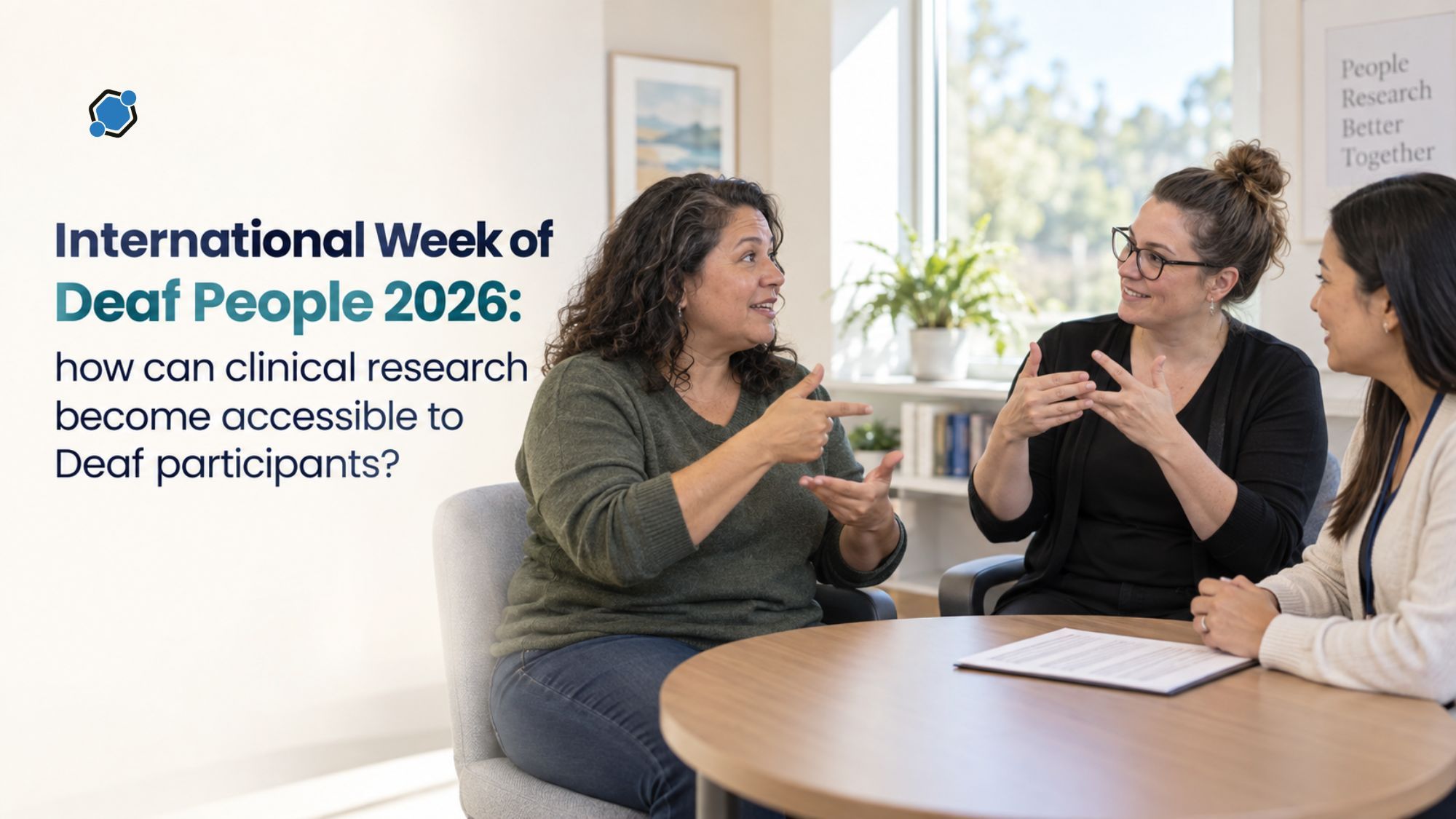
More than seventy million people around the world belong to signing Deaf communities, and hundreds of distinct sign languages have developed alongside them. These communities carry rich cultural histories, distinct languages, and shared experiences that shape how members interact with education, work, and healthcare. Yet when it comes to medical research, the Deaf community remains one of the most underrepresented and understudied populations in the United States and globally.
International Week of Deaf People shines a spotlight on that reality every September. The observance is a global reminder that access to information, healthcare, and research participation is a human right, and that systems built around hearing populations often leave Deaf people out by default.
What International Week of Deaf People is and when it takes place
International Week of Deaf People is coordinated each year by the World Federation of the Deaf, a global body that represents national Deaf-led associations. The observance falls in the last full week of September and culminates in the International Day of the Deaf on the final Sunday of the week. Within that same week, September 23 is recognized by the United Nations as the International Day of Sign Languages, a date chosen because it marks the founding of the World Federation of the Deaf in 1951.
In 2026, International Week of Deaf People runs from September 21 through September 27, and the theme is "Declaring Deaf People's Human Rights." The theme is anchored to the twentieth anniversary of the United Nations Convention on the Rights of Persons with Disabilities. National associations mark the week with cultural events, education campaigns, sign language visibility initiatives, and policy advocacy. Health equity is a growing part of that agenda, and research participation belongs squarely inside it, echoing the goals highlighted during representation in medical research observances that mark similar themes throughout the year.
Why the Deaf community faces unique healthcare access barriers
Deaf identity varies from person to person. Some people identify as culturally Deaf, using a signed language as a primary means of communication and belonging to a linguistic community. Others are hard-of-hearing, late-deafened, or identify with the broader disability community. What connects these experiences in healthcare is a set of communication barriers that hearing systems tend to overlook.
Written English is often a second language for people who use American Sign Language, the visual language used by many Deaf people in the United States. Health information written at a college reading level may be inaccessible even when it is technically available. Phone-based appointment lines, verbal-only instructions, and rushed clinic visits without a qualified interpreter compound the problem. Research has documented lower rates of preventive care, higher use of emergency services for routine issues, and gaps in understanding of prescribed medications among Deaf sign language users.
The legal framework already exists. Under the Americans with Disabilities Act, Section 504 of the Rehabilitation Act, and Section 1557 of the Affordable Care Act, covered healthcare providers must provide qualified interpreters and other auxiliary aids free of charge whenever communication is complex enough to require them. Enforcement is imperfect, and the practical experience of many Deaf patients still involves scrambling for accommodations that should be standard. A deeper look at how disability rights apply in research settings shows that many of the same duties reach trial sponsors and research sites.
The gap in Deaf inclusion in clinical trials
Clinical trials are studies that test whether a study intervention, which may be a medication, a device, a behavioral program, or a diagnostic tool, is safe and works as intended. Enrolling a broad range of participants matters because a study intervention may affect people differently based on age, sex, ancestry, coexisting conditions, and life circumstances. When entire communities are missing from research, the findings apply less well to those communities once the study intervention reaches the public.
Deaf people have historically been left out for structural reasons rather than clinical ones. Recruitment materials are seldom translated into sign language. Consent forms are written in dense medical English. Study visits are scheduled through phone lines that do not accept video relay calls. Investigators may exclude Deaf participants outright rather than budget for interpreters. Peer-reviewed research has found that the majority of principal investigators and research coordinators surveyed had never enrolled a Deaf sign language user in a clinical trial.
Regulatory conversations about representative enrollment have accelerated in recent years, though the policy landscape remains unsettled. Sponsors and research organizations have been debating how to plan for and measure inclusion of underrepresented populations, and Deaf inclusion is one important thread inside the broader debate about diverse trial enrollment requirements. The scientific case is clear even where the regulatory case is contested: representative enrollment produces evidence that serves the whole population.
What accessible clinical research looks like in practice
Making a clinical trial accessible to Deaf participants is not a mystery. It requires planning, budget, and community relationships from the start rather than as an afterthought.
Practical steps include recruiting through Deaf-community channels such as sign language video content, Deaf-led organizations, and captioned social media rather than phone-only outreach. Consent materials can be delivered in American Sign Language, ideally featuring Deaf presenters, and paired with plain-language written materials at appropriate reading levels. Sites can budget for qualified sign language interpreters, including Certified Deaf Interpreters where nuance is required, and use video remote interpreting as a supplement rather than a substitute for in-person interpretation of complex discussions.
Informed consent is a particularly important area to get right, because some standard trial terms such as randomization, placebo, and blinding may not have well-established sign equivalents and require careful conceptual translation. Comprehension checks, repeated conversations, and time to ask questions all support genuine understanding. For anyone reviewing the paperwork of a study they may join, what to look for on a consent form applies just as much to Deaf participants as to hearing ones, provided the document itself is accessible.
Cultural humility training for study staff, and the presence of Deaf people on the research team, are repeatedly cited as the strongest drivers of trust and participation. A Deaf community advisor who helps design materials is more valuable than a translation added at the last minute.
Where DecenTrialz fits in expanding access to clinical research
Awareness of a clinical trial is often the first missing piece for underrepresented communities. DecenTrialz is a clinical trial recruitment and pre-screening platform that uses AI-assisted matching and registered nurse-led pre-screening to help people learn about studies they may qualify for. The platform pre-screens only. The research site team owns final eligibility determination, informed consent, study walk-through, and enrollment.
For communities that have historically been left out of research, being able to discover relevant studies in the first place is a meaningful step. That is where a matching platform can support the broader work of advocacy groups, community organizations, and research sites, much like the community-led guidance that connects patients to trials. Deaf inclusion in research still depends on the sponsor, the site, and the study team building accessible processes, and broader discovery helps ensure interested Deaf participants can be seen in the first place. People who want to learn more can visit DecenTrialz to explore studies that may be a fit.
Frequently asked questions
When is International Week of Deaf People in 2026?
International Week of Deaf People 2026 runs from September 21 through September 27. The International Day of Sign Languages falls on September 23, and the International Day of the Deaf falls on the final Sunday of the week.
Is Deaf inclusion in clinical trials required by law in the United States?
Federal civil rights laws, including the Americans with Disabilities Act, Section 504 of the Rehabilitation Act, and Section 1557 of the Affordable Care Act, require covered entities to provide effective communication and reasonable accommodations. How these duties apply in a specific trial depends on the sponsor, the site, the funding source, and the specifics of the protocol.
What accommodations should Deaf participants ask about before joining a trial?
Common accommodations include qualified sign language interpreters for study visits, materials in sign language and plain-language written English, captioning of study videos, and flexible communication methods for scheduling and follow-up. The study team is the best source of information on what a specific study can provide.
Why is representation of Deaf people in research important?
Research findings apply best to the populations included in a study. When Deaf people are absent from trials, health information, safety data, and study interventions may not reflect their experiences, environments, and communication needs.
Building a research system that reflects every community
International Week of Deaf People is more than a week on the calendar. It is a reminder that research systems designed around only part of the population produce evidence that fits only part of the population. Deaf inclusion is achievable with planning, budget, and genuine community partnership. Anyone interested in learning about clinical studies, including members of the Deaf community and those who support them, can explore what is available through DecenTrialz.
Was this article helpful?

Similar Blogs

Visceral Fat Health Risks: What Makes Belly Fat Different From Other Body Fat?
Body fat is usually discussed as a single quantity, weighed on a scale and summarized in o...
 Anish Teepireddy
Blood Pressure Numbers: What Do Systolic and Diastolic Actually Mean?
A blood pressure result contains two numbers, and most people are never told what either o...
 Paramraj
National HIV/AIDS and Aging Awareness Day 2026: What Aging With HIV Looks Like Today
The population of people living with HIV in the United States has aged in a way few would ...
Mahesh UpadristaStay Informed. Stay Connected.
Get updates on verified clinical trials, emerging treatments, and research breakthroughs directly in your inbox. No spam, just science that matters.
