 HIPAA Compliant
 ISO 27001 Certified
Centralized statistical monitoring in clinical trials: what CROs need to build
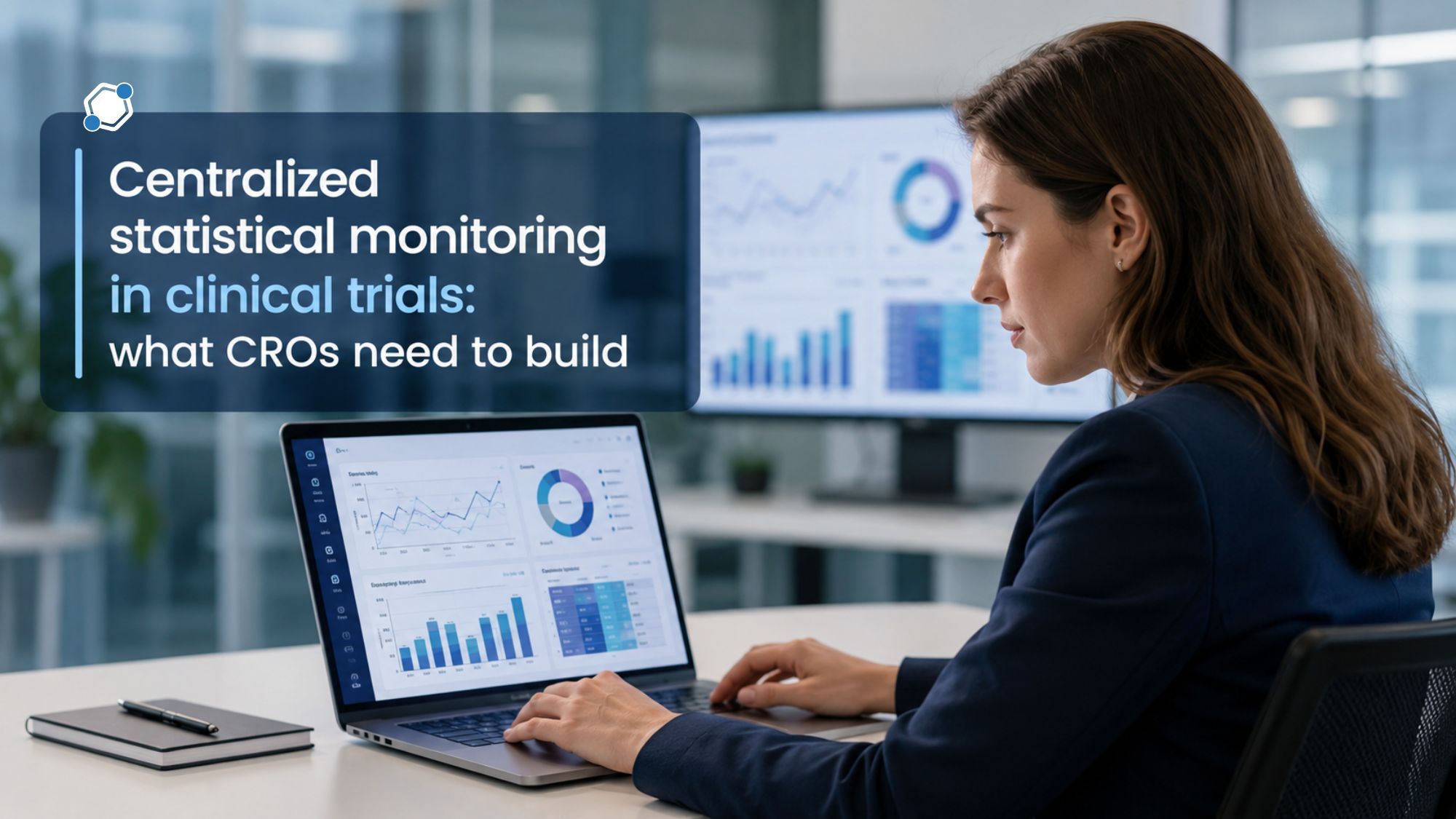
Every clinical trial produces a running stream of data long before database lock. Case report form entries, laboratory values, adverse event reports, visit timings, and query resolutions pile up week by week across dozens or hundreds of sites. Inside that stream, most sites are performing normally, a smaller number are drifting off pattern, and occasionally one is doing something that will not become visible until an audit or an inspection. Centralized statistical monitoring is the discipline of finding the drift and the misconduct early, using the data the trial is already generating.
For CROs, the shift is now regulatory as well as operational. ICH E6(R3), finalized in early 2025, gives centralized monitoring its own dedicated recognition alongside investigator site monitoring. It is no longer a nice-to-have layer above source data verification. It is one of the two core oversight approaches, and the U.S. Food and Drug Administration and the European Medicines Agency both expect sponsors and their CROs to explain how it is being applied. Building the capability well takes more than a dashboard.
What centralized statistical monitoring actually is
Centralized statistical monitoring, often shortened to CSM, is the ongoing remote analysis of accumulating trial data pooled across all sites, looking for patients, sites, or patterns that are statistically inconsistent with the rest of the trial. A clinical research associate visiting a site checks one participant's records against source documents. CSM asks a different question. Does this site's data, considered as a whole, look like everyone else's?
It sits inside a broader framework called risk-based quality management, usually shortened to RBQM, which is the quality-by-design system the industry has moved toward since ICH E6(R2). Inside RBQM, centralized monitoring is one of several risk-based monitoring, or RBM, techniques, and CSM is the statistical engine that powers it. As a foundational reference point, from design to discovery: how CROs power every trial phase sets out the broader operational role CROs play across the study lifecycle that RBQM sits inside.
Two categories of indicator do most of the work in practice. Key risk indicators, or KRIs, are pre-defined metrics computed per site and compared across sites, such as screen failure rate, time to query resolution, or missed visit rate. Quality tolerance limits, or QTLs, are a small number of study-level thresholds tied to parameters critical to participant safety or result reliability, and a breach must trigger evaluation and, if material, a summary in the final clinical study report.
The signals CSM is designed to catch
Peer-reviewed analysis has repeatedly found that traditional on-site source data verification changes only a small fraction of the entries in an electronic case report form. Most of what matters at the level of data integrity is invisible to line-by-line verification because it does not live in any single record. It lives in patterns across records.
CSM looks for those patterns in two complementary layers. The first is pre-specified indicators, meaning the KRIs and QTLs a study team decides in advance to watch. The second is unsupervised statistical monitoring, meaning algorithms that compare each site against every other site across many variables at once and produce a per-site data inconsistency score. That second layer catches issues the study team was not specifically looking for.
The classes of signal that surface most often include digit preference, meaning terminal digits of measurements that recur too regularly and suggest rounding or fabrication; inlier and duplicate detection, meaning values that cluster too tightly around the mean because real biological variability is missing; protocol deviation clustering at a single site, which usually points to training gaps or ambiguous protocol wording; safety reporting anomalies such as implausibly low adverse event rates or delayed serious adverse event reporting; enrollment velocity irregularities that suggest back-filled records; and unblinding risks flagged by the FDA's 2023 questions-and-answers guidance. In an adjacent governance layer, what is a data safety monitoring board (DSMB)? explains the independent body that acts on the safety signals CSM often surfaces.
The critical distinction is between a signal and a finding. A signal is an early statistical anomaly worth investigating. A finding is a confirmed issue that requires action or reporting. Most signals do not turn into findings, and that is not a failure of the method. That is the method working.
From signal to CAPA: the escalation pathway CROs need
A CSM program is only as good as what happens after a signal fires. The pathway most inspection-ready CROs build has four steps.
First, triage. The signal is routed to the responsible central monitor, who reviews it in context. Small sites produce more variance. Sicker populations produce more adverse events. A signal fired by a site with fifteen participants is not the same as a signal fired by a site with two hundred, and the central monitor is the person who tells the difference.
Second, investigation. The monitor drills into the source of the signal, looks at related indicators, and decides whether it warrants formal escalation. Safety signals move immediately to medical monitoring. Data integrity signals move to data management and, if warranted, to quality assurance.
Third, root cause analysis. Determining why a signal fired is the step most easily skipped and most consequential to skip. A missed visit signal caused by a coordinator shortage is a different problem from one caused by protocol misunderstanding, and the wrong fix will not hold. Root cause analysis that treats symptoms rather than causes shows up later as a rising repeat-finding rate across the portfolio, which is itself a program-level warning light.
Fourth, corrective and preventive action, usually shortened to CAPA. Each action gets a named owner, a realistic due date, and an effectiveness check to confirm the fix worked. A well-designed dashboard makes the whole pathway visible to sponsors in near real time, and 7 features every CRO wants in a cross-site recruitment dashboard covers the surrounding operational visibility layer.
What ICH E6(R3) changes for CRO monitoring operations
E6(R3) reorganizes good clinical practice around a set of overarching principles, an Annex 1 for traditional interventional trials, and an Annex 2 for non-traditional designs including decentralized studies. Several changes have direct operational consequences for CROs running centralized monitoring.
Centralized monitoring is now formally recognized as a legitimate core oversight approach, not a supplement to on-site monitoring. Source data verification is no longer the default expectation. Quality-by-design and critical-to-quality factors are elevated to the front of study planning, and sponsors are expected to identify those factors prospectively, link them to specific risks, and control the risks with proportionate monitoring, KRIs, and QTLs. A dedicated data governance section requires defined data flows, standardized formats, cross-system traceability, and quality control proportionate to each data point's impact on trial conclusions.
The proportionality principle also matters. A small biotech running one small study is not expected to build the same infrastructure as a large sponsor running dozens of global trials, and CROs supporting smaller studies can defensibly document a lighter, well-controlled process. What R3 does insist on is that sponsor oversight of delegated CRO monitoring be genuine, documented, and inspection-ready, not a contractual formality. For a paired view from the site side, ICH E6(R3): a plain-English readiness guide for research sites covers the readiness questions that sit alongside the CRO-side monitoring updates.
The practical CRO work involves rewriting monitoring, data management, and quality standard operating procedures around critical-to-quality factors rather than forms completion; documenting the risk-proportionate mix of on-site, remote, and centralized methods in every monitoring plan; and maintaining a time-stamped audit trail of every signal, threshold, decision, and CAPA.
Where CSM programs stall in practice
The failure modes are consistent across the industry.
Alert fatigue is the most common. When thresholds are set too sensitively, especially early in a trial when data is thin, central monitors are flooded with signals that turn out to be noise, and real signals get missed inside the volume. Thresholds need to be tuned conservatively at first, with justified false-alarm rates, and adjusted as the trial matures.
Confinement to electronic data capture, or EDC, data is the second. A CSM program that only looks at what sits inside the EDC misses the growing volume of laboratory, interactive response technology, electronic clinical outcome assessment, and wearable data streams that carry equally important signals. Integrating those streams into a single analytical layer is where many programs slow down.
Integration friction with legacy systems is closely related. Risk registers often live inside a quality management platform while KRIs live inside the clinical operations stack, and reconciling them across teams becomes a manual burden that erodes the case for the program. Data harmonization is the underlying discipline at every layer of a trial, and cross-site enrollment demographics: how CROs harmonize, aggregate, and report covers a parallel example of the aggregation challenge at the recruitment layer.
Organizational placement is the quietest failure mode. When the RBQM function sits too low in the organization to influence study decisions, risk assessment degrades into a check-box exercise, thresholds are set to whatever will not embarrass anyone, and the value proposition disappears. Success requires biostatistics, data management, clinical operations, and medical monitoring to work as a real cross-functional group with authority.
How DecenTrialz supports the upstream data quality CSM programs rely on
The cleanest CSM program in the industry cannot compensate for messy upstream data. Screen failure rates, enrollment velocity, referral quality, and pre-screening completion patterns are all inputs to key risk indicators, and the quality of those inputs is set long before a central monitor opens a dashboard.
DecenTrialz provides AI-assisted participant matching and registered nurse-led pre-screening. The research site team owns eligibility determination, informed consent, study walk-through, and enrollment decisions.
That scope boundary matters for CRO oversight. Because referrals reaching a site have already been reviewed by a registered nurse against protocol criteria, the noise that later appears as screen failure clustering and enrollment velocity signals inside a CSM program is reduced at the source. For CROs building or maturing a centralized statistical monitoring capability, cleaner and better-matched referrals produce a more interpretable data stream at every site, which makes the difference between a signal that reflects a real integrity issue and a signal that reflects population noise easier to see. Learn how DecenTrialz fits into CRO workflows at decentrialz.com.
Building a CSM operating model that holds up under inspection
The CROs that will do well under E6(R3) are the ones that have already rewritten their SOPs around critical-to-quality factors, staffed real central monitoring roles inside biometrics and clinical data science, integrated data streams beyond EDC, and built a signal-to-CAPA workflow with named owners and effectiveness checks. The ones that will struggle are the ones treating centralized monitoring as a dashboard rather than an operating model.
To see how AI-assisted matching and registered nurse-led pre-screening can strengthen the upstream data quality a central monitoring program depends on, visit decentrialz.com and get in touch.
Was this article helpful?

Similar Blogs
Clinical Trial Patient Matching: Why Do Sponsors Need More Than a Public Registry Listing?
Every applicable clinical trial conducted in the United States must be registered in the f...
 Swaroop ESD
DecenTrialz vs traditional recruitment platforms: how does full-service matching differ from self-service trial search?
Comparisons between DecenTrialz and traditional recruitment platforms usually come down to...
Vamshi Kantoju
RN-led pre-screening in clinical trials: what does nurse review add that AI matching cannot?
Artificial intelligence has changed how quickly clinical trial candidates can be identifie...
Deeksha GittaStay Informed. Stay Connected.
Get updates on verified clinical trials, emerging treatments, and research breakthroughs directly in your inbox. No spam, just science that matters.
