 HIPAA Compliant
 ISO 27001 Certified

What makes community-based recruitment work for research sites
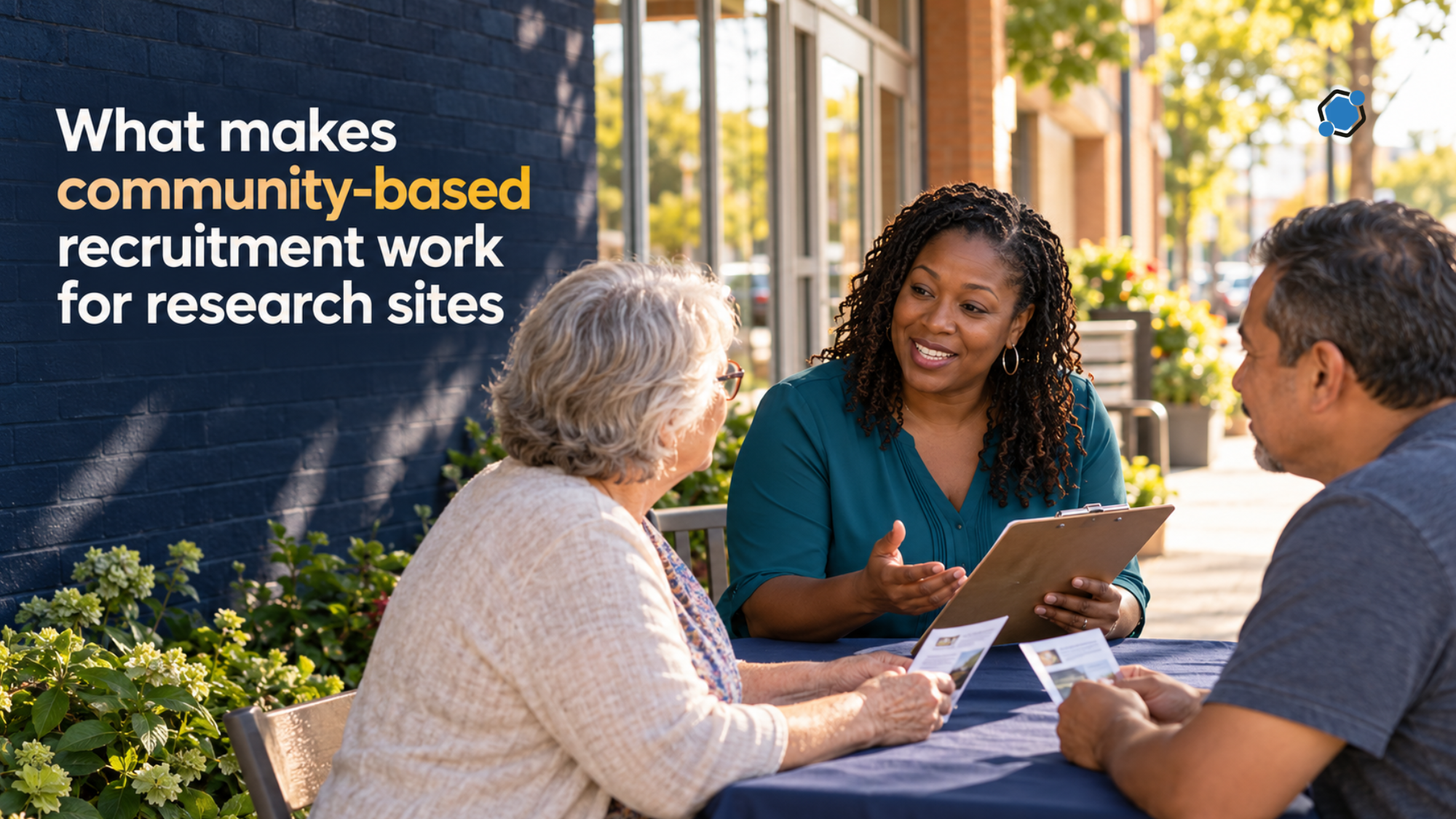
Clinical trial recruitment has moved beyond the walls of the research site. Many of the people a study needs never appear in a site's own patient records, and some have little reason to trust an institution they have never visited. Community-based recruitment addresses this gap by working with trusted local organizations, such as faith communities, community health centers, barbershops, and senior centers, to share accurate study information where people already gather.
This article explains how community-based recruitment works, why it matters to research sites, which rules apply, and how sites can build local partnerships that produce qualified referrals rather than one-time attention.
What is community-based recruitment in clinical trials?
Community-based recruitment is the practice of reaching potential clinical trial participants through organizations that already hold a community's trust. Instead of relying only on electronic medical record (EMR) searches, referrals from affiliated physicians, and paid advertising, the site works alongside local partners who help share approved study information with people the site would not otherwise reach.
The approach draws on community-based participatory research (CBPR), a model in which community members help shape research as partners rather than serving only as research subjects. Research sites commonly work with:
- Faith-based organizations and places of worship
- Community health centers, including Federally Qualified Health Centers (FQHCs), which are federally funded clinics that serve patients regardless of their ability to pay
- Community health workers and promotoras, who are trusted local health educators and are often bilingual
- Barbershops, beauty salons, and other neighborhood businesses
- Local chapters of patient advocacy organizations
- Senior centers, libraries, food banks, and cultural associations
Patient advocacy organizations are a particularly strong fit, because many already run community outreach that turns awareness into matched participants. Community-based recruitment adds to a site's existing recruitment channels. It does not replace them.
Why does community-based recruitment matter for research sites?
Enrollment shortfalls remain one of the most persistent problems in clinical research. Industry analyses have consistently found that a meaningful share of activated sites enroll fewer participants than planned, and some enroll none at all. When recruitment depends only on the site's own patient base, the pool of potential participants is limited to the people who already walk through the door.
Representation is the second driver. Federal reporting on new drug approvals continues to show that older adults, racial and ethnic minority groups, and people living in rural areas are often underrepresented compared with the populations affected by the conditions being studied. Part of this gap is structural. Trials tend to concentrate at large urban centers, and historical research abuses have left lasting mistrust in some communities.
Published community-engagement programs show what partnerships can add. Studies that used rural outreach coordinators, faith communities, barbershops, and community health workers have reported stronger enrollment and broader reach than traditional channels alone, particularly among groups that standard outreach tends to miss. One finding repeats across these programs: the messenger matters. Information from a trusted local source is far more likely to prompt action than the same message from an unfamiliar institution.
The evidence also carries a caution. Research in community oncology settings has found that running a trial at a community location does not, by itself, broaden who enrolls. Relationships, culturally appropriate outreach, and consistent follow-through determine the result. Sponsors are watching this closely, and sites that can show a credible plan for reaching representative populations are better positioned when sponsors build diverse enrollment pipelines.
What rules apply when local organizations help recruit?
Community partners operate inside the same regulatory framework as any other recruitment channel. The site, and specifically the principal investigator (the physician or scientist responsible for the study at that site), remains accountable for how potential participants are approached.
Federal expectations on representative enrollment
The Food and Drug Omnibus Reform Act of 2022 (FDORA) requires sponsors of certain late-stage studies to submit Diversity Action Plans that set enrollment goals. The Food and Drug Administration (FDA) issued draft guidance on these plans in June 2024. As of this writing, that guidance remains in draft, so the submission requirement has not yet taken effect. Sites can follow where the Diversity Action Plan stands in 2026.
Separately, in December 2025 the FDA issued final guidance titled "Enhancing Participation in Clinical Trials," which replaced its 2020 guidance on trial diversity. It recommends that enrollment reflect the population likely to use the product, including characteristics such as age, sex, race, ethnicity, and where people live.
IRB review of partner materials
An Institutional Review Board (IRB) is the independent committee that reviews research to protect participants. The FDA treats recruitment advertising as the start of the informed consent process, which is how a person learns about a study's purpose, procedures, risks, and alternatives before voluntarily agreeing to join. Flyers, scripts, social media posts, and talking points that partners use therefore generally need IRB approval before they are shared.
Partner messaging must not overstate benefits, describe participation as free care, or pressure people who depend on the partner for food, health services, or spiritual support. Regulators call that kind of pressure undue influence. ICH E6(R3), the updated international Good Clinical Practice standard that the FDA adopted as final guidance in September 2025, keeps independent ethics review and voluntary participation as core principles.
Privacy and contact information
The Health Insurance Portability and Accountability Act (HIPAA) limits how health information moves between organizations. Federal guidance states that researchers outside a covered entity, such as a clinic, cannot use the HIPAA preparatory-to-research provision to contact that entity's patients. If a health center wants to share patient contact details with a site, the site needs written patient authorization or an IRB-approved waiver.
The simplest model is for partners to give interested people the site's contact information and let those individuals reach out directly.
Compensation for community partners
Paying partners for their time, space, and expertise is appropriate and supports a fair relationship. Payments tied to each referral or enrollment, often called finder's fees, are a different matter. Many institutions prohibit them, and they raise undue influence concerns because they reward referral volume rather than appropriate referrals.
How can a research site build a community partnership that lasts?
Durable partnerships are built before a study needs them. A site that appears only when enrollment is behind is easily read as transactional, while a site that stays present between studies builds trust that carries into the next protocol. A practical sequence for research sites looks like this:
- Map the community by identifying where the target population gathers, which organizations it trusts, and which health concerns matter locally.
- Start by listening, meeting partner leaders to understand their priorities before presenting any study.
- Form a community advisory board (CAB), a standing group of community members who advise on study materials, logistics, and outreach, and compensate members for their time.
- Develop plain-language, culturally and linguistically appropriate materials with partners, then submit the final versions for IRB approval.
- Train partners on boundaries. Partners can describe a study, share approved materials, and provide contact details. They should not assess eligibility, offer medical advice, or predict how anyone will respond to a study intervention.
- Define the referral pathway, agreeing on exactly how an interested person moves from a partner to pre-screening, who follows up, and how quickly.
- Track every referral source, recording inquiries, pre-screens, screen failures, and enrollments by partner.
- Return results by sharing study progress and findings with partner communities in accessible formats.
Referral-source tracking is what turns community work into evidence. Sponsors increasingly compare projected enrollment against actual delivery when choosing sites, and the recruitment metrics that decide site selection look stronger when a site can show which partners produce qualified referrals.
Sites should budget for this work from the start. Staff time, travel, translation, partner compensation, and event costs belong in the study budget and in sponsor negotiations. Published programs with strong results typically assigned dedicated engagement staff rather than adding outreach to an already full coordinator workload.
What mistakes weaken community partnerships?
Most failures in community-based recruitment are predictable, and most stem from how the system around the partnership is designed rather than from the partners themselves. The most common include:
- Helicopter research, which means arriving for a single study, recruiting participants, and leaving without returning anything to the community
- One-off outreach, such as a single health fair, which can raise awareness but rarely changes enrollment on its own
- Overpromising benefits, which damages credibility and can conflict with IRB-approved messaging
- Unscreened referral volume, where broad outreach sends many interested people who do not meet basic criteria
- Slow or missing follow-up, which leaves people referred by a trusted partner without a response and weakens confidence in both the site and the partner
Unscreened volume deserves particular attention. A screen failure occurs when someone who begins formal screening at the site turns out not to meet the study's eligibility criteria. Each one consumes coordinator hours and can discourage the person involved, and the hidden cost of bad referrals falls heavily on site staff.
Community partnerships work best when broad community interest is matched against basic protocol criteria early, before anyone travels to the site. That early check is called pre-screening, and it takes place before informed consent, without study procedures or invasive tests.
Where DecenTrialz fits in community-based recruitment
Community partners are strongest at building trust and awareness. Converting that interest into qualified referrals requires a structured step between the partner and the site, and that is where DecenTrialz fits.
DecenTrialz is a clinical trial recruitment, pre-screening, and participant management platform. People who learn about research through a community partner can share basic information, AI-assisted matching compares that information against study criteria, and a registered nurse (RN) reviews each potential participant before a structured referral is sent to the research site. Real-time dashboards show which referral sources produce qualified referrals, which supports the partner-level tracking described above.
Final eligibility determination, informed consent, the study walk-through, and enrollment remain with the authorized research site and study team.
This division of work keeps each party in its strongest role. The community partner owns the relationship, DecenTrialz handles early matching and pre-screening, and the site owns every clinical and regulatory decision. Research sites that want to turn local partnerships into a steady source of qualified participants can learn more at decentrialz.com.
Was this article helpful?

Similar Blogs
What research sites need to know about central IRBs, local IRBs, and reliance agreements
A multisite clinical trial used to mean one protocol and many separate ethics reviews. Eac...
 Anish Teepireddy
Remote eConsent for research sites: what compliance requires beyond the electronic signature
Electronic informed consent, often shortened to eConsent, is now standard at many research...
 Swaroop ESD
Clinical Nurse Specialist Recognition Week 2026: What Is a CNS and Why Does the Role Matter?
September 1 is the birthday of Hildegard Peplau, an American nurse and theorist who argued...
Vamshi KantojuStay Informed. Stay Connected.
Get updates on verified clinical trials, emerging treatments, and research breakthroughs directly in your inbox. No spam, just science that matters.
