 HIPAA Compliant
 ISO 27001 Certified
Clinical Nurse Specialist Recognition Week 2026: What Is a CNS and Why Does the Role Matter?
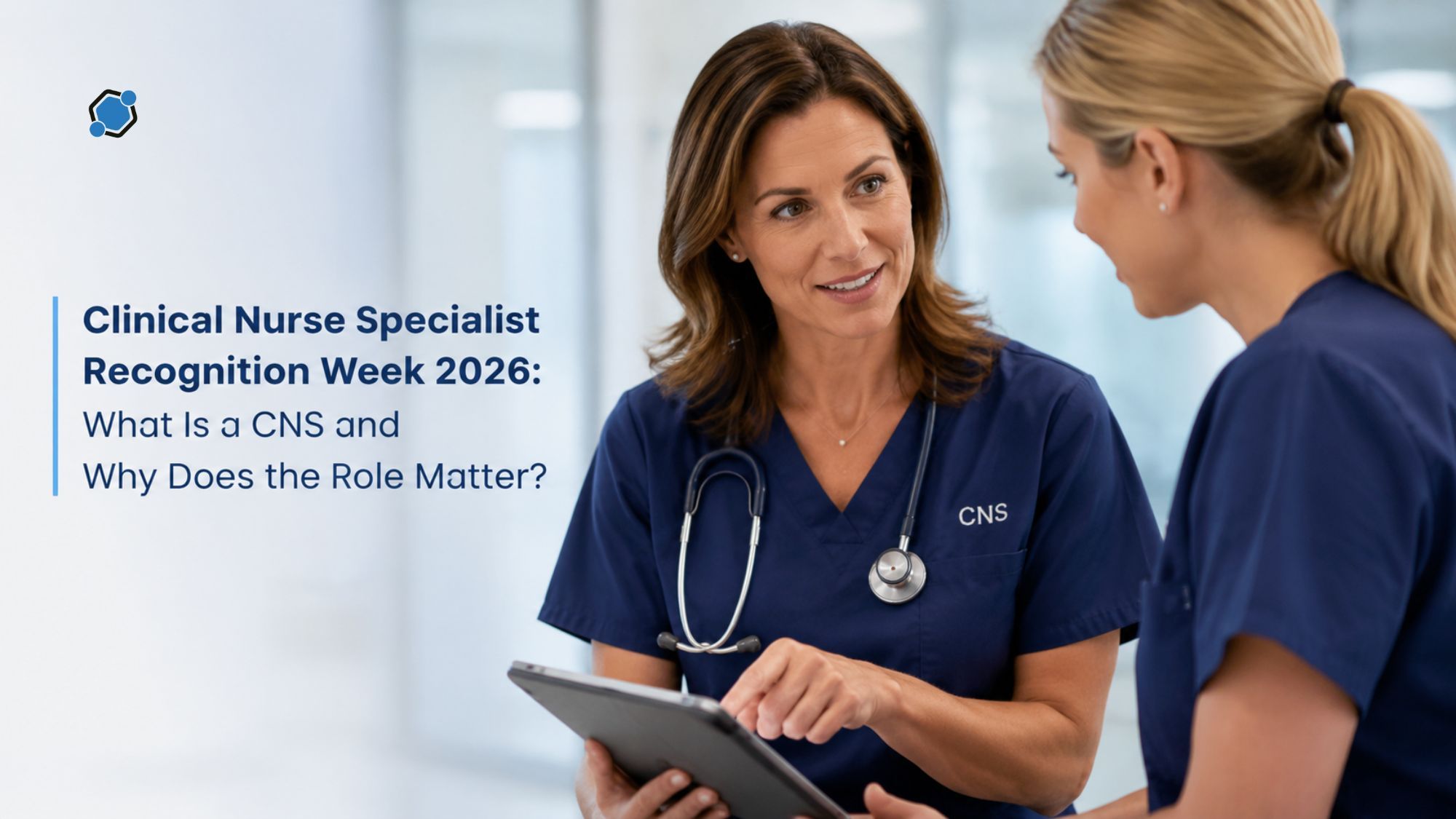
September 1 is the birthday of Hildegard Peplau, an American nurse and theorist who argued in the mid-twentieth century that the relationship between a nurse and a patient is a form of care in its own right, not simply a channel for carrying out a physician's orders. That date now opens National Clinical Nurse Specialist Recognition Week, observed in the United States from September 1 through September 7. The National Association of Clinical Nurse Specialists established the observance in 2009 and organizes it each year, with the 2026 week carrying the theme Amplify.
The week exists in part because the role it honors is one of the least recognized in American health care. Many people have received hospital or clinic care that a clinical nurse specialist helped design, without ever encountering the job title. A clinical nurse specialist may have written the infection prevention protocol followed on a surgical floor, trained the nursing staff who managed a relative's pain after an operation, or redesigned how a hospital identifies patients at risk of falling.
Understanding what a clinical nurse specialist does clarifies something broader about modern health care: a substantial amount of the expertise that shapes patient care sits within nursing rather than outside it.
What is a clinical nurse specialist?
A clinical nurse specialist, commonly abbreviated as CNS, is an Advanced Practice Registered Nurse. Advanced Practice Registered Nurse, or APRN, is a regulatory category covering nurses who have completed graduate-level education and national certification beyond their initial registered nurse license. There are four APRN roles in the United States: the clinical nurse specialist, the certified nurse practitioner, the certified nurse-midwife, and the certified registered nurse anesthetist.
The clinical nurse specialist was the first of these advanced practice nursing roles to be established, dating back roughly seventy years. Each clinical nurse specialist practices within a defined specialty area. Some specialize by patient population, such as pediatrics or older adults. Others specialize by setting, such as critical care or the emergency department, or by condition, such as diabetes, oncology, or wound care.
The path to the role runs through several stages. A person first completes a nursing degree, passes the national licensing examination, and works as a registered nurse. Most graduate programs expect a period of bedside experience before admission. The candidate then completes a master's or doctoral degree in a clinical nurse specialist program, earns national certification in a population focus, and obtains advanced practice licensure from a state board of nursing. The full sequence takes several years beyond the initial nursing degree.
One point causes frequent confusion: what a clinical nurse specialist is legally permitted to do varies from state to state. In some states, a clinical nurse specialist may assess patients, make diagnoses, order diagnostic tests, and prescribe medication independently. In other states, the same nurse practices under a written collaborative agreement with a physician. Prescriptive authority in particular differs considerably across jurisdictions. Anyone seeking current specifics should consult the relevant state board of nursing rather than rely on a general description, and readers interested in how nurses contribute across research settings will find the regulatory picture varies there as well.
What do clinical nurse specialists actually do?
The professional framework for the role describes three spheres of impact. The phrase sounds abstract, but the underlying idea is straightforward: a clinical nurse specialist works to improve care at three levels simultaneously.
- The patient sphere covers direct clinical work, such as a pain management specialist consulting on a case where standard approaches have not worked, or a wound care specialist evaluating a wound that is failing to heal.
- The nursing practice sphere covers work with other nurses, including mentoring, teaching, building competency programs, and updating unit protocols so they reflect current evidence.
- The systems sphere covers institution-wide work, such as leading quality improvement projects, developing policy, and redesigning how a department delivers a particular kind of care.
A concrete example makes the three-level structure clearer. Suppose a hospital notices that a certain intestinal infection is occurring more often than expected among admitted patients. A clinical nurse specialist might review the cases individually, identify where current practice is falling short, rewrite the cleaning and antibiotic-handling protocols, train nursing staff across affected units on the revised approach, and then track whether infection rates change. That single project touches the patient, the nursing team, and the institution.
This systems-level orientation is why the role is easy to overlook. Much of the work happens before a patient arrives or after they leave, embedded in protocols and training rather than in a visible bedside encounter. The same invisibility affects other essential health care roles, including the coordinators who keep hospital units running. Published summaries of clinical nurse specialist outcomes associate the role with shorter hospital stays, better pain control, fewer complications among hospitalized patients, and higher patient satisfaction.
How is a clinical nurse specialist different from a nurse practitioner or a registered nurse?
The comparison most people want is between a clinical nurse specialist and a nurse practitioner, since both are advanced practice nurses who may diagnose, treat, and prescribe depending on state law.
The difference lies in emphasis. A nurse practitioner is oriented primarily toward autonomous direct patient care, whether in primary care or an acute setting. Many people encounter nurse practitioners as their regular clinician. A clinical nurse specialist also provides expert direct care, but adds two responsibilities the nurse practitioner role does not center: developing nursing practice and changing health systems. A reasonable summary is that a nurse practitioner is an expert clinician focused on the patient, while a clinical nurse specialist is an expert clinician who also works to improve how nursing is practiced and how institutions deliver care.
The distinction from a registered nurse is one of education and scope. A registered nurse holds an undergraduate or diploma-level nursing qualification and practices as a skilled generalist. A clinical nurse specialist holds a graduate degree, national certification in a specialty population, and advanced practice licensure, along with authority that a registered nurse license does not confer.
The other two advanced practice roles are more narrowly defined by their field. A certified nurse-midwife focuses on pregnancy, childbirth, and gynecologic care. A certified registered nurse anesthetist focuses on anesthesia and now requires a doctoral degree for entry to practice. Nursing expertise also extends into settings outside the hospital entirely, including care delivered in a participant's home, where the nurse often works with limited immediate backup and correspondingly greater independent judgment.
How do specialist nurses support clinical trial participants?
Research is a formal competency of the clinical nurse specialist role. The professional core competencies include locating, interpreting, and applying evidence in clinical practice, participating in the conduct of research, and mentoring other nurses to translate research findings into everyday care. In practice, clinical nurse specialists frequently act as the bridge between published evidence and what actually happens at the bedside.
An important clarification belongs here, because two similar-sounding roles are regularly conflated. A clinical nurse specialist is an advanced practice licensure category. A clinical research nurse, sometimes called a research nurse coordinator or clinical trials nurse, is a registered nurse who specializes in the function of research, and that role does not require advanced practice licensure. Clinical research nursing was formally recognized as a nursing specialty in 2016. Its defining description centers on maintaining equilibrium between care of the research participant and fidelity to the study protocol. Readers who want the operational detail of that function can review what a research coordinator handles day to day. A clinical nurse specialist may lead or contribute to research, but the two roles are not interchangeable.
Across both roles, nurses carry much of the participant-facing work in clinical research. They explain study procedures and what participation involves, help confirm whether someone meets the criteria for a study, monitor symptoms and side effects, watch for safety signals, support adherence to the protocol, and maintain contact so participants are not lost to follow-up. Under international good clinical practice standards, the informed consent process is conducted by the investigator or by site staff the investigator has formally delegated, and the investigator retains ultimate responsibility for it. Delegation does not transfer accountability.
DecenTrialz is a clinical trial recruitment and pre-screening platform that combines AI-assisted participant matching with pre-screening conducted by registered nurses, then delivers qualified referrals to research sites. The nursing component exists for the reason this observance highlights: a nurse asking structured questions about a person's health history can identify a genuine mismatch with a study, or a genuine fit, far more reliably than a form can.
The research site team owns final eligibility determination, informed consent, the study walk-through, and enrollment.
Frequently asked questions about clinical nurse specialists
Can a clinical nurse specialist prescribe medication?
In many states, yes. Prescriptive authority for clinical nurse specialists is set by individual state boards of nursing and varies widely. Some states permit independent prescribing, while others require a collaborative agreement with a physician. A few states grant clinical nurse specialists authority in areas where nurse practitioners do not have it, and the reverse is also true.
How long does it take to become a clinical nurse specialist?
Several years beyond an initial nursing degree. The sequence involves a nursing degree, registered nurse licensure, typically a period of clinical experience, a master's or doctoral program in a clinical nurse specialist track, national certification, and state advanced practice licensure.
Do clinical nurse specialists see patients directly?
Yes. Direct patient care is the central sphere of the role, and it is often consultative, meaning the clinical nurse specialist is brought in for complex cases where usual approaches have not produced the expected result.
Is a clinical nurse specialist the same as a clinical research nurse?
No. A clinical nurse specialist is an advanced practice registered nurse with graduate education and specialty certification. A clinical research nurse is a registered nurse whose specialty is the practice of research and who does not need advanced practice licensure. The roles overlap in research settings but are separate.
When is National Clinical Nurse Specialist Recognition Week?
September 1 through September 7 every year. The dates are fixed rather than floating, anchored to Hildegard Peplau's birthday on September 1.
Why recognition matters beyond a single week
The nursing workforce in the United States is aging, and shortages are projected to fall unevenly, with rural areas affected more than metropolitan ones. Advanced practice nursing, meanwhile, is among the fastest-growing parts of the health workforce. Both trends matter for clinical research, because studies depend on qualified nursing staff to run safely and to keep participants properly informed and supported.
Recognition weeks are easy to dismiss as ceremonial. This one carries practical information: knowing that a clinical nurse specialist exists, and what the role can do, helps patients and families ask better questions during a hospital stay and helps prospective research participants understand who they are speaking with. Anyone considering a study can start by learning what happens at an initial screening visit. Individuals interested in exploring whether a clinical study might be relevant to their situation can begin with a pre-screening conversation, understanding that no platform can promise trial access, enrollment, or any particular health outcome.
Was this article helpful?

Similar Blogs

What research sites need to know about central IRBs, local IRBs, and reliance agreements
A multisite clinical trial used to mean one protocol and many separate ethics reviews. Eac...
 Anish Teepireddy
Mini-stroke symptoms: how to recognize a transient ischemic attack before a full stroke
A transient ischemic attack, often called a mini-stroke, is a short episode of stroke symp...
 Deeksha Gitta
Breast Biopsy Procedure, types, and what to expect
A breast biopsy is a diagnostic step, not a diagnosis. When a mammogram, ultrasound, MRI, ...
Vamshi KantojuStay Informed. Stay Connected.
Get updates on verified clinical trials, emerging treatments, and research breakthroughs directly in your inbox. No spam, just science that matters.
