 HIPAA Compliant
 ISO 27001 Certified
Clinical trial awareness campaigns: how advocacy groups turn community outreach into matched participants
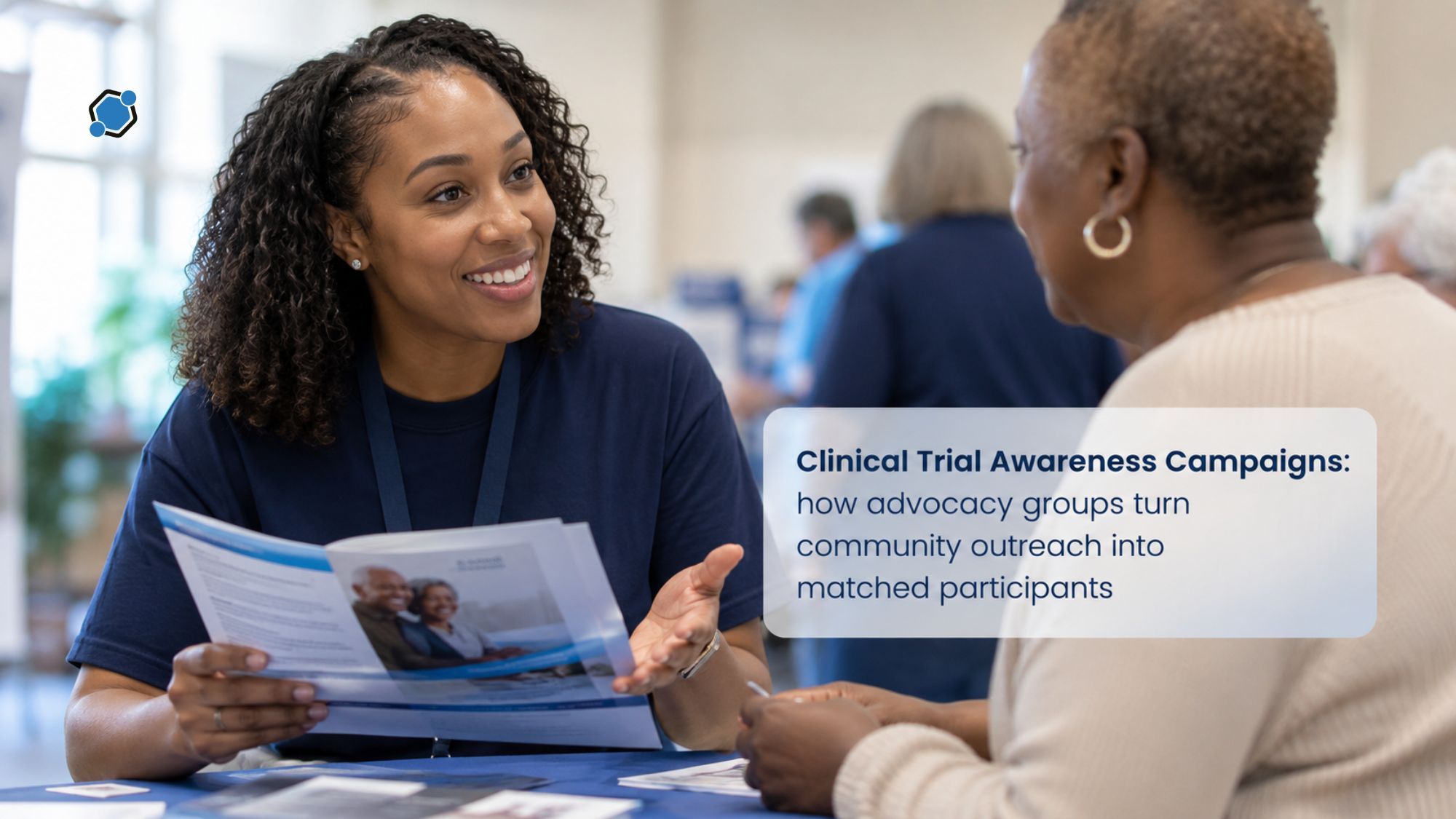
Advocacy groups are often the first place people go when a diagnosis reshapes their lives. Community members trust their newsletters, their peer networks, and their local events. That trust makes advocacy groups one of the most effective sources of clinical trial awareness in the United States. It also makes them acutely aware of a specific problem: the interest they generate through outreach does not always translate into people actually reaching a clinical trial. The gap sits between the moment someone raises a hand and the moment a trial team follows up with real, actionable next steps. Closing that gap is the work advocacy groups increasingly ask their partners to do.
The recruitment gap is a handoff problem, not an awareness problem
Awareness campaigns are frequently blamed for weak recruitment outcomes. The evidence points elsewhere. A 2024 industry pilot documented what researchers call the last mile leak in the recruitment pipeline, showing that a large share of interested patients are never pre-screened, and that only a fraction of those who reach out through public trial listings receive an accurate, actionable response.
The picture that emerges is not one of a disengaged public. It is one of a workflow that cannot keep pace with the interest advocacy groups generate. Community members hear about a trial, feel motivated to explore it, and then encounter silence, outdated contact information, or a form that leads nowhere. The recruitment funnel is leaking before screening even begins.
For advocacy groups, this is a familiar and frustrating pattern. The trust their members placed in the referral is spent, but nothing came of it. Improving outcomes requires fixing the handoff, not the outreach. A closer look at the ongoing recruitment challenge sponsors need to change shows how far the industry still has to go on this point.
Community trust is the asset advocacy groups already own
Community trust is not a soft benefit. It is a measurable driver of enrollment. Peer-reviewed research on trial recruitment has found that outreach delivered through a trusted messenger, whether a peer navigator, a community health worker, a promotora, or a fellow patient, dramatically outperforms cold outreach. In some studies the gap between the two approaches is an order of magnitude or more.
Advocacy groups have this asset by definition. They exist because their members trust them, often more than they trust institutions. Data from patient perception research consistently shows that advocacy organizations sit near the top of the list of sources community members turn to when exploring research participation.
The implication for advocacy leaders is straightforward. A campaign that leverages this trust already has the hardest ingredient in place. What it needs is a pathway that honors the trust rather than wastes it. Approaches for engaging underrepresented communities in clinical research describe what that pathway typically looks like in practice.
Pre-screening and screening are not the same thing
Community members often hear the words pre-screening and screening used interchangeably. They mean different things, and the distinction matters for anyone who wants to understand what happens after a person raises a hand.
Pre-screening is a preliminary eligibility check. It is usually done remotely, by phone, video call, or online questionnaire, and covers basic information like age, diagnosis, and a few key inclusion or exclusion items. No invasive tests, procedures, or study interventions happen at this stage. Screening is different. It is the site-based medical evaluation that takes place after a person signs an informed consent form. It typically involves an in-person visit, medical review, and confirmatory tests.
DecenTrialz operates in the pre-screening layer. AI-assisted matching aligns a person against active trial criteria, and a registered nurse conducts the pre-screening conversation. The nurse pre-screens only. Final eligibility decisions, the informed consent conversation, and enrollment remain with the research site team. This clean division is what lets an advocacy group refer members into the system with confidence about who does what. A fuller explanation of why not everyone qualifies for a trial can help community members prepare for that conversation.
Closing the silence between a referral and a next step
One of the most consistent complaints from advocacy leaders is the silence that follows a referral. A community member expresses interest, is pointed toward a study, and then hears nothing. Sometimes the trial has stopped recruiting. Sometimes the site is short-staffed. Sometimes contact information is out of date. The reasons vary; the effect on trust is the same.
Closing this loop requires infrastructure the advocacy group does not typically own. Structured referral workflows, dashboards that track what happened to a referral, and automated status updates are all features of purpose-built platforms rather than membership systems. Without them, advocacy staff are left to chase down updates manually, if at all.
DecenTrialz was built with this problem in mind. Its structured referral workflow tracks each community member as they move through matching and RN pre-screening, and its dashboards return status back to the referring advocacy group. That visibility does not require the advocacy group to become a recruitment vendor. It simply allows advocacy staff to close the loop with their own community. Similar patterns for how dashboards transform sponsor oversight apply directly to advocacy partnerships as well.
Ready to see how this works for your organization? Partner with DecenTrialz to build a warm handoff that respects your community's trust.
Culture, language, and access shape who reaches pre-screening
Awareness campaigns often succeed at generating interest across communities that historical trials underserved. What happens next tends to be uneven. If study materials are only available in English, if pre-screening requires a working smartphone and reliable broadband, or if visits demand travel a person cannot afford to take from work, the funnel narrows sharply after the initial hand-raise.
Federal guidance increasingly acknowledges this. The FDA's 2024 draft guidance on Diversity Action Plans, mandated under the Food and Drug Omnibus Reform Act, explicitly names sustained community engagement, including partnerships with patient advocacy groups, as a strategy for enrolling underrepresented populations. The FDA's September 2024 final guidance on decentralized clinical trials supports telehealth visits, local providers, and home visits, which can reduce the travel burden for rural and working-class participants. ICH E6(R3), adopted in early 2025, notes that innovative designs can enable the inclusion of a wider and more diverse participant population.
For advocacy groups, this policy tailwind means outreach can now plug into an operational model that meets communities where they are. AI-assisted matching against real trial criteria, plain-language questionnaires, remote nurse pre-screening, and decentralized study designs together create a path that fits more lives, not fewer. The broader picture of how decentralized trials may improve research access reinforces why this shift matters for advocacy audiences.
Small communities and rare disease outreach need different math
Rare disease advocacy groups face a distinct version of the same problem. Their communities are small, geographically dispersed, and often invisible to conventional recruitment channels. Many maintain patient registries and natural history studies, sometimes assembled over years by a handful of dedicated staff. That foundation gives them extraordinary depth of relationship, but rarely the operational capacity to run structured trial recruitment.
Federal research programs recognize the pattern. The NIH Rare Diseases Clinical Research Network builds patient advocacy group inclusion into its consortia by design, treating advocacy organizations as research partners rather than as recruitment channels switched on late in a study.
For a small foundation, matching a community member against active trial criteria, running an RN pre-screening call, and returning structured status information are all tasks that fit poorly into a volunteer or small-team model. A partner platform absorbs that operational load without displacing the community relationship. The advocacy group continues to lead the outreach, the trust conversation, and the follow-through with its members. DecenTrialz supplies the matching, the pre-screening capacity, and the visibility. The research site handles the medical decisions that only it can make. This pattern is explored further in why patient advocacy groups matter in decentralized clinical research.
Frequently asked questions
What is the difference between pre-screening and screening for a clinical trial?
Pre-screening is a preliminary eligibility check that usually happens remotely, by phone, video call, or an online form. It covers basic information like age, diagnosis, and a few key criteria, and does not involve tests or procedures. Screening is the in-depth medical evaluation that happens at the research site after a person signs an informed consent form. Informed consent is the dividing line between the two.
How do patient advocacy groups help people find clinical trials?
Advocacy groups raise awareness through newsletters, community events, peer networks, and social media. Many partner with matching platforms and research organizations so that community members who express interest are routed to a structured pre-screening conversation and, if appropriate, referred to a research site. The advocacy group usually stays involved as a source of information, support, and trusted communication throughout the process.
Why do people sometimes not hear back after showing interest in a clinical trial?
Common reasons include trials that stopped recruiting after a listing went live, outdated contact information, understaffed research sites, and workflows that were not designed to respond quickly to community outreach. Purpose-built referral platforms with dashboards and structured follow-up are designed to close this gap by tracking each expression of interest through to a clear outcome.
Does a nurse pre-screener decide if someone qualifies for a clinical trial?
No. A registered nurse conducting pre-screening asks preliminary eligibility questions to see if a person may be a fit for a study. Final eligibility determinations, informed consent, and enrollment decisions belong to the research site team that runs the trial. The nurse's role is to make sure the person who reaches the site is well matched, informed, and ready for the site team to take over.
Do participants have to pay to use a clinical trial matching service?
Participants do not pay to use a clinical trial matching service. Costs are covered by sponsors, research sites, and platform partners. If a community member is ever asked to pay a fee to be matched to a trial or to receive pre-screening, that is a serious warning sign and should be reported to a trusted health authority.
Turn community outreach into matched participants with DecenTrialz
Advocacy groups already do the hardest part of clinical trial recruitment. They build the trust, deliver the community education, and put the opportunity in front of the people who most stand to benefit. What often breaks is what happens next.
DecenTrialz fills that specific gap. AI-assisted matching aligns interested community members against active trial criteria. Registered nurses conduct structured pre-screening conversations, respecting the boundary between preliminary eligibility and the research site team's authority over medical decisions. A structured referral workflow and dashboards return visibility to the advocacy group, so no community member disappears into an operational black hole.
The invitation is simple. Bring the community relationship. DecenTrialz brings the matching, the pre-screening capacity, and the closed-loop tracking. Together, that turns awareness into matched participants without asking advocacy groups to become a recruitment operation. Partner with DecenTrialz to design a handoff that protects your community's trust.
Was this article helpful?

Similar Blogs
Clinical Trial Data Governance: What Advocacy Groups Should Verify Before Endorsing a Study
Patient information now travels further than most study participants expect. A study that ...
 Swaroop ESD
Tokenization in Clinical Trials: What Should Advocacy Groups Ask Sponsors About Patient Privacy
Tokenization has become one of the most widely adopted data techniques in modern clinical ...
Mahesh Upadrista
How advocacy groups turn patient registries into clinical trials
For most rare and chronic disease communities, the biggest obstacle to research is not sci...
Deeksha GittaStay Informed. Stay Connected.
Get updates on verified clinical trials, emerging treatments, and research breakthroughs directly in your inbox. No spam, just science that matters.
