 HIPAA Compliant
 ISO 27001 Certified
Gene Editing Has Reached Real Patients. Here’s What CRISPR Clinical Trials Look Like Now.
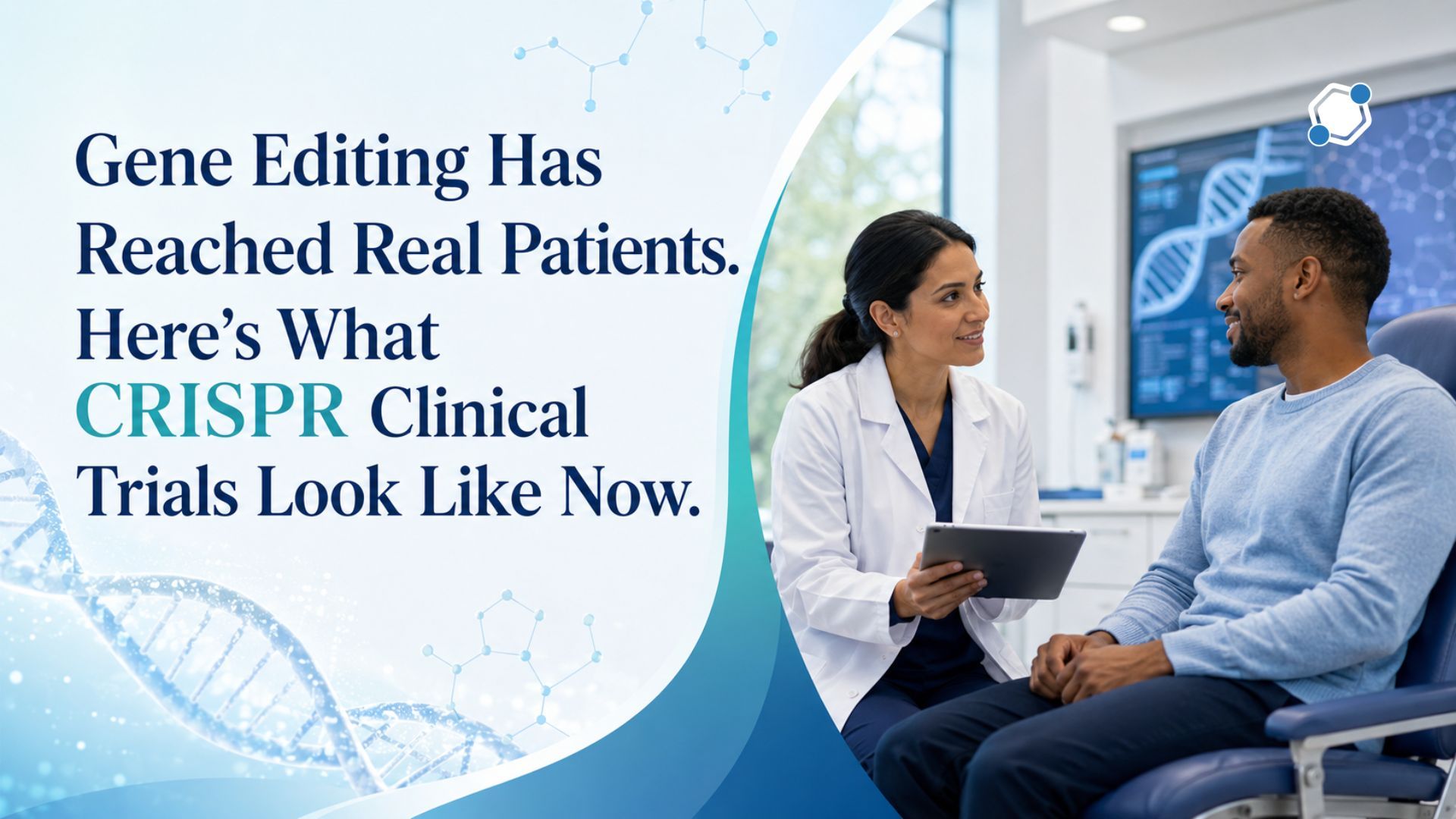
CRISPR (which stands for clustered regularly interspaced short palindromic repeats) is a tool that lets scientists make precise edits to DNA, the genetic instructions inside every cell. A decade ago, CRISPR was a research-stage technology that most people had never heard of. Today, it is the basis of the first gene editing therapy to receive United States Food and Drug Administration (FDA) approval, and dozens of CRISPR clinical trials are actively recruiting participants in the United States and abroad. The field has moved from “what might be possible” to “what is being tested in real patients right now.”
For anyone curious about CRISPR clinical trials, including people who may eventually consider joining one, the questions that matter are practical: what does CRISPR actually do, has it been shown to work, what conditions is it being studied for, and what should someone know before considering a trial?
This guide answers each of those questions in plain language.
CRISPR in Plain Language
DNA is the set of instructions the body uses to build and run itself. Think of the genome (every cell’s full set of DNA) as a giant cookbook: every gene is a recipe, and every recipe is written using a specific sequence of letters. When a recipe contains a typo, the body may produce a faulty protein (a working molecule that cells use to carry out specific jobs), which can cause or contribute to disease.
CRISPR can find a specific spot in that cookbook and make a precise change. Researchers program the system to look for a particular sequence of letters, cut the DNA at that exact place, and either disable the faulty recipe or replace it with a corrected version. The technical term for this is gene editing.
The most common question about CRISPR is whether it permanently changes a person’s DNA. The honest answer is yes, and that is the point. Once a cell’s DNA is edited, the change stays. Currently, however, CRISPR therapies in trials edit cells in the body (called somatic cells), not the eggs or sperm that pass DNA to children. The edits affect the person who receives the therapy, not their future children.
CRISPR is being used in two general ways. In one approach, called ex vivo editing, doctors take cells out of the body, edit them in a laboratory, and put them back. In the other, called in vivo editing, the editing tools are delivered directly into the body and reach the target cells from inside. Both approaches are being studied in clinical trials right now.
For more on how new medical approaches are tested before reaching patients, see Clinical Trials Explained: Simple Guide for Beginners.
From Laboratory to First Approval: How CRISPR Reached Patients
CRISPR was first described as a gene editing tool in 2012. The earliest human studies began a few years later and focused on safety. Could CRISPR be used in people without causing dangerous side effects? Could the editing be made precise enough to avoid unintended changes elsewhere in the genome?
Those early trials, run on small numbers of participants, suggested the answer was yes. Larger studies followed, testing whether CRISPR-edited cells could actually help patients with specific diseases. The first major target was a group of inherited blood disorders, including sickle cell disease (a condition in which red blood cells become rigid and crescent-shaped, blocking blood flow and causing severe pain) and beta-thalassemia (an inherited disorder in which the body produces less of the protein that carries oxygen in the blood).
In December 2023, the FDA approved the first CRISPR-based therapy for sickle cell disease. A similar approval for beta-thalassemia followed soon after. The therapy uses ex vivo editing: a person’s own blood-forming cells are taken out, edited to produce a healthier form of hemoglobin (the oxygen-carrying protein in blood), and returned to the body. It does not work for everyone, and the process requires significant preparation, including intensive chemotherapy to clear space in the bone marrow so the edited cells can take hold. Even with those caveats, the approval marked a turning point: for the first time, a CRISPR-based therapy was available outside of a research study.
This pattern of scientific discovery moving into FDA-approved therapy is not unique to CRISPR. From COVID-19 to Cancer: How mRNA Technology Is Transforming Modern Medicine follows a closely related story arc with another modern molecular tool.
Where CRISPR Clinical Trials Stand in 2026
Three years after the first approval, the CRISPR field looks very different. The original approved therapy now has post-approval studies underway to monitor long-term safety and outcomes, which is standard practice for any newly approved medical product. These follow-up studies, sometimes called Phase IV studies, continue for years after a therapy reaches the market.
At the same time, dozens of new CRISPR clinical trials are recruiting participants. Some of these trials are testing improvements to the original blood-disorder approach, including next-generation editing methods that may be safer, more efficient, or applicable to a broader range of patients. Others are exploring entirely new diseases and conditions where CRISPR has not yet been tried in people.
Most of these trials are still in the earlier phases of testing. Phase 1 and Phase 2 trials, which focus on safety and initial signs of effectiveness, make up the majority of the current pipeline. A smaller number of trials have advanced to later phases, where the goal is to confirm benefit in larger groups of participants. The progression mirrors how any new class of medicine is developed: cautious early studies, then expansion as safety is established.
The progression from initial approval to ongoing studies mirrors how every new class of medicine matures. How Clinical Trials Advance Medicine and Change Lives explores that broader role in more detail.
The Conditions CRISPR Is Being Studied For
CRISPR clinical trials now span a wide range of conditions. The most established work continues in inherited blood disorders, building on the experience of the first approved therapy. Sickle cell disease and beta-thalassemia remain the conditions with the deepest CRISPR research base, and ongoing trials are testing whether the approach can be made simpler, faster, or more accessible.
Cancer is the largest growth area for CRISPR research. Most cancer-focused trials use a combination strategy: editing a person’s immune cells with CRISPR to make them better at finding and attacking cancer, then putting those edited cells back into the body. Specific cancers being studied include certain types of lymphoma and leukemia (cancers of blood and lymph tissue), multiple myeloma (a cancer of plasma cells in the bone marrow), and some solid tumors of the brain and chest.
Other active research areas include hemophilia (an inherited bleeding disorder), type 1 diabetes (a condition in which the body’s immune system attacks the cells that produce insulin), several autoimmune diseases such as lupus (a condition in which the immune system attacks the body’s own tissues) and systemic sclerosis (a related disease that causes skin and internal organs to harden over time), and several rare genetic conditions. The diversity reflects how broadly applicable the underlying tool is: anywhere a single faulty gene is driving disease, CRISPR may eventually be tested.
Trial activity is concentrated in academic medical centers, specialty hospitals, and a small number of biotech companies. Many trials run at multiple sites; others are tied to a single research center. For a closer look at how clinical trials are advancing options for people with rare and inherited conditions, see Hope in Research: How Clinical Trials Are Transforming Rare Disease Treatment.
What to Know If You Are Considering a CRISPR Clinical Trial
CRISPR clinical trials are not a fit for everyone. Most have specific eligibility requirements based on the condition being studied, the participant’s medical history, prior therapies, and other factors. Anyone interested in joining a trial should expect a thorough screening process before the research team can make an enrollment decision.
A few practical points are worth understanding upfront. CRISPR trials, especially those involving ex vivo editing, are often more involved than a typical drug trial. The process can include cell collection, intensive preparation before the edited cells are returned, hospital stays, and long follow-up periods that may last years. The exact requirements depend on the specific trial and what is being tested.
Cost is another common question. In most clinical trials in the United States, the experimental product itself is provided at no charge to participants. Routine medical care related to the underlying condition is generally billed to insurance in the same way it would be outside the trial. Specific arrangements vary by trial and should be reviewed in detail before signing up.
Eligibility is one of the most common reasons people are not able to join a specific trial. Eligibility Explained: Why Not Everyone Qualifies for a Trial explains why and what factors typically matter.
DecenTrialz is a platform that connects people with clinical trials they may be eligible for. You share some basic information about yourself, get matched with studies that could be relevant, and a nurse pre-screens you to walk you through what each one involves before you decide whether to take the next step. The research team running the study makes all final eligibility and enrollment decisions. You can start a search at decentrialz.com.
For people receiving care for sickle cell disease, beta-thalassemia, or any other condition where CRISPR is being studied, talking with the treating doctor is also a sensible step. A doctor familiar with the patient’s case can help judge whether a clinical trial fits the broader care picture.
Next Steps
CRISPR clinical trials have moved from theoretical promise to active research being conducted in patients today. The first CRISPR-based therapy is approved and available for two inherited blood disorders, and dozens of new trials are testing the approach in cancer, hemophilia, autoimmune disease, type 1 diabetes, and other conditions. The field is still early, but the trajectory is clear.
For anyone curious about whether a CRISPR trial may be a fit, the practical first steps are straightforward: learn about the specific condition’s research landscape, prepare the questions worth asking, and consider getting matched with trials that fit. You can begin a search at decentrialz.com.
Was this article helpful?

Similar Blogs
International Week of Deaf People 2026: how can clinical research become accessible to Deaf participants?
More than seventy million people around the world belong to signing Deaf communities, and ...
 Deeksha Gitta
Visceral Fat Health Risks: What Makes Belly Fat Different From Other Body Fat?
Body fat is usually discussed as a single quantity, weighed on a scale and summarized in o...
 Anish Teepireddy
Blood Pressure Numbers: What Do Systolic and Diastolic Actually Mean?
A blood pressure result contains two numbers, and most people are never told what either o...
ParamrajStay Informed. Stay Connected.
Get updates on verified clinical trials, emerging treatments, and research breakthroughs directly in your inbox. No spam, just science that matters.
