 HIPAA Compliant
 ISO 27001 Certified
World Hepatitis Day 2026: Testing, vaccines, and the research shaping what comes next
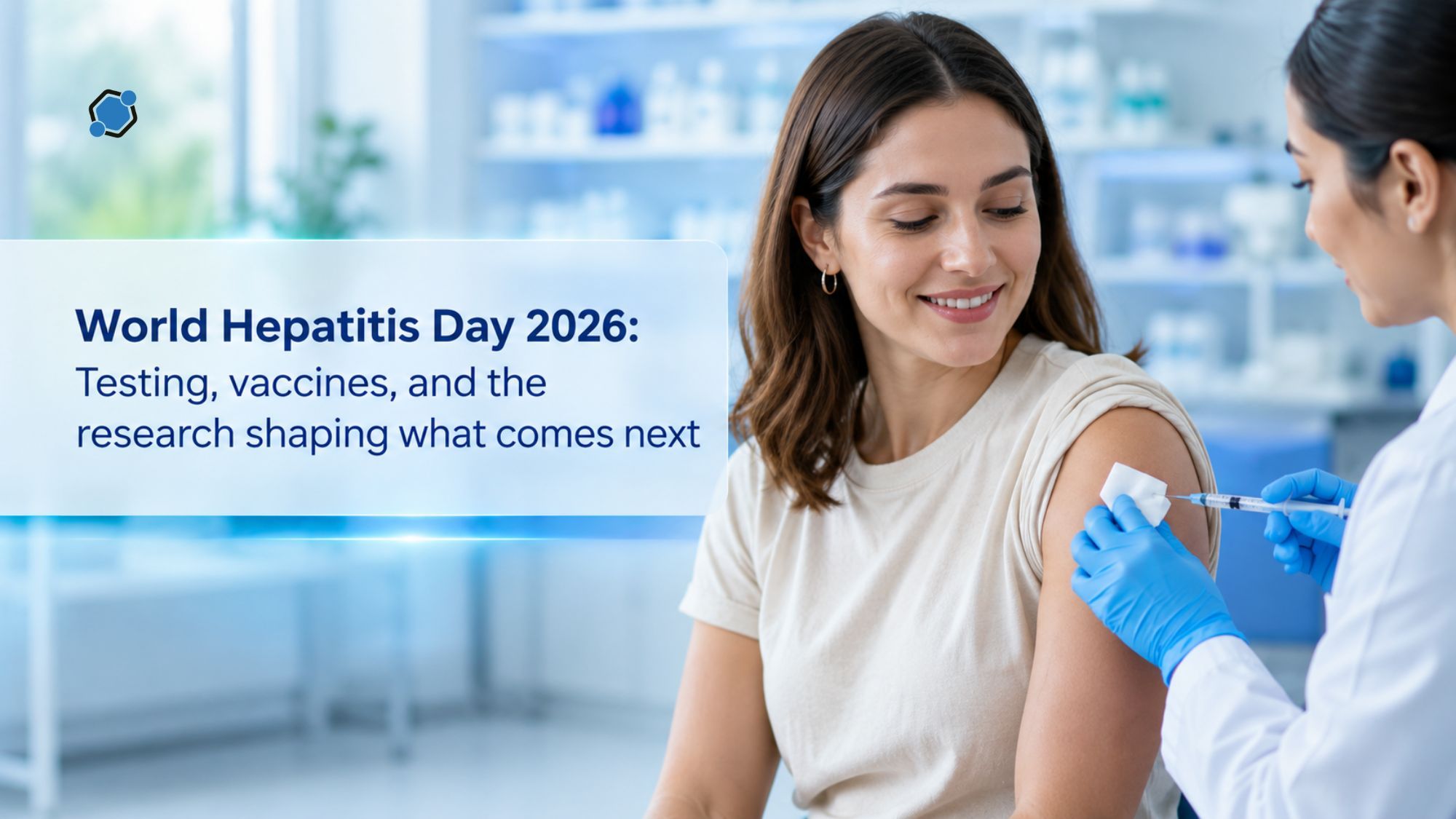
World Hepatitis Day falls on July 28 every year. The 2026 theme, set by the World Health Organization, is "Hepatitis: Let's break it down," and the focus is on removing the barriers, whether financial, social, or systemic, that keep people from prevention, testing, and care. For millions of people worldwide, hepatitis is a silent liver infection that quietly causes damage long before any symptom appears. This year's observance is a reminder that testing, vaccination, and continued research remain the tools most likely to change that pattern.
What World Hepatitis Day marks and why the date is July 28
The date honors Dr. Baruch Blumberg, an American physician and researcher born on July 28, 1925. Blumberg discovered the hepatitis B virus in 1967, developed the first blood test for it, and helped create the first hepatitis B vaccine. He received the Nobel Prize in Physiology or Medicine in 1976 for that body of work. The World Hepatitis Alliance introduced the awareness day in 2008, and in 2010 the World Health Assembly formally recognized July 28 as one of the World Health Organization's official global health observances.
The 2026 campaign asks a straightforward question: what actually stands between people and the tools that already exist to prevent, diagnose, and manage viral hepatitis? Answers include stigma, awareness gaps, cost, uneven access to care, and delayed diagnosis. The observance sits alongside other viral awareness efforts such as National HIV Testing Day 2026: testing, treatment, and research, which shares a common theme: infections that can stay quiet for years are best caught through routine testing, not waiting for symptoms.
What hepatitis is and why it often stays silent for years
Hepatitis simply means inflammation of the liver. The liver is one of the busiest organs in the body, filtering the blood, breaking down medications, storing energy, and helping with digestion. When the liver becomes inflamed, whether from a virus, alcohol, certain medications, or other causes, that work is disrupted. Viral hepatitis is the most common global form, and there are five main types: A, B, C, D, and E.
Hepatitis A and E spread mainly through contaminated food and water, and both are usually short-term illnesses. Hepatitis B, C, and D spread through blood and body fluids. Hepatitis B and C are the two that most often become long-lasting, or chronic, infections. Hepatitis D, sometimes called delta hepatitis, only occurs in people who already have hepatitis B, and it tends to make the disease more severe.
The reason chronic hepatitis B and C are so consequential is that they often cause no symptoms for years, sometimes decades. During that quiet period, ongoing inflammation can lead to scarring of the liver (called fibrosis), then more severe scarring (cirrhosis), and eventually liver failure or liver cancer. Because the early stages are usually invisible, blood tests are the only reliable way to know. This is one reason biomarkers, the hidden health signals inside the body, are so central to hepatitis care: they show what physical symptoms cannot.
How vaccines and universal screening protect people today
Two of the five viral hepatitis types are preventable by vaccination. The hepatitis A vaccine is safe, effective, and given in two doses. The hepatitis B vaccine, first developed in the late 1970s, is often called the world's first anti-cancer vaccine because preventing chronic hepatitis B also prevents a large share of liver cancer cases worldwide. The hepatitis B vaccine is now recommended for all infants, ideally with a birth dose in the first day of life, and for adults who have not previously been vaccinated. Vaccinating against hepatitis B also prevents hepatitis D, since delta infection cannot occur without B.
There is no vaccine for hepatitis C, but there is something almost equally powerful: a cure. Since 2014, a group of oral antiviral medications known as direct-acting antivirals has been able to cure the vast majority of people with hepatitis C, usually in eight to twelve weeks. The medications are well tolerated and work across most strains of the virus. Curing hepatitis C not only helps the individual but also reduces the chance of onward transmission, which is why public health experts now describe it as "treatment as prevention."
On the testing side, the Centers for Disease Control and Prevention recommends that every adult in the United States be screened at least once in their lifetime for hepatitis B and at least once for hepatitis C. Pregnant people are screened during each pregnancy. These recommendations exist because most infected people feel completely well, and because the tools to treat, cure, or manage viral hepatitis work best when the infection is caught early. Hepatitis fits within a broader group of long-lasting conditions that respond to earlier recognition, a point taken up in the observance around Chronic Disease Awareness Day 2026.
Where treatments and cures for viral hepatitis stand right now
The current care landscape looks very different from what it did two decades ago. For hepatitis A, most people recover with rest and time, and a small share benefit from close medical monitoring. For hepatitis B, medications can suppress the virus and reduce liver damage, but they usually need to be taken long term because they do not eliminate the virus completely. For hepatitis C, the direct-acting antiviral cure has changed the outlook entirely.
The next frontier is what researchers call a functional cure for hepatitis B, meaning a finite course of medication that allows a person to stop treatment and remain free of active infection. Several approaches are being studied. Some use short strands of genetic material to quiet the virus's production of key proteins. Others target the way the virus assembles itself inside liver cells, or the way it enters those cells in the first place. Therapeutic vaccines and immune modulators are also being investigated. None of these are standard care yet, and they are being tested carefully across multiple stages of research, but the direction of travel is clear.
For hepatitis D, targeted research has produced the first therapy designed specifically for delta infection, which blocks the virus from entering liver cells. This work is a reminder that scientific breakthroughs in one area often reshape what is possible elsewhere. The story parallels how mRNA technology moved from COVID-19 vaccines to cancer research: a technique proved in one setting opens doors in others.
What clinical trials are exploring next for viral hepatitis
Clinical trials in viral hepatitis span the full range of research questions. Some studies focus on prevention, including next-generation vaccines and vaccines against hepatitis E, which is not yet vaccine-preventable in the United States. Some focus on new therapies, particularly for hepatitis B functional cure and for hepatitis D. Others focus on how the diseases progress over time, which factors predict who develops severe liver damage, and how to detect that damage earlier.
A significant share of hepatitis research is observational rather than interventional, meaning it studies what happens with existing care rather than testing a new medication. These natural history studies, which learn about a disease before treating it, are particularly important for rarer forms of hepatitis and for understanding long-term outcomes in people already living with chronic infection. Biomarker research is another growing area: identifying signals in blood or imaging that predict outcomes better than current tools.
Participants make every one of these studies possible. A vaccine cannot be approved without volunteers who help test it. A cure cannot be validated without people willing to try the investigational product and share what happens. A natural history study cannot describe a disease's course without participants who agree to be followed over time. Trial participants are the reason the current cure for hepatitis C exists at all.
How AI-assisted matching and nurse pre-screening help people explore hepatitis studies
Finding a hepatitis trial that fits a specific individual is genuinely complicated. Eligibility often depends on viral type, prior treatment history, the degree of any liver damage, other health conditions, and geography. Reading through study listings and matching them against a personal medical history is not a small task.
DecenTrialz is a participant recruitment platform that helps with the earliest part of that process. AI-assisted matching looks at study eligibility criteria and surfaces studies that could potentially be a fit. A registered nurse then conducts pre-screening: a conversation to check basic fit signals, answer questions about what participation would involve, and decide whether a referral to a specific study makes sense. The nurse pre-screens only. All final eligibility determinations, the full study walk-through, informed consent, and enrollment are handled by the research site team running the study. This division exists because those steps require the site's clinical judgment, direct medical oversight, and formal responsibility for participant care.
For someone curious about hepatitis research, this pathway shortens the distance between interest and a real conversation with a research team. Exploration can begin at decentrialz.com.
How to take the next step this World Hepatitis Day
The 2026 theme is a call to break down the barriers between people and the tools that already exist. Three concrete steps sit at the center of that call. Get tested at least once for hepatitis B and hepatitis C, as recommended by the CDC. Check vaccination status for hepatitis A and hepatitis B with a primary care provider. Consider whether clinical research participation could be a fit, especially for anyone living with a chronic viral hepatitis infection or at higher risk.
To explore whether a hepatitis study could be a match, a search can be started at decentrialz.com. The platform is designed to make the early steps clearer, so the path from awareness to informed action becomes shorter every July 28.
Was this article helpful?

Similar Blogs
Liver Awareness Month 2026: Liver Disease, Liver Cancer, and the Research Changing Outcomes
Every October, two overlapping observances turn attention to an organ most people rarely t...
 Vamshi Kantoju
Down Syndrome Awareness Month 2026: what it is and why research matters
Every October, the United States recognizes Down Syndrome Awareness Month. The month exist...
Mahesh Upadrista
Mental Illness Awareness Week 2026: facts, stigma, and the science changing mental health care
Mental Illness Awareness Week runs from October 4 to October 10, 2026. Established by Cong...
Deeksha GittaStay Informed. Stay Connected.
Get updates on verified clinical trials, emerging treatments, and research breakthroughs directly in your inbox. No spam, just science that matters.
