 HIPAA Compliant
 ISO 27001 Certified

How CROs can improve cybersecurity in decentralized clinical trials by consolidating systems
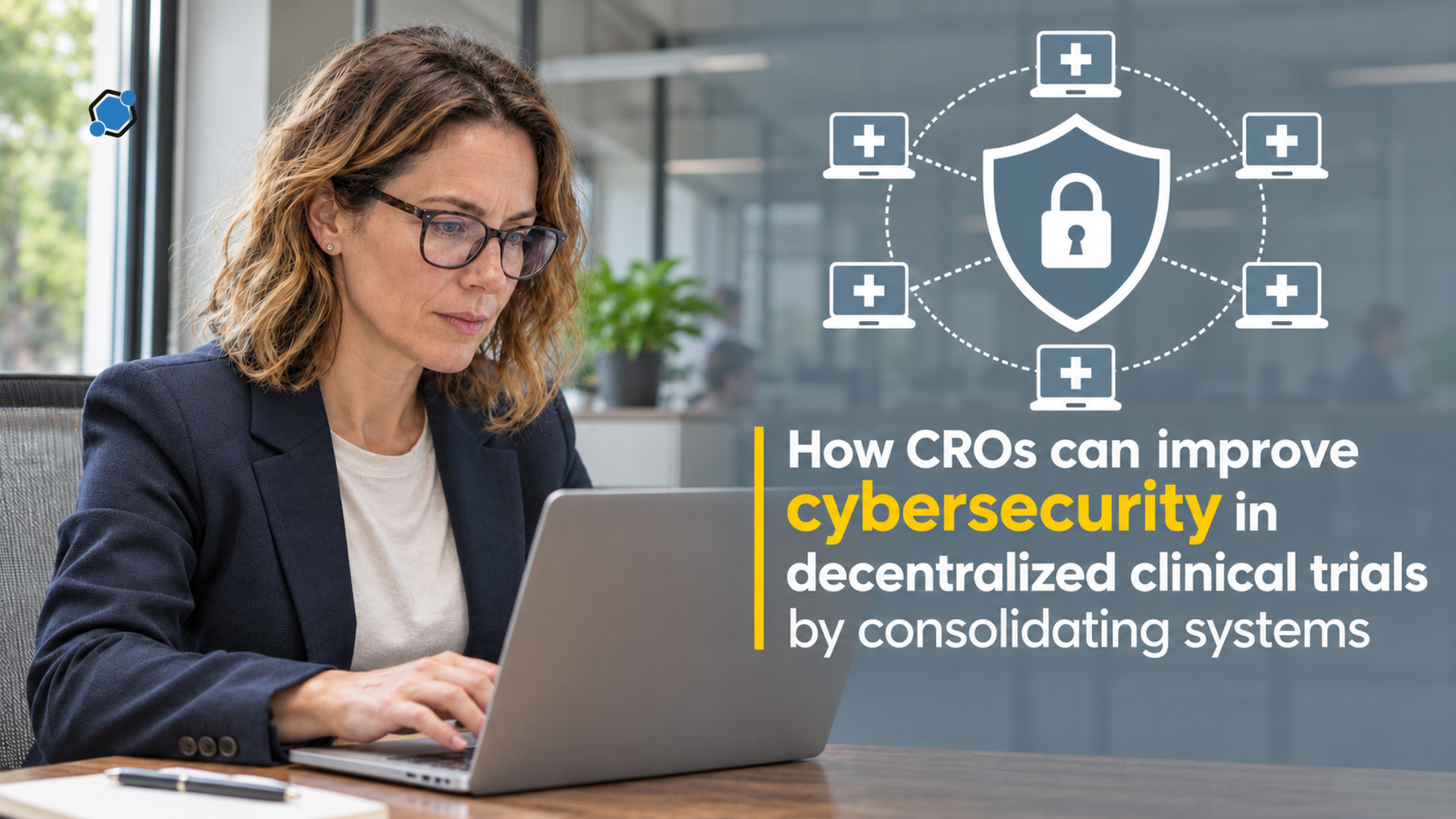
Clinical trials now run on far more software than they did a decade ago. A single decentralized or hybrid study can involve an electronic consent tool, a symptom diary app, telehealth visits, wearable sensors, home nursing services, direct-to-patient drug shipments, and several data systems, each supplied by a different service provider. Cybersecurity in decentralized clinical trials depends less on any one of these tools and more on how many there are and how well they are governed together.
For contract research organizations (CROs), the companies sponsors hire to run all or part of a clinical trial, this creates a specific problem. Every added system brings another login, another data connection, and another organization holding participant information. Consolidating that digital environment, meaning fewer systems, shared access controls, and one clear map of where data travels, is one of the most practical ways to reduce cyber risk while also producing the oversight evidence sponsors and regulators expect.
Why are decentralized clinical trials harder to secure?
A decentralized clinical trial (DCT) is a study in which some or all trial activities take place outside a traditional research site, such as in a participant’s home or at a local clinic. A hybrid trial combines site visits with these remote elements. Both models rely on a set of digital tools that site-based trials used far less. Typical components include:
- Electronic informed consent (eConsent), which lets participants review and sign consent documents remotely
- Electronic patient-reported outcome (ePRO) and clinical outcome assessment (eCOA) tools, the apps and devices participants use to record symptoms and complete questionnaires
- Telehealth platforms for remote visits, along with wearable devices and sensors
- Systems that track investigational product shipped to participants’ homes and schedule home nursing visits
- Core data systems such as electronic data capture (EDC), the clinical trial management system (CTMS), randomization and supply management, and the electronic trial master file (eTMF)
- Recruitment, pre-screening, and referral platforms
Security professionals use the term attack surface to describe every point where an attacker could try to break in or pull data out: devices, apps, user accounts, data connections, and outside organizations. In a site-based trial, much of that surface sits inside a hospital network. In a decentralized trial, data may begin on a participant’s personal phone, pass through a home health provider, and land in a sponsor database, with each handoff adding exposure.
Home visits illustrate the point. A mobile nurse who records vital signs on a tablet and uploads results through a separate portal brings a new organization, new devices, and new credentials into the study. Research sites face a parallel challenge in maintaining oversight of home nursing services.
Which cyber threats matter most to CROs running decentralized trials?
Health care has carried the highest average cost of a data breach of any industry for well over a decade, according to a long-running annual study of breach costs. Clinical trial data adds sensitivity because it combines health information, identity details, and confidential research results.
Outside organizations are a major part of the risk. A widely cited annual analysis of confirmed breaches found that third parties were involved in roughly one in three health care breaches in its 2026 edition. For a CRO that coordinates many service providers on behalf of a sponsor, that pattern describes daily operations. The threats most relevant to decentralized trial operations include:
- Ransomware, malicious software that locks systems and often steals data before a ransom is demanded
- Phishing, deceptive emails or messages designed to capture passwords from study staff, monitors, or service provider administrators
- Supply chain compromise, in which an attacker breaches one service provider to reach the organizations it serves
- Insecure application programming interfaces (APIs), the connectors that pass data between systems automatically
- Lost, shared, or poorly secured personal devices used to collect trial data
- Insider threats, whether careless or deliberate
Real incidents show how quickly one weak link spreads. In 2020, a ransomware attack on a clinical trial software provider forced some studies to fall back on paper records while systems were restored. In 2024, an attack on a national health care payment clearinghouse became the largest health data breach ever reported to federal regulators and disrupted operations across the U.S. health system. In both cases, a single service provider became the point of failure for many organizations that depended on it.
Recruitment is often where outside partners first touch participant data, which is why sites and CROs pay close attention to working with external recruitment partners without giving up control of that data.
What do regulators expect from sponsors and CROs?
Regulators have not issued a single cybersecurity rulebook for decentralized trials, but their expectations point toward a smaller, better documented technology environment. The U.S. Food and Drug Administration (FDA) finalized its guidance on conducting clinical trials with decentralized elements in September 2024. It recommends that the data management plan describe where data originates and how it flows from every source to the sponsor, including a diagram, and that it list the service providers involved in collecting and handling data. FDA’s October 2024 final guidance on electronic systems, records, and signatures in clinical investigations, which supports 21 CFR Part 11 (the federal regulation on electronic records and signatures), adds expectations for IT service providers, validation, access controls, and backup and recovery. FDA guidance is nonbinding, but it reflects how the agency evaluates trial conduct.
The international clinical trial guideline ICH E6(R3), the updated good clinical practice standard adopted in January 2025, goes further. It asks sponsors to keep a record of important computerized systems, including their access controls and security measures, to remove user permissions when they are no longer needed and review them periodically, and to oversee every service provider that performs trial activities on their behalf. E6(R3) took effect in the European Union in July 2025, and FDA published it as final guidance in September 2025. Its annex on decentralized and other nontraditional designs takes effect in the European Union in January 2027 and remained a draft at FDA as of October 2026.
Privacy law adds another layer. Research sites are usually covered by HIPAA, the federal health privacy law, while sponsors usually are not, and a CRO’s position depends on the role it plays. Health apps outside HIPAA can fall under the Federal Trade Commission’s Health Breach Notification Rule, updated in 2024. A proposed update to the HIPAA Security Rule, published in January 2025 with requirements such as encryption and multifactor authentication, had not been finalized as of October 2026, so the current rule still applies. The wider effect of the guideline on oversight is covered in this look at CRO quality management under ICH E6(R3).
What does consolidating the digital environment mean in practice?
Consolidation means reducing the number of separate tools, service providers, and data connections that touch trial data, and then governing what remains through shared controls. It is a governance discipline rather than a single purchase. In practice, it usually combines several moves:
- Retiring overlapping tools so each trial function has one approved system
- Single sign-on (SSO), which lets users reach several systems through one verified login, backed by central identity and access management
- Role-based access, so each user sees only the data their job requires
- Fewer integrations, with each remaining data connection documented and secured
- Unified audit trails, the time-stamped records showing who viewed or changed data and when
- Central monitoring of security alerts and data quality across systems
The benefits are concrete. Fewer accounts mean fewer passwords to steal and faster removal of access when staff leave a study. A single view of data flows makes inspections easier to prepare for and gives sponsors clearer evidence of oversight. Shared dashboards also reduce the need to export sensitive data into spreadsheets and email attachments, which is one reason CROs increasingly expect partners to provide a shared cross-site recruitment dashboard.
Consolidation also carries real trade-offs. Concentrating data and functions in one platform creates concentration risk: if that platform fails or is breached, more of the study is affected at once. Deep dependence on one provider can also create lock-in, making a later change costly. A balanced approach keeps the number of critical providers small while requiring tested backups, documented exit plans, and the ability to export data in usable formats.
How can CROs consolidate and secure the decentralized trial technology stack?
The following sequence helps CROs move from scattered tools to a governed environment. It aligns with E6(R3) and with a widely used federal cybersecurity framework whose 2024 update made governance and supply chain risk explicit priorities.
- Inventory and map. List every system and service provider in the study and draw how data moves from the participant to the sponsor.
- Rationalize. Remove duplicate tools and integrations that add risk without adding value.
- Centralize identity. Use single sign-on with multifactor authentication, which requires a second proof of identity beyond a password, along with role-based permissions and scheduled access reviews.
- Qualify service providers. Use security questionnaires, review independent security audit reports and recognized security certifications, and confirm validation documentation. Confirm that a certification’s scope covers the specific product used in the trial, since certifications support due diligence but do not replace it.
- Contract for security. Include data processing terms, business associate agreements where HIPAA applies, breach notification timelines, encryption of data in transit and at rest, and audit rights.
- Unify oversight. Consolidate audit trails and security monitoring, and review them using a risk-based approach.
- Plan for failure. Maintain incident response and business continuity plans, including paper or offline fallbacks for critical data collection.
- Train every user. Sites, home health staff, and participants need clear guidance on device use, phishing, and how to report a problem.
Recruitment and pre-screening tools belong inside this framework, not outside it. They often handle health information before a participant ever reaches a site, so the same inventory, access, and contract controls should apply. For AI-based recruitment tools, CROs can extend the same discipline to validating AI recruitment tools before deployment.
Frequently asked questions about cybersecurity in decentralized clinical trials
Does HIPAA apply to CROs in decentralized trials?
The answer depends on the CRO’s role. Research sites are usually HIPAA covered entities, and a CRO may act as a business associate when it performs certain functions on a covered entity’s behalf. Research alone is not a covered function, so many CROs receive participant data under a signed HIPAA authorization instead. Data collected directly by apps outside HIPAA may fall under other federal rules.
Who is responsible when a trial service provider is breached?
Responsibility is shared, but accountability does not move with the task. Under E6(R3), sponsors may delegate trial activities to CROs and other service providers, yet the sponsor keeps ultimate responsibility for trial quality and data integrity. Contracts should define notification timelines, investigation duties, and each party’s role so a response can begin without delay.
Where recruitment platforms fit in a consolidated trial environment
Decentralized trials can widen access to research, and CROs that inventory their tools, consolidate access, and hold every service provider to the same standards are better placed to show sponsors and regulators that trial data is protected.
DecenTrialz is a clinical trial recruitment, pre-screening, and participant management platform. It combines AI-assisted participant matching with registered nurse-led pre-screening and structured referral workflows, and it gives sponsors, CROs, and research sites real-time dashboards that show where each referral stands. As one part of a trial’s technology stack, it can be reviewed with the same inventory, access, and contract questions described above.
Final eligibility determination, informed consent, the study walk-through, and enrollment remain with the authorized research site and study team.
CRO teams evaluating how recruitment and pre-screening fit into a consolidated trial environment can learn more at decentrialz.com.
Was this article helpful?

Similar Blogs

FSP vs full-service outsourcing: which model fits which sponsor in 2026?
The choice between FSP vs full-service outsourcing is one of the most consequential decisi...
 Mahesh Upadrista
How CROs Validate Digital Endpoints in Clinical Trials
Digital endpoint validation is one of the few areas in clinical operations where a technic...
Paramraj
How CROs validate AI recruitment tools
Contract Research Organizations, known as CROs, run the day-to-day operations of clinical ...
Vamshi KantojuStay Informed. Stay Connected.
Get updates on verified clinical trials, emerging treatments, and research breakthroughs directly in your inbox. No spam, just science that matters.
