 HIPAA Compliant
 ISO 27001 Certified

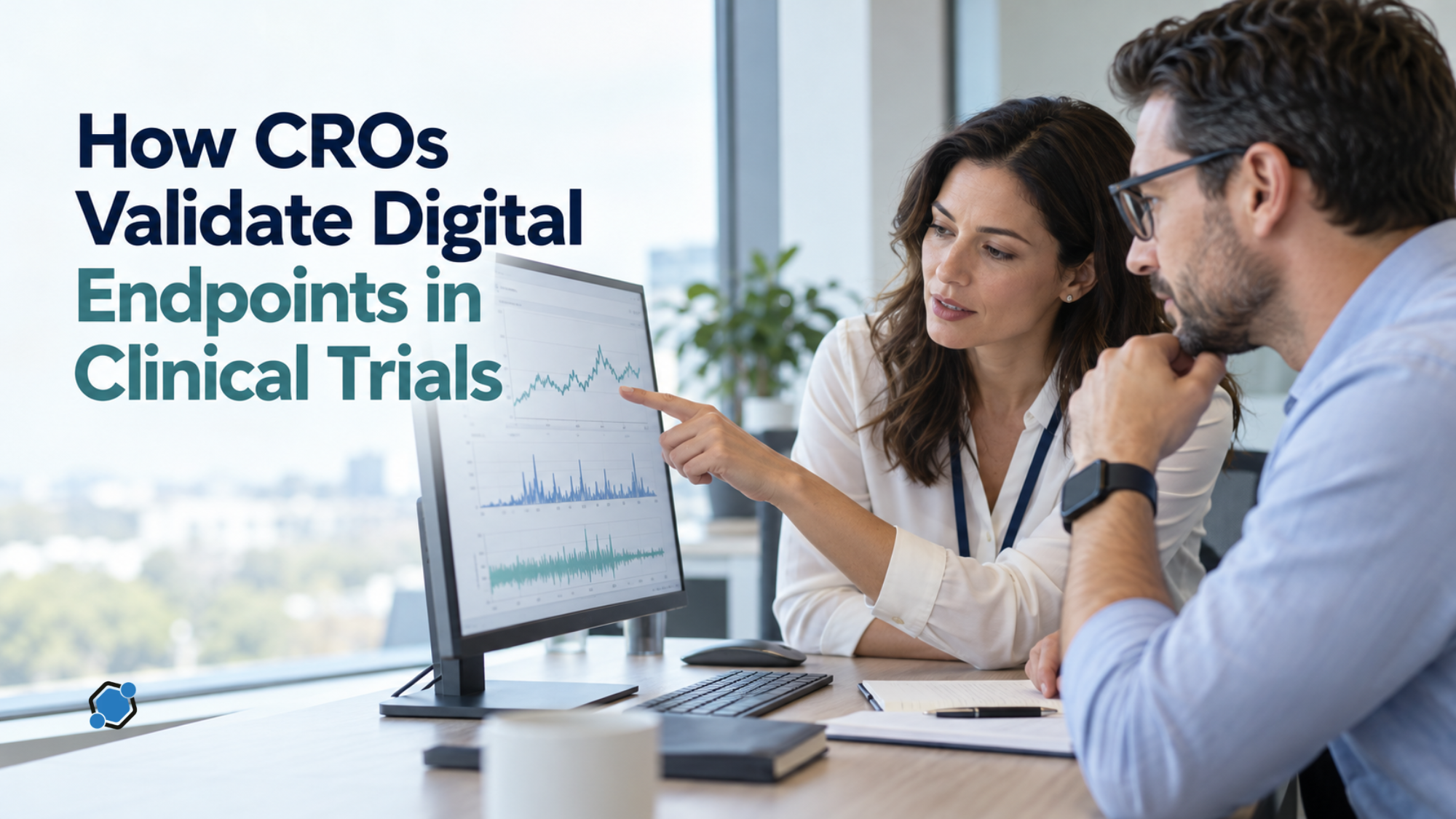
How CROs Validate Digital Endpoints in Clinical Trials
Digital endpoint validation is one of the few areas in clinical operations where a technically flawless deployment can still produce unusable data. A sensor can run for months without a single fault and still generate an endpoint that a regulatory agency will not accept, because agencies do not evaluate devices in the abstract. They evaluate whether one defined measurement, produced by one device model running one algorithm version, is fit for purpose in one defined population.
The U.S. Food and Drug Administration (FDA) set out that expectation in its December 2023 guidance on digital health technologies for remote data acquisition in clinical investigations. The guidance places responsibility on the sponsor even when the sponsor does not control how the technology was designed or built. For contract research organizations, that responsibility converts into operational work: vendor qualification, version control, documented data flow, and analysis rules that have to be settled before the first participant is enrolled.
What digital endpoint validation actually means
A digital health technology, in FDA's wording, is a system that uses computing platforms, connectivity, software, and/or sensors for health care and related uses. In a trial, that covers wrist-worn activity monitors, ankle-mounted gait sensors, continuous glucose monitors, smartphone-based cognitive tests, and connected inhalers.
Three terms are routinely used interchangeably, and the distinction between them is where most validation confusion begins.
- A digital measure is the quantity the technology produces, such as steps per day, stride speed, or minutes of movement during the night.
- A digital endpoint is a trial outcome built from that measure, with the device, the timing, and the aggregation method all specified in the protocol.
- A context of use is the exact circumstance in which the endpoint has been shown to work: the population, the disease stage, the age range, the device placement on the body, and whether the endpoint serves as primary, secondary, or exploratory.
Validation does not travel outside its context of use. An endpoint accepted for ambulatory adults carries no automatic standing in a pediatric population, at a more advanced disease stage, or when the sensor moves from ankle to wrist.
FDA also separates two ideas that are often merged. Verification confirms that the technology measures the raw physical parameter, such as acceleration, pressure, or temperature, accurately and precisely. Validation confirms that the technology appropriately assesses the clinical event or characteristic in the proposed participant population. The umbrella standard across both is fit for purpose, meaning the level of evidence is sufficient to make the resulting data interpretable for the role the endpoint plays in the study.
The evidence bar rises with that role. An exploratory measure can be supported by relatively modest evidence. A primary endpoint intended to support a labeling claim carries the highest bar. For a plain-language view of the measurement side of this topic, see what wearable data can and cannot measure.
The four questions behind every validated digital endpoint
The framework most widely used in the industry, known as V3, breaks validation into verification, analytical validation, and clinical validation. A 2025 peer-reviewed extension, V3+, adds usability validation. Each stage answers a different question, and evidence for one does not substitute for another.
- Verification: does the sensor capture the raw physical signal correctly? This is bench work, covering sampling rate, accuracy against reference instruments, drift, battery behavior, and performance under temperature and humidity conditions.
- Analytical validation: does the algorithm convert that signal into the intended metric, in the population being studied? This requires comparison against a reference standard, such as video-annotated observation for step counting or polysomnography for sleep.
- Clinical validation: does the metric reflect something meaningful about how participants feel, function, or survive? This covers whether the measure separates groups known to differ, whether it moves when the condition changes, and what size of change patients consider important.
- Usability validation: can the intended participants actually use the technology correctly, in their own homes, for the full duration of the study? Evidence here comes from use-related risk analysis and from testing prototypes and final products against predefined success criteria.
The analytical validation stage is where most avoidable failures occur, because algorithms validated in healthy volunteers are assumed to transfer to patients. FDA uses this exact scenario as its own cautionary example, noting that a step-counting algorithm developed in healthy adults may not apply to participants with a shuffling gait. Published evaluations support the concern. Step counting performs considerably worse at slow walking speeds, and accuracy declines further in people with more severe movement impairment.
Usability is easy to treat as a secondary concern and expensive to treat that way. A device that is uncomfortable or difficult to charge produces absent data rather than bad data, and missing data has a direct effect on statistical power. The same logic that governs which visits stay on-site and which move remote applies to device burden: every added task is a point at which a participant can disengage.
Where CRO accountability actually sits
Sponsors remain accountable to regulators for endpoint validity, and manufacturers generate most verification evidence. The CRO sits between them, and the practical oversight work lands there. It starts with vendor qualification, and it should produce documentation rather than assurances.
- The exact device model, firmware version, and algorithm version, with a contractual mechanism for notifying the study team of any change.
- Verification reports covering raw parameter accuracy, sampling frequency, storage capacity, transmission frequency, and specified operating conditions.
- Analytical validation evidence generated in the target population, with the reference standard named and agreement statistics reported.
- Confirmation of whether raw sample-level data can be accessed during and after the study, and in what format.
- A documented data path from the device to the first durable electronic data repository, including time-stamped audit trails.
- The end-user license agreement terms governing whether participant data can be shared with other parties.
- Usability evidence from a comparable population, plus the training materials that will be given to sites and participants.
Proprietary algorithms are a recurring friction point, because a study team that cannot see the processing cannot independently reproduce a derived endpoint. Three mitigations are standard: arrange for the agency to receive algorithm documentation through a reference to the manufacturer's master file, retain raw data so endpoints can be recomputed, and require analytical validation evidence in the target population even when source code stays closed.
Data custody deserves equal attention. FDA treats the first durable electronic data repository as the source, and does not intend to inspect individual devices when data and metadata are transferred under a prespecified, validated plan. That makes the transfer specification a regulatory document, not an IT detail. FDA's October 2024 questions and answers on electronic systems, records, and signatures in clinical investigations also states that regulated entities, explicitly including CROs, remain responsible for compliance when they use IT service providers.
The current Good Clinical Practice guideline reinforces the same expectations. It requires computerized systems used in clinical trials to be fit for purpose, validated in proportion to risk, and supported by data governance that preserves metadata, audit trails, and traceability. Those requirements apply to sensor data exactly as they apply to any other trial data. See what ICH E6(R3) changes for CRO quality management for the wider operational picture.
What has to be settled before first patient in
Validation gaps discovered after database lock cannot be closed retrospectively. The protocol and the statistical analysis plan are where a digital endpoint either becomes defensible or does not.
- The endpoint definition: what is measured, with which device and version, over what period, and how repeated measurements are aggregated into a single value.
- Wear-time rules: what constitutes a valid day, and how many valid days are required before a participant period counts toward analysis.
- Missing data handling, including how partially observed days are treated and which sensitivity analyses will test alternative thresholds.
- Intercurrent events under the estimand framework, such as a participant beginning to use a cane or walker partway through the study.
- Whether participants can see their own data, which can introduce a behavioral effect or compromise blinding, and whether that display can be switched off.
- Data transfer specifications, file formats, reconciliation checks, and mapping to standard clinical data structures.
- Training for site staff and participants, documented, with a run-in period considered where device handling is demanding.
- Data minimization: collect only the streams an endpoint depends on, since every additional stream adds transfer, storage, privacy exposure, and participant burden.
Adherence is not static. Device wear typically declines over the months following enrollment, so a wear-time threshold that looks comfortable in week one can exclude a meaningful share of participants by month twelve. Building that expectation into the analysis plan is more reliable than correcting for it later. The same preventive logic underpins centralized statistical monitoring programs, which detect data anomalies early rather than at close-out.
Common questions about digital endpoint validation
Does regulatory clearance of a device mean the endpoint is validated?
No. Clearance or marketing authorization addresses the device's intended use as a product. It does not establish that the measure derived from it is analytically valid in your study population or clinically meaningful for your endpoint. Verification evidence from the manufacturer can be leveraged, but analytical and clinical validation still have to match the trial's context of use.
Has any digital endpoint been formally qualified by a regulator?
Few, and narrowly. In 2023 the European Medicines Agency qualified stride velocity at the 95th centile, a measure of a person's fastest everyday walking strides captured by an ankle-worn sensor, as a primary endpoint in ambulant Duchenne muscular dystrophy for patients aged four and above. FDA has not qualified a sensor-derived primary efficacy endpoint through its drug development tool programs. In 2024 it qualified a consumer smartwatch atrial fibrillation history feature as a medical device development tool, limited to secondary endpoint use in studies of cardiac ablation devices. Both are tightly bounded by their stated context of use.
Who generates each type of validation evidence?
Verification normally comes from the hardware manufacturer. Analytical validation comes from whoever develops the algorithm, which may be the manufacturer or a separate analytics provider. Clinical validation is typically performed by the sponsor, often with CRO execution. Usability evidence is shared between the developer and the study team. The CRO's distinct contribution is assembling, reviewing, and maintaining this evidence package so it survives inspection, in the same way that monitoring teams document what still gets source-verified at the site under a risk-based approach.
What happens if the vendor updates the firmware or algorithm mid-study?
An uncontrolled update can make data collected before and after the change non-comparable. Freeze device and algorithm versions contractually, or require advance notice, bridging data, and sponsor approval before any change is deployed. Record version metadata alongside every data point, and retain raw data so derived values can be recomputed on a single consistent algorithm if necessary.
Why this work belongs at the front of the study
The economics of digital endpoint validation are front-loaded. Qualification discussions with health authorities are slow, and evidence generation costs far more once a study is already running. Engaging regulators before moving from exploratory to registrational studies is the most consistent recommendation across published guidance on this topic.
The participant side matters too. A digital endpoint only produces usable data if the people enrolled can manage the technology for the full study period, which makes device burden a recruitment and retention question as much as a scientific one.
DecenTrialz is a clinical trial recruitment, pre-screening, and participant management platform. It combines AI-assisted participant matching with pre-screening led by registered nurses, then routes structured referrals to the research site team, with real-time dashboards giving sponsors and CROs visibility into referral flow. The research site team retains full responsibility for final eligibility determination, informed consent, the study walk-through, and enrollment. For CRO teams running studies that depend on sustained device use, a referral pathway that surfaces participant circumstances before site visits begin supports an endpoint that holds its data over time.
Was this article helpful?

Similar Blogs

How CROs validate AI recruitment tools
Contract Research Organizations, known as CROs, run the day-to-day operations of clinical ...
 Vamshi Kantoju

Clinical Trial Patient Matching: Why Do Sponsors Need More Than a Public Registry Listing?
Every applicable clinical trial conducted in the United States must be registered in the f...
Swaroop ESD
DecenTrialz vs traditional recruitment platforms: how does full-service matching differ from self-service trial search?
Comparisons between DecenTrialz and traditional recruitment platforms usually come down to...
Vamshi KantojuStay Informed. Stay Connected.
Get updates on verified clinical trials, emerging treatments, and research breakthroughs directly in your inbox. No spam, just science that matters.
