 HIPAA Compliant
 ISO 27001 Certified
Site oversight of home nursing and mobile phlebotomy in decentralized trials
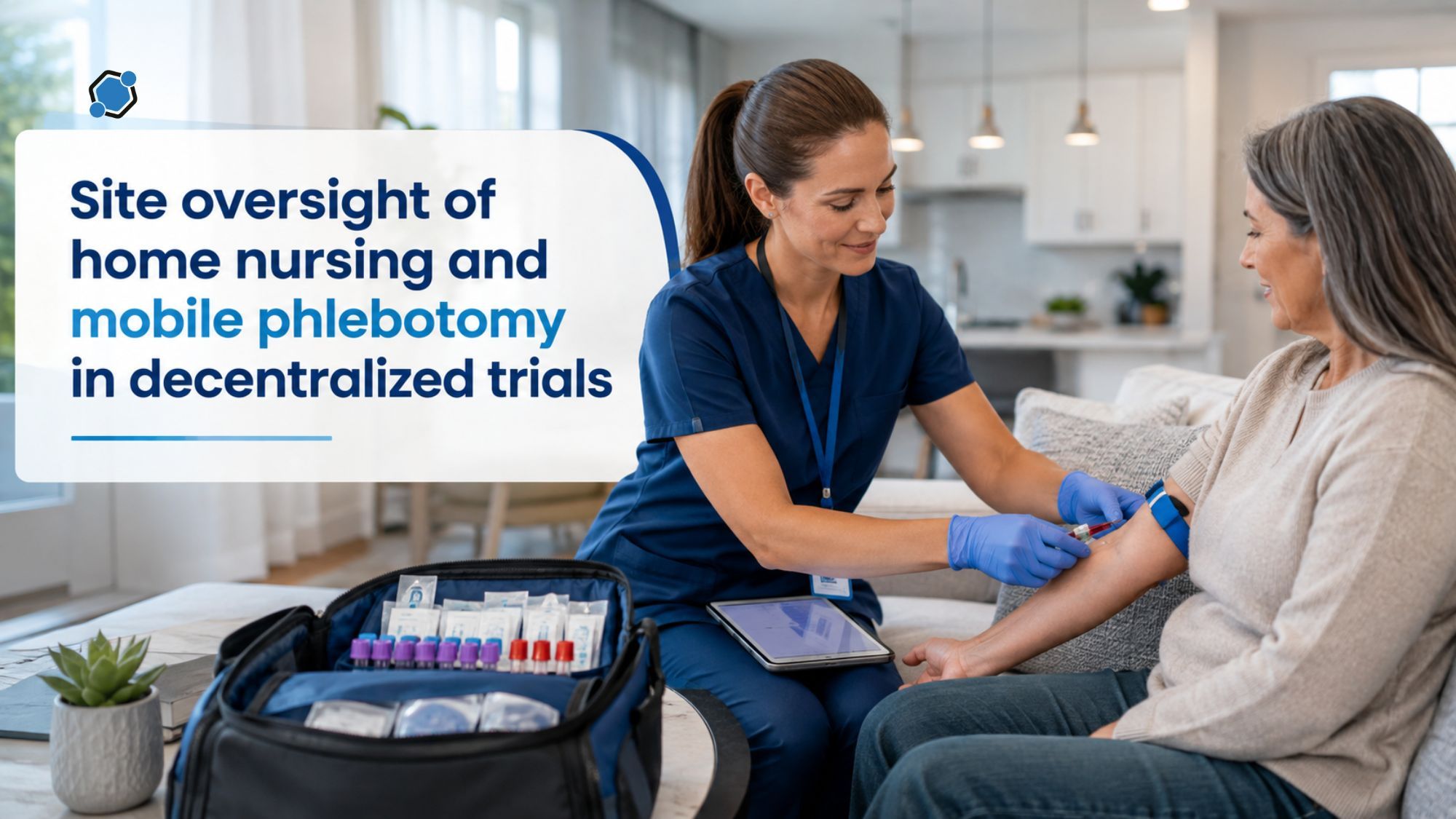
Home nursing visits and mobile phlebotomy have moved from pandemic-era experiments to routine features of hybrid and decentralized clinical trials. A nurse visits a participant's home to administer a study drug or capture vital signs. A phlebotomist arrives at a participant's kitchen table to collect the blood sample the protocol calls for. The participant never leaves the house, and the site never sees the visit happen.
The regulatory framework does not change to accommodate that shift. Under 21 CFR Part 312, Form FDA 1572, the FDA's September 2024 final guidance on decentralized clinical trials, and ICH E6(R3), the investigator remains accountable for participant safety and data integrity no matter where the visit takes place. Tasks can be delegated. Responsibility cannot.
For research sites, that raises a specific operational question. When a third party performs protocol activities in a location the site has never inspected, what does oversight look like, and how is it evidenced when a monitor or inspector asks? This article walks through the delegation, documentation, communication, and monitoring practices that keep site accountability intact off-site.
What home nursing and mobile phlebotomy visits include
A home nursing visit sends a qualified nurse, typically a registered nurse or licensed practical nurse, to a location convenient for the participant. That location is usually the home but can be a workplace, a community setting, or a private clinic. Depending on the protocol, the nurse performs vital sign measurements, physical assessment, investigational product administration by injection, infusion, or oral route, adverse event assessment, concomitant medication review, source document creation, and electronic patient-reported outcome capture. Some visits also include blood draws with on-site processing and shipment.
Mobile phlebotomy is narrower in scope. A certified phlebotomist or nurse comes to the participant to collect blood or urine samples per the protocol schedule. Order-of-draw, two-identifier labeling, chain-of-custody initiation, and controlled transport to the central laboratory sit at the center of the workflow. The clinical judgment involved is smaller than a home nursing visit; the sample integrity requirements are just as strict.
Both services fit inside decentralized and hybrid clinical trial designs. A fully decentralized trial runs without in-person site visits. A hybrid trial mixes on-site visits with remote or home-based activities and is currently the dominant model. Site teams evaluating which activities move off-site will find further context in Hybrid clinical trial visits: how research sites decide what stays on-site and what goes remote.
Are home nursing visits the same as telehealth visits?
No. A telehealth visit is a video or phone interaction between the participant and a study team member. A home nursing visit is an in-person visit to the participant's location by a nurse who performs hands-on procedures. Some protocols use both, sometimes on the same day, but the oversight requirements differ. Telehealth visits generate site-attributable source documents directly. Home nursing visits generate source documents through a third party, which is the coordination gap this article addresses.
Why site accountability stays with the investigator off-site
Form FDA 1572 is the investigator's binding commitment to the sponsor and to the FDA. It states that the study will be conducted according to the signed protocol and applicable regulations, and that the investigator will supervise all personnel who assist in the conduct of the study. Nothing in the form makes an exception for procedures performed by a third-party nurse or phlebotomist.
The FDA's September 2024 final guidance on decentralized clinical trials confirms the point directly. Investigators are responsible for the conduct of the trial and for protecting the rights, safety, and welfare of participants. They must ensure that trial-related activities delegated to local healthcare providers are conducted according to the investigational plan and applicable regulations, and they remain responsible for the adequate supervision of those to whom they have delegated those activities. ICH E6(R3), adopted by ICH in January 2025 and adopted by the FDA in September 2025, reinforces the same principle: transferring or delegating an activity to a service provider leaves the responsibility for the conduct of the trial with the sponsor or investigator.
The FDA guidance also draws a useful distinction between two categories of home-visit staff. Local healthcare providers performing tasks within routine clinical practice, such as taking vital signs, do not need to be listed on Form FDA 1572 and do not require detailed protocol knowledge. Staff who contribute directly and significantly to the trial data, such as those assessing adverse events, applying a protocol-defined scoring system, or administering the investigational product, are subinvestigators and must be listed on the form. Sites should classify each home-visit role against this distinction before the first visit occurs. For sites building the wider quality management picture that surrounds this classification, ICH E6(R3): a plain-English readiness guide for research sites covers the framework in detail.
Delegation, training, and source documentation that hold up in audit
Once the role categories are set, the paperwork has to match. Where the protocol or sponsor requires third-party home-visit staff to be listed on the site's delegation of authority log, the site should collect and file the supporting documentation before the first visit. Curriculum vitae, current professional license, Good Clinical Practice training certificate, protocol-specific training records, and, for anyone handling shipments, IATA dangerous goods training all belong in the investigator site file.
Practice varies on whether third-party home-visit staff appear on the site delegation log or on a sponsor-completed log copied to the site. The FDA guidance suggests the log is not required for local healthcare providers performing routine-practice tasks, but many institutional standard operating procedures and sponsor protocols still require it. Sites should resolve this in writing per study. The written answer, whatever it is, protects the site in an audit.
Source documents created off-site have to reach the site file promptly and completely. Same-day transmission is a common expectation, allowing the investigator to conduct a preliminary safety review before the next study day. A source document locator, filed in the investigator site file, identifies what data is considered source, where it lives, and how it moves. Monitors need to know where to look, and inspectors need to see the trail without gaps.
Monitoring plans are the third piece. Audit reviews of decentralized studies have repeatedly found that monitoring plans included no explicit instructions for verifying home-visit source documents, which turns a solvable coordination problem into a finding. Sites can catch this early by confirming the plan explicitly addresses decentralized services before enrollment opens. Building this into a broader inspection-readiness posture is covered further in What is continuous inspection readiness? A research site guide to eTMF audit-proofing.
Do home-visit nurses need to be on the site's delegation log?
It depends. FDA guidance states that local healthcare providers performing routine-practice tasks, such as taking vital signs, do not need to be on the site delegation log. Staff performing subinvestigator-level activities, such as adverse event assessment or investigational product administration, should be on the log with full training documentation on file. Institutional standard operating procedures and sponsor protocols sometimes require every home-visit nurse on the site log regardless. Sites should confirm the requirement in writing with the sponsor per study rather than defaulting to a general answer.
Real-time visibility across visits, samples, and safety escalation
The investigator cannot supervise what the site cannot see. Real-time visibility across scheduled visits, sample status, and adverse events is what makes off-site oversight practical rather than theoretical. Clinical trial management systems that combine visit tracking, alerts for approaching visit windows, and investigational product expiry warnings pull that visibility into one operational view. Clinical Trial Management Systems: The Backbone of Site Operations walks through the operational fit.
Sample tracking sits alongside visit tracking. Pre-made kits shipped from the central laboratory, continuous temperature monitoring during transport, courier logistics with delivery confirmation, and laboratory receipt notifications together close the loop between the participant's home and the analysis pipeline. Temperature excursions caught in transit can be resolved. Excursions discovered weeks later at analysis usually cannot.
Safety escalation is the third layer of visibility. A written standard operating procedure should define which findings trigger immediate contact with the principal investigator, which channels are used, and what timeframes apply. Participants should have a single, clear point of contact if a concern arises after the nurse or phlebotomist leaves. Remote observation of home visits by videoconference, endorsed by the FDA guidance for supervising trial personnel performing tasks like fitting sensors or documenting lesions, adds another spot-check option without adding a site visit.
Failure modes sites can catch and prevent early
A short list of failure modes accounts for most of the trouble sites encounter with home nursing and mobile phlebotomy visits. Naming them in advance makes prevention easier.
Missed visits and out-of-window visits are the most common. A missed visit never occurred before the next window opened. An out-of-window visit occurred, but late. Both are protocol deviations, and clinical importance varies: a late routine questionnaire is not equivalent to a missed pharmacokinetic safety draw. Dashboard alerts, reminder systems, and clear visit-window rules shared with the vendor prevent both.
Temperature excursions on samples or on the investigational product can invalidate an analysis or a dose. Validated packaging, continuous monitoring, and pre-approved contingency plans reduce the risk. Incomplete source documentation, whether missing signatures, missing timestamps, or notes that never made it back to the site, is often caught late. Same-day transmission and a source document locator prevent late discovery.
Adverse events that are not escalated promptly create both a safety concern and a regulatory concern. Explicit escalation thresholds and named points of contact in the vendor operating manual reduce ambiguity in the moment. Investigational product accountability gaps, particularly on direct-to-participant and direct-from-participant shipments, are a recurring audit finding. Investigator authorization for release, receipt confirmation, and documented return or disposal close the accountability chain.
Participant confusion about roles is a quieter failure mode. When multiple parties interact with a participant, unclear communication about who is who erodes trust and can slow safety reporting. Role-clarity communication and a single point of contact prevent it. Vendor communication gaps between operations teams and the site coordinator prevent everything else from working. Scheduled study team calls with the vendor and named coordinators on both sides are the baseline. Related patterns and prevention practices at the participant intake stage are covered in Top 5 Ways to Reduce Screen Failures at Research Sites.
How DecenTrialz supports site-led recruitment and pre-screening
Home nursing and mobile phlebotomy coordination is one variable in a larger site workload. Recruitment quality is another. When a site enrolls better-matched participants from the outset, operational energy spent on ineligible referrals, screen failures, and repeat outreach is freed up for the parts of the study that require investigator attention, including home-visit oversight.
DecenTrialz supports this stage of the workflow through AI-assisted participant matching and registered nurse-led pre-screening. Prospective participants are matched against protocol criteria, and registered nurses conduct structured pre-screening conversations before a referral reaches the site.
Final eligibility determination, informed consent, study walk-through, and enrollment always belong to the research site team.
Sites that want to see how the pre-screening layer fits alongside their existing recruitment workflow can review the platform at decentrialz.com.
Partner with DecenTrialz to strengthen your participant pipeline
Coordinating home nursing and mobile phlebotomy without losing oversight is complex enough on its own. Recruitment quality does not need to add to that load. A steadier pipeline of pre-screened, better-matched participants lets site teams put oversight capacity where it matters most.
Research sites interested in a recruitment and pre-screening layer that respects site accountability from the first contact can start at decentrialz.com.
Was this article helpful?

Similar Blogs

What research sites need to know about central IRBs, local IRBs, and reliance agreements
A multisite clinical trial used to mean one protocol and many separate ethics reviews. Eac...
 Anish Teepireddy
Remote eConsent for research sites: what compliance requires beyond the electronic signature
Electronic informed consent, often shortened to eConsent, is now standard at many research...
 Swaroop ESD
Clinical Nurse Specialist Recognition Week 2026: What Is a CNS and Why Does the Role Matter?
September 1 is the birthday of Hildegard Peplau, an American nurse and theorist who argued...
Vamshi KantojuStay Informed. Stay Connected.
Get updates on verified clinical trials, emerging treatments, and research breakthroughs directly in your inbox. No spam, just science that matters.
