 HIPAA Compliant
 ISO 27001 Certified
Efficacy vs. Effectiveness in Clinical Trials: Why One Drug Can Have Two Different Numbers
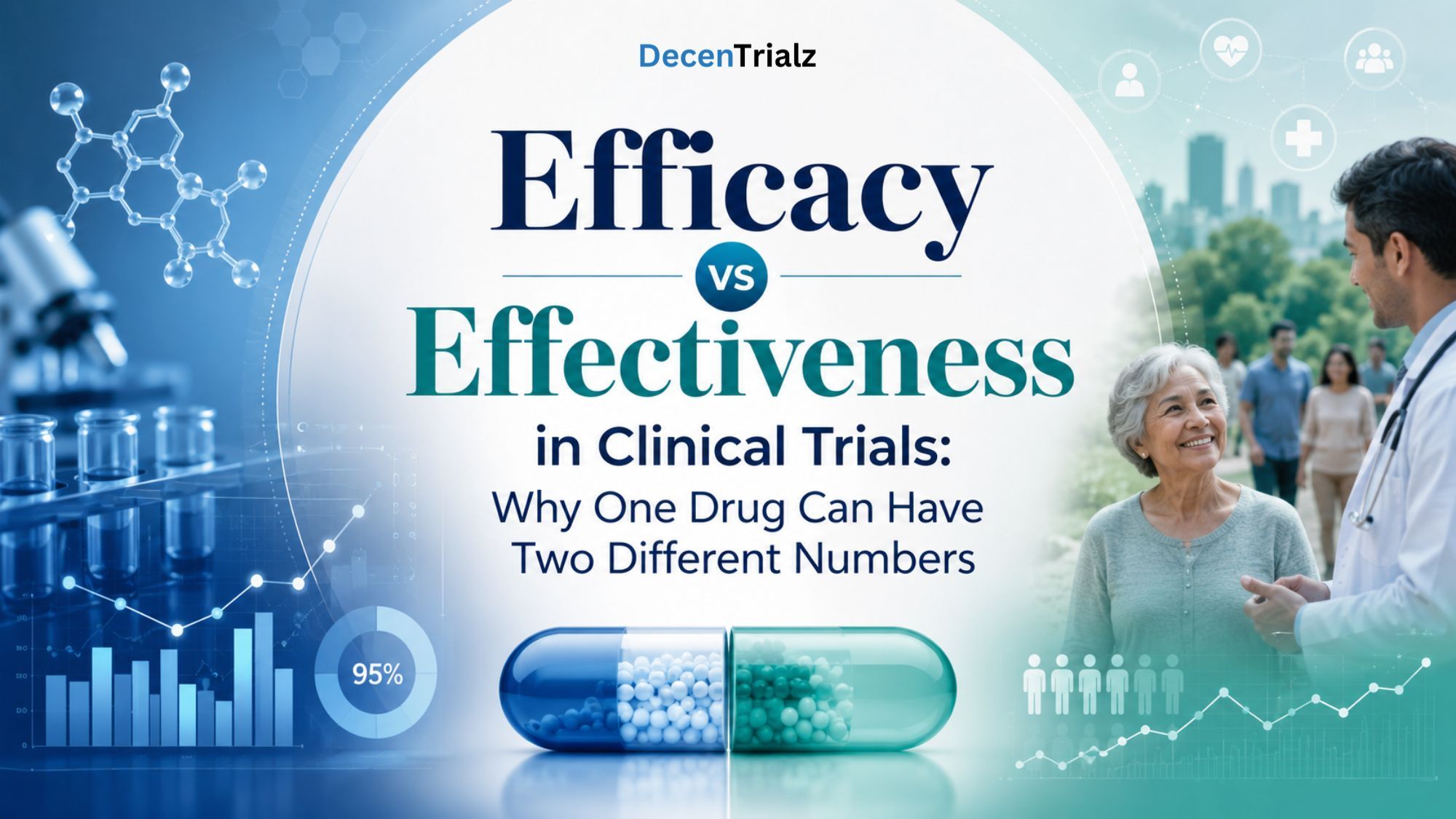
Two terms in clinical research describe how well a treatment works: efficacy and effectiveness. They sound similar, and they are often used interchangeably outside research settings. In clinical research, they describe two different things, measured under two different sets of conditions, with two different methods. The same treatment can produce two different numbers depending on which is being measured. For anyone reading a trial result or considering whether to take part in a clinical study, the difference matters.
What Efficacy Means in a Clinical Trial
Efficacy is how well a treatment works under the carefully controlled conditions of a clinical trial. Researchers select a specific group of participants based on detailed eligibility rules. They monitor when and how the treatment is taken, track participant responses closely, and compare results in the group receiving the treatment to results in a comparison group receiving a placebo or an existing standard treatment. The percentage that emerges from this comparison is the efficacy figure.
COVID-19 vaccines offer a recent illustration. Early efficacy figures in the range of 94 to 95 percent were calculated by comparing infection rates in participants who received the vaccine to infection rates in participants who received a placebo. Each figure reflected what the vaccine did in the specific group of people studied, under the specific conditions of the trial. The results were real and measured precisely. They were also results from one defined setting, not a prediction of what the vaccine would do in every population, in every environment, over every time period.
What Effectiveness Means After the Trial
Effectiveness is how well a treatment works once it is being used in everyday life, outside the controlled setting of a trial. The same drug is now prescribed by clinicians of varying experience, taken by patients with varying levels of consistency, used by people with health conditions and other medications that the original trial may have excluded, and stored or administered under conditions that vary across pharmacies, clinics, and homes.
Researchers measure effectiveness using observational studies, registries, electronic health records, and insurance claims data. These methods look at what actually happens when a treatment is used in the broader population, without the controlled comparison conditions of a randomized trial. The Centers for Disease Control and Prevention, for example, runs a national network that estimates flu vaccine effectiveness each season by tracking who got vaccinated, who got sick, and what the difference looks like across age groups and virus types.
Because the methods are different and the population is different, the effectiveness number often differs from the efficacy number reported earlier. This is expected, not a sign that something went wrong.
Why the Same Drug Can Have Two Different Numbers
The gap between efficacy and effectiveness is not a flaw in either measurement. It is a predictable result of how clinical trials are designed. Four factors shape the difference.
- Trial populations are narrower than the populations that eventually use the treatment.
- Compliance with the treatment regimen is tighter in trials than in everyday life.
- Administration conditions, including storage, timing, and dosing, are tightly controlled in trials.
- Demographic representation in trials may not match the broader real-world population.
Trial populations are narrower than real-world populations. Clinical trials commonly exclude people with multiple chronic conditions, people taking certain other medications, very elderly or very young patients, pregnant patients, and people facing barriers to consistent follow-up. Once a treatment is approved, it is used by all of those groups.
Compliance is tighter in trials. Participants are reminded, monitored, and supported in ways that everyday patients are not. In real life, people miss doses, stop early, or take medications inconsistently. Roughly 50 percent of patients prescribed statins for cholesterol management discontinue them within the first year. A drug that looks highly effective when taken consistently in a trial cannot produce the same population-level effect when half of patients stop taking it.
Administration conditions are controlled in trials. Vaccines are stored at exact temperatures, drugs are given at specified intervals, and side effects are tracked in real time. In the real world, storage breaks happen, dose intervals slip, and reactions get reported unevenly.
Demographic representation varies. Trial populations have historically underrepresented older adults, women, racial and ethnic minorities, and people with multiple health conditions. The real-world population includes all of them, and treatment responses can differ across groups.
The seasonal flu vaccine illustrates these factors in combination. Effectiveness measured by the Centers for Disease Control and Prevention typically falls between 30 and 60 percent depending on the season, the age group, and which virus strains are circulating. The number reflects strain mismatch, variation in immune response by age, and the conditions of real-world administration. The vaccine still prevents tens of thousands of hospitalizations and thousands of deaths every year in the United States. Lower than peak efficacy is not the same as not working.
The gap can also be small. Direct-acting antiviral medications for hepatitis C show cure rates above 95 percent in clinical trials, and observational studies report real-world cure rates that are also above 95 percent. When a treatment is well tolerated, the regimen is short, and patients complete it, efficacy and effectiveness converge closely.
How the FDA Tracks Effectiveness After Approval
In the United States, the Food and Drug Administration approves drugs and biologics primarily on the basis of efficacy data from controlled clinical trials. That is the threshold for getting a product onto the market. The regulatory process does not stop at approval.
Phase IV studies, sometimes called post-marketing surveillance, continue once a drug is in widespread use. They track safety, long-term outcomes, and how the drug performs across broader populations. Some Phase IV studies are required by the FDA as a condition of approval. Others are conducted to detect rare adverse events that only become visible once millions of people have taken the drug.
The 21st Century Cures Act, signed into law in December 2016, directed the FDA to evaluate real-world evidence as part of regulatory decisions, including approvals for new uses of existing drugs and post-approval study requirements. The FDA published its framework for the Real-World Evidence Program in December 2018 and has issued ongoing guidance since.
Real-world evidence is built from real-world data: electronic health records, medical claims, product and disease registries, and increasingly from wearable devices and patient-reported outcomes. These sources let researchers track what actually happens after a treatment enters general use, in populations and settings that any single trial could not fully represent.
The point worth carrying forward is this. The gap between efficacy and effectiveness is studied on purpose by regulators. Efficacy data answers whether a treatment can work. Effectiveness data answers whether it does, for whom, and under what conditions. Both questions matter, and both are part of how the system is designed to function.
What This Means for You as a Patient or Trial Participant
A number attached to a clinical trial result describes what was observed in the trial population under the trial's specific conditions. It is not a personal prediction. Two people with the same diagnosis can respond differently to the same treatment, based on their health history, other medications they take, their age, and how the treatment fits into their daily life.
For someone considering participation in a clinical trial, the difference between efficacy and effectiveness matters in three practical ways.
First, efficacy figures from completed trials describe what a treatment did for a specific group of people under controlled conditions. Your own response, if you were to receive the treatment, would depend on your specific circumstances, not on the trial average.
Second, the eligibility and pre-screening process for any trial exists in part to identify whether your situation aligns with what the study is designed to measure. The pre-screening conversation, often led by a study nurse, is where details about your medications, health conditions, and history are evaluated against the trial's specific criteria.
DecenTrialz approaches this stage with AI-assisted matching and nurse-led pre-screening, designed to understand a person's full picture before any referral is made to a research site.
Third, the gap between efficacy and effectiveness is one reason that direct questions about a trial deserve direct answers. If a study reports a high efficacy number, that does not mean every participant in the trial benefited equally, and it does not mean every future patient will. Asking what the result means for someone in your specific situation is a reasonable question for any study team.
Was this article helpful?

Similar Blogs
Blood Pressure Numbers: What Do Systolic and Diastolic Actually Mean?
A blood pressure result contains two numbers, and most people are never told what either o...
 Paramraj
National HIV/AIDS and Aging Awareness Day 2026: What Aging With HIV Looks Like Today
The population of people living with HIV in the United States has aged in a way few would ...
Mahesh Upadrista
Prediabetes symptoms: what the early signs are and how prediabetes is reversed
Prediabetes means blood sugar is higher than normal, but not yet high enough to be called ...
Deeksha GittaStay Informed. Stay Connected.
Get updates on verified clinical trials, emerging treatments, and research breakthroughs directly in your inbox. No spam, just science that matters.
