 HIPAA Compliant
 ISO 27001 Certified
Healthy Aging Month 2026: what it is and how older adults can join clinical research
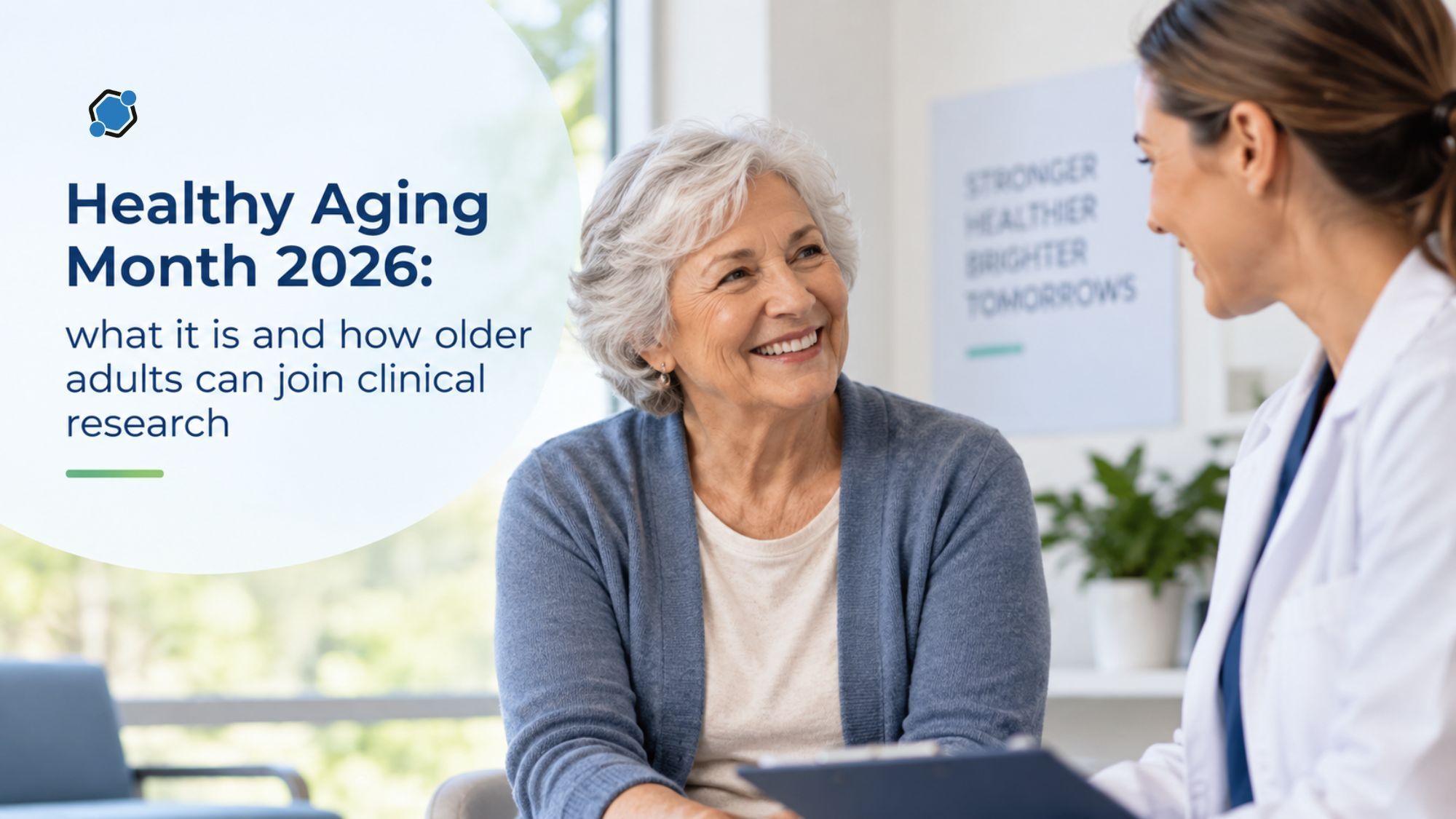
Curiosity has no age limit. That message anchors Healthy Aging Month 2026, the September observance that invites adults across the United States to take an active role in how they age. The observance reframes growing older as a season of possibility, not decline, and it draws attention to the physical, mental, social, and financial choices that shape well-being in later life.
Healthy Aging Month is also a useful moment to consider the role of clinical research in aging well. Most medicines and study procedures that older adults rely on were tested in trials that, until recently, enrolled younger participants far more often. This article explains what Healthy Aging Month is, the everyday pillars that support aging well, and how clinical research is beginning to include older adults more meaningfully.
What Healthy Aging Month is
Healthy Aging Month is a national observance held every September. It was founded in 1992 by the editor of a leading magazine on aging, who wanted a positive, forward-looking counterpart to the more clinical framing that dominated conversations about later life at the time. September was chosen deliberately, as a kind of grown-up back-to-school moment when adults are often ready to reset routines and take stock of their health.
The observance focuses on adults 45 and older, though its themes reach every age group. It emphasizes four dimensions of well-being: physical, mental, social, and financial. In 2021 the United States Senate formally recognized September as Healthy Aging Month through a unanimous resolution, and community organizations, workplaces, senior centers, libraries, and health systems now mark the month with programs, screenings, classes, and educational campaigns.
The 2026 theme is Curiosity Has No Age Limit, a call to keep learning, exploring, and connecting throughout life. Curiosity is not simply a mood; it is a documented driver of cognitive engagement and social connection, both of which are linked to healthier aging. Adults new to conversations about clinical research may also find it useful to review how clinical trials work before exploring the research angle later in this article.
The everyday pillars that support aging well
Healthy Aging Month rests on a well-studied set of daily habits. Physical activity sits at the center. Federal guidelines recommend that older adults aim for regular aerobic movement most days of the week, along with strength training on multiple days and balance exercises that reduce the risk of falls. Even light daily movement can improve mobility, mood, and cardiovascular health over time.
Nutrition is another cornerstone. A pattern rich in vegetables, fruits, whole grains, lean protein, and healthy fats supports metabolic health, cognitive function, and bone strength. Older adults often benefit from paying particular attention to protein intake, hydration, and vitamin D and calcium sources, since nutritional needs shift with age.
Sleep is easy to underestimate. Consistent, restorative sleep supports memory, immune function, mood, and physical recovery. Difficulty sleeping is common in older adults, but persistent problems should be discussed with a healthcare professional rather than accepted as an inevitable part of aging.
Cognitive engagement and social connection deserve equal weight, and they map directly to the 2026 theme. Lifelong learning, hobbies, meaningful work, and staying connected to friends, family, and community are all linked to better brain health in later life. Loneliness and prolonged social isolation, on the other hand, are associated with higher risks of cognitive decline, depression, and heart disease.
Preventive care ties the pillars together. Routine checkups, blood pressure monitoring, recommended cancer screenings, dental and vision care, and up-to-date vaccinations reduce the chances that manageable issues turn into serious ones. Fall prevention, medication review, and managing chronic conditions such as high blood pressure, diabetes, or arthritis are also central to independent, engaged aging. Many of these choices overlap with everyday healthy habits that support wellness across all life stages.
Two clinical terms are worth knowing here. Comorbidity refers to having more than one health condition at the same time, which is common in older adults. Polypharmacy refers to routinely using multiple medications, generally five or more. Both are ordinary features of later life, and both are relevant to how clinical research enrolls and cares for older participants.
Why older adults matter in clinical research
Most medicines, devices, and study procedures used by older adults were tested in earlier clinical trials. Yet older adults have historically been underrepresented in research relative to the burden of illness they carry. This matters because the way the body processes a study drug can change with age, and because the presence of multiple conditions or medications can influence both safety and effectiveness. Without adequate data from older participants, dosing, side effects, and benefits in this population remain less well understood.
The U.S. Food and Drug Administration has issued formal guidance encouraging the inclusion of older adults in clinical research, with particular attention to adults 75 and older. Several structural barriers still limit participation: restrictive eligibility criteria, complex consent forms, transportation and visit burden, and caregiving responsibilities at home. Readers interested in how criteria are set can review why eligibility rules exist and how those rules balance participant safety with the goals of the study.
How decentralized trials expand access for older adults
Decentralized and hybrid trial models are helping to close the age gap in research. In these designs, some study activities take place outside a traditional research site through telehealth appointments, remote monitoring devices, and visits from a registered nurse at the participant’s home. For older adults with mobility limits, multiple conditions, or caregiving obligations, this design reduces travel and can make participation feasible where it once was not.
A closer look at home nursing visits shows how these appointments typically work, from a nurse arriving at a scheduled time to collect information and perform simple assessments, to communicating results back to the research site team. Wearable devices and secure participant apps can also track relevant health signals between visits, which further reduces the number of in-person appointments required.
DecenTrialz supports the early stages of this experience. Adults can share information about their health, get matched to studies through an AI-assisted process, and speak with a registered nurse who completes an initial pre-screening review. From there, a referral is made to the research site team. Final eligibility determination, informed consent, the study walk-through, and enrollment are always handled by the research site team. The role of the platform is to make it easier for people to explore whether research participation is a fit, not to replace the medical judgment of the site.
How participation contributes beyond the individual
Older adults who choose to participate in a clinical study contribute to something larger than their own experience. Their participation shapes the evidence base for the next generation of medicines and study procedures, and it improves how research benefits public health across the population. When older adults are represented in a study, the resulting data more accurately reflect how a therapy will behave in real-world use, particularly in patients with several conditions or medications.
Participation also helps researchers understand aspects of aging that only older adults can teach. Balance and gait patterns, cognitive resilience, medication interactions, and the way multiple conditions cluster together are all better characterized when older adults are included from the start rather than added as an afterthought. Healthy Aging Month is one moment in the calendar to consider whether participation might be a meaningful contribution to make.
Frequently asked questions
What is Healthy Aging Month?
Healthy Aging Month is a national observance held every September, founded in 1992 to focus attention on the positive aspects of aging, particularly for adults 45 and older. It emphasizes physical, mental, social, and financial well-being.
When is Healthy Aging Month observed?
Healthy Aging Month is observed each September in the United States. The 2026 theme is Curiosity Has No Age Limit.
Who founded Healthy Aging Month?
Healthy Aging Month was founded in 1992 by the editor of a national magazine dedicated to aging, as a positive counterpart to the more clinical framing that dominated conversations about later life at the time.
What are the pillars of healthy aging?
The commonly cited pillars are physical activity, nutrition, sleep, cognitive engagement, social connection, preventive care, fall prevention, and management of chronic conditions. Mental health support and up-to-date vaccinations are often included as well.
Can older adults join clinical trials?
Yes. Older adults can and increasingly do participate in clinical research. Eligibility depends on the specific study, the participant’s health history, and the protocol. Regulators actively encourage broader inclusion of older adults.
What do comorbidity and polypharmacy mean?
Comorbidity means having two or more health conditions at the same time. Polypharmacy means routinely using several medications, generally five or more. Both are common in older adults and are considered during study eligibility review.
What does a registered nurse pre-screening involve?
A registered nurse reviews basic health information a person has shared, explains what a study may involve, and helps determine whether it makes sense to refer that person to the research site team for a formal eligibility review.
How do decentralized trials help older participants?
Decentralized designs use tools such as telehealth, home visits from a nurse, and remote monitoring to reduce travel and visit burden. This can make participation more accessible for older adults who face mobility, transportation, or caregiving challenges.
Taking the next step this September
Healthy Aging Month is a prompt, not a prescription. Aging well is built from many ordinary choices: how a person moves, eats, sleeps, connects, and cares for their health across the years. Clinical research is one more way adults can shape the future of medicine, and it becomes more meaningful when older participants are represented in the studies that will inform their own care and the care of others their age.
Adults exploring participation can start by learning what is available, asking questions of their healthcare team, and sharing information with a platform that can help identify potentially relevant studies. Curiosity, after all, does not have an age limit, and neither does the opportunity to contribute to research that will benefit future generations.
Was this article helpful?

Similar Blogs
Why is my blood pressure still high on medication? Resistant hypertension explained
Blood pressure that stays high after treatment has already started is more common than mos...
 Vamshi Kantoju
What is insulin resistance and how does it affect blood sugar?
Insulin resistance is a condition in which muscle, liver, and fat cells respond weakly to ...
Swaroop ESD
Mini-stroke symptoms: how to recognize a transient ischemic attack before a full stroke
A transient ischemic attack, often called a mini-stroke, is a short episode of stroke symp...
Deeksha GittaStay Informed. Stay Connected.
Get updates on verified clinical trials, emerging treatments, and research breakthroughs directly in your inbox. No spam, just science that matters.
