 HIPAA Compliant
 ISO 27001 Certified
International Nurses Day 2026: Nurses in Clinical Trials
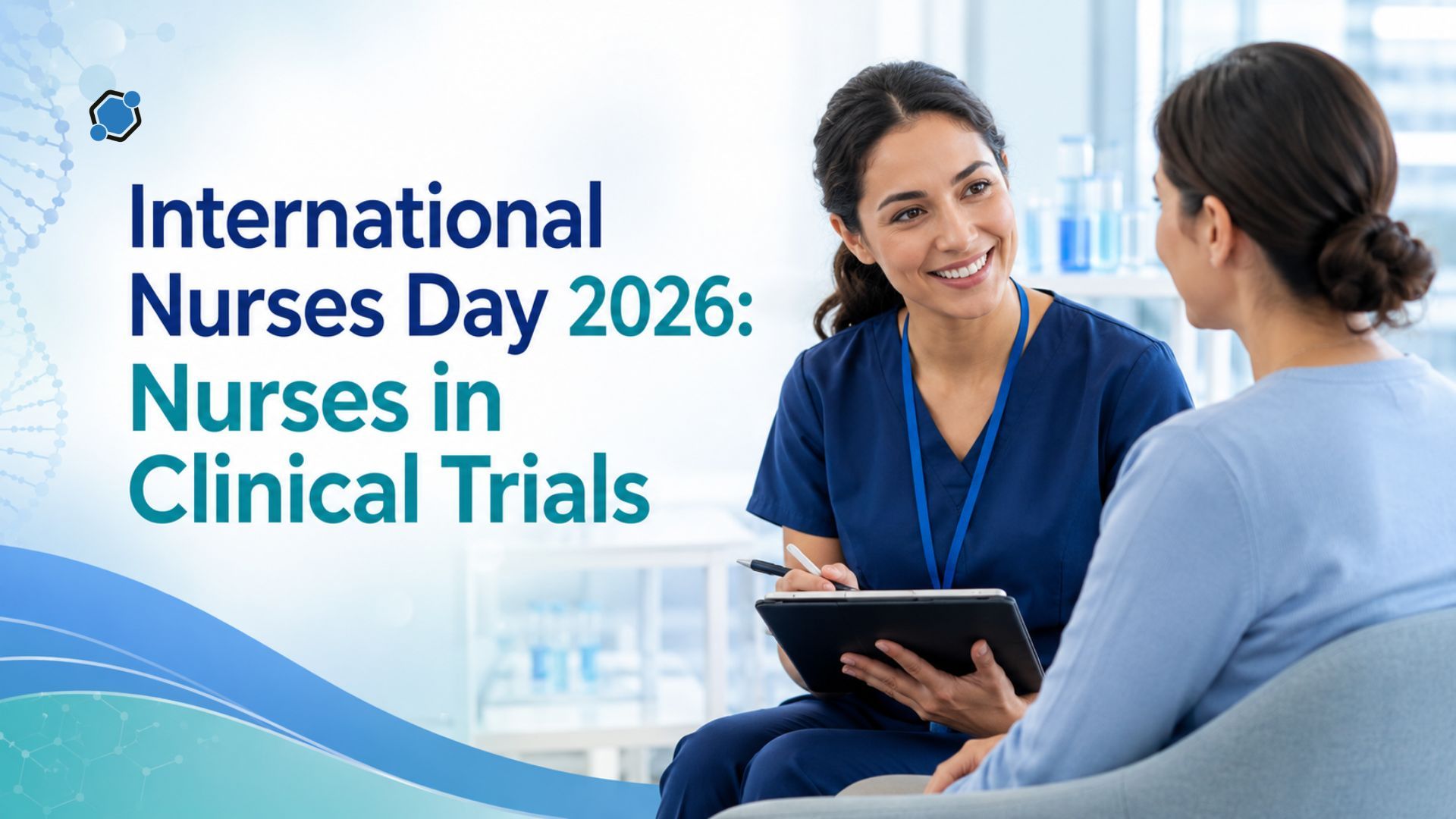
Most people who join a clinical trial expect their first conversation to be with a doctor. In practice, it almost always starts with a nurse. The nurse is the one who answers the initial call, walks through the study schedule line by line, reads body language across a video screen, and notices when a participant has a concern they have not put into words yet. Long before a doctor signs the informed consent form, a nurse has done most of the work that determines whether the participant feels ready to be there.
This is the practical reality behind the International Council of Nurses’ (ICN) 2026 theme for International Nurses Day, observed every May 12: “Our Nurses. Our Future. Empowered Nurses Save Lives.” In hospitals and primary care, the phrase sits comfortably alongside familiar nursing roles. In clinical research (the field that runs clinical trials, which are studies that test whether a new approach to preventing, diagnosing, or treating a health condition is safe and effective), it describes something more specific. It describes the people who hold the human relationship inside a trial together, while the medical side runs in the background.
This article looks at where nurses fit into clinical trials, why most participants meet a nurse first, and why the 2026 theme reads as a precise description of what clinical research nurses already do.
What International Nurses Day Is and Why the 2026 Theme Matters
International Nurses Day was first observed in 1965, and the International Council of Nurses, a global federation of national nurses associations, has coordinated it ever since. The date, May 12, is Florence Nightingale’s birthday. She is widely regarded as the founder of modern nursing.
The yearly theme shapes how the observance is discussed inside hospitals, public health agencies, and research institutions. The 2026 theme connects three ideas. The first is that nurses need to be invested in, through training, fair pay, and adequate staffing. The second is that empowered nurses translate directly into safer patient care. The third is that strong patient outcomes contribute to communities and economies that can support a healthy population. These ideas reinforce each other. A nurse who is overstretched cannot catch the subtle changes in a patient that a well-staffed nurse can. A nurse who has not had time to update their training cannot recognize newer adverse-event patterns. Investment is the prerequisite for safety, and safety is the prerequisite for the population-level outcomes the theme points toward.
For clinical research, the theme reflects a practical reality that is easy to miss from the outside. When a participant has a question between visits, a nurse usually answers it. When a participant needs an unscheduled check-in, a nurse usually decides whether the situation calls for a physician’s attention. When a participant feels something is off but cannot quite name what, a nurse is the one who hears it and figures out what to do next. Investing in nurses, as the 2026 theme calls for, is also investing in the people who keep clinical trials safe for the people inside them.
For readers entirely new to clinical research, the Clinical Trial Volunteers Guide: Your First Step Into Clinical Trials covers the basics of what a trial is and what participation looks like at a high level.
What Clinical Research Nurses Do (and Why Most Patients Meet One First)
A clinical research nurse is a registered nurse who works on clinical trials, sometimes alongside standard hospital or clinic care. Some hold a specialized certification in clinical research nursing. Others come from acute care, oncology, mental health, or community nursing, and they carry that experience into the research setting.
The structure of a trial puts a nurse at almost every point of contact a participant has with the study. The first conversation is usually a pre-screening call, often by phone or video, in which the nurse asks about health history, current medications, the participant’s diagnosis if relevant, and availability to follow the study schedule. The goal is to flag obvious mismatches before the participant makes a trip to the research site. After pre-screening comes the screening visit, a longer in-person appointment where eligibility is confirmed through health history review, physical assessment, and (depending on the protocol, the document that defines how a study is run) lab work or imaging. Most of that day is spent with a nurse.
If the participant is eligible and decides to proceed, the next major step is informed consent. The principal investigator (the licensed physician responsible for the study at a given site) signs the consent form, but the nurse is usually the one who walks through it in detail, explaining risks, benefits, the visit schedule, and the participant’s right to withdraw at any time. From there, the trial moves into its active phase. The nurse administers the study drug or device, takes vital signs before and after dosing, draws blood, records responses, and tracks how the participant is doing between visits. Even after the last dose, the relationship continues. Follow-up contact stretches for weeks or months, depending on the study, and the nurse keeps that channel open.
The reason most participants meet a nurse first, rather than the doctor leading the trial, is structural. Principal investigators are typically working clinicians whose time is limited during recruitment. Nurses carry the day-to-day participant relationship, while the principal investigator focuses on the clinical decisions only a physician can make. This is the same division of labor that runs in most hospitals and clinics. Clinical research borrows it because it works.
For a closer look at the criteria nurses are checking against during screening, Eligibility Explained: Why Not Everyone Qualifies for a Trial covers the categories that most often determine who can and cannot participate.
Why Nurse-Led Pre-Screening Matters for Participants
Pre-screening is the conversation that decides whether a participant should travel to a research site in the first place. On paper, it covers basic health history, current medications, the participant’s diagnosis if relevant, and a few questions about availability. In practice, it is the moment where a trained ear matters most.
A nurse can hear the difference between a medication name a participant mentions in passing and the same medication taken at a dose that would disqualify them from a study. A nurse can recognize when a participant’s description of “managed pretty well” actually means a recent flare-up that has not been documented yet. A nurse can also hear hesitation, which is often the early signal that the participant has not been told something they needed to know before agreeing to consider the trial.
This kind of listening is what reduces screen failures. A screen failure is the technical term for a participant making it to the screening visit and then not meeting one or more eligibility requirements. Screen failures are common, and they are not only an inconvenience for the research team. They cost the participant a half day or full day at the site, often after taking time off work or arranging transportation, only to learn they are not eligible. A well-run pre-screening conversation, led by a nurse who knows what to ask and how to ask it, prevents many of those wasted visits.
The screening visit itself builds on what the pre-screening covered. Your First Clinical Trial Screening Visit: What to Expect Step by Step walks through the visit in detail, including the assessments typically run and how the eligibility decision is made.
How Nurses Protect Patient Safety Throughout a Trial
The “Empowered Nurses Save Lives” half of the 2026 theme is not metaphorical. In a clinical trial, nurses are usually the first to notice when something is not right with a participant. They take vital signs before dosing, again afterward, and again at intervals across the visit. They ask about symptoms at every contact. They recognize the difference between an expected side effect that the protocol already describes and an unexpected effect that triggers an adverse event report (a documented medical issue that occurs during the trial, whether or not it turns out to be related to the study). They know when something needs to be escalated to the principal investigator and when a participant can be reassured and sent home.
What this looks like on a dosing day is a series of small, quiet checks: blood pressure before the first dose, pulse a few minutes after, a question about whether the participant is feeling lightheaded or unusually warm, a glance at color and breathing pattern. Nothing dramatic. The drama, if any, happens because a nurse caught something at the small-check stage and acted on it.
The same pattern extends between visits. The nurse keeps a continuous channel of communication with the participant through phone, secure messaging, or telehealth platforms, and coordinates with the participant’s regular healthcare team where the trial intersects with standard of care (the current accepted approach to managing a condition outside the trial). Documentation matters here as much as observation. A nurse who notices a pattern across three participants in the same week may be the first person to surface a safety signal the study team needs to investigate.
This role matters because participants may be receiving a study drug whose full safety profile is still being studied. A nurse’s clinical judgment is what catches problems before they become serious. The 2026 theme’s emphasis on empowerment is not abstract. An empowered nurse, with adequate staffing and clear authority to escalate concerns, is the difference between a problem caught at the small-check stage and a problem caught later.
For a clearer picture of how dosing day actually unfolds, Day 1 of a Clinical Trial: What Happens When the Study Begins walks through the morning-of arrival, the pre-dose checks, the first dose, and the monitoring that follows.
How to Find a Clinical Trial Where Nurses Guide You Through It
Most people considering a clinical trial want to know that a real person will walk them through the process before they commit to anything. That is a reasonable expectation, and it is also how well-run trials are designed to operate.
DecenTrialz is built around that expectation. You share basic information about yourself and the conditions you are interested in, get matched with clinical trials that may fit your situation, and a nurse pre-screens you before you are referred to the research team running a study. The research team makes all final eligibility and enrollment decisions, since they are the ones responsible for the participant’s care during the trial, and they are the ones who walk you through the specifics of the study before you sign anything. You can start a search at decentrialz.com.
A second path is to talk with your regular doctor. If you are being treated for a condition that has active research, your clinician may already know which trials are recruiting locally and which sites have a strong track record.
Before committing to any trial, it helps to know what questions to ask the research team. Top Questions to Ask Before Joining a Clinical Study covers the questions participants most often wish they had asked earlier, including questions about who their day-to-day contact at the site will be, which in most cases turns out to be a nurse.
Next Steps
International Nurses Day 2026 frames a recognition that runs through clinical research every day of the year. The nurse who answers the first pre-screening call, the nurse who walks through informed consent, the nurse who takes vital signs at dosing and follows up between visits: these are the people who turn a clinical trial into something a participant can actually engage with. The 2026 theme’s emphasis on empowerment is what makes that engagement safe.
If you are exploring whether a clinical trial might be right for you, you can begin a search at decentrialz.com. A nurse will pre-screen you before referring you to the research team for any study that may be a fit.
Was this article helpful?

Similar Blogs
Mini-stroke symptoms: how to recognize a transient ischemic attack before a full stroke
A transient ischemic attack, often called a mini-stroke, is a short episode of stroke symp...
 Deeksha Gitta
Breast Biopsy Procedure, types, and what to expect
A breast biopsy is a diagnostic step, not a diagnosis. When a mammogram, ultrasound, MRI, ...
Vamshi Kantoju
Mobile phlebotomy in clinical trials: how home blood draws work
Blood tests are one of the most common procedures in a clinical trial. They tell the study...
 Anish Teepireddy
Stay Informed. Stay Connected.
Get updates on verified clinical trials, emerging treatments, and research breakthroughs directly in your inbox. No spam, just science that matters.
