 HIPAA Compliant
 ISO 27001 Certified
What is National Cancer Survivors Day, and why does it speak to clinical research?
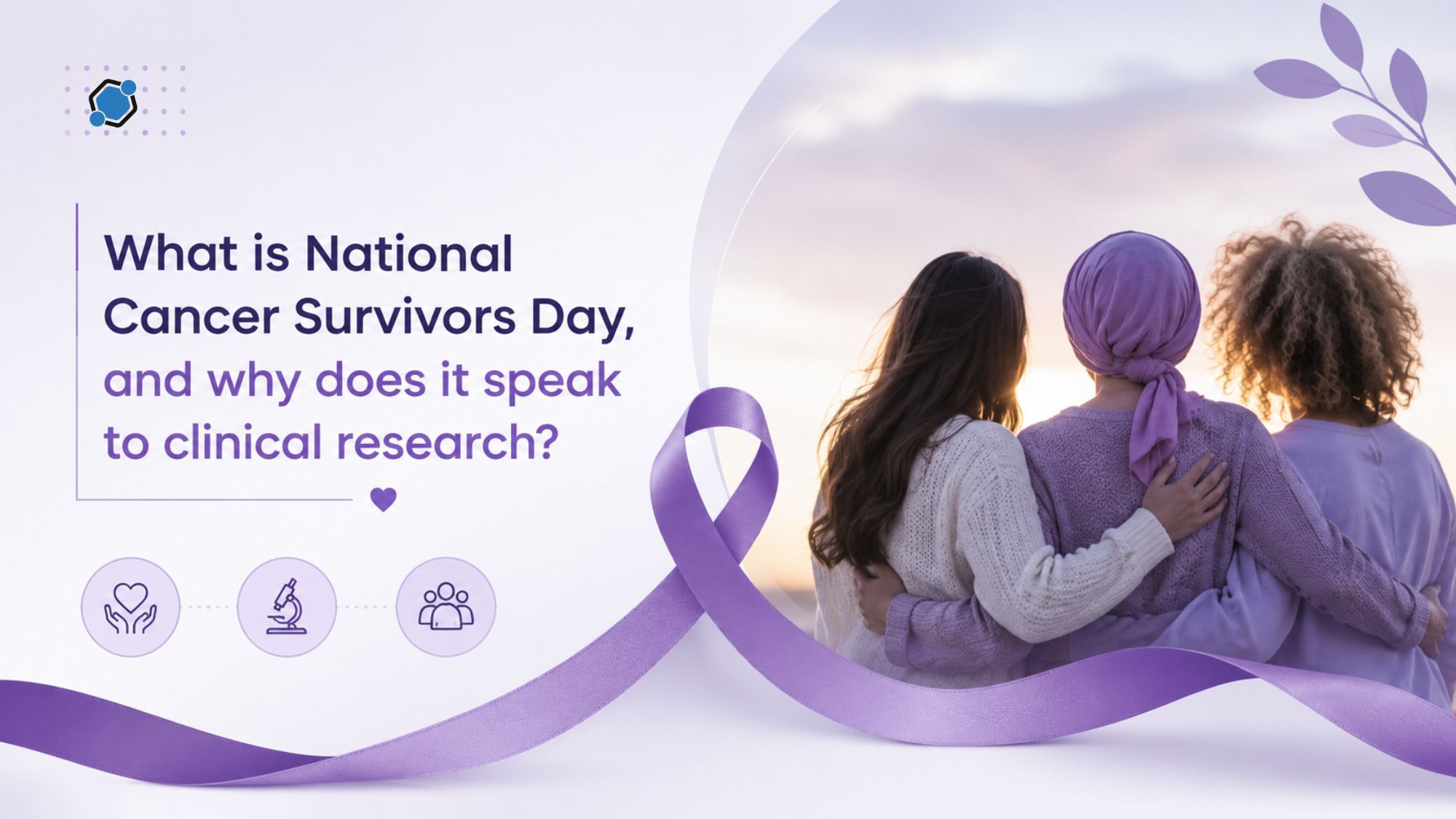
On the first Sunday of every June, communities across the United States, and increasingly around the world, hold quiet gatherings, parades, walks, and small kitchen-table moments to recognize the people in their lives who have lived with cancer. The day has a name, National Cancer Survivors Day, and a date this year of Sunday, June 7, 2026. What the day actually is, who counts as a cancer survivor, and where the observance intersects with the work of clinical research is less widely understood. This article walks through each.
What National Cancer Survivors Day is
National Cancer Survivors Day is an annual observance held on the first Sunday in June. It is organized by a U.S.-based nonprofit foundation that was created to give survivors, families, and supporting communities a shared moment of recognition each year. The day has grown beyond U.S. borders and now reaches at least twenty countries across five continents, with hundreds of community events held both publicly and privately on the same Sunday.
The observance is framed as a Celebration of Life with three connected purposes: celebrating the people who are still here, raising awareness of the ongoing challenges that come with a history of cancer, and inspiring hope for people newly diagnosed and for the families standing beside them. The day is open to everyone, not only to survivors themselves. Caregivers, friends, family members, healthcare professionals, researchers, and supporters all have a place in it.
What the day is not is also worth naming. It is not a fundraiser tied to a single charity, not a single political campaign, not an awareness day for a single cancer type. It is broader. It belongs to anyone whose life has been touched by cancer, whether through their own diagnosis or someone else's, and to the science that has made so many of these celebrations possible. A longer view of that science is laid out in How Clinical Trials Advance Medicine and Change Lives.
Who counts as a cancer survivor
The definition of cancer survivor used by the foundation behind this observance and by the National Cancer Institute is broader than most people expect. Anyone living with a history of cancer, from the moment of diagnosis through the rest of their life, is considered a survivor. A person who heard the words yesterday is a survivor. A person finishing chemotherapy this month is a survivor. A person twenty years past treatment with no signs of disease is also a survivor. They are all part of the same population.
Survivorship, in this medical sense, refers to the period that begins at diagnosis and continues for the remainder of life, including living through and beyond treatment. The term is not a label and not a verdict. It is a way of recognizing that a person's life and health care have been shaped by cancer in lasting ways.
The numbers are striking. According to federal cancer statistics, there are approximately 18.6 million cancer survivors living in the United States as of 2025, a figure that represents roughly 5.4 percent of the population and is projected to exceed 22 million by 2035. Among current survivors, around 70 percent have lived five years or more since their diagnosis, and 49 percent have lived ten years or more. About 22 percent are twenty or more years past diagnosis.
These numbers carry an important implication for clinical research. A growing share of the people walking into a research site this week are not newly diagnosed. They are years into a longer story, and the questions research can help answer are no longer only about how to treat the disease. Some of the most common worries that survivors and newly diagnosed patients carry about clinical studies are addressed in Clinical Trial Myths Busted: Facts Every Participant Should Know.
The challenges that continue after treatment
Cancer treatment, no matter how successful, often leaves changes that last well beyond the final infusion or the final surgical follow-up. Some of these changes are physical. Many are emotional. Some are financial. Together, they form what survivorship medicine calls the post-treatment landscape.
The physical changes include what specialists call late effects, which are side effects that emerge or persist months or even years after treatment ends. These can include long-lasting fatigue, peripheral neuropathy (nerve damage that often shows up as numbness, tingling, or pain in the hands and feet), cognitive changes sometimes called chemo brain, shifts in heart or lung function depending on the treatment used, and increased sensitivity in skin, joints, or organs that received radiation. Late effects are not predictable for every survivor, but their possibility is now a routine part of how survivors and their healthcare teams plan follow-up care.
The emotional changes are equally real. Many survivors carry an ongoing fear of recurrence, where every scan and every routine appointment can bring back the anxiety of the original diagnosis. Depression, identity shifts, and changes in relationships are also common. These are not weaknesses; they are well-documented features of life after a cancer diagnosis.
Survivors also live with a higher risk of second cancers, sometimes related to the original disease, sometimes to the treatment that addressed it, and sometimes to factors entirely separate. Long-term monitoring matters because of this.
Financial toxicity, the term survivorship researchers use for the long-term economic burden of cancer, can stretch well past the period of active treatment. Medical bills, insurance gaps, lost work hours, and ongoing follow-up costs add up. For some families, the financial weight of a cancer history is felt for years.
None of this is meant to diminish the celebration that anchors the day. Survival is real. But honesty about what comes after treatment is part of the same observance, and it is the reason research continues to engage survivors directly. A practical look at the steps that follow a completed trial, and at what survivors and follow-up care can look like, is set out in After the Trial: Next Steps and Follow-Up Care.
How clinical research connects to survivorship
Clinical research and cancer survivorship are connected in ways that go further than the trials that brought a new therapy to approval. Survivorship is itself an active research field, and a significant share of cancer studies recruiting today are specifically about what happens after the first round of treatment.
Several categories of clinical study are particularly relevant to people living with a history of cancer. Long-term follow-up studies track how survivors do over the years after treatment, observing for late effects, recurrence patterns, and quality-of-life outcomes. Late-effect management studies test ways to address the lasting side effects of cancer therapy, from heart-function support to nerve-pain treatments to cognitive rehabilitation. Quality-of-life and supportive-care studies examine fatigue, sleep, exercise, nutrition, and mental health interventions in survivors. Second-cancer prevention studies look at how to reduce the risk of a new cancer in people who already have a history of one. Surveillance studies focus on detecting recurrence earlier and more reliably than current monitoring allows.
Based on a search of public trial registries in May 2026, around 378 clinical studies focused on cancer survivorship are actively recruiting worldwide, with approximately 113 of those in the United States. The broader cancer research landscape is much larger; nearly 7,000 cancer-related clinical trials of all types are currently recruiting in the United States. These counts shift as studies open and close, so the exact numbers will look somewhat different a few months from now.
For research sites and study teams, the survivorship field is where long-term relationships with participants live. The person who was screened, consented, and treated in a study three years ago may now be a candidate for a follow-up study or a quality-of-life study run by the same team. The infrastructure that supports survivorship research, from registries to long-term monitoring protocols to coordinator continuity, is part of what keeps cancer research moving forward over decades rather than only over the years of a single trial. A short read on the kinds of cancer trials currently moving care forward is 5 Active Clinical Trials Advancing Cancer Care.
How to find a trial that fits
For a survivor wondering whether a clinical study might be relevant, there are a few practical realities worth knowing. The first is that eligibility for trials does not stop with treatment. Many studies recruit participants who are in remission, in long-term follow-up, or living with a stable cancer that is being monitored rather than actively treated. The second is that finding a trial that fits takes some structured help, because the cancer trial landscape is large and the eligibility criteria for any individual study are narrow.
DecenTrialz helps people in the United States find clinical trials that may fit their situation. After someone shares basic information about themselves and the conditions they are interested in, the platform may identify trial options that appear to match their profile. A registered nurse then completes an initial pre-screening review before the person is referred to the research site running the study. The research site and study team handle the walk-through of study details, the final eligibility check, the consent conversation, and enrollment, since they are the ones responsible for the participant's care during the trial. You can start a search at decentrialz.com.
A doctor or oncology team can also be a starting point, particularly for survivors who already have a long-term relationship with a specialist who may know about studies in their area. Both paths are valid, and survivors are encouraged to use whichever fits their situation best. A step-by-step picture of how the trial-search and enrollment process generally unfolds is set out in How to Find and Enroll in a Clinical Trial: A Step-by-Step Guide.
What the day asks across the cancer community
National Cancer Survivors Day is, at its heart, a recognition. It recognizes the people who have lived through a cancer diagnosis and the people who have stood with them. It recognizes that survivorship continues after the active treatment ends, and that the challenges of living with a history of cancer are real and worth naming out loud. It recognizes that the science behind survivorship is ongoing, and that the people the science depends on are the people the day is built around.
For survivors and their families, the day is an invitation. Some celebrations are large and public; others are private and quiet. Both count. There are no expectations attached to how someone marks the day.
For research sites, study teams, healthcare professionals, and the broader clinical research community, the day is a reminder that the work of recruitment, pre-screening, consent, dosing, and follow-up does not end at last patient out. It continues into the years that come after, into the long-term outcomes that the participants in those studies are still living through.
If you are a cancer survivor or supporting one and are thinking about whether a clinical study might fit your situation, you can begin a search at decentrialz.com to see what is currently recruiting. There is no expectation either way. The path is there if it is useful.
Was this article helpful?

Similar Blogs
Direct-to-patient shipping in clinical trials: how study medication arrives safely at home
Home delivery of prescription medications has become a familiar part of everyday healthcar...
 Swaroop ESD
Women’s Equality Day: what does August 26 commemorate, and why does it still matter?
Every August 26, the United States marks Women’s Equality Day. The observance honors a sin...
Paramraj
Signs of Breast Cancer Other Than a Lump: What Adults Should Watch For
Most public awareness campaigns focus on finding a lump. That message has saved lives, but...
Vamshi KantojuStay Informed. Stay Connected.
Get updates on verified clinical trials, emerging treatments, and research breakthroughs directly in your inbox. No spam, just science that matters.
