 HIPAA Compliant
 ISO 27001 Certified
Why Alzheimer's & Brain Awareness Month Matters in 2026
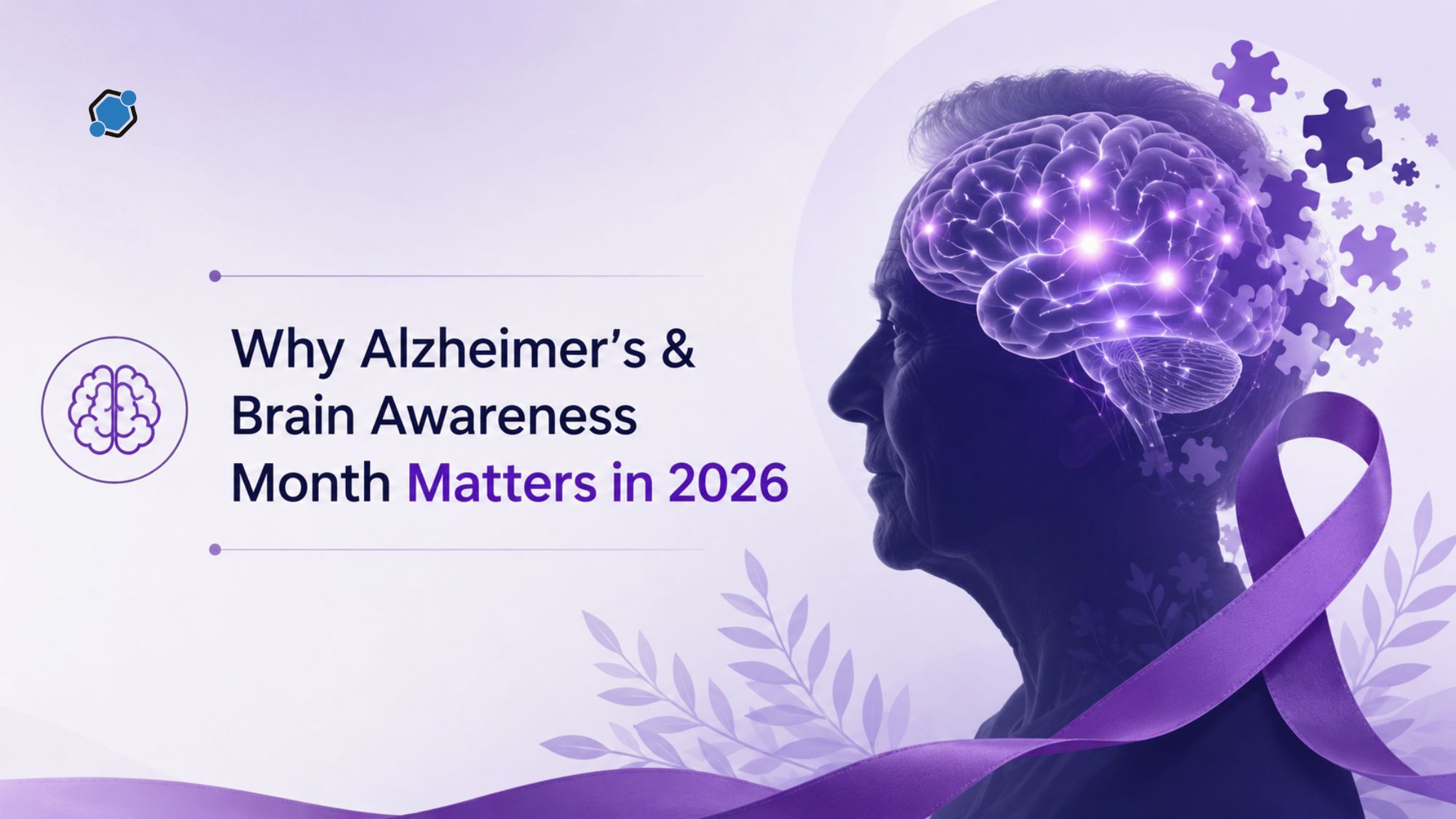
More than 55 million people worldwide live with dementia today, and that figure is expected to climb to roughly 78 million by 2030. June is the month dedicated to confronting those numbers. Known as Alzheimer's and Brain Awareness Month, it is a coordinated global effort to raise public understanding of dementia, support those affected by it, and accelerate research into prevention, diagnosis, and treatment.
The campaign has grown into one of the most visible health observances on the calendar. Communities organize walks, fundraisers, and educational events throughout the month. Buildings light up in purple, the color of the movement. Online, the hashtag #ENDALZ trails across social platforms as people share family stories, caregiving experiences, and calls for greater investment in dementia research.
The month also marks a quieter shift in tone within the medical and research community. Brain health is increasingly seen not as a fixed state determined by age and genetics, but as something that can be supported and protected throughout life. That shift carries real implications for individuals, families, and clinical research alike.
What Brain Awareness Month Stands For
Alzheimer's and Brain Awareness Month was established by the leading U.S. organization focused on Alzheimer's disease, and it has since gained recognition from global health authorities. While the campaign began in the United States, observance now spans multiple regions, with awareness activities held across Europe, the Eastern Mediterranean, and other parts of the world.
The month emphasizes three connected goals. First, increase understanding of Alzheimer's and other forms of dementia so that early signs are recognized and stigma is reduced. Second, encourage everyday actions that may support long-term brain health. Third, build public momentum behind the research community working toward better diagnostics and treatments.
A common feature of the campaign is the use of personal stories. Families affected by Alzheimer's are encouraged to share their experiences with care, loss, advocacy, or hope, often using the hashtag #ENDALZ. The visibility helps reduce the isolation that many caregivers describe, and it has helped move dementia from a topic spoken about quietly to one discussed openly in workplaces, schools, and policy conversations.
Awareness months work because they make conversations possible that might not happen otherwise. The same is true of broader public engagement with health research, which is explored in more depth in How Clinical Trials Contribute to Public Health.
Alzheimer's, Dementia, and What We Often Mix Up
The words Alzheimer's and dementia are often used as if they mean the same thing. They do not. Understanding the difference matters for anyone trying to make sense of a loved one's diagnosis or evaluate personal risk.
Dementia is an umbrella term. It refers to a decline in memory, thinking, judgment, language, or behavior that is severe enough to interfere with daily life. It is not a single disease but a group of symptoms with many possible causes. Alzheimer's disease is the most common of those causes and accounts for roughly half of all dementia cases worldwide.
Other forms of dementia include vascular dementia, which is linked to reduced blood flow in the brain, and Lewy body dementia, which often involves movement and sleep changes alongside cognitive symptoms. Some causes of dementia-like symptoms are reversible. Thyroid problems, certain vitamin deficiencies, reactions to medications, and untreated depression can all produce symptoms that look like dementia but improve once the underlying issue is addressed.
This is why a proper medical evaluation matters. There is no single test that confirms Alzheimer's disease. Diagnosis usually involves a combination of cognitive assessments, blood work, neurological examination, and brain imaging, alongside a careful review of medical history. Identifying the underlying cause shapes the right treatment plan.
For readers new to how studies are designed and run, Clinical Trials Explained: Simple Guide for Beginners offers a starting point in plain language.
Risk Factors and the Case for Prevention
One of the most significant shifts in dementia science over the past decade is the recognition that prevention may be possible for a substantial share of cases. Global health estimates suggest that around 45 percent of dementia cases are potentially preventable by addressing modifiable risk factors across a person's life.
These risk factors fall into categories that touch most aspects of daily life. They include cardiovascular health, hearing loss, social isolation, physical inactivity, alcohol use, smoking, head injury, air pollution, untreated depression, vision loss, and the management of conditions such as diabetes, high blood pressure, and obesity. Education in early life and ongoing cognitive engagement are also considered protective.
No single habit guarantees prevention. The evidence points instead to a layered approach. Activities that combine physical movement, social interaction, and mental challenge, such as group exercise classes, learning a new skill, or community volunteering, may carry more benefit than any one habit on its own. Quality sleep, balanced nutrition, and management of hearing and vision changes also play a role.
For someone considering how to take action this month, the most useful starting point may not be a dramatic lifestyle overhaul but a single sustained change. Improving sleep consistency, addressing untreated hearing loss, or scheduling a long-overdue physical can each contribute meaningfully over time.
Early Detection, Diagnosis, and What's New in Research
Detection has long been one of the hardest parts of dementia care. Many people delay seeking evaluation because symptoms develop slowly, are easy to dismiss as normal aging, or carry a sense of stigma. Yet earlier detection is increasingly understood to expand the range of options available for treatment, support, and life planning.
The diagnostic landscape is also changing. Researchers have developed and validated blood-based tests that may help detect signs of Alzheimer's disease before clear symptoms appear. These tools are not yet a replacement for full clinical evaluation, but they represent a meaningful step toward earlier and more accessible screening.
Treatment options have also expanded in recent years. Some newer therapies aim to slow disease progression rather than only manage symptoms, particularly when started in the earlier stages of Alzheimer's. Clinical trials continue to evaluate additional disease-modifying drugs, lifestyle-based prevention programs, biomarkers for early identification, and care models for people already living with dementia.
Participation in research is part of what makes this progress possible. Trials need volunteers across a wide range of ages, backgrounds, and stages, including healthy adults interested in prevention studies and individuals already living with cognitive symptoms. Eligibility requirements vary widely from one study to another, and many people find that the only way to know if a particular trial fits is to ask.
Not every interested volunteer ends up qualifying, and the reasons can be surprising. Eligibility Explained: Why Not Everyone Qualifies for a Trial walks through how these criteria are set and why they matter.
How to Take Part This June
Brain Awareness Month offers many entry points, and not all of them require donating or wearing purple. Some of the most meaningful actions are personal and quiet.
Talking with family is one of them. Many adults have never had a direct conversation with parents, siblings, or partners about brain health, family history of dementia, or wishes around future care. June is a useful prompt for those conversations, which tend to be far easier when they happen well before they are needed.
Practical health actions also count. Scheduling a check-up, addressing untreated hearing loss, asking a doctor about cognitive screening, or starting a daily walking habit are all small, evidence-aligned steps that compound over time. Community involvement is another option. Local Alzheimer's chapters, caregiver support groups, and patient communities often welcome volunteers throughout the month.
For those who want to connect with a broader community, Patient Advocacy Groups: Finding Support and Trial Information outlines how these groups can be a source of information, peer support, and study access.
For people drawn to research, learning about clinical trials is a meaningful way to engage. Trials in the dementia space cover everything from prevention strategies for healthy adults to new treatments for people with mild or moderate symptoms. Caregivers also play a role in many studies, and some research focuses specifically on improving care models and reducing caregiver burden.
DecenTrialz is one of the platforms that can help with this step. It connects people who are exploring clinical trial participation with research studies they may be eligible for, with support from a nurse during the early conversations to answer questions and clarify what taking part might involve. For someone touched by Alzheimer's, whether personally, as a caregiver, or through a loved one, exploring trial options can be a tangible way to honor the spirit of this awareness month.
Anyone considering this step for the first time may find it helpful to read Clinical Trial Volunteers Guide: Your First Step Into Clinical Trials before reaching out.
The color purple, the stories shared, and the events held all point to the same broader idea. Brains are not static, dementia is not inevitable, and a future with better answers will be built, in part, by the choices made now. June is a reminder that those choices matter.
Was this article helpful?

Similar Blogs
Why is my blood pressure still high on medication? Resistant hypertension explained
Blood pressure that stays high after treatment has already started is more common than mos...
 Vamshi Kantoju
What is insulin resistance and how does it affect blood sugar?
Insulin resistance is a condition in which muscle, liver, and fat cells respond weakly to ...
Swaroop ESD
Mini-stroke symptoms: how to recognize a transient ischemic attack before a full stroke
A transient ischemic attack, often called a mini-stroke, is a short episode of stroke symp...
Deeksha GittaStay Informed. Stay Connected.
Get updates on verified clinical trials, emerging treatments, and research breakthroughs directly in your inbox. No spam, just science that matters.
