 HIPAA Compliant
 ISO 27001 Certified
National Minority Donor Awareness Month: why diverse donors and research participants matter
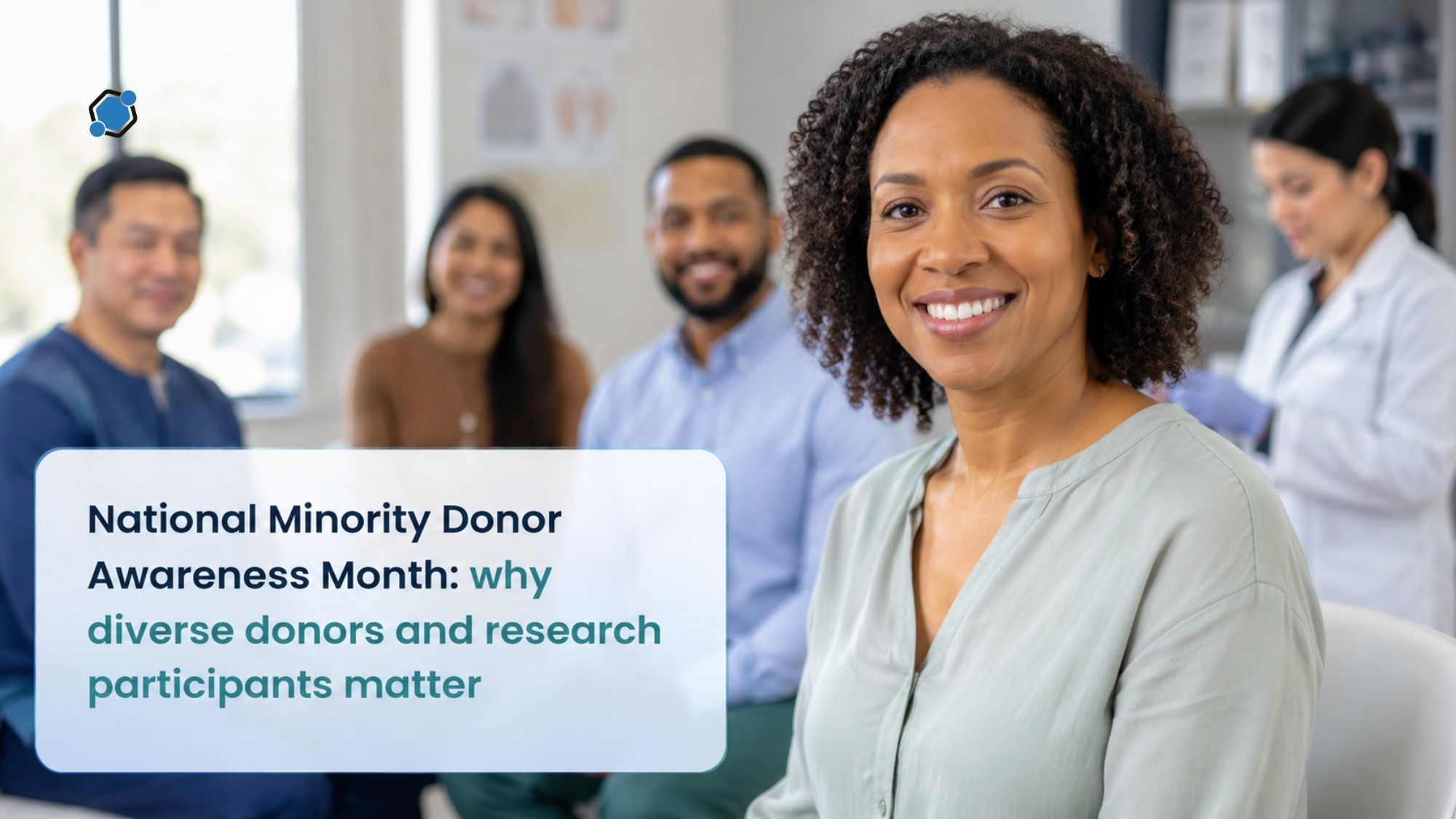
The U.S. organ transplant waiting list reflects a persistent imbalance. People from multicultural communities make up the majority of patients waiting for a life-saving transplant, while donor registries do not reflect that same diversity. National Minority Donor Awareness Month, observed every August, exists to address that gap.
The same pattern shows up beyond organ donation. Marrow and stem cell registries, cord blood banks, the blood supply, and clinical research all face similar disparities in who is represented. This article explains what the observance covers, why donor and participant diversity matters biologically, and how registration and research participation connect to better outcomes for patients across communities.
What National Minority Donor Awareness Month is
National Minority Donor Awareness Month began as an awareness week in 1996, launched by Dr. Clive Callender, a transplant surgeon at Howard University, and the National Minority Organ Tissue Transplant Education Program (MOTTEP), which Dr. Callender had established in 1991. It later expanded to a full month in August. The observance is now coordinated by the National Organ, Eye and Tissue Donation Multicultural Action Group, a coalition that includes federal agencies, transplant organizations, kidney foundations, and community groups.
The purpose is threefold. First, to educate multicultural communities about organ, eye, tissue, marrow, and blood donation. Second, to encourage registration and family conversations about donation wishes. Third, to promote healthy living that can reduce the need for transplants in the first place. The enduring campaign message, “One Voice, One Vision, to save and heal lives,” anchors the observance year to year.
The month is sometimes referred to as National Multiethnic Donor Awareness Month by partner organizations. Both names describe the same effort.
Why donor diversity matters for matching
Donation and transplant can succeed across racial and ethnic lines. However, the biological markers that determine whether a donor is a good match for a specific recipient are inherited. This means matches are often more likely, and often better, between people who share ancestry.
Three sets of markers matter most. Blood type is the most familiar. Human leukocyte antigen (HLA) typing, sometimes called tissue typing, refers to a group of proteins on cells that the immune system uses to distinguish self from non-self. HLA is central to matching bone marrow, stem cells, and solid organs. Red blood cell antigens beyond the basic ABO groups can also affect transfusion matching, particularly for patients who need frequent transfusions.
These markers are inherited, which is why ancestry shapes match probability. A patient of West African descent, for example, is statistically more likely to find a strong marrow match from a donor with similar heritage. When registries and blood supplies do not reflect the full diversity of the patient population, patients from underrepresented communities wait longer, receive fewer optimal matches, or in some cases cannot find a match at all.
Kidney disease illustrates the stakes clearly. Black Americans face a substantially higher risk of kidney failure than white Americans, driven in part by an inherited gene variant more common in people of West African ancestry. Hispanic Americans also face elevated kidney failure risk. Both groups spend longer on the transplant waiting list on average.
Can donors and recipients be from different backgrounds?
Yes. Matches across racial and ethnic groups do happen and do succeed. The point is not that only same-heritage matches work. The point is that a larger and more diverse pool of donors and registered volunteers produces more matches overall and better matches on average. For patients with rare tissue types or mixed ancestry, that diversity often makes the difference between finding a suitable donor and not.
Understanding why eligibility criteria work the way they do can also help demystify medical decision-making. Eligibility Explained: Why Not Everyone Qualifies for a Trial covers similar ground for clinical research.
The types of donation this month highlights
National Minority Donor Awareness Month covers several kinds of donation, each with different registration steps and different windows of participation.
Deceased organ donation refers to the recovery of organs after death from a registered donor. A single donor can save multiple lives through kidney, liver, heart, lung, pancreas, and intestine donation. Tissue and eye donation, which can also occur after death, restores sight through corneal transplant and heals many more patients through skin, bone, heart valve, and connective tissue donation.
Living donation involves a healthy person voluntarily giving an organ or partial organ during life. Kidney donation is the most common form, since a healthy individual can generally live a normal life with one kidney. Partial liver donation is also possible because the liver can regenerate. Living donation shortens wait times and often produces better long-term outcomes for the recipient.
Marrow and peripheral blood stem cell donation supports patients with blood cancers, sickle cell disease, and certain immune and genetic disorders. Registration involves a simple cheek swab kit that can be requested online and returned by mail. If a registered volunteer later matches a specific patient, most donations today are collected through the bloodstream in an outpatient procedure, not through the older marrow-collection method.
Cord blood donation happens at the time of a baby's birth. The blood remaining in the umbilical cord after delivery contains stem cells that can be donated to a public bank for anyone in need. Cord blood tolerates less-perfect matching than adult marrow, which makes it especially valuable for patients from underrepresented and mixed-ancestry backgrounds.
Blood donation supports emergency care, surgery, cancer care, and chronic conditions such as sickle cell disease, which requires frequent transfusion for many patients. Blood centers screen donations and match blood as closely as possible for recipients with complex antigen profiles. Progress in transplantation and cellular therapy has been shaped by decades of clinical research. How Clinical Trials Advance Medicine and Change Lives explains that connection.
Addressing mistrust and common myths
Mistrust of the medical system in some multicultural communities has real historical roots. The U.S. Public Health Service study at Tuskegee, which withheld available care from Black men with syphilis for decades, ended in 1972. Henrietta Lacks's cells were taken and used in research without her consent. Forced sterilizations affected Black, Hispanic, and Indigenous women in the twentieth century. These histories are legitimate, and no one should be asked to set them aside to make a decision about donation or research participation.
Modern donation and research operate under a different framework. Independent ethics review boards, formal informed consent processes, federal oversight, and organ allocation rules based on medical criteria are all designed to prevent the abuses of earlier eras. Awareness of history and awareness of current protections can coexist.
Several persistent myths about donation are worth addressing directly. A registered donor does not receive different or lesser emergency care. The clinical team caring for a patient in an emergency is entirely separate from any donation team, and donation is only considered after every effort to save the patient's life has been exhausted. Donation does not prevent an open-casket funeral. Donor families are not charged for the costs of donation. Organ allocation is based on medical urgency, blood and tissue matching, time on the waiting list, and geography, not on wealth or celebrity status.
Faith perspectives are often less restrictive than assumed. Most major religions permit or actively encourage donation as an act of generosity, and many faith leaders describe it in terms of saving life. Anyone with specific concerns can speak with clergy from their own tradition. Clinical Trial Myths Busted: Facts Every Participant Should Know addresses similar misconceptions in the research context.
Does my religion allow organ donation?
Positions vary by tradition and, in some cases, by individual conscience, but most major faiths practiced in the United States either permit donation or actively support it as an act of compassion. A conversation with a trusted faith leader can clarify the specifics of any particular tradition.
How donation connects to clinical trial participation
The same inherited biology that makes donor diversity important also shapes clinical research. Study intervention safety, dosing, and outcomes can differ across populations for reasons that include genetic variation, differences in how the body processes certain substances, and the interaction of any condition with other health factors. When clinical research does not include enough participants from communities most affected by a given condition, the resulting knowledge may not apply as accurately to those patients.
The parallel is direct. Multicultural communities are underrepresented in donor registries and also in clinical research enrollment. In some fields with high disease burden in these communities, such as sickle cell disease, multiple myeloma, and kidney disease, the underrepresentation in research is particularly striking. Broader participation in research helps ensure that new medical options reflect the biology of the people who will use them.
Sickle cell disease offers a hopeful example. Research over the past decade has produced advanced options that were unavailable before, including approaches based on modifying a patient's own cells. Continued research participation from the communities most affected keeps that progress moving forward.
DecenTrialz is a U.S.-based platform that uses AI-assisted trial matching and registered nurse-led pre-screening to help people find clinical research studies they may be interested in. DecenTrialz pre-screens only. The research site team handles study walk-through, eligibility determination, informed consent, and enrollment. Anyone can explore trial matching through DecenTrialz to see whether a current study may fit their situation, without any obligation.
Is joining a clinical trial the same as agreeing to be enrolled?
No. Expressing interest and going through pre-screening are early steps that help a participant and a research team decide whether a study is a possible fit. Formal enrollment happens only after the research site team reviews eligibility in detail and the participant reviews and signs an informed consent document. A participant can decline at any point.
How to take part this August
Taking action during National Minority Donor Awareness Month can be as small as a ten-minute registration or as involved as an ongoing commitment to research participation. Several pathways are available.
Registering as an organ, eye, and tissue donor takes a few minutes online through the National Donate Life Registry or during a driver's license renewal at the state motor vehicle office. Joining the marrow and stem cell registry involves requesting a free cheek swab kit, completing the swab at home, and returning it by mail. Giving blood at a local blood center or blood drive addresses ongoing shortages and directly supports patients with sickle cell disease and other conditions that require regular transfusion. Expectant parents can ask their delivery hospital about cord blood donation to a public bank. Anyone interested in living kidney or partial liver donation can contact a transplant center's living donor program.
Talking with family about donation wishes matters as much as registering. Family members are often consulted at the time of donation, and knowing a loved one's intentions in advance makes an already difficult moment easier.
For those interested in advancing research alongside or in addition to donation, current studies in transplantation, cell therapy, sickle cell disease, kidney disease, and blood cancers actively seek participants from all communities. Find a study through DecenTrialz to see current options and start a conversation with a nurse pre-screener who can explain what participation involves.
The observance lasts one month. The gap it addresses is a year-round reality. Every registration, every donation, and every research participant helps close it.
Was this article helpful?

Similar Blogs
Blood Pressure Numbers: What Do Systolic and Diastolic Actually Mean?
A blood pressure result contains two numbers, and most people are never told what either o...
 Paramraj
National HIV/AIDS and Aging Awareness Day 2026: What Aging With HIV Looks Like Today
The population of people living with HIV in the United States has aged in a way few would ...
Mahesh Upadrista
Prediabetes symptoms: what the early signs are and how prediabetes is reversed
Prediabetes means blood sugar is higher than normal, but not yet high enough to be called ...
Deeksha GittaStay Informed. Stay Connected.
Get updates on verified clinical trials, emerging treatments, and research breakthroughs directly in your inbox. No spam, just science that matters.
