 HIPAA Compliant
 ISO 27001 Certified
5 Reasons Patient Enrollment and Retention Are Failing Clinical Trials
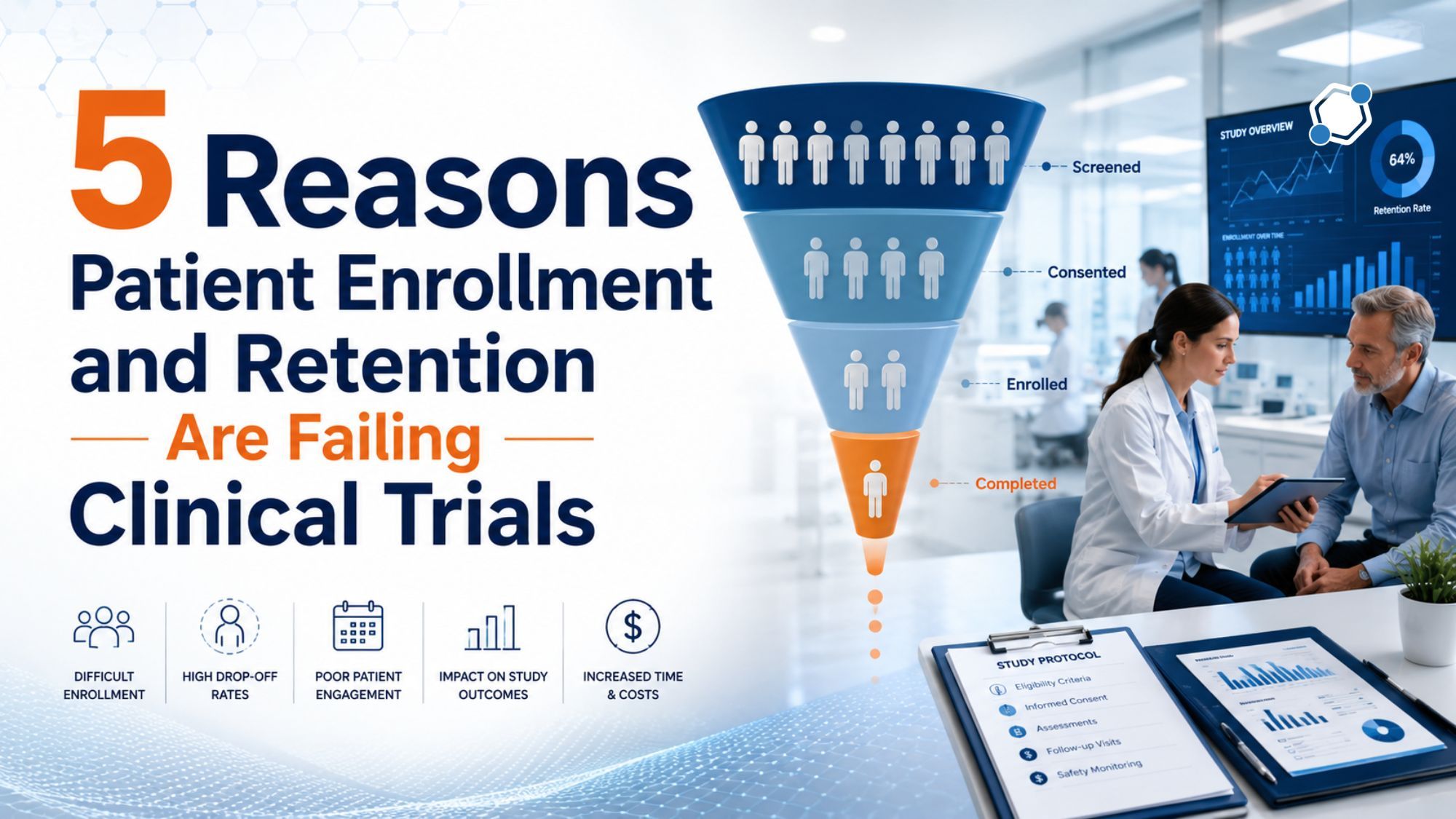
Patient enrollment and retention shortfalls are not edge cases. Industry analysis of publicly funded trials has shown that only around 31 percent meet original enrollment goals. Roughly one in four cancer trials fails to enroll a sufficient number of participants, and a meaningful share of registered trials close without enough enrolled patients to answer the primary research question. Slow recruitment and high dropout are the most consistent reasons clinical trials run over budget, miss timelines, or fail to produce statistically powered results.
What makes the problem stubborn is that the causes are well-documented. Across decades of published research, the same factors recur: protocol design that drifts from the real patient population, site selection that overlooks track record, communication that loses participants at the start, and retention treated as something to address after enrollment rather than designed in alongside it.
The hidden cost of slow recruitment compounds across every downstream activity, from database lock to regulatory submission. Below are five recurring reasons enrollment and retention fall short, each rooted in design-stage decisions rather than execution failures.
1. Eligibility Criteria Are Too Narrow
Inclusion and exclusion criteria define who can enter a trial, and overly specific criteria are one of the most common reasons enrollment slows. A trial designed around a narrow population, often carried over from prior protocols without re-examination, can spend months recruiting toward a target that the available patient pool was never realistically going to fill.
Industry analysis attributes roughly 16 percent of protocol amendments to changes in inclusion and exclusion criteria. Across a review of 3,400 clinical trials, more than 40 percent had amended protocols before the first subject visit, with an average delay of about four months per amendment. Each amendment then creates a downstream issue of its own: the recruited cohort before and after an amendment may not be statistically comparable, which complicates the analysis the trial was designed to support.
Eligibility criteria also encode unstated assumptions. Cutoffs based on prior treatment exposure, advanced disease stage, or specific genetic markers may be scientifically defensible, but each cutoff narrows the recruitable pool. When the science requires precision, that is the cost of doing the trial. When it does not, the cutoff is paying for nothing.
Better eligibility alignment, supported by careful attention to reducing screen failures, is one of the highest-leverage protocol decisions a sponsor can make. The path to fewer screen failures starts with understanding which exclusions are scientifically necessary and which were inherited from earlier work.
2. Patient Burden Is Too High
The most consistent predictor of low retention is participant burden. Burden compounds across travel time, visit frequency, in-clinic wait time, out-of-pocket cost, lost work, and the cognitive load of understanding what each visit involves.
Population-level survey data on routine medical care shows adults are generally willing to travel about 30 minutes and 22 miles for a routine appointment, with shorter tolerance in older patient populations. Trial protocols routinely exceed those tolerances, particularly when visits are scheduled at study centers that pull from broad geographic catchments rather than from local populations. Wait time at the site compounds the problem. Survey data shows the highest patient satisfaction at average wait times of roughly 13 minutes and the lowest at roughly 34 minutes. Around 30 percent of U.S. patients have walked out of an appointment because the wait was excessive.
Out-of-pocket cost adds another layer. Insurance may not cover the medical care associated with a trial beyond what is deemed routine, and high deductibles can put participation out of reach for patients who would otherwise qualify and want to join. The participant population that can absorb the cost is not a representative sample of the population the trial intends to inform.
The result of cumulative burden is that participants who would have completed the trial under a lighter protocol withdraw under a heavier one. Burden cannot be eliminated, but it can be measured and minimized at the design stage rather than after months of attrition data have already accumulated.
3. Site Selection Hurts Enrollment
Site choice is one of the few decisions made before enrollment opens, and one of the few with measurable predictive power. Investigator enthusiasm is the single most-cited positive recruitment factor across the published research base. Site experience is the second. A site with a history of running 6 to 10 prior clinical trials meets enrollment targets more reliably than a site with fewer prior trials, and meaningfully outperforms a site with no track record.
Time-to-first-patient is another leading indicator. Sites that enroll a first participant quickly tend to maintain that pace; sites that take longer tend to underperform throughout the trial. In multi-center studies, it is not uncommon for a substantial share of approved sites to fail to enroll a single patient. The downstream consequences are significant. Opening additional sites to compensate for non-enrolling ones requires fresh contracts, ethics submissions, staff training, and protocol amendments, and often forces the trial budget to reallocate away from secondary endpoints such as imaging or biomarker work.
Sponsor-side selection criteria should look beyond geographic spread to the underlying performance signals: prior trial completion history, investigator engagement, site staffing depth, and the available local patient population. Site performance metrics make these signals visible before the trial opens, not after recruitment has stalled.
4. Informed Consent Is Hard to Read
Informed consent is both an ethical requirement and a recruitment-and-retention decision. Reviews of approved informed consent forms have found average reading levels at roughly the 10th grade, well above the average reading level in the general population. Documents written above the reading comfort of lower-literacy participants create a gap that is not subtle.
A patient retention survey of completed trials found that 35 percent of participants who later dropped out reported finding the consent form difficult to understand, compared with 16 percent of participants who completed the trial. Even among completers, about one in six described the consent form as vexing. The gap is among the strongest predictors of dropout that surface before the first study visit takes place.
Research on simplified consent design shows comprehension does not decrease when readability is improved. Plain-language consent forms maintain the same level of participant understanding of trial details while reducing the proportion of participants who find the document opaque. Simplified consent does not reduce comprehension. It reduces dropout.
Consent design also affects retention indirectly. Clear, accessible consent materials create a different starting expectation than documents written above the average reading level. Visit attendance, protocol adherence, and willingness to remain enrolled when the protocol asks something difficult all reflect that early experience.
5. Retention Is Treated as an Afterthought
The most common structural failure is the assumption that recruitment and retention are sequential problems. Recruitment teams hit enrollment. Then retention teams take over. The participants who leave in months two and three of a six-month trial often leave because the protocol was not designed with retention in mind.
Patient-centric protocol design front-loads retention thinking into the schedule, the staffing model, the participant materials, and the visit windows. Visit timing accounts for participant work, family, and travel constraints rather than treating site convenience as the default. Staff continuity is planned so that participants see familiar faces at each visit rather than rotating through new personnel. Participant communication is consistent across channels, in language the participant can act on. Each of these decisions has to be made before enrollment opens, because mid-study retrofits trigger protocol amendments and add cost. Patient-centric protocol design treats retention as a design-stage variable, not an execution-stage rescue.
A registry analysis of nearly 2,600 closed clinical trials found that almost 48,000 patients had enrolled in studies that closed unable to answer the primary research question, often because of failed accrual or under-enrollment. The patients who participated in those trials gave time and accepted risk for a result that could not be statistically supported. Front-loading retention into protocol design is the structural answer to that outcome.
What This Means for Sponsors
Each of the five reasons traces back to a design-stage decision rather than an execution problem. Eligibility, burden, site choice, consent design, and retention strategy are all set before the first participant is screened. Adjustments after recruitment opens are expensive, slow, and incomplete. The cost of fixing a design-stage decision at the execution stage is the cost of a protocol amendment plus everything that depends on it.
DecenTrialz is a participant screening platform for sponsors, CROs, and research sites in the United States. The platform connects patients who may want to join a clinical trial with the research teams running the studies, using AI-assisted participant matching, nurse-led pre-screening, and structured referral workflows. Real-time dashboards surface conversion and enrollment metrics by source and channel, which makes the upstream causes of downstream dropout visible before the failures compound. Final eligibility verification, informed consent, and enrollment remain with the research site and study team.
The structural answer to enrollment and retention failure is design-stage attention paired with operational visibility once the trial opens. Recruitment platforms that pair AI-assisted matching with nurse-led pre-screening can reduce the upstream failures that drive downstream dropout, but the underlying protocol decisions still have to be made well.
Was this article helpful?

Similar Blogs

Predictive feasibility in clinical trials: what sponsors should check before committing to enrollment targets
Feasibility assessments decide who runs a study, where it runs, and how quickly it can enr...
 Paramraj
Clinical Trial Patient Matching: Why Do Sponsors Need More Than a Public Registry Listing?
Every applicable clinical trial conducted in the United States must be registered in the f...
Swaroop ESD
DecenTrialz vs traditional recruitment platforms: how does full-service matching differ from self-service trial search?
Comparisons between DecenTrialz and traditional recruitment platforms usually come down to...
Vamshi KantojuStay Informed. Stay Connected.
Get updates on verified clinical trials, emerging treatments, and research breakthroughs directly in your inbox. No spam, just science that matters.
