 HIPAA Compliant
 ISO 27001 Certified
How pre-screening delivers quality participants to the research site
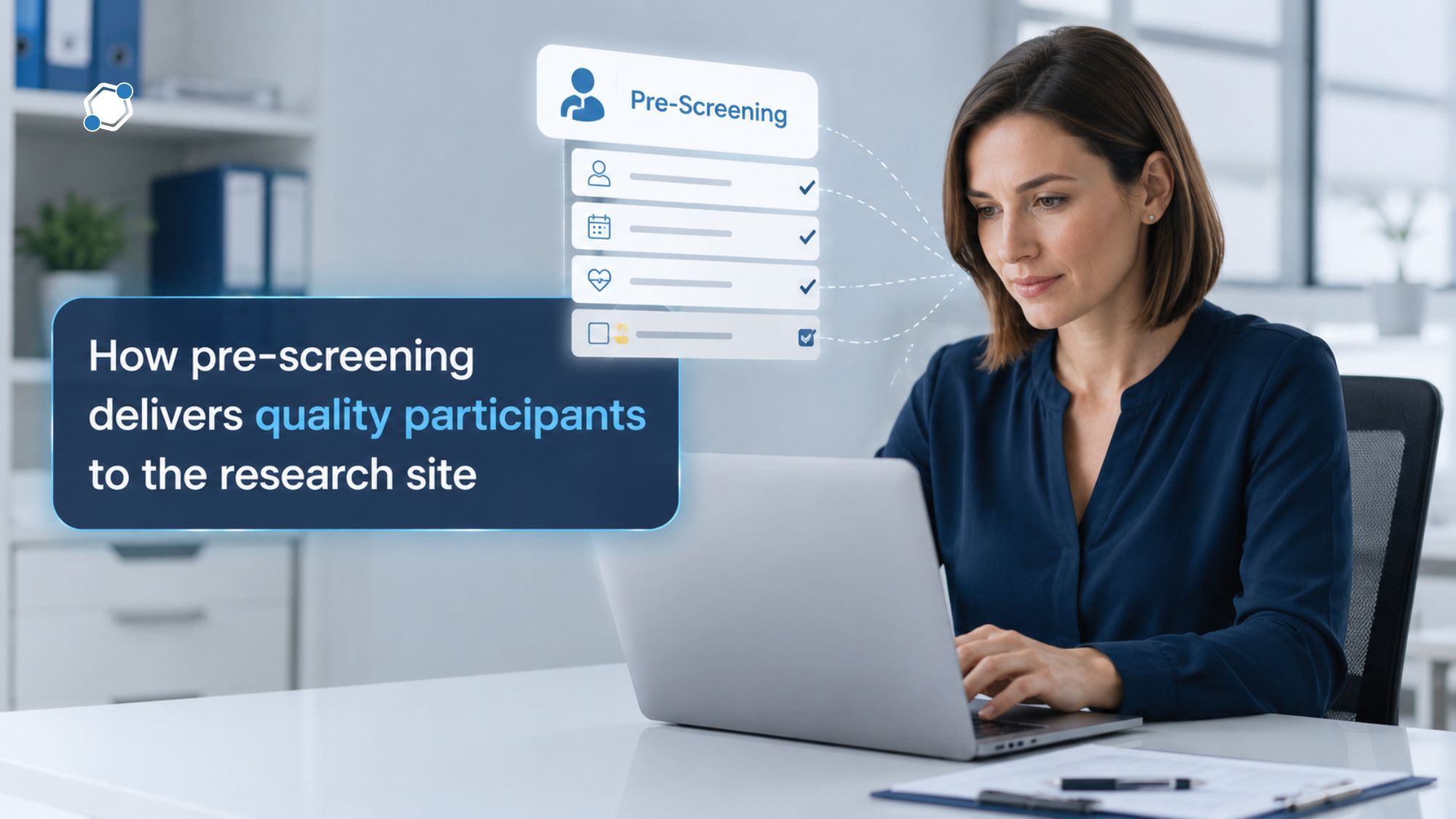
Pre-screening happens before a participant ever reaches a research site. It is a short, purposeful conversation that turns interest into readiness, and the quality of that conversation decides who arrives, what they know, and how the first site visit goes. Research site teams feel the difference on day one. Participants who arrive after a careful pre-screening call are calmer, better informed, and closer to eligible. Participants who arrive after a scripted or rushed call arrive uncertain, defensive, or unsuitable for the protocol. The gap between those two experiences is not accidental. It reflects who conducted the pre-screening, how it was done, and what the participant carried away from the call.
What pre-screening is, and what it is not
Pre-screening sits in a specific place in the recruitment workflow. It happens after a person expresses interest in a study, whether through a physician referral, an advertising response, an advocacy group, or a recruitment platform, and before that person signs an informed consent form at the research site. The purpose is narrow. A short conversation, usually by phone, gauges whether the person is likely to meet basic inclusion and exclusion criteria and whether the study is a reasonable fit for their circumstances.
Pre-screening is not consent. It is not a full medical history intake. It is not eligibility determination, which requires source-verified data collected under a signed consent form at the site. Regulatory guidance and institutional review boards treat pre-screening as a limited pre-consent activity, bounded by what a participant can be asked before formally joining a study. That distinction shapes what the conversation should attempt, and how it connects to the pre-screening funnel metrics that sponsors and site teams rely on further down the line.
Why the pre-screening conversation decides who reaches the research site
The pre-screening call is the first real human contact between the study world and a prospective participant. It carries disproportionate weight because it is where first impressions form, questions surface, and hesitations either resolve or harden. A person who feels heard and informed on that call is more likely to show up for a screening visit, engage meaningfully with the consent process, and remain in the study once enrolled. A person who feels rushed, confused, or oversold arrives at the research site already halfway out the door.
The mechanics are direct. Pre-screening decides how many interested people become scheduled screening visits, and it also decides what those people know, expect, and worry about by the time they meet a site coordinator or investigator. Site teams see this pattern every day, even when they cannot see the pre-screening call itself. Some referrals feel ready, others feel raw. The difference almost always traces back to what happened on that first conversation, which is why qualified participant referrals matter far more to site throughput than raw referral volume ever does.
What a strong pre-screening conversation actually sounds like
A pre-screening conversation that delivers quality participants has recognizable features. It opens with a human greeting, not a script recital. The caller explains what pre-screening is, roughly how long the call will take, and that the participant can stop or ask questions at any point. Eligibility questions are not fired off in sequence. Each one comes with a brief reason: why the study needs this information, what it helps confirm, and how the answer moves the conversation forward.
Placebo, randomization, and voluntary withdrawal are addressed directly, not sidestepped. Participants ask about these topics more often than site teams realize, and dodging them signals that something is being hidden. Time commitment, procedures, travel, and what happens after the study are laid out plainly. The caller listens for concerns that were not asked and surfaces them. The conversation ends with a clear next step, and the participant knows what to expect at each stage of the site eligibility funnel, from arrival at screening through to randomization.
What weak pre-screening sends to the research site instead
The opposite pattern is easy to recognize once a site team has seen it a few times. Referrals arrive with basic questions the pre-screening call should have answered. Participants show up expecting one thing and encounter another, then withdraw during consent. Coordinators spend the first block of the screening visit doing pre-screening work that should have already happened. No-show rates climb. Screen failure rates climb. Coordinator time gets absorbed into recovery, not protocol delivery.
Weak pre-screening usually shares a common set of features. The conversation is transactional, run from a script with little room for questions. Clinical jargon appears without translation, so the participant nods along without understanding. Safety concerns are minimized rather than addressed. Time pressure shows through, and the participant senses the caller is trying to close, not converse. Participants who agree to a screening visit under those conditions often do so because they did not feel able to ask for more, not because they were ready. Research sites absorb the hidden cost of bad referrals every time that upstream failure lands in a screening slot.
What research sites notice when pre-screening quality changes
When the pre-screening layer works well, site teams see the effect within a few visits. Participants arrive on time. They arrive having read, or at least opened, the study documents sent to them. They ask specific questions rather than general ones. Coordinators can move directly into source verification, consent walkthrough, and screening procedures without spending the first block of the visit re-explaining the basics. Participants who show up are actually likely to qualify, and the visits that end in screen failure fail for protocol-driven reasons, not for reasons that pre-screening should have caught.
The reverse also holds. When pre-screening quality slips, sites feel it immediately. Consent-day withdrawals rise. Coordinators repeat information the participant should have received a week earlier. Small misunderstandings become large ones by the time the visit is over. That is one reason site teams looking to reduce screen failures at research sites often find the highest-leverage fix is not on-site at all, but in the conversation that happens before the participant ever walks through the door.
The nurse-led difference in pre-screening
Who conducts the pre-screening call changes what participants get out of it. A registered nurse brings clinical vocabulary, comfort with sensitive questions, and the ability to translate protocol language into plain terms without oversimplifying. Nurses are trained to listen for what a participant is not saying, to notice when a symptom description does not quite match an eligibility criterion, and to explain safety concepts without hedging.
Nurses are also credible to participants in a way that non-clinical callers rarely are. Trust in clinicians remains higher than trust in most other parts of the research ecosystem, and that credibility carries into the pre-screening call. Participants ask harder, more useful questions when they sense the person on the other end can actually answer them. For the research site, the effect is upstream quality control: nurse-led pre-screening catches misalignments before they consume screening slots and surfaces concerns that would otherwise appear on consent day. The role that nurses play across clinical trials on International Nurses Day 2026 is the same role that shows up in a well-run pre-screening call: clinical judgment, plain language, and steady presence.
How DecenTrialz pre-screens for quality before the research site takes over
DecenTrialz conducts pre-screening through registered nurses, supported by AI-assisted matching that routes each interested person toward studies where they are likely to fit. The nurse conversation is the layer that matters most for site-level quality. It follows the pattern that produces ready participants: a human opening, plain-language explanations, honest handling of placebo and voluntary withdrawal, active listening for what the participant needs, and a clear next step. The AI layer sits behind it, narrowing the pool of studies to consider so the conversation stays focused on the ones that fit.
Participants who complete a DecenTrialz pre-screening call arrive at the research site with the basics understood. They know what a screening visit involves, roughly how long the study will take, what randomization means, and what happens if they choose to stop. They arrive with their concerns named and addressed rather than hidden. Site teams meet a participant who is ready for the next stage of the process, not one who needs pre-screening redone. Research site teams remain fully in charge of eligibility, consent, and enrollment throughout. To see how the pre-screening handoff works in practice, visit decentrialz.com.
Partner with DecenTrialz for quality participants at your research site
Quality at the research site begins with quality on the pre-screening call. Site teams that receive well-pre-screened participants see fewer no-shows, cleaner consent visits, and less coordinator time spent on questions that should have been resolved before the participant arrived. That is the practical value of the pre-screening layer, and it is why DecenTrialz invests in nurse-led conversations rather than form-based intake.
Research sites looking to reduce recruitment friction and receive participants who arrive ready to engage can partner with DecenTrialz to handle the pre-screening layer end to end. Visit decentrialz.com to learn how the partnership works and what it delivers to research site teams.
Was this article helpful?

Similar Blogs
How CROs Validate Digital Endpoints in Clinical Trials
Digital endpoint validation is one of the few areas in clinical operations where a technic...
 Paramraj
How CROs validate AI recruitment tools
Contract Research Organizations, known as CROs, run the day-to-day operations of clinical ...
Vamshi Kantoju
Clinical Trial Patient Matching: Why Do Sponsors Need More Than a Public Registry Listing?
Every applicable clinical trial conducted in the United States must be registered in the f...
Swaroop ESDStay Informed. Stay Connected.
Get updates on verified clinical trials, emerging treatments, and research breakthroughs directly in your inbox. No spam, just science that matters.
