 HIPAA Compliant
 ISO 27001 Certified
Clinical Trial Operations Reimagined: How Efficiency, Access, and AI Are Reshaping Sponsor and CRO Strategy
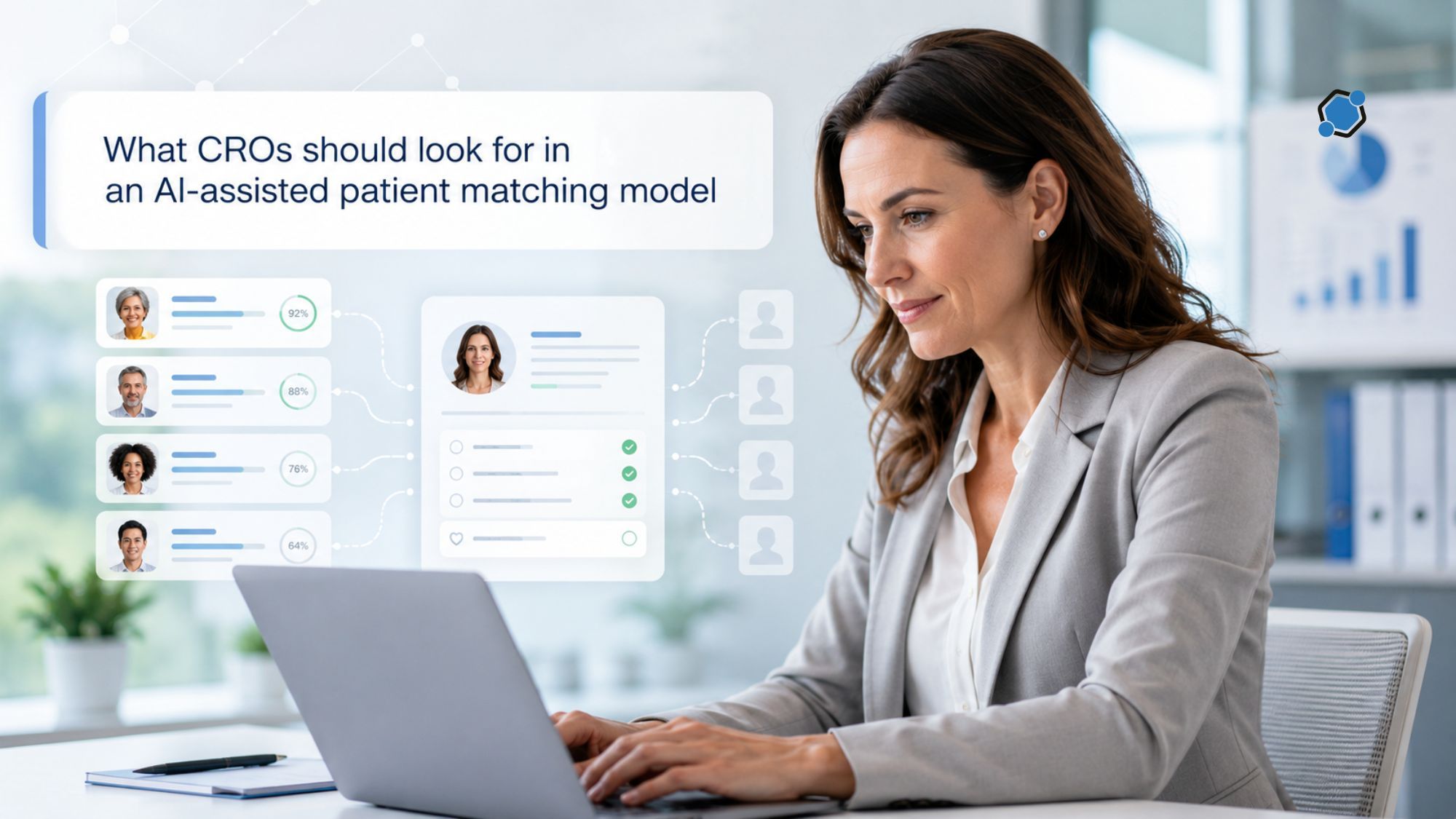
AI-assisted patient matching has moved from novelty to standard vendor category in the modern CRO recruitment stack. What has not caught up is a shared framework for evaluating the model behind the interface. Vendors demo well. Dashboards look sharp. The harder question, and the one CRO clinical operations and vendor management teams keep coming back to, is whether the underlying model will hold up when a monitor asks how a candidate ended up on a site’s referral list, or when a sponsor asks why enrollment skewed toward one geography and not another.
This piece lays out the evaluation surface CROs should actually inspect before signing an AI-assisted patient matching partner. Not model architecture for its own sake, but the observable behavior, the governance layer, and the evidence a vendor should be ready to hand over on request.
What AI-assisted patient matching actually does in trial recruitment
At its core, AI-assisted patient matching is the use of machine learning models to compare a protocol’s eligibility criteria against structured and semi-structured data about potential participants, then rank or route candidates who look like a fit. The data can come from electronic health records, patient-submitted questionnaires, registries, or a combination. The output is not enrollment. It is a shortlist of candidates who warrant a closer human review.
That distinction matters for CROs. A matching model does not decide who joins a trial. It narrows the top of the funnel so the site coordinators and study teams downstream spend their time on realistic candidates rather than volume that will screen-fail. The evaluation question is therefore not “does the model make good medical decisions.” It is whether the model produces a shortlist that improves the quality of downstream work, and whether the CRO can defend how that shortlist was produced.
This positioning also sets the frame for the rest of this article. Everything CROs should inspect flows from one operational question: can this model deliver qualified candidates in a way that stands up to sponsor scrutiny, site pushback, and regulatory review. A related read for CROs working through vendor selection is How to choose a patient recruitment agency: a guide for CROs.
The data behind the model: sources, coverage, and representativeness
Every AI-assisted patient matching model is only as strong as the data feeding it. CROs evaluating a matching vendor should start with three questions about that data, and expect precise answers.
The first is provenance. Where does the input data actually come from. Is it electronic health record data from a defined network of health systems, self-reported information from a consumer-facing intake flow, claims data, registry data, or some combination. Each source carries different limitations. EHR data tends to be richer on clinical detail but narrower on geography. Self-reported data reaches broader populations but is less reliable on complex eligibility criteria such as prior lines of therapy or specific laboratory values.
The second is coverage. Coverage means both the size of the reachable population and its distribution across the geographies, demographics, and disease states that matter for a given protocol. A model trained on a dataset that skews toward large academic centers in a handful of states will produce a shortlist that reflects that skew. For a trial that needs community enrollment across multiple regions, that is a limitation the CRO needs to know about before the protocol goes live.
The third is representativeness. Even within a nominally large dataset, underrepresented populations can be systematically thin. CROs should ask vendors to describe the demographic composition of the population the model is drawing from, not just the total count. This is where matching outputs and diversity commitments meet, and it is a conversation better had during due diligence than after a sponsor’s diverse enrollment plan runs into a real-world ceiling. Recruitment Analytics: How CROs Can Add Value Beyond Operations covers the broader analytics posture CROs bring to this kind of question.
Accuracy claims: validation evidence CROs should ask to see
Vendors will offer numbers. Match rates, screen-fail reduction percentages, time-to-first-patient improvements, precision and recall figures. Some of these numbers are meaningful. Many are not, or at least not without context. The job of a CRO evaluating a matching model is to separate the two.
Ask what population the accuracy figure was measured on. Accuracy on a retrospective set of past trials in oncology says very little about performance on a prospective rare disease study. Ask whether the validation was internal, external, or peer-reviewed. Internal benchmarks against synthetic patients tell one story. Prospective validation across live studies tells a much stronger one. Ask what “match” was defined as. A candidate flagged by the model, a candidate who passed pre-screening, a candidate who enrolled, and a candidate who completed the study are four different outcomes and often collapsed into one headline number.
CROs should also ask for the failure modes. Where does the model tend to over-match, and where does it under-match. Every model has both. A vendor that cannot describe its own failure modes is either not measuring them or not willing to share, and both are red flags. 7 Features Every CRO Wants in a Cross-Site Recruitment Dashboard touches on the reporting standard that makes this kind of accuracy transparency possible.
Bias controls and diverse enrollment outcomes
Bias in a patient matching model is not a hypothetical. When training data underrepresents certain groups, models trained on that data will under-match those groups on future protocols. This is well established in the literature and is now a routine part of regulator and sponsor conversations about AI in trial recruitment.
For CROs, the evaluation question has two parts. First, does the vendor have an explicit process for measuring bias in matching outputs, and can they show what that measurement looks like on recent studies. Second, does the vendor have a process for correcting the imbalance when it appears. Bias measurement without a correction pathway is documentation, not governance.
Correction can take several forms. Adjusted sampling from underrepresented populations. Weighting during ranking. Human review layers that explicitly check the demographic composition of shortlists before they route to sites. None of these are perfect on their own. What CROs should look for is a vendor that has thought through the mechanics and can describe them in operational terms, not just in a diversity statement.
A useful adjacent piece for the diversity-focused framing is Cross-site enrollment demographics: How CROs harmonize, aggregate, and report.
Explainability and the audit trail behind every match
When a monitor, an auditor, or a sponsor asks why a specific candidate appeared on a site’s referral list, the vendor should be able to answer. That is the practical definition of explainability in this setting. It is not about opening the model’s weights. It is about being able to trace, for any individual match, the criteria that were evaluated, the data points that supported the match decision, and the version of the model that produced it.
CROs should ask three things about this. First, is there a per-candidate record showing which eligibility criteria were satisfied by which data points. Second, is the model version tracked over time, so a match produced six months ago can be reconstructed with the model that actually produced it, not the current one. Third, is there a human review layer between the model output and the site referral, so no site coordinator is asked to accept a black-box shortlist.
That last point deserves its own emphasis. Model-only matching, where an algorithm’s output flows directly into a site’s referral queue without a human reviewer in between, creates risk on multiple fronts. It removes the check that catches obvious errors before they reach a coordinator’s inbox. It weakens the audit trail. And it puts the CRO in the position of defending a decision no human at the vendor actually made. The stronger pattern is model output plus a clinical reviewer who confirms the candidate is worth routing, with both layers documented. For the broader industry framing on how AI is reshaping this stage of trial work, AI in Clinical Trials: How It Is Changing Study Design and Patient Recruitment is a useful adjacent read.
Data privacy, security, and regulatory posture
Every AI-assisted patient matching model handles protected health information at some stage, either directly or through data-partner arrangements. CROs evaluating a vendor need to see the same level of privacy and security posture they would demand from any partner touching participant data.
The concrete questions are familiar. How is data handled at rest and in transit. What is the vendor’s HIPAA posture, and if the vendor operates internationally, how are cross-border data flows managed. Where relevant to the trial, does the vendor’s system operate consistently with 21 CFR Part 11 expectations for electronic records. What is the incident response history, and how are breaches communicated to partners. What data does the vendor retain after a study closes, and under what basis.
None of this is unique to AI-assisted matching. What is specific to AI is the additional question of what data was used to train the model, whether that data was appropriately consented, and whether any participant data from prior studies has been repurposed for training in ways the original participants did not agree to. A vendor that can answer these questions cleanly is a vendor that has thought about the problem. A vendor that gets uncomfortable when asked is a vendor whose contract language deserves a very careful read.
How DecenTrialz approaches AI-assisted patient matching
DecenTrialz uses AI-assisted participant matching and registered nurse-led pre-screening. Final eligibility determination, informed consent, study walk-through, and enrollment are always handled by the research site team. The nurse pre-screens only; she does not walk participants through study details or handle consent.
The evaluation posture described in this article maps directly to how DecenTrialz operates. The matching model narrows the top of the funnel. A registered nurse then conducts a structured pre-screening review before any candidate is routed to a site. That review is the human layer that catches what a model alone cannot, and it is the layer that produces an audit trail a CRO can defend when a sponsor asks how a referral was qualified.
For a CRO, this means the shortlist arriving at sites is not raw model output. It is model output that has already passed a clinical reviewer’s check, with the reasoning documented and available. The site team then takes the qualified referral through eligibility confirmation, informed consent, and enrollment. That scope boundary is deliberate and matches the operational reality of how research sites work. Explore the platform at decentrialz.com.
Choosing a matching partner CROs can defend
The strongest AI-assisted patient matching partner is not the one with the most impressive demo. It is the one whose model, data, governance, and human review layer can be explained on a monitoring visit without hedging. That is the standard CROs should apply during evaluation, because it is the standard sponsors and regulators are already moving toward.
Data provenance, validated accuracy, bias controls, explainability, human review, and a clean privacy posture. If a vendor can walk through all six without softening the answers, the shortlist arriving at sites will hold up. If the vendor cannot, no interface polish will paper over the gap when a real study is running.
To see how AI-assisted matching plus registered nurse-led pre-screening works in practice, visit decentrialz.com and connect with the team about your next study.
Was this article helpful?

Similar Blogs

How CROs validate AI recruitment tools
Contract Research Organizations, known as CROs, run the day-to-day operations of clinical ...
 Vamshi Kantoju
Clinical Trial Patient Matching: Why Do Sponsors Need More Than a Public Registry Listing?
Every applicable clinical trial conducted in the United States must be registered in the f...
Swaroop ESD
DecenTrialz vs traditional recruitment platforms: how does full-service matching differ from self-service trial search?
Comparisons between DecenTrialz and traditional recruitment platforms usually come down to...
Vamshi KantojuStay Informed. Stay Connected.
Get updates on verified clinical trials, emerging treatments, and research breakthroughs directly in your inbox. No spam, just science that matters.
