 HIPAA Compliant
 ISO 27001 Certified
Hybrid clinical trial visits: how research sites decide what stays on-site and what goes remote
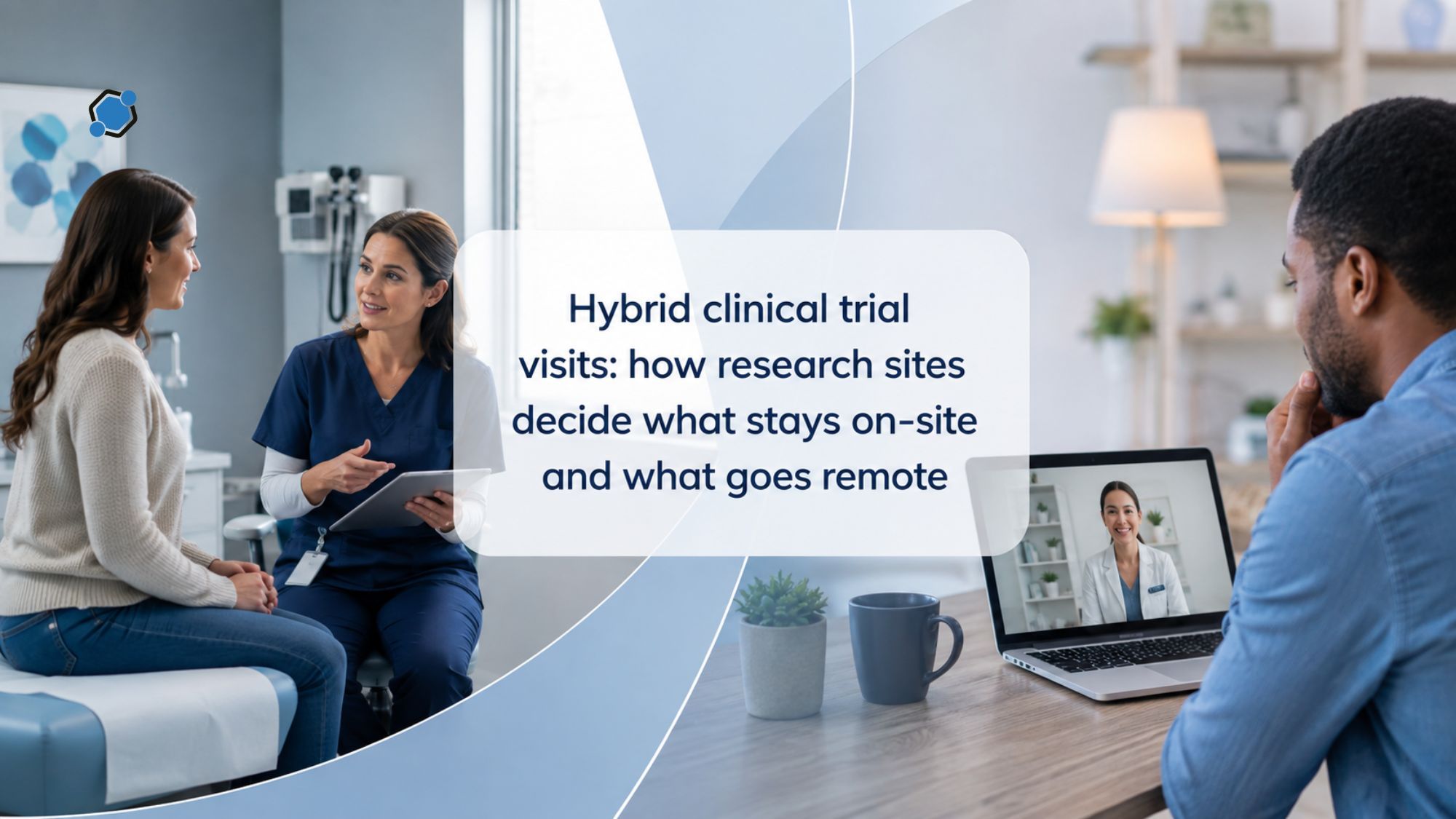
Hybrid designs are no longer an experiment for research sites to accommodate on the margins. They are the operating model for a growing share of Phase II and Phase III studies, and the practical questions have shifted. The question is no longer whether a protocol will include remote elements. It is which visits belong at the site, which can move into a participant's home, and which can be handled by telehealth, local providers, or wearable devices.
That decision matters most at the site level, because sites carry the workflow consequences of every choice. A well-designed hybrid schedule protects data quality, keeps coordinator workloads manageable, and preserves the site's ability to meet enrollment and retention targets. A poorly designed one shifts hidden work onto coordinator desks and quietly erodes the site's performance metrics.
This article walks through how research sites can evaluate hybrid visit designs, negotiate them with sponsors and contract research organizations, and run them well once activated.
What hybrid visits mean at the site level
A hybrid clinical trial combines traditional in-person site visits with decentralized elements. Those elements include telehealth consultations, in-home nursing visits, local healthcare provider assessments, local laboratory draws, wearables and sensors, electronic patient-reported outcomes (ePRO, meaning symptom or quality-of-life data entered by the participant on a device), and direct-to-participant shipment of the study drug.
The important framing for site teams is that hybrid is not a label applied to the whole trial. It is an activity-level decision applied to individual procedures. Within a single visit, some tasks may occur at the site, others in the participant's home, and others through remote data capture. A site coordinator's schedule of assessments becomes a map of modalities as much as a map of procedures.
The site capabilities explored in Telehealth and Remote Monitoring: Expanding Site Capabilities illustrate how sites integrate remote components without losing oversight.
What regulators expect from sites running hybrid visits
Two regulatory anchors matter most. The United States Food and Drug Administration (FDA, the federal agency overseeing drug and device studies) issued final guidance in September 2024 on conducting clinical trials with decentralized elements. The International Council for Harmonisation of Technical Requirements for Pharmaceuticals for Human Use (ICH, the international body that develops harmonized clinical research standards) adopted Annex 2 of the E6(R3) Good Clinical Practice guideline in June 2026, formally addressing decentralized and non-traditional designs.
Both documents share a core message. Regulatory requirements do not change when a visit moves off-site. Investigator responsibility for participant safety, informed consent, and study drug accountability applies identically whether the interaction happens in a clinic, a living room, or a video call.
For site teams, this has three concrete implications. First, the protocol must specify which visits are on-site, which are remote, and which are left to participant choice. If that specification is missing or vague, sites should raise it during protocol review. Second, informed consent remains the investigator's responsibility. A local healthcare provider working near a participant cannot obtain consent on the study's behalf. Third, adverse event surveillance (adverse events, or AEs, are unwanted medical occurrences experienced by a study participant) must have a pre-specified triage and escalation pathway that sites can operationalize.
Sites that treat hybrid protocols as a compliance exercise rather than a workflow redesign run into trouble. The framework laid out in Clinical Trial Compliance: Essential Practices Every Site Must Follow applies with equal force to hybrid designs.
The visit-by-visit decision: on-site versus remote
A practical way to evaluate any procedure in a hybrid schedule is to ask three questions. Does the procedure require hands-on administration or specialized equipment? Does it anchor a primary or key secondary endpoint whose measurement conditions must be standardized? Does it require real-time protocol expertise or carry acute safety risk?
Any yes points toward on-site. All three answered no points toward a strong remote candidate.
Applied across the schedule of assessments, this framework produces predictable patterns.
Screening and confirmatory eligibility often mix modalities. Initial pre-screening can happen remotely, while diagnostic confirmation typically requires site-based procedures. Baseline visits usually anchor at the site because they establish the reference point for all subsequent measurements. Investigational product administration depends on the product itself. Complex infusions, first-in-human dosing, and products requiring specialized preparation stay on-site. Well-characterized oral or self-administered injectable products can move to direct-to-participant shipment with appropriate training.
Safety monitoring is often the most decentralizable category. Routine laboratory work, vital signs, weight, and standard cardiac tracing can move to home nursing or local laboratories. Imaging and specialized diagnostic testing generally require local imaging centers or the site itself. Efficacy endpoints split by measurement type. Patient-reported outcomes and passive digital biomarkers work well remotely. Clinician-rated primary endpoints and standardized functional tests typically stay on-site to preserve measurement conditions.
Sites can reduce screen failure and improve match quality upstream by applying the strategies covered in Reducing Screen Failures in Clinical Trials: How Sites Can Improve Eligibility Matching.
Which visits should always stay on-site?
Any procedure requiring hands-on administration of the study drug, specialized equipment, or acute safety observation. Baseline assessments that anchor the primary endpoint. Any activity requiring direct investigator judgment in real time.
Can informed consent be obtained remotely?
Electronic consent is permitted and often improves participant comprehension. What cannot change is who obtains it. Consent is an investigator responsibility, and a local provider working near the participant is not authorized to fulfill it on the study's behalf.
Where hybrid designs quietly increase site workload
The most common misconception about hybrid trials is that decentralizing visits reduces site burden. In practice, hybrid designs often redistribute burden rather than eliminate it. Sites become the oversight-of-record for procedures they did not perform, review data from vendors they did not select, and troubleshoot devices they did not deploy.
Continuous between-visit monitoring generates a steady stream of ePRO alerts, wearable data anomalies, and telehealth follow-up requests that land on coordinator desks. Multi-vendor data reconciliation across the electronic data capture (EDC, the primary study database) system, ePRO platform, wearable data pipeline, and local laboratory feeds requires ongoing coordinator attention. Multilingual outreach for geographically dispersed cohorts adds a communication load that traditional site models never carried.
Recognizing this pattern early is essential. Sites that assume a hybrid protocol will feel lighter than a traditional protocol often discover the opposite. The workload rebalancing strategies in Overcoming Site Challenges: Reducing Administrative Burden apply directly.
Building site workflows that keep hybrid visits sustainable
Sites running hybrid protocols well tend to share several workflow patterns.
A clear responsibility map exists for every decentralized procedure. Each activity has a named responsible role, an oversight mechanism, and a documented location for source data. When home nursing visits occur, the site knows which coordinator reviews the incoming record, on what schedule, and how any signal is escalated.
Technology stacks are integrated rather than layered. Electronic consent, ePRO, EDC, telehealth, and wearable data feeds are treated as a single evidence system with defined systems of record for each data object. Sites that treat these as separate silos generate duplicated work and reconciliation errors.
Coordinators are trained to work across modalities. Site teams that continue to think of themselves as in-person operators struggle. Teams that build competence in remote data review, telehealth etiquette, and vendor liaison work absorb hybrid protocols with less friction.
The data quality practices covered in Quality Data Capture: How EDC and eSource Tools Streamline Sites apply with particular force to hybrid trials, where source records originate across more locations than a traditional protocol.
Working with sponsors on hybrid visit design
Sites are increasingly at the table when hybrid designs are finalized. That involvement matters because sponsors and contract research organizations (CROs, the organizations sponsors contract to run studies) often lack visibility into how a schedule of assessments will land at the coordinator level.
Site input during feasibility and protocol review is the single most valuable point of leverage. Questions worth raising include which visits are locked to modality versus flexible, how vendor-generated data will flow into site records, who is responsible for participant device support, and how remote adverse event signals will be triaged. Sites that raise these questions early avoid absorbing decisions they had no chance to influence.
Does hybrid design actually reduce site workload?
Not automatically. It reduces some categories of work and adds others. Sites that end up net ahead are usually those that renegotiate coordinator time budgets, vendor responsibilities, and support functions before the study activates.
How DecenTrialz supports site pre-screening in hybrid trials
Hybrid protocols place a premium on candidate quality. A schedule of assessments with more remote components is less forgiving of screen failures, because time and resources spent on unsuitable candidates are harder to recover across dispersed workflows.
DecenTrialz supports the front end of the recruitment funnel through AI-assisted matching against protocol eligibility and registered nurse-led pre-screening that verifies key criteria before candidates reach the site. The research site team handles final eligibility, informed consent, study walk-through, and enrollment. The result for site coordinators is a cleaner candidate flow with fewer downstream corrections. Learn more at decentrialz.com.
Running hybrid visits well starts with site-level clarity
Hybrid clinical trial visits are the operating model, not the exception. The sites that run them well are those that treat each protocol as an activity-level design question, negotiate modality decisions with sponsors before activation, and build coordinator workflows that recognize hybrid work as different, not lighter.
To see how DecenTrialz supports site-level pre-screening across hybrid and traditional protocols, visit decentrialz.com.
Was this article helpful?

Similar Blogs

Remote eConsent for research sites: what compliance requires beyond the electronic signature
Electronic informed consent, often shortened to eConsent, is now standard at many research...
 Swaroop ESD
Clinical Nurse Specialist Recognition Week 2026: What Is a CNS and Why Does the Role Matter?
September 1 is the birthday of Hildegard Peplau, an American nurse and theorist who argued...
Vamshi Kantoju
Source Data Verification in Clinical Trials: What Research Sites Still Verify Under Risk-Based Monitoring
If you have worked at a research site for more than a few years, you have watched a monito...
ParamrajStay Informed. Stay Connected.
Get updates on verified clinical trials, emerging treatments, and research breakthroughs directly in your inbox. No spam, just science that matters.
