 HIPAA Compliant
 ISO 27001 Certified
What Aphasia Awareness Month means for clinical research today
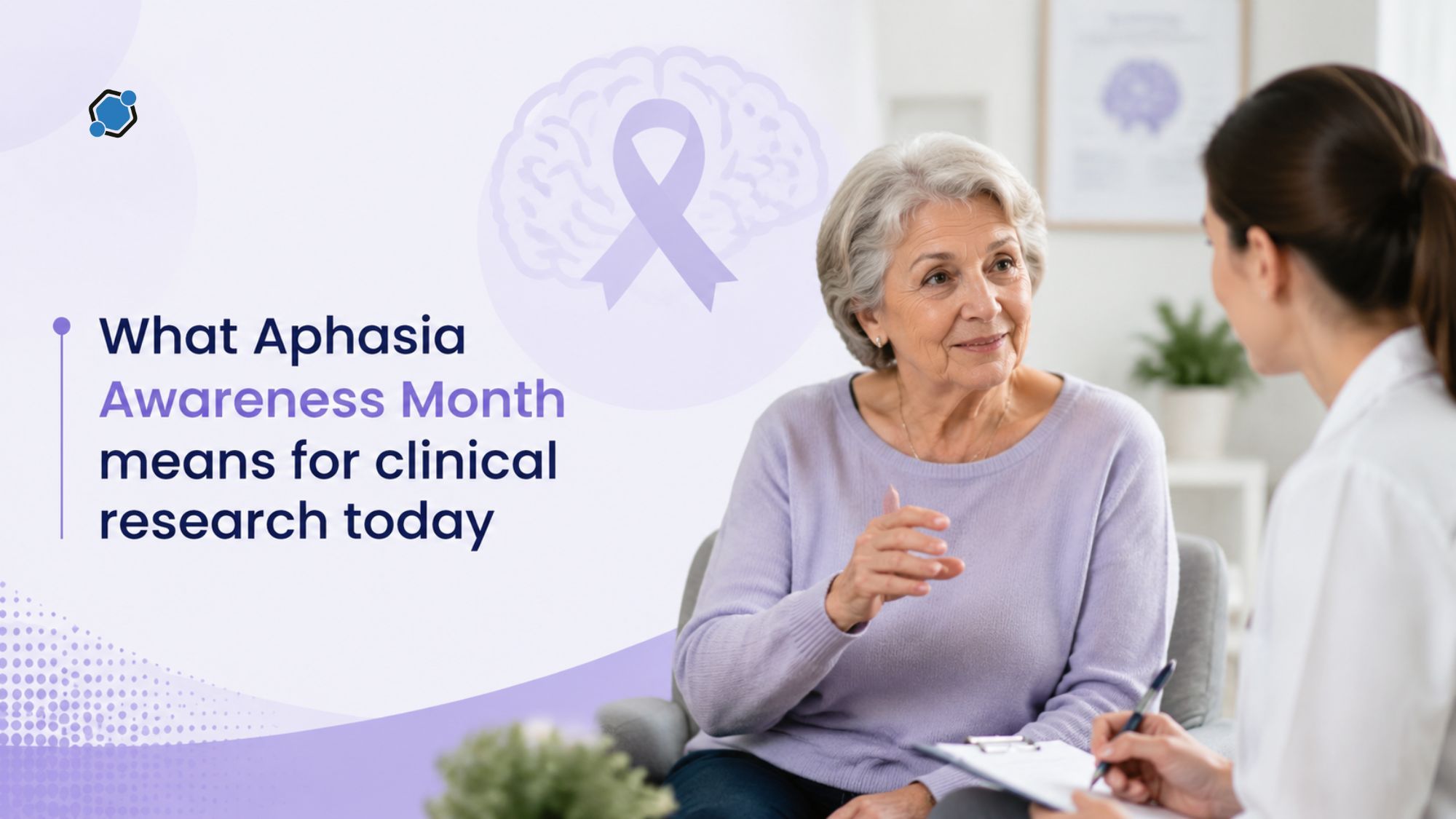
Every June, a quiet observance moves through clinical research circles, advocacy organizations, and the broader public. Aphasia Awareness Month draws attention to a condition that affects more than two million Americans yet remains one of the least recognized outcomes of stroke and brain injury. For the people who live with it, the month is a chance to be seen. For the clinical research community, it is a reminder that the work of restoring language to people who have lost it is still very much underway.
What Aphasia Awareness Month is
Aphasia Awareness Month is observed throughout June in the United States and the United Kingdom. The observance is anchored by a U.S. nonprofit foundation dedicated to people living with aphasia and their families, and by the United Kingdom's leading stroke charity. Both organizations use the month to publish stories from people living with aphasia, share educational resources, and ask the public, employers, and healthcare professionals to learn what aphasia is and what it is not. The most common social tag during the month is #AphasiaAwarenessMonth, and it tends to fill timelines in early June with first-person accounts and family stories that rarely surface the rest of the year.
If you have never heard of aphasia, this is the month it is most likely to land in your awareness, which is exactly the point. The condition is widespread, but the term itself sits well outside common vocabulary, which is part of why people who live with it often go unheard. To see how observances like this one tie advocacy work to clinical research access, read Patient Advocacy Groups: Finding Support and Trial Information.
What aphasia actually is
Aphasia is a language disorder. It is the loss or impairment of the ability to speak, understand spoken language, read, or write, caused by damage to the parts of the brain that handle language. It is not a loss of intelligence, a hearing problem, or a personality change. The person who had a stroke or brain injury and now lives with aphasia is the same adult they were the day before. Their language pathways were injured. Their thinking, memory, judgment, and identity remain.
The most useful misconception to clear up early is the assumption that someone who struggles to speak does not understand what is being said to them. Many people with aphasia understand far more than they can produce. Speaking to them slowly, giving them time, and treating them as the adults they are matters more than any single piece of technology in the room.
There are several forms. Some people have what is called expressive or non-fluent aphasia, where understanding remains relatively intact but speech is effortful and word-finding is hard. Others have receptive or fluent aphasia, where speech flows but the words and grammar do not match what the person intends. Global aphasia involves significant difficulty across speaking, understanding, reading, and writing. A separate category, primary progressive aphasia, develops slowly as part of a neurodegenerative condition (a gradual decline in brain cells over time) rather than from a single event like a stroke. For readers who are new to clinical research and want the foundation before reading further, Clinical Trials Explained: Simple Guide for Beginners covers the basics in plain language.
What causes aphasia and who lives with it
The most common cause of aphasia is stroke, which is what happens when blood flow to part of the brain is blocked or when a blood vessel in the brain bursts. In the United Kingdom, around one in three people develop aphasia after a stroke. In the United States, more than two million people currently live with aphasia, a number larger than the populations of several mid-sized states combined.
Stroke is not the only cause. Traumatic brain injury from a car crash, a fall, or an assault can damage the same language regions. Brain tumors can press on or invade language areas, producing aphasia symptoms before or after surgery. Some people develop aphasia gradually through a neurodegenerative condition, where the parts of the brain responsible for language slowly deteriorate over years. For a broader look at how clinical research touches conditions like these at population scale, see How Clinical Trials Contribute to Public Health.
Where clinical research stands today
Clinical research on aphasia is active. The field is smaller in scale than cancer or cardiovascular disease, but it is consistent and growing. As of early June 2026, approximately 89 clinical trials are recruiting participants with aphasia worldwide, with about 52 of those open in the United States. For context, around 85 stroke rehabilitation trials and roughly 389 stroke trials overall are recruiting in the United States, which means aphasia-specific research sits within a much larger field studying stroke and recovery as a whole.
The interventions being studied fall into a few recognizable groups. Roughly half of the worldwide aphasia trials involve speech and language therapy in some form, often testing new schedules, intensities, or computer-supported delivery methods. About a third include some form of brain stimulation, such as transcranial direct current stimulation, which uses a low electrical current applied through the scalp to influence brain activity, or transcranial magnetic stimulation, which uses magnetic pulses for a similar purpose. A growing number combine therapy with stimulation, and others test drug candidates for the more difficult forms like primary progressive aphasia. Remote and home-based delivery of therapy and stimulation is now common, which has changed how some studies are run. For the operational side of that shift, see Telehealth and Remote Monitoring: Expanding Site Capabilities.
These numbers will move month to month as trials open, close, and report results. The headline is that the research field is steady, and the range of approaches under study is wider than it was even five years ago.
How participation works for someone with aphasia
For someone living with aphasia who is curious about a clinical trial, the path begins outside the clinic. DecenTrialz helps people in the United States find clinical trials that may fit their situation. After someone shares basic information about themselves and the conditions they are interested in, the platform may identify trial options that appear to match their profile. A registered nurse then completes an initial pre-screening review before the person is referred to the research site running the study. The research site and study team handle the walk-through of study details, the final eligibility check, the consent conversation, and enrollment, since they are the ones responsible for the participant's care during the trial. You can start a search at decentrialz.com.
Aphasia trials carry one specific consideration that other trial types may not. Because the condition itself affects how a person communicates, the pre-screening conversation and the informed consent process need accommodations from the start. That means giving the participant time, offering written summaries alongside spoken explanations, allowing a family member or care partner to be present, and recognizing that the person may need to reread or rehear information. Most aphasia studies are run by speech-language researchers who know this well, and the study teams are trained for it. A participant should expect a slower pace, not because their abilities are doubted, but because real consent requires real comprehension. For a step-by-step walkthrough of the participation pathway, see How to Find and Enroll in a Clinical Trial: A Step-by-Step Guide.
A typical aphasia study will involve multiple visits over weeks or months, structured language tasks, sometimes brain imaging like an MRI, and sometimes a therapy schedule the participant follows at home. Some include a control condition, where one group does not receive the experimental therapy during the study period to allow comparison. The study team explains all of this in detail before any decision to enroll.
What June asks of everyone involved
For people living with aphasia and their families, June is a chance to be heard. The communities organizing the month know that the most powerful awareness tool is the voice of someone living with the condition, even when that voice is slow, halting, or assisted. Sharing a story, joining a community event, or simply showing up online with the month's hashtag puts a face on a condition that hides too well in everyday life.
For research sites and study teams, the month is a reminder that the work of recruiting, consenting, and retaining participants with communication disorders requires specific care. The accommodations that make aphasia trials feasible are not extras; they are the trial. Sites that handle aphasia well are sites the field will keep coming back to.
For the broader clinical research community, the month is a quiet check-in on a field that does not get the funding or visibility of larger therapeutic areas, but that touches the daily life of millions of people. If you are considering joining a clinical study, or you know someone who is, you can begin a search at decentrialz.com to see what is currently recruiting.
Was this article helpful?

Similar Blogs

Why is my blood pressure still high on medication? Resistant hypertension explained
Blood pressure that stays high after treatment has already started is more common than mos...
 Vamshi Kantoju
What is insulin resistance and how does it affect blood sugar?
Insulin resistance is a condition in which muscle, liver, and fat cells respond weakly to ...
Swaroop ESD
Mini-stroke symptoms: how to recognize a transient ischemic attack before a full stroke
A transient ischemic attack, often called a mini-stroke, is a short episode of stroke symp...
Deeksha GittaStay Informed. Stay Connected.
Get updates on verified clinical trials, emerging treatments, and research breakthroughs directly in your inbox. No spam, just science that matters.
