 HIPAA Compliant
 ISO 27001 Certified
FAST and BE FAST Stroke Warning Signs: How to Recognize a Stroke and What to Do
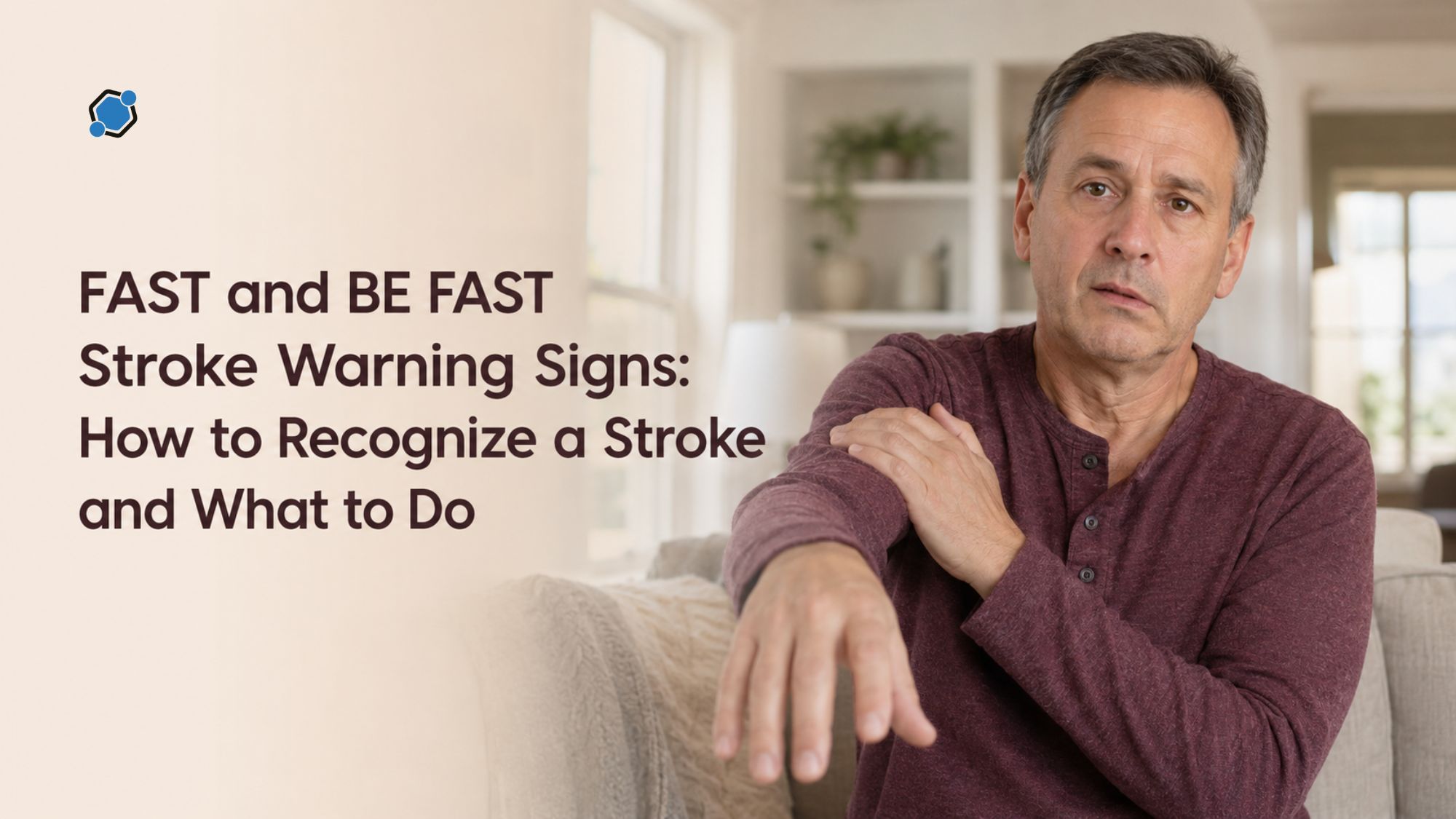
A stroke interrupts blood flow to part of the brain, and the damage begins within minutes. Two short checklists, FAST and BE FAST, exist because most strokes are noticed first by an ordinary person rather than by a medical professional. Each letter stands for something specific to look for, and the final letter stands for the action that follows. Learning both checklists, and learning where each one falls short, is what separates an immediate emergency call from a delay that costs brain tissue.
What the FAST checklist stands for
FAST is a four-letter memory aid built around the three signs that appear most often during a stroke, plus the action that should follow. It was designed originally as a rapid assessment for ambulance crews and was later adapted for public education, because a four-item list is short enough to recall under pressure.
The four checks are:
- Face. Ask the person to smile. One side of the face may droop or look uneven.
- Arm. Ask the person to raise both arms. One arm may drift downward or fail to lift at all.
- Speech. Ask the person to repeat a simple sentence. Speech may be slurred, garbled, or difficult to produce.
- Time. Any single one of these signs is reason to call 911 immediately, and the time the symptoms began should be recorded.
These three signs tend to appear together for an anatomical reason. The front and middle portions of the brain, which control movement on one side of the body and the production of language, share a common blood supply. When that supply is blocked, the face, the arm, and speech are commonly affected at the same time.
Speech problems after a stroke cover a wide range. Some are slurring caused by weakened muscles around the mouth and throat. Others involve a genuine loss of the ability to produce or understand language, a condition covered in more detail in this look at loss of language after a stroke.
The T in FAST carries more weight than its position suggests. Recording the moment symptoms started, or the last moment the person was known to be well, directly determines which treatments the hospital can offer.
What BE FAST adds, and why balance and vision matter
BE FAST keeps all four FAST checks and adds two letters at the front:
- Balance. Sudden loss of coordination, unsteadiness on the feet, or a spinning sensation that arrives without warning.
- Eyes. Sudden double vision, sudden loss of vision in one or both eyes, or a section of the visual field going dark.
The reason for the expansion is anatomical rather than stylistic. The back of the brain, including the brainstem and the cerebellum, receives blood from a separate set of arteries than the regions controlling the face and the arms. That part of the brain governs balance, coordination, eye movement, and vision. A stroke there can produce severe symptoms while leaving the face symmetrical and both arms strong, which means it passes a FAST check without raising any alarm.
Strokes in this region account for a meaningful share of all strokes and are among the most frequently missed. Part of the difficulty is that sudden vertigo and unsteadiness overlap with far more common and far less serious problems, including inner ear disturbances, migraine, and ordinary viral illness. Adding balance and vision to the checklist raises the chance that such a stroke is caught, at the cost of more false alarms, and that trade-off is what clinicians weigh when deciding which version to teach.
Both versions remain in active use across the United States. Some national health authorities and many certified stroke centers now promote the six-letter version, while others continue with the four-letter version on the grounds that a shorter list survives better in a real emergency. The broader recognition that stroke often arrives outside the classic pattern is also why how stroke presents in women has become its own area of public education.
Stroke signs that neither checklist includes
Both checklists are screening tools rather than complete symptom lists. Several important warning signs sit outside them entirely, and treating either acronym as exhaustive creates a blind spot.
A sudden, severe headache with no obvious cause deserves particular attention. A headache of that kind, often described afterward as the worst the person had ever experienced, is associated with bleeding in or around the brain rather than with a blocked vessel. Sudden confusion, sudden numbness down one side of the body, difficulty swallowing, and nausea or vomiting accompanying any neurological change all belong on the list as well.
Symptoms that disappear on their own form a separate and frequently misunderstood category. A transient ischemic attack, sometimes called a mini-stroke, produces stroke symptoms that resolve because blood flow is restored before permanent damage occurs. Resolution offers no reassurance. A transient ischemic attack signals a heightened short-term risk of a full stroke, much of that risk concentrated in the first days afterward, and an observer cannot distinguish it from a stroke while it is happening. The correct response is identical: call 911.
Age and sex both influence how a stroke announces itself. Presentations that fall outside the classic pattern occur more often in women and in younger adults, and the mismatch between public expectation and clinical reality contributes to delay in recognition and in diagnosis. Public education has been broadening steadily for this reason, alongside wider conversations about everyday brain health.
Why the response to a stroke is measured in minutes
Brain tissue deprived of blood does not survive long. Neurons, the connections between them, and the fibers that carry their signals are lost continuously from the moment flow stops, which is the origin of a phrase used throughout emergency medicine: time is brain.
Treatment options narrow as the clock runs. Clot-dissolving medication is available only within a defined window measured from symptom onset. Procedures that physically remove a clot from a large vessel carry a longer but still limited window, and apply only to patients whose brain imaging shows tissue that can still be saved. Those windows have widened in recent years for carefully selected patients, though earlier arrival remains better in every scenario, and many people who arrive late remain ineligible for any of it.
Calling 911 rather than driving to a hospital changes the process in several concrete ways. Emergency crews alert the hospital while still on the road, so the stroke team and the scanner are ready on arrival. They route the person to a hospital equipped to manage a stroke rather than to the closest building with an emergency department. They also monitor the person during transport, which matters because stroke symptoms can worsen quickly.
Imaging comes first at the hospital for a specific and important reason. A stroke caused by a clot and a stroke caused by bleeding produce similar symptoms but call for opposite treatments. Giving clot-dissolving medication to someone bleeding into the brain would be dangerous, so a brain scan is performed before any such decision is made. A bystander at the scene has no way to tell the two apart, which is a further reason that waiting at home is never a reasonable option.
How stroke research depends on the same recognition speed
Stroke research runs against the same clock that stroke treatment does. Studies of acute stroke care often enroll participants within hours of symptom onset, which means the people who reach care late are excluded from the research for the same reason they are excluded from the treatment. Other areas of stroke research operate on longer timelines and remain open well after the acute phase, including rehabilitation, recovery of movement and language, and prevention of a second stroke.
Finding a suitable study is difficult for most people, because eligibility criteria are detailed and differ substantially from one study to the next even within the same condition. That difficulty is the subject of this explanation of why trial criteria exclude some people.
DecenTrialz is a clinical trial recruitment and pre-screening platform. It uses AI-assisted matching to surface studies that may fit a person's situation, followed by pre-screening conversations led by registered nurses who walk through the basic criteria before any referral is made. Final eligibility determination, informed consent, the study walk-through, and enrollment always belong to the research site team. Anyone curious about stroke research can start at decentrialz.com.
Common questions about FAST and BE FAST
What does BE FAST stand for?
BE FAST stands for Balance, Eyes, Face, Arm, Speech, and Time. The first two letters cover a sudden loss of balance or coordination and a sudden change in vision. The remaining four are the original FAST checks, unchanged.
What is the difference between FAST and BE FAST?
BE FAST is the longer version. It contains everything in FAST and adds balance and vision, which are the signs most often produced by strokes affecting the back of the brain. FAST is shorter and easier to recall under stress, while BE FAST catches a wider range of strokes.
Can a stroke happen without face drooping?
Yes. Facial drooping is common but far from universal. A stroke affecting balance, vision, or coordination frequently occurs with a completely symmetrical face and full strength in both arms, which is precisely the gap that BE FAST was built to close.
What should someone do if a stroke is suspected?
Call 911 immediately, note the time symptoms began or the last time the person appeared well, and stay with the person until help arrives. Food, drink, and medication should be withheld, because swallowing may be impaired without any outward sign.
How long is the window for stroke treatment?
The window depends on the treatment and on the individual. Clot-dissolving medication carries the shortest window from symptom onset, while clot-removal procedures extend further for selected patients whose brain imaging supports it. Eligibility is decided case by case at the hospital, so the practical answer is that earlier arrival always widens the available options.
Do stroke symptoms that go away still need emergency care?
Yes. Symptoms that resolve on their own may indicate a transient ischemic attack, which signals a heightened risk of a full stroke in the days that follow. Emergency evaluation is warranted regardless of how brief the episode was.
Recognition is one part of stroke awareness
Learning FAST or BE FAST takes a few minutes, and either version is a substantial improvement over having no framework at all. The stronger position is to hold both at once: run the six checks, understand that a sudden severe headache and unexplained confusion also count, and treat any symptom that resolves as a reason to seek care rather than a reason to relax.
Lowering the chance of a stroke in the first place runs in parallel with recognizing one. Blood pressure control carries more weight than any other modifiable factor, alongside management of irregular heart rhythms, blood sugar, cholesterol, and smoking. This look at why blood pressure gets this attention explains why that single measure sits at the center of stroke prevention.
Gaps in stroke awareness are structural rather than personal. Public campaigns have raised knowledge of stroke symptoms considerably, yet the step between recognizing a sign and picking up the phone remains the weakest link in the chain. Clear and consistent messaging closes that gap far better than blame does. Information about stroke research and participation options is available at decentrialz.com.
Was this article helpful?

Similar Blogs
Why is my blood pressure still high on medication? Resistant hypertension explained
Blood pressure that stays high after treatment has already started is more common than mos...
 Vamshi Kantoju
What is insulin resistance and how does it affect blood sugar?
Insulin resistance is a condition in which muscle, liver, and fat cells respond weakly to ...
Swaroop ESD
Mini-stroke symptoms: how to recognize a transient ischemic attack before a full stroke
A transient ischemic attack, often called a mini-stroke, is a short episode of stroke symp...
Deeksha GittaStay Informed. Stay Connected.
Get updates on verified clinical trials, emerging treatments, and research breakthroughs directly in your inbox. No spam, just science that matters.
