 HIPAA Compliant
 ISO 27001 Certified
World Brain Day 2026: brain health, access, and everyday prevention
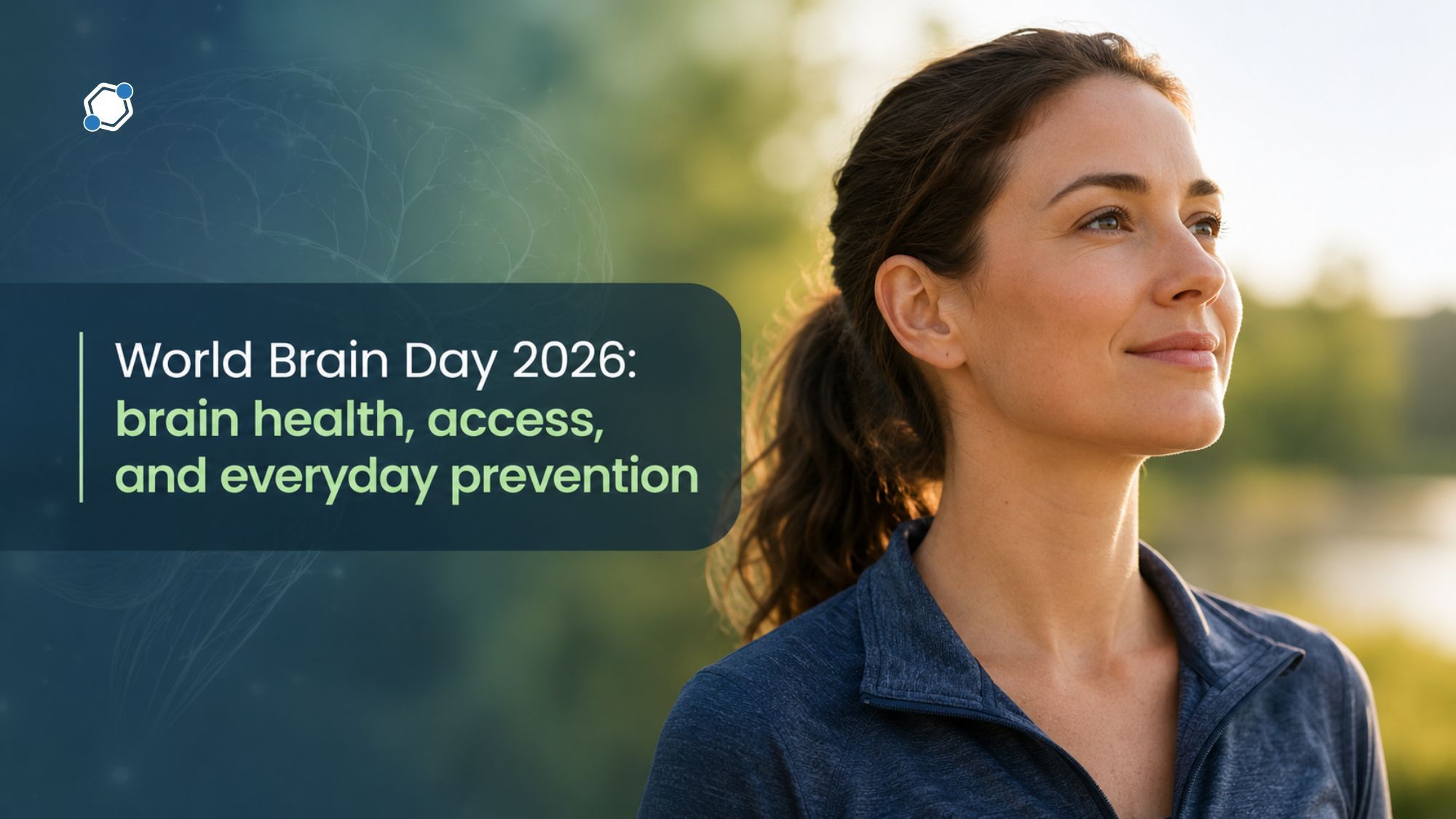
World Brain Day is an annual public health observance dedicated to the brain and to the many conditions that affect it. In 2026 it takes place on Wednesday, July 22, and the theme is "Brain Health: Access for All." The observance is led by the World Federation of Neurology, an international body that represents national neurological societies across six world regions.
The information below explains what World Brain Day 2026 is, what the theme of access means, what a neurological disorder is in plain terms, which conditions come up most often in daily life, what everyday habits appear to support brain health, and how clinical research fits into the wider effort to protect the brain.
World Brain Day 2026: what it is and when it happens
World Brain Day is observed every year on July 22. In 2026 that date falls on a Wednesday. The day was established in 2014 by the World Federation of Neurology, working with its regional bodies covering Africa, the Eastern Mediterranean, Europe, Pan America, Asia Oceania, and the Pan Arab region. The date is not arbitrary. It marks the founding of the World Federation of Neurology in Brussels in 1957.
Each year the campaign focuses on a specific theme. Recent themes have concentrated on prevention, on brain health across all ages, and now, in 2026, on access to brain care. The purpose is to raise awareness among the general public, to give clinicians and researchers a common message for the day, and to prompt policy makers to prioritize brain health.
An awareness day is a public education campaign anchored to a specific date, meant to concentrate attention around a topic that can otherwise get lost in the wider news cycle. World Brain Day is one of the largest such campaigns for neurology, the area of medicine focused on the brain, the spinal cord, and the nerves throughout the body.
For readers who want a related look at how observance days connect the public to research, see International Clinical Trials Day 2026, which covers the origins and impact of another key research awareness date.
World Brain Day 2026: the theme of access and why it matters
The 2026 theme, "Brain Health: Access for All," carries a simple message from the campaign leaders: access delayed is potentially access denied. The point is that even where effective care exists, it does not reach everyone who needs it, and the delay itself can worsen outcomes.
Access to brain care is uneven in ways that go beyond individual choice. The healthcare system distributes neurological specialists, imaging equipment, medications, and rehabilitation services unequally across countries and communities. In many parts of the world, the number of neurologists per person is a small fraction of what is available in high-income settings. Even within the same country, distance to a specialist, waiting times, and cost can shape whether a person is diagnosed early or late.
Neurological conditions are among the leading causes of illness and disability worldwide. When early care is out of reach, the burden on individuals, families, and health systems grows. That concern sits behind the 2026 theme, and it is why the observance emphasizes five areas of action: visibility of brain health as a public priority, capability of health systems to deliver care, protection of people at risk, equity across populations, and advocacy that turns awareness into policy.
Access barriers are not unique to neurology. For a related look at how awareness campaigns address long-term conditions more broadly, see Chronic Disease Awareness Day 2026.
What the brain does, and what a neurological disorder means
The brain is the control center of the body. It manages movement, sensation, speech, memory, mood, sleep, breathing, and countless automatic processes that keep a person alive. The brain works together with the spinal cord and the peripheral nerves, which are the nerves that branch out to the rest of the body, to form the nervous system.
A neurological disorder is any condition that affects this system. Some neurological disorders develop suddenly, such as a stroke, which occurs when blood flow to part of the brain is cut off. Others develop gradually over years, such as Alzheimer's disease, the most common form of dementia. Dementia is a broader term for a loss of brain function that affects memory, thinking, and judgment.
Neurology is the medical specialty that focuses on these conditions. Neurologists are physicians trained to diagnose and manage disorders of the brain, spinal cord, and nerves. Many neurological conditions can be managed effectively, and outcomes are often better when the condition is recognized and addressed early.
Some neurological conditions affect language and communication in ways that are not always visible. For a closer look at one such condition and the research around it, see What Aphasia Awareness Month means for clinical research today.
Common neurological conditions explained in plain language
Several neurological conditions affect large numbers of people worldwide. A brief explanation of each helps make the topic of World Brain Day 2026 more concrete.
Stroke is a medical emergency in which blood flow to part of the brain is interrupted, either by a blocked artery or by a bleed. Brain cells begin to die within minutes, so time to care is critical. Warning signs include sudden weakness on one side of the body, sudden trouble speaking, and a sudden severe headache.
Alzheimer's disease and other forms of dementia cause a gradual loss of memory, thinking skills, and independence. Alzheimer's is the most common form. Not all memory changes in older adults amount to dementia, and current research suggests that many risk factors for dementia can be modified across life.
Epilepsy is a condition in which the brain produces recurring seizures. A seizure is a burst of unusual electrical activity in the brain that can affect movement, sensation, or awareness. Epilepsy can appear at any age, and many people with epilepsy live full lives with appropriate care.
Parkinson's disease is a movement disorder in which certain nerve cells in the brain weaken and die. It often begins with a slight tremor and can progress to affect walking, balance, and speech.
Migraine is a neurological condition that causes recurring headaches, often severe, sometimes with nausea, light sensitivity, or visual changes. Migraine is more than an ordinary headache and can significantly disrupt daily life.
Multiple sclerosis, often shortened to MS, is a condition in which the immune system mistakenly attacks the protective covering around nerves in the brain and spinal cord, which disrupts the signals nerves send throughout the body. Traumatic brain injury refers to an injury to the brain caused by a bump, blow, or jolt to the head. A concussion is a mild form.
Dementia is one of the most widely discussed of these conditions. For a related look at the awareness effort focused specifically on the aging brain, see Why Alzheimer's & Brain Awareness Month Matters in 2026.
Everyday habits that support brain health across a lifetime
Prevention is a central part of the World Brain Day message, and the science behind it has strengthened in recent years. What is good for the heart is generally good for the brain, because the brain depends on healthy blood vessels and steady oxygen delivery.
Regular physical activity is one of the strongest supports for long-term brain health. Any movement that raises the heart rate, done consistently, appears to help. Sleep matters as well, because the brain performs important cleanup and memory work overnight. Both short sleep and disrupted sleep have been linked to poorer brain outcomes over time.
Blood pressure, blood sugar, and cholesterol influence the risk of stroke and of some forms of dementia. Managing these numbers with the help of a primary care physician is one of the most direct ways to protect the brain. Reducing tobacco and heavy alcohol use, staying socially connected, addressing hearing loss when it develops, and staying mentally engaged through reading, learning, or work all appear to support cognitive resilience over decades.
No single habit is a guarantee, and no single choice prevents neurological disease on its own. What research shows is a pattern: consistent lifestyle choices, taken together and started early, reduce a meaningful share of the modifiable risk for conditions such as stroke and dementia.
High blood pressure sits at the center of that pattern. For a related look at why blood pressure matters for long-term brain and cardiovascular health, see World Hypertension Day 2026: Theme, Importance, and Clinical Trials.
How clinical research advances brain health, and how DecenTrialz supports early matching
Much of what is understood today about the brain and about neurological conditions has come from clinical research. A clinical trial is a research study in which volunteers help answer specific questions about whether a new medical approach is safe and works as intended. Trials run in phases: a first phase checks safety in a small group, a second looks at effectiveness and safety in a larger group, a third confirms results in a much larger group, and a fourth continues monitoring after a therapy is approved.
Access to research participation is often as uneven as access to routine care. Many people never learn about studies that might be relevant to their condition, and the pathway from interest to enrollment can feel opaque. That gap is what participant recruitment platforms are built to close.
DecenTrialz is a United States platform that supports the early part of this pathway. It uses AI-assisted participant matching to help people find studies that may fit their situation, and a registered nurse then conducts a pre-screening conversation to review basic study criteria. Pre-screening is a preliminary, non-invasive check, not a formal evaluation.
Final eligibility determination, the full study walk-through, informed consent, and enrollment always belong to the research site team. Informed consent is the process, led by the research site, in which the study team explains the purpose, procedures, risks, and possible benefits of a study in plain language so a person can freely decide whether to take part. DecenTrialz does not replace any part of that process. Its role is to reduce the friction of getting to the door of a site that runs the studies a person may be a candidate for.
To see what brain health and neurology studies may be relevant, visit decentrialz.com.
Taking the next step on World Brain Day 2026
World Brain Day 2026 is an opportunity to turn awareness into a specific action. That action can be a conversation with a primary care physician about blood pressure, sleep, or memory concerns. It can be a change to a daily routine. It can also be an exploration of whether a clinical study is relevant to a personal health situation.
Access to brain care, whether through routine medicine or through research, begins with knowing what is available. Anyone interested in current neurology and brain health studies can start by exploring active research through AI-assisted matching and a nurse-led pre-screening conversation. From that point, the research site team handles every step, from formal screening through informed consent to enrollment.
Explore active brain health and neurology studies at decentrialz.com.
Was this article helpful?

Similar Blogs
Why is my blood pressure still high on medication? Resistant hypertension explained
Blood pressure that stays high after treatment has already started is more common than mos...
 Vamshi Kantoju
What is insulin resistance and how does it affect blood sugar?
Insulin resistance is a condition in which muscle, liver, and fat cells respond weakly to ...
Swaroop ESD
Mini-stroke symptoms: how to recognize a transient ischemic attack before a full stroke
A transient ischemic attack, often called a mini-stroke, is a short episode of stroke symp...
Deeksha GittaStay Informed. Stay Connected.
Get updates on verified clinical trials, emerging treatments, and research breakthroughs directly in your inbox. No spam, just science that matters.
