 HIPAA Compliant
 ISO 27001 Certified
Why Does National Cancer Research Month Matter in 2026?
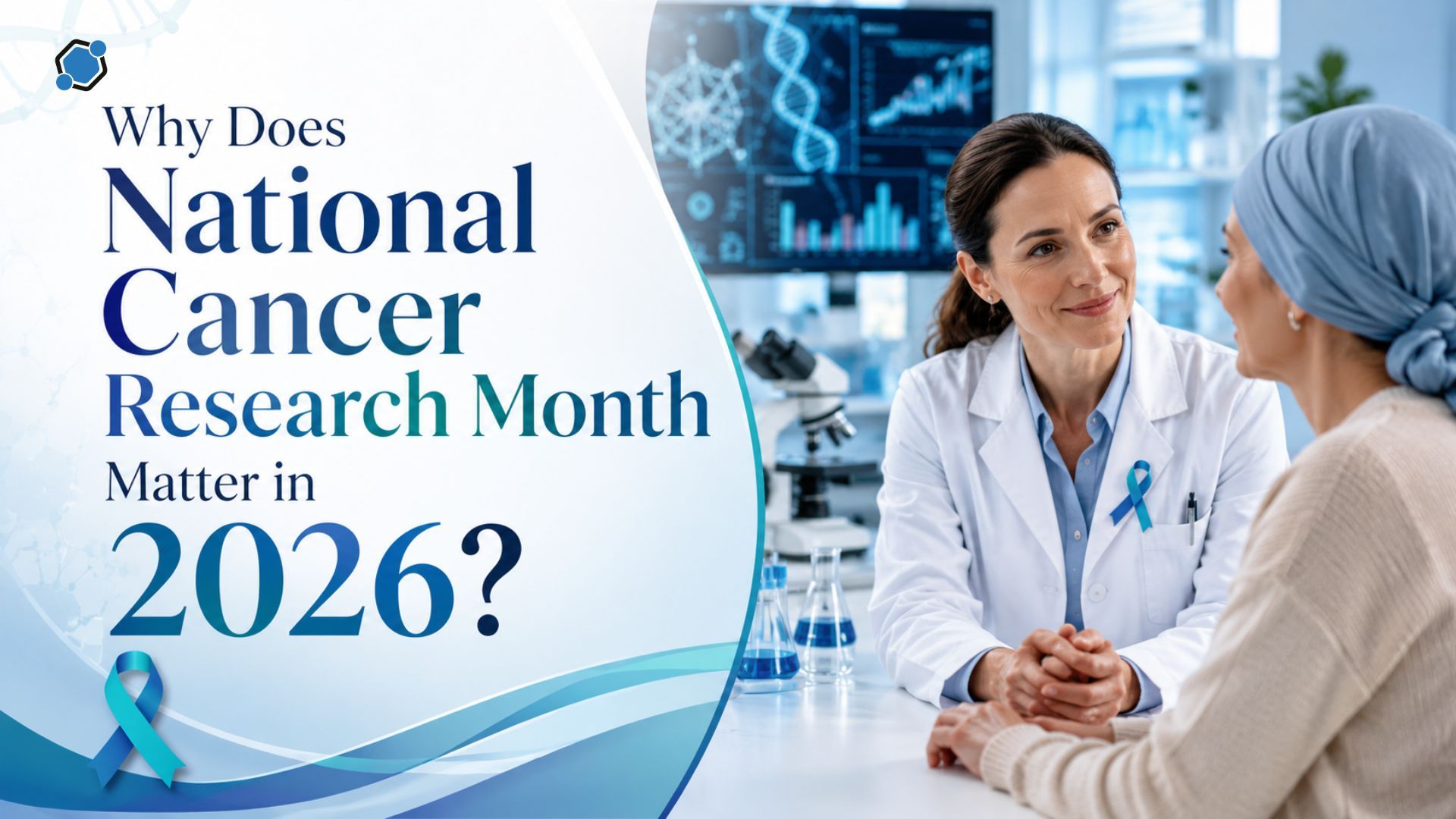
Each May in the United States, organizations across cancer care and research observe National Cancer Research Month. The observance sits between Mother's Day, Memorial Day, and the start of summer, so it can be easy to miss in a crowded calendar. For the millions of people facing a cancer diagnosis, supporting someone through one, or thinking about how to lower their own risk, the month is more than a formality. It is a reminder of how much the science of cancer is changing, and how that change is reaching real people through clinical trials.
National Cancer Research Month matters in 2026 because cancer research is moving faster than at almost any point in its history. More than 18,000 cancer clinical trials are actively recruiting participants worldwide, with over 7,000 of those running at sites in the United States. The science behind cancer care is shifting from one-size-fits-all chemotherapy toward immunotherapy, cell therapy, targeted therapies, and approaches built around the specific biology of an individual's cancer. The sections below explain what the observance is, what cancer clinical trials actually are, where the research stands today, and what people considering participation should know.
What Is National Cancer Research Month?
National Cancer Research Month is an annual observance held each May in the United States. It is led by the American Association for Cancer Research (AACR), a professional society that brings together cancer researchers, clinicians, advocates, and survivors. The AACR has organized the observance for many years, and it has grown to involve hospitals, universities, advocacy groups, government health agencies, and individual research labs across the country.
The purpose of the month is to draw public attention to the work happening in cancer research and to recognize the people involved in it: scientists running experiments, doctors conducting trials, patients who participate in studies, and survivors who advocate for further investment. It is also a reminder that cancer research is not a single project happening in one place. It is thousands of studies running in parallel, each one focused on a specific question about preventing, finding, or treating a particular kind of cancer.
Awareness of this kind matters for practical reasons. Cancer research depends on three things: funding, scientific talent, and people willing to participate in studies. National Cancer Research Month helps build the public support that sustains all three.
What Are Cancer Clinical Trials?
A clinical trial is a research study in which people volunteer to help test a new way of preventing, finding, or treating a disease. Cancer clinical trials apply this idea specifically to cancer. Each trial is designed to answer a defined research question, follows a written plan called a protocol, and operates under the oversight of an Institutional Review Board (IRB), which is an independent ethics committee responsible for protecting participants.
Cancer clinical trials run in stages, often called phases. Phase 1 trials test a new approach in a small number of people to see whether it is safe and how it should be dosed. Phase 2 trials look at whether it shows signs of working in a particular cancer type. Phase 3 trials compare the new approach with the current standard of care in much larger groups to see whether it is genuinely better. Phase 4 trials continue to study a therapy after it has been approved by the U.S. Food and Drug Administration (FDA), watching for long-term effects that only show up over years.
Not every cancer clinical trial tests a drug. Trials also study new ways to prevent cancer in people at high risk, new screening methods that detect cancer earlier, surgical or radiation techniques, supportive-care approaches that reduce side effects, and questions about quality of life during and after care. For an introduction to how clinical trials work in general, Clinical Trials Explained: Simple Guide for Beginners walks through the basics in plain language.
The State of Cancer Research in 2026
The scale of active cancer research in 2026 is significant. More than 18,000 cancer clinical trials are recruiting participants globally, with over 7,000 of those running at sites in the United States. To put that in concrete terms, about 940 clinical trials are recruiting people with breast cancer in the U.S. alone, and a similar number are recruiting for lung cancer. Hundreds more are running for colorectal cancer, prostate cancer, blood cancers like leukemia and lymphoma, brain cancers, rare cancers, and many other specific subtypes.
The mix of approaches being studied is broader than it was even a decade ago. Chemotherapy is still part of cancer care and is still studied in many trials, often in new combinations or sequences. Immunotherapy, which trains the body's own immune system to recognize and attack cancer cells, is the focus of more than 700 actively recruiting trials in the United States. Cell therapies like CAR-T (chimeric antigen receptor T-cell therapy, in which a patient's own immune cells are modified to fight cancer) are being studied in additional cancer types beyond the blood cancers where they were first approved. Targeted therapies, which work against specific genetic changes inside cancer cells, are now standard tools in trials for many cancer types.
Cancer prevention is a smaller but real part of the research picture. Roughly 150 prevention-focused cancer clinical trials are recruiting in the United States right now, studying questions like which medications can lower risk in high-risk groups, how vaccines may reduce certain virus-related cancers, and how diet, lifestyle, and screening changes affect long-term outcomes. For a closer look at recently active studies in this area, 5 Active Clinical Trials Advancing Cancer Care covers a sample of what is happening in current cancer research.
Common Concerns About Joining a Cancer Clinical Trial
People considering a cancer clinical trial often run into a few specific worries. These come up frequently enough that they are worth addressing directly.
The first concern is that joining a trial means giving up current cancer care. In most cancer clinical trials, this is not how it works. Many trials test a new therapy added to the existing standard of care, or compare the new approach against the current standard. Placebo-only designs, where participants receive an inactive substance instead of an active therapy, are uncommon in cancer trials of active care because withholding care from someone with cancer would be unethical. Placebos are more often used in prevention trials, supportive-care trials, or alongside the standard of care rather than instead of it.
The second concern is that participants will be treated like test subjects rather than patients. Cancer clinical trials are run by teams of doctors, nurses, and study coordinators whose job is to provide care while collecting research data. Before joining, every participant goes through a process called informed consent, in which the study team explains what the trial involves, what is known and unknown about the approach being studied, and what the participant's rights are. Participants can ask questions at any point and can withdraw from the trial at any time, for any reason, without losing access to standard care.
The third concern is that clinical trials are only an option for people who have run out of other choices. This is no longer the case for most cancer types. Trials run across all stages of cancer, including for people who are newly diagnosed, in remission, or at high risk of developing a specific cancer. Some trials test what could become the first-line therapy for a particular cancer, not the last.
Every cancer clinical trial has its own eligibility requirements, called inclusion and exclusion criteria. These can include the specific cancer type and stage, prior therapies the person has received, age, overall health, and certain laboratory measurements. Some trials look for very specific genetic features in the cancer itself, since many newer therapies are designed to work against particular mutations.
Eligibility criteria can feel restrictive, but they exist for two reasons. The first is participant safety: criteria help screen out people for whom the approach being studied could be unsafe, given other health conditions or medications. The second is scientific validity: tightly defined groups make it possible to see whether the approach is actually working, rather than producing mixed results from very different participants.
Not qualifying for one trial does not mean not qualifying for any. With over 7,000 cancer clinical trials recruiting in the United States, there is often more than one study related to a given cancer type, stage, and biology. People who are screened out of one trial frequently find they are a fit for another. For a closer look at how eligibility works and what to do if a specific trial does not fit, Eligibility Explained: Why Not Everyone Qualifies for a Trial covers it in plain language.
How to Explore Cancer Clinical Trials
If you are thinking about cancer clinical trials, either for yourself or for someone you are caring for, there are a few practical paths.
DecenTrialz is a platform that connects people to clinical trials they may be eligible for. You share some basic information about yourself and the kind of cancer you or your family member is dealing with, get matched with cancer clinical trials that may fit your situation, and a nurse pre-screens you to walk through what each study involves before you decide whether to take the next step. The research team running each study makes all final eligibility and enrollment decisions, since they are the ones responsible for the participant's care during the trial. You can start a search at decentrialz.com.
Talking with your oncology team is also a useful step. Doctors who treat cancer often know which trials are open at their own institution, and many cancer centers have research staff whose job is to help patients understand whether participation makes sense. If your oncologist is not aware of trials that fit, or if you want to look more broadly, the matching approach above can run alongside that conversation rather than replacing it.
For a step-by-step view of what searching, screening, and enrolling actually look like, How to Find and Enroll in a Clinical Trial: A Step-by-Step Guide walks through the process in detail.
National Cancer Research Month exists to draw attention to a field that has changed substantially in the last decade and is changing further now. The number of cancer clinical trials recruiting today, the variety of approaches being studied, and the increasing use of therapies tailored to the biology of an individual's cancer all reflect a research landscape that is moving faster than it was even five years ago. For people who want to learn what is happening in cancer research, or who are considering whether participation is right for them, the month is a good moment to start. You can begin a search at decentrialz.com.
Was this article helpful?

Similar Blogs

ADHD Awareness Month 2026: adult diagnosis, the gap in women, and research shaping better care
Millions of adults in the United States are being recognized with Attention-Deficit/Hypera...
 Swaroop ESD
Breast Cancer Awareness Month 2026: Signs, Types, and Why Research Still Matters
Before the ribbon was pink, it was peach. In the early 1990s, a grandmother in California ...
Paramraj
HER2 positive and HER2 negative breast cancer explained: testing, treatment, and what HER2 low means
A breast cancer pathology report contains a great deal of information, and HER2 status is ...
Swaroop ESDStay Informed. Stay Connected.
Get updates on verified clinical trials, emerging treatments, and research breakthroughs directly in your inbox. No spam, just science that matters.
