 HIPAA Compliant
 ISO 27001 Certified
Asthma and Allergy Awareness Month 2026: The Power of Community in Clinical Trials
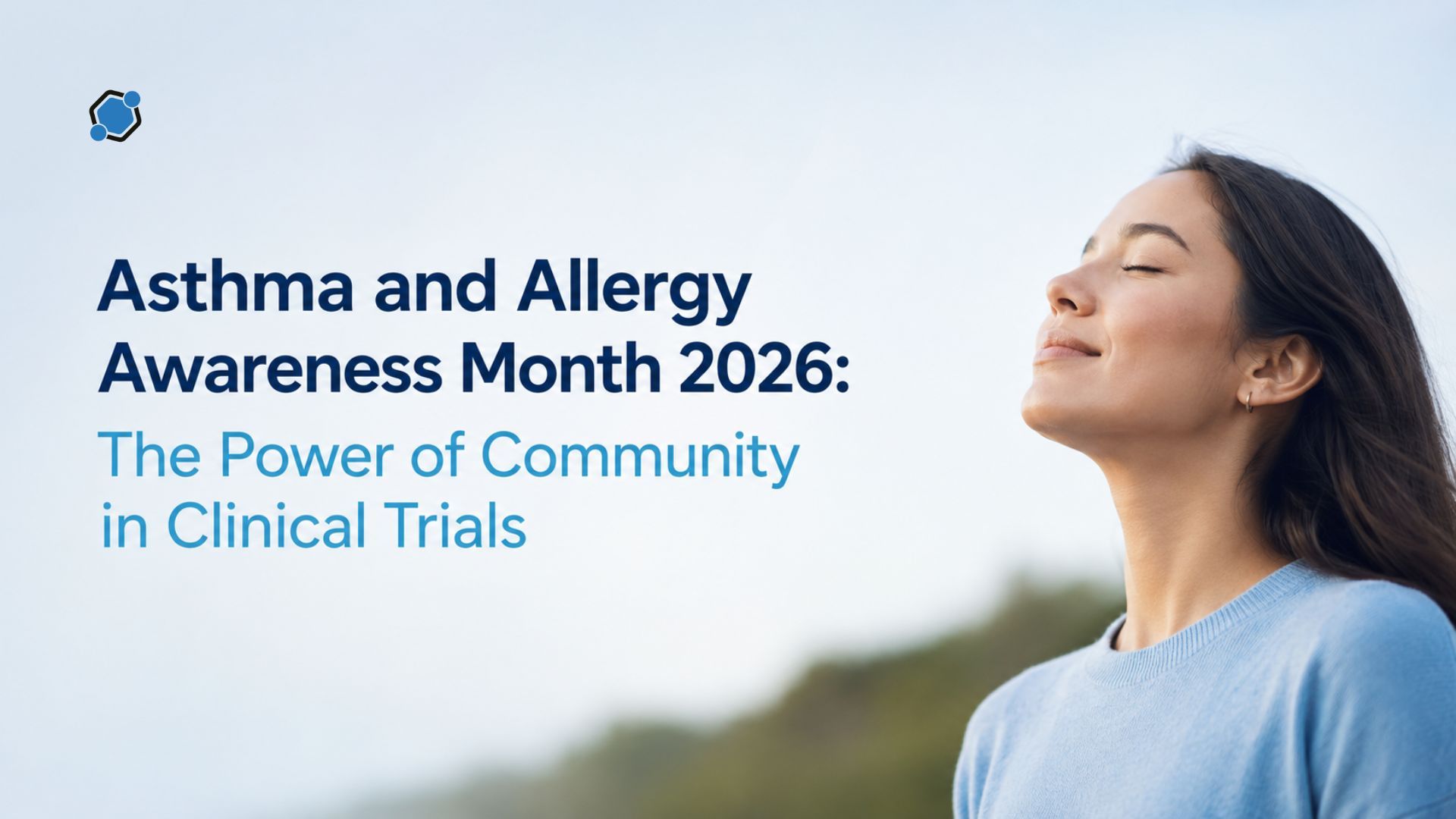
Asthma and allergies are among the most common chronic conditions in the United States. Tens of millions of people manage them every day, often without thinking of themselves as part of a community.
Each May, the Asthma and Allergy Foundation of America (known as AAFA) sets a theme for Asthma and Allergy Awareness Month. The 2026 theme is “The Power of Community to Improve Asthma and Allergy Health.”
The point is straightforward. Managing asthma and allergies takes more than a daily inhaler or an epinephrine auto-injector. It takes the people around you: family, friends, doctors, school staff, coworkers, lawmakers who set health policy, and the researchers running studies that develop new options.
Those researchers are part of the community too. A clinical trial is a research study that tests whether a new medication or approach is safe and works in people. Every asthma inhaler and allergy medication on a pharmacy shelf today went through clinical trials first. The next generation of asthma and allergy options is being tested in clinical trials happening right now.
Asthma and Allergy Awareness Month 2026
AAFA has run Asthma and Allergy Awareness Month every May since 1984. The 2026 observance focuses on how community shapes day-to-day life with asthma and allergies. Where you live, the air you breathe, the people around you, and the policies that affect your school, workplace, or neighborhood all play a role in whether your symptoms stay in check.
The scale is hard to overstate. AAFA reports that more than 106 million people in the United States have asthma or some form of allergy. That breaks down to about 28 million with asthma, 22 million with food allergies, and 82 million with nasal allergies. Allergy & Asthma Network counts differently and reports 25 million with asthma and 50 million with allergies overall. The numbers vary because counting chronic conditions is hard, but the takeaway is the same. Asthma and allergic disease are everywhere in the country.
May 2026 also includes other observances connected to asthma and allergies. World Asthma Day falls on May 5, organized by the Global Initiative for Asthma (known as GINA). Its 2026 theme is “Access to anti-inflammatory inhalers for everyone with asthma,” which points at how many people still cannot reach the daily inhalers their doctors recommend. Allergy & Asthma Day Capitol Hill is on May 6. Food Allergy Awareness Week runs from May 10 to 16.
Clinical trials are one of the ways the asthma and allergy community moves care forward. If you are new to what clinical trials are and how they work, Clinical Trials Explained: Simple Guide for Beginners covers the basics.
Why Community Matters in Asthma and Allergy Care
Asthma and allergies are not conditions anyone manages alone. A child with a peanut allergy depends on family, friends, school staff, and restaurant servers to spot risks they cannot always spot themselves. An adult with severe asthma depends on coworkers who recognize an asthma attack when it happens, a doctor who fine-tunes their daily regimen, and an insurance plan that covers the medications they need.
The same network of people extends to research. The next generation of asthma and allergy options comes out of clinical trials, and clinical trials only run when patients agree to take part. A study of a new asthma medication needs a community of participants, sites, and researchers willing to commit to a long study so that future patients have better options than what is available today. How Clinical Trials Advance Medicine and Change Lives describes how this kind of research has produced the therapies people rely on now.
Community matters at a policy level too. Decisions about insurance coverage, research funding, environmental health rules, and access to specialists shape what daily life with asthma or allergies actually looks like. Patient advocacy organizations work on these issues year-round. Awareness Month is when their message reaches a wider audience.
What Asthma and Allergy Clinical Trials Are Studying Now
A lot of asthma and allergy research is happening in the United States right now. The big picture covers several areas.
For asthma, a newer kind of medication called a biologic has become a major area of research. Biologics work more like a precision tool than older asthma medications, which act broadly across the immune system. Each biologic is built to target one specific part of the immune reaction that fuels airway inflammation. Several biologics are already approved for severe asthma. Studies are testing new ones, looking at whether they work in younger patients, and asking whether they can help earlier in the disease, before someone reaches severe symptoms.
For food allergies, the main research direction is oral immunotherapy. The idea is to give a patient very small amounts of the food they are allergic to, under medical supervision, slowly increasing the amount over months. The goal is not a cure. It is a safety margin: if the patient is accidentally exposed to the food, the reaction is less severe. Studies are testing this approach for peanut, milk, egg, tree nut, and other food allergies. Some studies are also testing whether adding a biologic medication makes the process safer or faster.
For nasal allergies, research includes longer-acting medications and alternatives to traditional allergy shots, such as versions of the therapy taken as a tablet or drops under the tongue. For eczema, which often appears alongside asthma and food allergies (sometimes in the same person), several new medications are being tested.
These are research areas, not promises. A medication being studied in a clinical trial has not yet been shown to be safe and effective for the specific use being tested. That is exactly why the study is being done. Some of these approaches will succeed and become approved options. Others will not. That is how research works. If joining a trial is something you are considering, Clinical Trial Volunteers Guide: Your First Step Into Clinical Trials covers what the process looks like from a participant’s perspective.
Common Concerns About Joining a Clinical Trial
Three concerns come up over and over when people consider an asthma or allergy clinical trial.
The first is the worry that joining a trial means giving up your current care. For most asthma and allergy trials, this is not how the study is built. Many studies test a new medication on top of what you are already taking, which means you keep your current inhaler, allergy medication, or auto-injector, and the study adds or substitutes one specific piece. Some studies do involve pausing a current medication for a defined period. When that happens, the research team explains it clearly before you agree to take part. You can ask questions, weigh the answers, and decide whether the study fits your situation.
The second is the worry that ending up in the placebo group means being denied real care. A placebo is an inactive pill or injection that looks like the study drug but does not contain the active ingredient. Studies use placebos so researchers can tell whether observed effects come from the medication or from something else. For long-term conditions like asthma and food allergies, studies that give one group only a placebo and nothing else are uncommon, because there are already approved options that work. Most studies compare the new medication to either a placebo added on top of your usual care or to an already-approved medication. The research team explains exactly which design the study uses.
The third concern is that clinical trials are only for people with severe or last-resort cases. This is not the case. Asthma and allergy trials run across the full range of disease severity. Some studies test new daily controllers for mild and moderate asthma. Some study how to prevent food allergies in children at high risk. Some test newer nasal allergy medications for people whose current routine is not quite working. Not everyone qualifies for every study, because each one has its own eligibility requirements. Eligibility Explained: Why Not Everyone Qualifies for a Trial covers how those requirements are set and why they vary so much from study to study.
How to Find an Asthma or Allergy Clinical Trial
Two practical paths exist for finding an asthma or allergy clinical trial that might fit your situation.
The first is to talk with your doctor. An allergist, a lung specialist, your primary care provider, or your child’s pediatrician often knows which trials are recruiting in your area and can tell you whether a study might be appropriate for your specific situation.
The second is DecenTrialz. You share some basic information about yourself and the asthma or allergy condition you are looking into, get matched with clinical trials that may fit your situation, and a nurse pre-screens you to walk through what each study involves before you decide whether to take the next step. The research team running each study makes all final decisions about who is enrolled, because they are the ones responsible for the participant’s care during the study. You can start a search at decentrialz.com.
If you decide to apply to a trial after the initial match and pre-screening, the first appointment with the research team is called the screening visit. That visit is where the team checks whether the study is a fit for your specific situation. Your First Clinical Trial Screening Visit: What to Expect Step by Step covers what happens during that appointment.
Asthma and Allergy Awareness Month 2026 puts the spotlight on the community because asthma and allergy outcomes really are community outcomes. The people running clinical trials are part of that community, too. Whether your role this May is sharing AAFA’s posts, attending a local awareness event, talking with your doctor about your current routine, or looking into whether a clinical trial fits your situation, the connection AAFA points to is real. You can begin a search at decentrialz.com.
Was this article helpful?

Similar Blogs

Health Unit Coordinator Day: the behind-the-scenes team that helps clinical trials run
Every August 23, the United States recognizes Health Unit Coordinator Day. The date honors...
 Paramraj
Home nursing visits in clinical trials: what participants can expect
Clinical trial visits are starting to look different. In a growing number of studies today...
Vamshi Kantoju
World Mosquito Day 2026: How clinical trials are advancing mosquito-borne disease prevention
Mosquitoes are often described as the deadliest animal on the planet, and the reason is no...
Mahesh UpadristaStay Informed. Stay Connected.
Get updates on verified clinical trials, emerging treatments, and research breakthroughs directly in your inbox. No spam, just science that matters.
