 HIPAA Compliant
 ISO 27001 Certified
Autoinflammatory Awareness Month: what participants should know about a hidden group of rare diseases
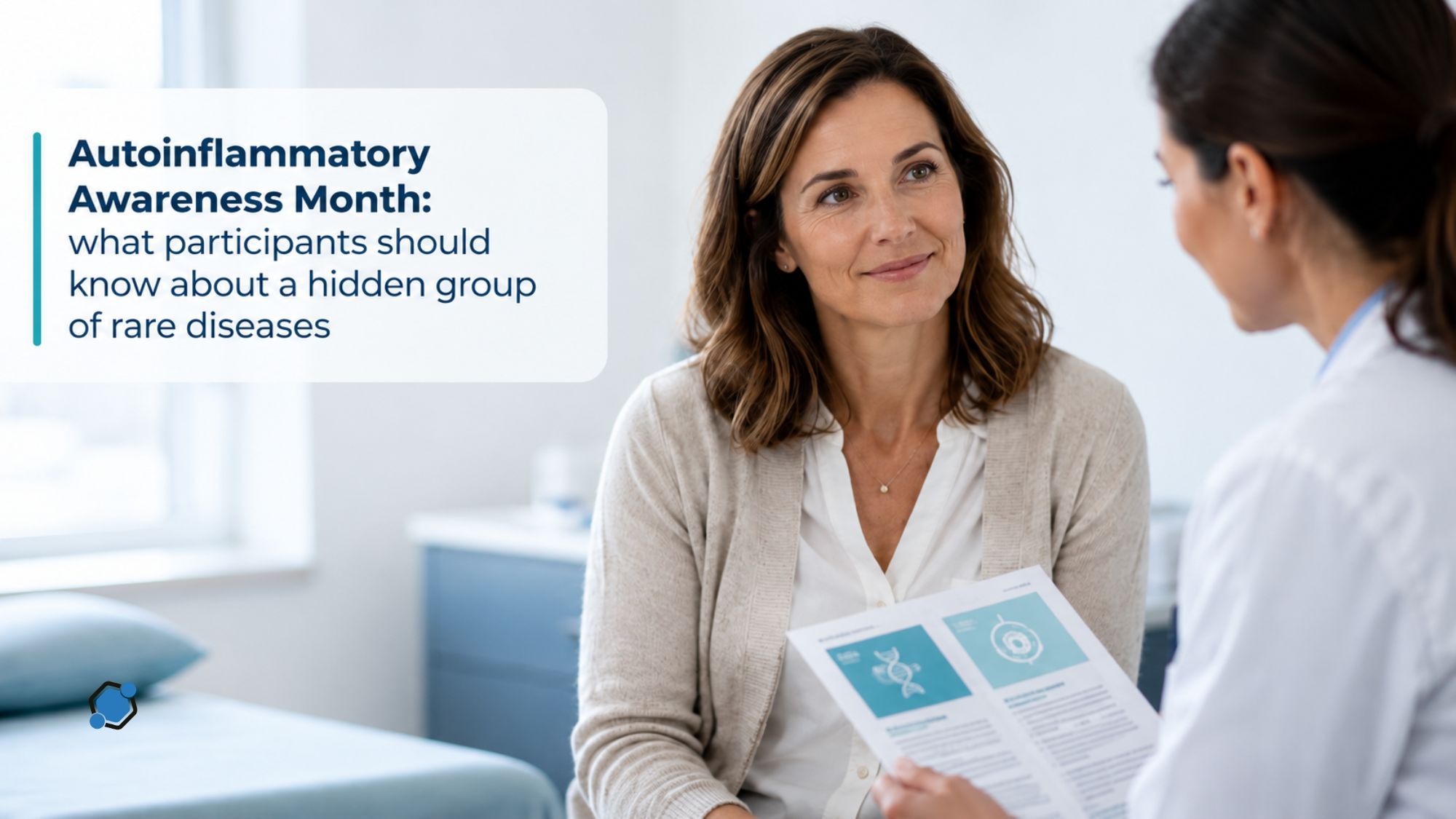
Recurring fevers that appear without infection, rashes that come and go on their own, and joint pain that flares in cycles are the everyday reality for people living with autoinflammatory diseases. These conditions sit outside the categories most patients and even many clinicians recognize, and the resulting confusion often stretches the path to diagnosis into years. Autoinflammatory Awareness Month, observed each August, exists to change that.
The month is a chance for patients, families, advocacy groups, and research communities to explain what autoinflammatory diseases are, how they differ from more familiar conditions, and why clinical research remains central to progress. For anyone considering trial participation, it is also a useful moment to understand where a platform such as DecenTrialz fits into the process.
What is Autoinflammatory Awareness Month?
Autoinflammatory Awareness Month has been observed every August since 2015. It was launched by the Autoinflammatory Alliance, a United States nonprofit that has supported patients and families affected by rare autoinflammatory diseases since 2006. The observance is recognized internationally, with events, patient gatherings, and educational campaigns coordinated across many countries.
The month carries the recurring theme “Shine a Light on Autoinflammatory Diseases.” That theme reflects both the literal lighting of landmarks and bridges in orange during August and the broader goal of drawing attention to a group of conditions that remain poorly understood outside specialist circles.
Patients themselves chose August. It is the hottest month in much of the Northern Hemisphere, which mirrors the recurring high fevers that mark many of these diseases. August also avoids the crowded conference calendar of spring and fall and gives communities a warm-weather window for in-person events.
The aims are practical. Awareness Month promotes earlier and more accurate diagnosis, encourages public and clinician education, connects patients to advocacy resources, and highlights the importance of ongoing research. Government proclamations at the state and city level, free virtual educational sessions, and patient stories shared on social media all fall under the August umbrella. For readers new to this space, the Hope in Research: How Clinical Trials Are Transforming Rare Disease Treatment blog offers a broader look at why rare disease research matters.
What are autoinflammatory diseases?
Autoinflammatory diseases are a group of rare disorders in which the body produces inflammation without an infection to fight or an external injury to heal. The alarm system that would normally respond to a threat activates on its own, repeatedly, and causes symptoms such as fever, rash, joint pain, abdominal pain, and fatigue.
The underlying problem lies in the innate immune system. The innate immune system is the part of the body’s defense that a person is born with. It responds quickly to any threat with the same nonspecific reaction. It is distinct from the adaptive immune system, which learns over time to recognize specific germs. In autoinflammatory disease, the innate response activates when it should not.
More than sixty conditions are now classified as autoinflammatory. Some are caused by a single gene mutation. Others appear to result from a combination of genetic and other factors. Many involve overproduction of a protein called interleukin-1, or IL-1, which is one of the main chemical messengers of inflammation. Others involve related signaling pathways.
For a general overview of how clinical research is designed around conditions like these, the Clinical Research Basics: What Every Trial Participant Should Understand Before Enrolling blog provides useful background.
Autoinflammatory versus autoimmune: what is the difference?
The names sound similar, and the two are often confused. The distinction matters because it affects how each condition is diagnosed and how it is managed.
Autoimmune diseases involve the adaptive immune system. In these conditions, the body produces antibodies or immune cells that target its own healthy tissues. Familiar examples include type 1 diabetes and rheumatoid arthritis. Blood tests can often detect the specific antibodies involved.
Autoinflammatory diseases involve the innate immune system. There are no self-targeting antibodies. Instead, the innate response activates without a proper trigger and produces widespread inflammation. Attacks often follow a recognizable pattern, and fevers tend to be a defining feature. Autoinflammatory conditions also tend to appear earlier in life and affect both sexes fairly equally, while several autoimmune diseases are more common in women.
The line between the two groups has become less sharp over time. Some conditions once labeled autoimmune are now understood to have strong autoinflammatory features. What matters for a reader is that autoinflammatory diseases are their own category and require their own diagnostic thinking. For a broader look at how misunderstandings shape the participant experience, see Clinical Trial Myths Busted: Facts Every Participant Should Know.
Are autoinflammatory diseases considered autoimmune?
No. Autoinflammatory diseases are separate from autoimmune diseases. They involve the innate immune system rather than the adaptive one, and they do not produce the self-directed antibodies that define autoimmune conditions.
Common autoinflammatory conditions and their signs
Several conditions in this group are well described in the medical literature, though most remain unfamiliar outside specialist practice. Recognizing the patterns is often the first step toward a diagnosis.
Familial Mediterranean Fever is the most common inherited autoinflammatory disease. It causes short attacks of fever with abdominal or chest pain, joint pain, and a rash on the lower legs. It occurs most often in people of Mediterranean and Middle Eastern ancestry but is found in other populations as well.
Cryopyrin-Associated Periodic Syndromes, or CAPS, is a spectrum of related conditions caused by a single gene. Presentations range from mild cold-triggered symptoms to severe childhood-onset disease. A hive-like rash that is often not itchy, joint pain, and progressive hearing loss are typical features of the moderate form.
TNF Receptor-Associated Periodic Syndrome, known as TRAPS, causes longer fever attacks with abdominal pain, muscle pain, a migrating rash, and swelling around the eyes.
Hyperimmunoglobulin D Syndrome, sometimes called mevalonate kinase deficiency, causes recurring fever episodes in infancy or early childhood, with swollen lymph nodes, abdominal pain, and joint pain. Vaccinations and mild illnesses can trigger flares.
Periodic Fever, Aphthous stomatitis, Pharyngitis, and cervical Adenitis, known as PFAPA, is the most common periodic fever syndrome in children. Fevers occur with striking regularity, roughly every three to eight weeks, along with mouth sores, sore throat, and swollen neck glands. Children are usually well between episodes.
Still’s disease, in both its adult and childhood forms, causes daily fever spikes, a salmon-colored rash, joint pain, and sore throat. Behçet’s disease produces recurring mouth ulcers, genital ulcers, eye inflammation, and skin lesions. Deficiency of Adenosine Deaminase 2, or DADA2, combines fever with blood vessel inflammation and, in some cases, early-life strokes. Chronic Recurrent Multifocal Osteomyelitis, or CRMO, causes sterile inflammation in the bones of children and adolescents. Schnitzler syndrome is an adult-onset condition that combines a chronic hive-like rash with an abnormal blood protein and bone pain.
What are periodic fever syndromes?
Periodic fever syndromes are a subset of autoinflammatory diseases in which fever attacks recur in a recognizable pattern, often on a predictable schedule. Between attacks, patients typically feel well. Familial Mediterranean Fever, TRAPS, HIDS, and PFAPA are examples.
Why diagnosis often takes years
The path to a correct diagnosis is often long. Many patients live with unexplained symptoms for years before a specialist identifies the underlying condition. The reasons sit in the system, not in the patients or the individual clinicians involved.
Symptoms overlap with many more common conditions. Recurring fever alone can point in dozens of directions, from infections to autoimmune disease to malignancy. Rashes, joint pain, and abdominal pain each carry their own long lists of possible causes. A pediatrician or general practitioner meeting a patient once every few months may see only isolated pieces of the pattern.
Specialist familiarity is another factor. Autoinflammatory diseases are rare, and many clinicians will encounter only a few cases across a career. Patients often see multiple specialists before one recognizes the picture. In healthcare systems where referrals require multiple layers of approval, that path is longer still.
The consequences are not only frustration. Delayed diagnosis can allow chronic inflammation to cause lasting damage. Repeated flares can affect school attendance, work, and family life, and can carry a real emotional weight, particularly when patients feel their symptoms are not being taken seriously.
Patient advocacy organizations play a large role in narrowing this gap. They educate clinicians, connect families with expert centers, translate materials into multiple languages, and support patient registries. The Patient Advocacy Groups: Finding Support and Trial Information blog explores this role in more detail.
Why do autoinflammatory diseases take so long to diagnose?
Symptoms overlap with more familiar conditions, the diseases are individually rare, and few clinicians outside specialist centers see them regularly. Patients often see several doctors across different specialties before a diagnosis is confirmed.
How clinical trials advance care for rare autoinflammatory diseases
Clinical research in autoinflammatory disease has grown steadily as more of the underlying biology is understood. Studies now investigate several signaling pathways that drive inflammation, including the IL-1 pathway, the IL-6 pathway, tumor necrosis factor signaling, and Janus kinase signaling. Others explore gene-level approaches and mechanisms specific to individual conditions.
Registries and natural history studies form the backbone of this work. A registry is an organized system that collects data from people who have a given condition. A natural history study tracks how a disease progresses in individuals over time. Together they provide the baseline needed to design meaningful trials, define what improvement looks like, and identify subgroups most likely to benefit.
Small patient populations create both a challenge and an opportunity. With so few people affected by any single autoinflammatory disease, each participant contributes a disproportionate share of the total evidence. That reality has pushed the field toward creative study designs, including external control arms drawn from registry data rather than placebo comparisons.
Participation carries meaning beyond any single result. Even a study that does not confirm the effect of a specific approach adds to the understanding of how the disease behaves, identifies markers that may support earlier diagnosis in the future, and strengthens the research networks that patients everywhere depend on.
How DecenTrialz helps interested participants take a first step
DecenTrialz is a clinical trial participant recruitment and pre-screening platform based in the United States. It uses AI-assisted matching and registered nurse-led pre-screening to help people who are interested in clinical research see whether a study may be relevant to their situation.
The research site team always owns final eligibility determination, informed consent, study walk-through, and enrollment. DecenTrialz does not take on any of these responsibilities. It provides an early, low-pressure step that helps a potential participant and a research team understand whether further conversation makes sense.
For someone living with an autoinflammatory disease, that first step can matter. Rare disease studies are often geographically dispersed, and finding one that fits both the medical picture and practical circumstances can be difficult. Registered nurse-led pre-screening allows an interested person to have a considered conversation about their history and the general shape of what participation would involve before any commitment.
To explore whether an active study may be a match, visit decentrialz.com and complete a short pre-screening. The research site team will take it from there if the fit looks promising.
Learning more during Autoinflammatory Awareness Month
Autoinflammatory Awareness Month is a useful time to learn more about these conditions, whether the interest is personal, professional, or both. Patient advocacy organizations offer disease-specific resources, virtual events, and community connections throughout August and year round. Publicly available health resources and reputable medical center websites provide accessible educational material.
For anyone considering clinical research participation, the month is also a natural moment to take a first step. Visit decentrialz.com to pre-screen for studies that may fit and to learn more about how the process works.
Was this article helpful?

Similar Blogs
Eczema Awareness Month 2026: Signs, triggers, and why research matters
October is Eczema Awareness Month in the United States, led by the National Eczema Associa...
 Paramraj
Liver Awareness Month 2026: Liver Disease, Liver Cancer, and the Research Changing Outcomes
Every October, two overlapping observances turn attention to an organ most people rarely t...
Vamshi Kantoju
Down Syndrome Awareness Month 2026: what it is and why research matters
Every October, the United States recognizes Down Syndrome Awareness Month. The month exist...
Mahesh UpadristaStay Informed. Stay Connected.
Get updates on verified clinical trials, emerging treatments, and research breakthroughs directly in your inbox. No spam, just science that matters.
