 HIPAA Compliant
 ISO 27001 Certified
Liver Awareness Month 2026: Liver Disease, Liver Cancer, and the Research Changing Outcomes
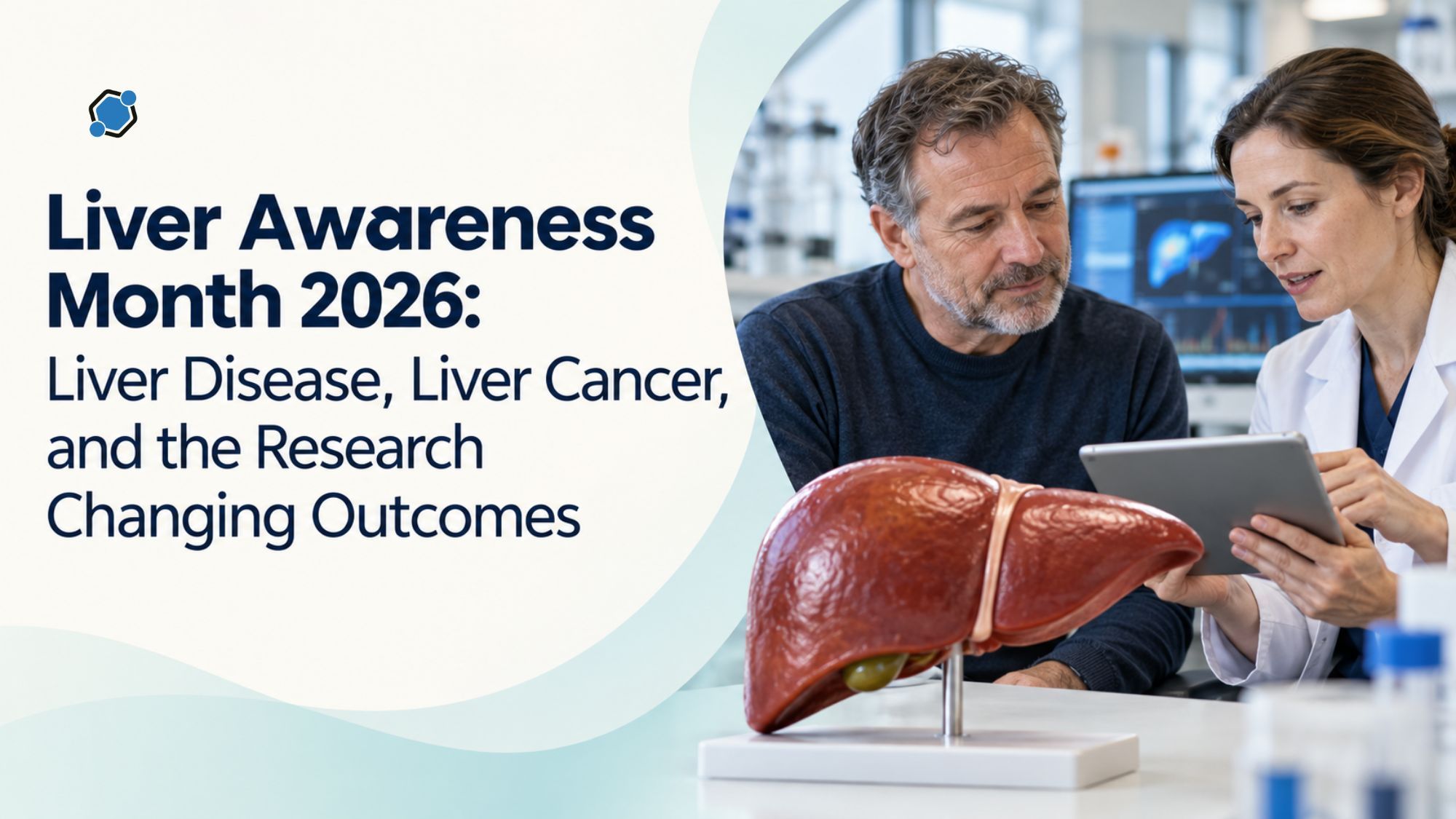
Every October, two overlapping observances turn attention to an organ most people rarely think about. National Liver Awareness Month was first designated by Congress in 1986, and the same month is marked by leading research and advocacy groups as Liver Cancer Awareness Month. Together, they draw focus to a set of diseases that affect tens of millions of Americans, often silently, and that are now the subject of some of the most significant recent advances in medicine. This article covers what both observances represent, why they matter, and the steps readers can take to protect liver health.
Why October is both Liver Awareness Month and Liver Cancer Awareness Month
National Liver Awareness Month began with a 1986 congressional resolution and a presidential proclamation signed on October 8 of that year. The American Liver Foundation (ALF), founded in 1976 and marking its 50th anniversary in 2026, has led the October observance ever since. The organization frames its goal as making liver health a year-round focus rather than a once-a-year topic.
Liver Cancer Awareness Month shares the same month but has different footing. Unlike the 1986 federal action, there is no federal proclamation for liver cancer awareness. Instead, major research and advocacy groups have established October as the recognized month, including the Global Liver Institute, which runs an annual #OctoberIs4Livers campaign, and the Hepatitis B Foundation, which highlights the link between chronic viral hepatitis and liver cancer.
ALF estimates that 80 to 100 million Americans have some form of liver disease, and many are unaware of it because early symptoms are often absent. The dual observance exists to narrow that awareness gap at a scale that matches the problem.
What the liver does, and why problems can go unnoticed
The liver is a dense, roughly three-pound organ in the upper right abdomen, tucked under the lower ribs. It performs hundreds of jobs, but a few stand out for public understanding.
All blood leaving the stomach and intestines flows through the liver first, by way of the portal vein, before reaching the rest of the body. That makes the liver both a filter and a processing plant. It breaks down toxins, metabolizes most prescription and over-the-counter medications, and processes nutrients from food. It makes bile, which the gallbladder stores and releases to help the body absorb fats and fat-soluble vitamins. It makes albumin, the main protein in blood, and the clotting factors that stop bleeding. It stores sugar as glycogen and releases it between meals to keep blood sugar steady.
The liver is also remarkably resilient. It continues working even when a large portion is damaged, which is both a blessing and a problem. People can have significant liver injury without feeling ill, and routine blood work may stay normal until the disease is advanced. Because the liver sits at the center of metabolism, how visceral fat affects health often tracks closely with liver health, especially in the early stages of fatty liver disease.
Common liver diseases and the biggest risk factors for liver cancer
The most common chronic liver condition in the United States is now metabolic dysfunction-associated steatotic liver disease, or MASLD. International liver societies renamed the condition in 2023 (it was formerly called NAFLD, or nonalcoholic fatty liver disease) to reflect the metabolic drivers behind it. Current national survey data estimate that about one in three American adults has MASLD, and projections suggest the share will continue to rise over the coming decades. The inflammatory, scarring form of MASLD is called MASH.
Other important chronic liver conditions include alcohol-associated liver disease, autoimmune hepatitis, and the viral hepatitis infections. Hepatitis B is vaccine-preventable; the Centers for Disease Control and Prevention (CDC) estimates about 660,000 Americans live with chronic hepatitis B, and roughly half are unaware of the infection. Hepatitis C has no vaccine, but it is curable in more than 95 percent of cases with 8 to 12 weeks of oral antiviral medication. All three categories, if untreated, can progress to cirrhosis, which is severe liver scarring.
Liver cancer is less common than the chronic diseases that often precede it, but it is deadly. The American Cancer Society estimates about 42,340 new cases of liver and intrahepatic bile duct cancer in the United States in 2026, and about 30,980 deaths. Liver cancer is the sixth leading cause of cancer death in the United States and the third leading cause worldwide. Most liver cancers develop in people who already have chronic liver disease.
The major risk factors are well established: chronic hepatitis B and hepatitis C, cirrhosis from any cause, heavy alcohol use, MASLD and obesity, and type 2 diabetes, which roughly doubles liver cancer risk. Several of these risk factors are modifiable, and some, like hepatitis B, are preventable with vaccination. The link between metabolic health and the liver is a major reason why recognizing the early warning signs of type 2 diabetes matters even for people without a known liver problem.
How research and clinical trials are changing liver care
The outlook for liver cancer has shifted considerably in the past two decades. Five-year relative survival has risen from about 7 percent in the mid-1990s to roughly 22 percent today, one of the largest gains for any cancer. Survival depends heavily on when the cancer is found. For liver cancer caught at an early, localized stage, five-year survival is roughly 37 percent; once the cancer has spread to distant sites, it is about 3 percent. That contrast is the reason major liver societies recommend regular surveillance (typically an ultrasound and a blood test every six months) for people at highest risk, especially adults with cirrhosis and certain people with chronic hepatitis B.
Treatment research has also moved quickly. The first medications ever approved for the inflammatory, fibrotic form of fatty liver disease (MASH) received U.S. Food and Drug Administration (FDA) approval in 2024 and 2025. In April 2025, the FDA approved a new first-line combination immunotherapy for advanced liver cancer, based on a trial showing improved overall survival compared with the previous standard. These approvals were made possible by patients who took part in clinical trials.
Research continues on better early-detection tools, a functional cure for chronic hepatitis B, and expanded immunotherapy combinations for liver cancer. For readers who are curious about participating, finding a clinical trial usually starts with understanding what options exist and which ones fit a person's specific condition.
What to do during Liver Awareness Month
Awareness is useful only when it leads to action. A few concrete steps are supported by current public health recommendations and professional society guidance.
- Know your hepatitis status. The CDC recommends a one-time hepatitis B test and a one-time hepatitis C test for every adult.
- Discuss hepatitis B vaccination with a healthcare provider for anyone not already vaccinated. More context on hepatitis testing and vaccination is covered in detail elsewhere.
- Take a short liver health risk quiz, such as the one offered by the American Liver Foundation, especially for adults who have diabetes, excess weight, or high blood pressure.
- Check acetaminophen totals across all medications. The FDA maximum for adults is 4,000 milligrams per day from all sources, and many over-the-counter cold and flu products contain acetaminophen.
- Share every supplement, including herbal and bodybuilding products, with a healthcare provider. Supplements have become a leading cause of drug-related liver injury in recent years.
- Prioritize liver-healthy eating and physical activity, and reduce or avoid alcohol.
- Ask about surveillance imaging and blood tests if cirrhosis or chronic hepatitis B is already diagnosed.
Frequently asked questions
What is the difference between National Liver Awareness Month and Liver Cancer Awareness Month?
Both are observed in October. National Liver Awareness Month covers all liver disease, from fatty liver and hepatitis to cirrhosis and transplant. Liver Cancer Awareness Month focuses specifically on primary liver cancer. The American Liver Foundation and other organizations typically mark them together.
Can early liver damage be reversed?
Early fatty liver disease and alcohol-related liver injury can often improve substantially with weight loss, better diabetes control, and reduced or no alcohol. Established cirrhosis is harder to reverse, but progression can be slowed and complications can be reduced. Each person's outlook depends on cause, stage, and overall health, and should be discussed with a liver specialist.
Can a routine blood test catch liver disease?
Standard liver enzyme results such as ALT and AST can be normal even when significant liver disease is present. For that reason, physicians often use additional noninvasive assessments, such as a FIB-4 score calculated from routine labs, elastography (a FibroScan is the most familiar version), or an abdominal ultrasound.
What color is the liver cancer awareness ribbon?
Emerald green is the most commonly cited ribbon color for liver cancer awareness.
Can someone with liver disease still join a clinical trial?
It depends on the specific trial. Some studies are designed for people with particular liver conditions; others exclude people with liver disease depending on the drug being tested. Eligibility is always determined by the research site team based on the study protocol.
A month to notice the quiet organ
Liver disease is one of the most common, most under-recognized, and most preventable categories of serious illness in the United States. Many of its drivers, including viral hepatitis, metabolic health, and alcohol use, have clear pathways for testing, treatment, or lifestyle change. Many of its most dangerous outcomes, including cirrhosis and liver cancer, can be delayed or detected earlier through the surveillance tools that already exist. October's dual observance is a reminder that attention to this quiet organ makes a measurable difference, both for individuals and for the broader public health landscape.
For people considering whether a clinical trial might be a good fit, DecenTrialz is a clinical trial recruitment platform that uses AI-assisted participant matching and registered-nurse pre-screening to connect interested participants with relevant studies. The research site team always owns the final eligibility determination, informed consent, and enrollment. Readers considering a trial for the first time may find it useful to review what to expect at your first screening visit before reaching out.
Was this article helpful?

Similar Blogs
Down Syndrome Awareness Month 2026: what it is and why research matters
Every October, the United States recognizes Down Syndrome Awareness Month. The month exist...
 Mahesh Upadrista
Mental Illness Awareness Week 2026: facts, stigma, and the science changing mental health care
Mental Illness Awareness Week runs from October 4 to October 10, 2026. Established by Cong...
Deeksha Gitta
National Depression and Mental Health Screening Month 2026: what it is and why it matters
Each October, health organizations across the United States observe National Depression an...
 Anish Teepireddy
Stay Informed. Stay Connected.
Get updates on verified clinical trials, emerging treatments, and research breakthroughs directly in your inbox. No spam, just science that matters.
