 HIPAA Compliant
 ISO 27001 Certified
Eczema Awareness Month 2026: Signs, triggers, and why research matters
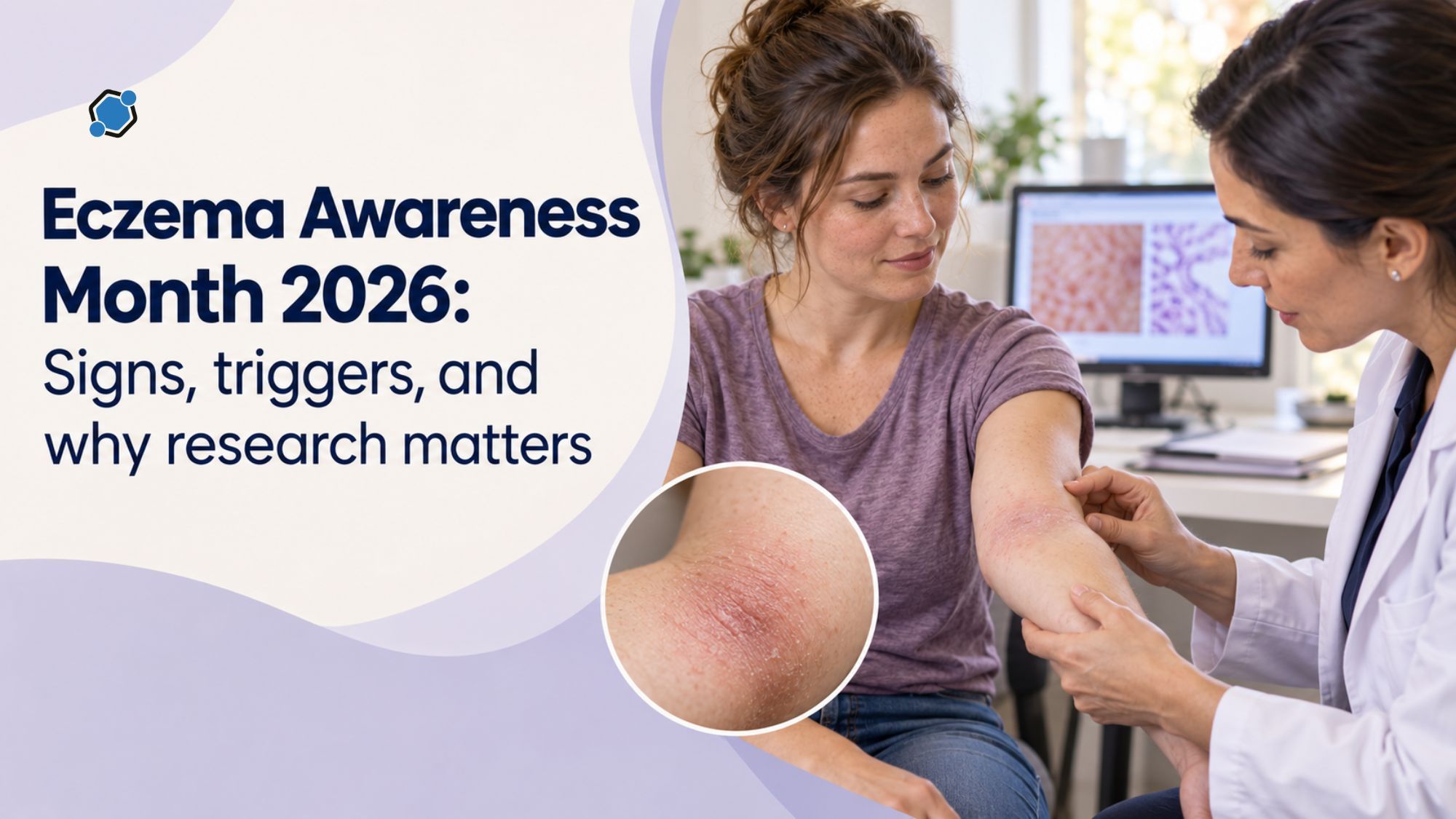
October is Eczema Awareness Month in the United States, led by the National Eczema Association. The observance centers on a condition that is more common, more disruptive, and more under-diagnosed than most people realize. Eczema is a group of inflammatory skin diseases affecting roughly 1 in 10 Americans, yet only about 1 in 5 people estimated to have the most common form, atopic dermatitis, has a documented diagnosis. That gap is one of the main reasons awareness still matters.
This article explains what eczema is, how it looks across different skin tones, what triggers flares, what treatment usually involves, and why clinical research continues to shape care.
What eczema actually is
Eczema is not a single disease. It is an umbrella term for a group of inflammatory skin conditions that cause dry skin, itching, rashes, scaly patches, blisters, and skin infections. Despite long-standing myths, eczema is not contagious. You cannot catch it from someone or give it to someone else.
The National Eczema Association recognizes seven main types:
- Atopic dermatitis, the most common and most studied form, which usually begins in childhood but can appear or return in adulthood.
- Contact dermatitis, caused by direct contact with something that irritates the skin, such as harsh soaps, or triggers an allergic reaction, such as nickel or poison ivy.
- Dyshidrotic eczema, which produces small, intensely itchy blisters on the hands and feet.
- Nummular (also called discoid) eczema, which forms coin-shaped patches of irritated skin.
- Seborrheic dermatitis, which affects oily areas such as the scalp and face. In infants it is often called cradle cap.
- Stasis dermatitis, which develops on the lower legs when circulation is poor.
- Neurodermatitis, usually limited to one or two patches of skin that become thick from repeated scratching.
In atopic dermatitis, researchers describe two problems happening at once. The skin barrier does not hold moisture or keep out irritants as effectively as it should, and the immune system over-reacts to things that would not normally cause trouble. The result is dry, inflamed, itchy skin that is more vulnerable to infection. People with a personal or family history of eczema, asthma, or hay fever are at higher risk, and the condition often appears alongside allergies, as part of what doctors call the atopic march. For a closer look at how allergic conditions overlap and how research is responding, see our related post on asthma and allergy clinical trials awareness.
How common eczema is, and who it affects
The exact numbers depend on how eczema is counted. According to the National Eczema Association, more than 31 million Americans have some form of eczema. Federal data from the Centers for Disease Control and Prevention, published in January 2026, show that 7.7 percent of U.S. adults and 12.7 percent of U.S. children have a diagnosed case. Globally, atopic dermatitis affects more than 100 million people, and it is the leading cause of skin-related disability worldwide.
Eczema can start at any age, but it usually begins early. About 80 percent of people with atopic dermatitis develop it before age six. Even so, roughly 1 in 4 adults with atopic dermatitis report that their symptoms first appeared in adulthood. In U.S. adults, women are diagnosed more often than men. The condition also shows meaningful differences by race. Black children have the highest prevalence of eczema in federal surveys, and Black children with atopic dermatitis often have more severe disease. These patterns reflect a mix of biology, skin-barrier differences, and social and environmental factors.
What eczema looks like, including on darker skin
Textbook descriptions of eczema usually mention red, inflamed patches. On lighter skin tones, that may be accurate. On darker skin, redness can be difficult to see. Eczema often appears purple, ashen gray, or dark brown instead. Flares may also show up as small bumps around hair follicles, or on the outer surfaces of the elbows and knees rather than inside the creases.
Another feature that is more visible on darker skin is pigment change after a flare. Patches of skin may become noticeably lighter or darker than the surrounding skin for weeks or months, long after the itch has settled. Many patients find these marks more bothersome than the active rash.
These visual differences are one reason eczema in people of color is often missed, misdiagnosed, or treated later than it should be. It is also one reason skin-of-color representation in clinical research still matters. Groups that experience eczema most severely are not always proportionally represented in the studies that shape new treatments, a theme explored in our post on why diverse participants matter in research.
Common triggers and the itch-scratch cycle
Triggers vary from one person to another, but the usual list is well established. Dry air, cold weather, heat and sweat, harsh soaps and detergents, fragrances, wool, dust, pet dander, pollen, and emotional stress can all set off a flare. For allergic contact dermatitis, specific allergens such as nickel or certain plants are often involved. Food allergies can play a role in some children with atopic dermatitis, but food is not a universal trigger, and major U.S. allergy guidelines advise against cutting foods out of the diet without medical testing and guidance.
Itch is the defining symptom. Among adults with moderate-to-severe atopic dermatitis, most report daily itching, and many describe itching for more than half the day. Scratching provides short-term relief but damages the skin further, which releases more inflammatory signals, which worsens the itch. This loop is often called the itch-scratch cycle. Breaking it is one of the main goals of treatment.
Why eczema is more than a skin problem
Eczema affects far more than the skin surface. Sleep disruption is extremely common, especially in children with moderate-to-severe atopic dermatitis. Adults frequently describe skin pain alongside itch, often as a burning sensation. The condition also carries a mental-health burden. Adults with atopic dermatitis are two to three times more likely to experience anxiety or depression, and school-aged children with eczema report higher rates of bullying.
There is also an economic cost. The National Eczema Association estimates that U.S. workers lose about 5.9 million workdays a year because of atopic dermatitis, and many patients spend $600 or more out of pocket each year on care. Over time, atopic dermatitis is also linked to other conditions, including asthma, hay fever, food allergies, and in adults, higher rates of certain cardiovascular and metabolic conditions. These are associations rather than proven causes, but they are part of why eczema is treated as a chronic health issue rather than a cosmetic nuisance. For more on how chronic conditions are tracked and researched, see our overview of autoinflammatory and inflammatory conditions in research.
How eczema is diagnosed and treated
There is no single lab test that confirms atopic dermatitis. A doctor usually makes the diagnosis based on a physical exam, how long symptoms have lasted, how they have behaved over time, and personal or family history. Patch testing may be used when contact dermatitis is suspected. Doctors may also need to rule out other skin conditions that can look similar, such as psoriasis, scabies, or fungal infections.
Treatment usually works in layers. For most people, daily moisturizing and gentle bathing come first. Short, lukewarm baths, fragrance-free cleansers, and applying moisturizer immediately after bathing help the skin hold on to water. From there, dermatologists and primary care providers often add topical corticosteroids or non-steroid topical options such as calcineurin inhibitors, a topical PDE-4 inhibitor, or a topical JAK inhibitor. For moderate-to-severe disease that does not respond to topical treatment, newer options include phototherapy, injectable biologic medicines that target specific immune signals, and oral medicines in the JAK inhibitor class.
Fear of topical steroids is common, and so are concerns about long-term treatment use. These are worth discussing with a doctor rather than acting on alone. Stopping prescribed treatment without guidance often leads to flares that are harder to control. More than half of adults with moderate-to-severe atopic dermatitis still describe their disease as not well controlled, which is a reminder that current treatment, while better than it was a decade ago, still leaves meaningful gaps.
Why clinical research is reshaping eczema care
Almost every eczema treatment introduced in the last several years, including biologic injections, oral JAK inhibitors, and newer non-steroid creams, reached patients through clinical trials. Research is now moving in several directions at once. Scientists are studying antibodies that target different immune pathways, longer-acting versions of existing treatments, oral pills designed to replace injections, and even therapies based on the healthy bacteria that live on human skin.
Studies also test more than drugs. Trials examine how to use existing treatments more effectively, how to reduce side effects, and how eczema behaves and responds across different skin tones. For readers curious about how modern recruitment and participant matching actually works, our explainer on how clinical trial matching services work is a useful starting point.
Participation is always voluntary. Informed consent explains what the study involves, what the known risks are, and what will happen with the data collected. Participants can leave a study at any time. Clinical research does not guarantee improvement for any individual, but it is the main pathway through which future treatments become available for everyone with eczema.
How to use Eczema Awareness Month
Awareness Month is a good prompt to take simple, practical steps. For readers who think they or a family member may have eczema but have never been formally evaluated, a conversation with a primary care provider or a dermatologist is the right first move. For readers already managing eczema, the month is a useful time to review what is and is not working, ask whether newer treatment options might fit, and raise any concerns about long-term use of current treatments.
For readers interested in exploring whether a clinical trial could be a fit, platforms like DecenTrialz help connect people to studies that may match their condition and medical history. On DecenTrialz, participants share some information about their health, an AI matching system looks for relevant trials, and a registered nurse reviews the information to pre-screen for fit. If the match looks promising, the information is passed on to the research site team, who handle the final eligibility review, informed consent, and enrollment. For a step-by-step walk-through of what happens after a referral, see what to expect at your first screening visit.
Eczema has been underestimated for a long time, both by the public and in healthcare visits where other concerns take priority. Awareness Month is an opportunity to change that, one informed conversation at a time.
Was this article helpful?

Similar Blogs
Liver Awareness Month 2026: Liver Disease, Liver Cancer, and the Research Changing Outcomes
Every October, two overlapping observances turn attention to an organ most people rarely t...
 Vamshi Kantoju
Down Syndrome Awareness Month 2026: what it is and why research matters
Every October, the United States recognizes Down Syndrome Awareness Month. The month exist...
Mahesh Upadrista
Mental Illness Awareness Week 2026: facts, stigma, and the science changing mental health care
Mental Illness Awareness Week runs from October 4 to October 10, 2026. Established by Cong...
Deeksha GittaStay Informed. Stay Connected.
Get updates on verified clinical trials, emerging treatments, and research breakthroughs directly in your inbox. No spam, just science that matters.
