 HIPAA Compliant
 ISO 27001 Certified
Down Syndrome Awareness Month 2026: what it is and why research matters
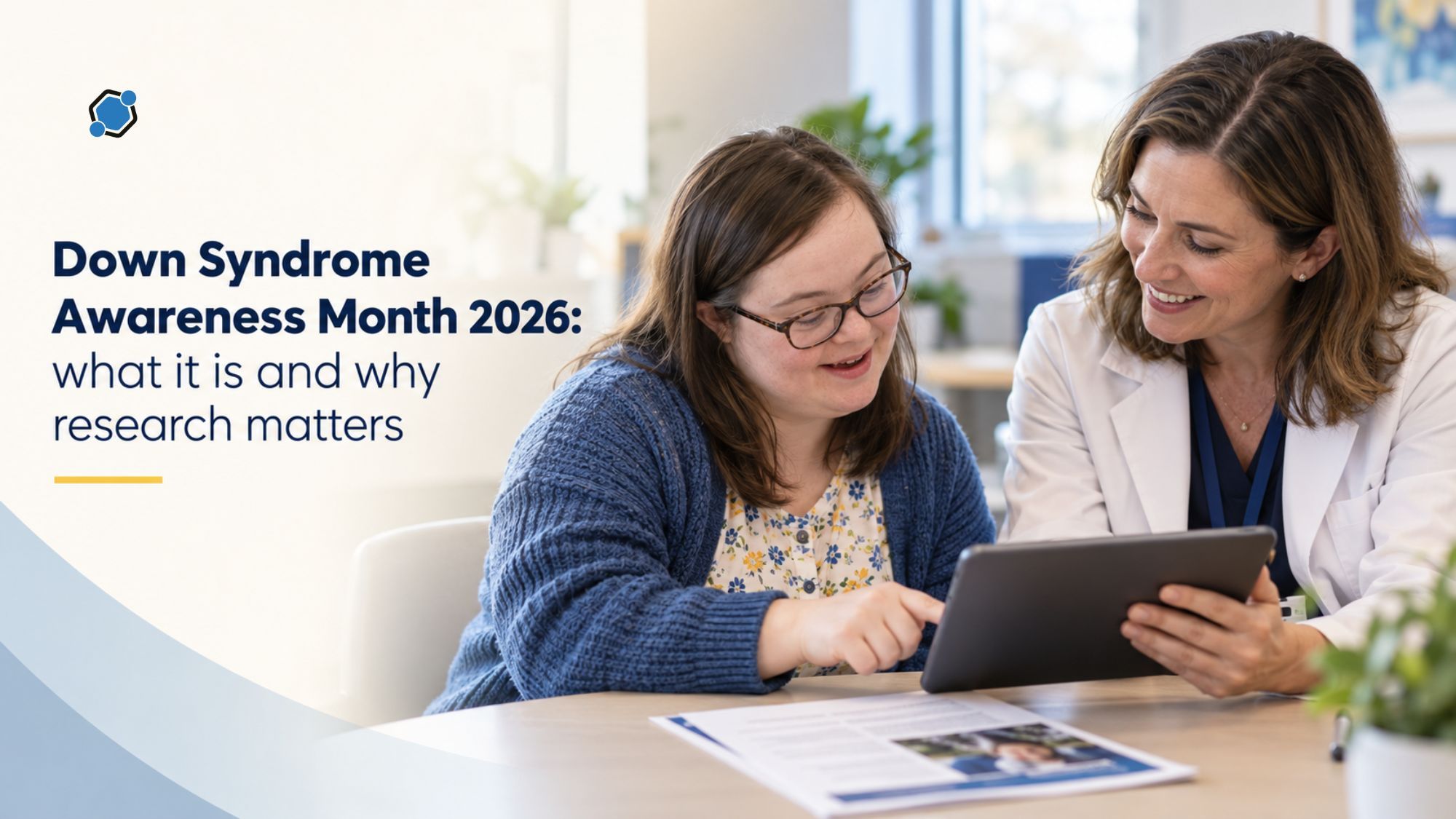
Every October, the United States recognizes Down Syndrome Awareness Month. The month exists to replace stereotypes with accurate information, celebrate the contributions of people with Down syndrome, and strengthen the connection between the community and the research that supports it. Over the past four decades, both have changed. Children once given a life expectancy of about 25 years can now expect to live into their 60s, which has shifted the research agenda from infancy toward adulthood, memory, and lifelong care.
What Down Syndrome Awareness Month is, and how it started
Down Syndrome Awareness Month is observed each year from October 1 to October 31 in the United States. The National Down Syndrome Society (NDSS), founded in 1979, helped establish the observance in the 1980s. President Ronald Reagan formally proclaimed October 1984 as National Down’s Syndrome Month, and awareness activities have taken place every October since.
The month is a chance to raise visibility, correct misconceptions, and highlight the full range of what people with Down syndrome do, study, work on, and contribute to. NDSS invites the public to share facts using #DownSyndromeAwarenessMonth and to attend or support local Buddy Walk events, a nationwide program that began in 1995 and now includes more than 150 affiliated walks across the country.
A separate global observance, World Down Syndrome Day, is held on March 21 (3/21), chosen to represent the three copies of chromosome 21 that cause the condition. The United Nations has officially recognized the day since 2012. The 2026 global theme set by Down Syndrome International is Together Against Loneliness, reflecting the health impact of social exclusion.
Down syndrome, in plain terms
Down syndrome is a chromosomal condition. Most people are born with 23 pairs of chromosomes, totaling 46. People with Down syndrome are born with a full or partial extra copy of chromosome 21, for a total of 47. It is the most common chromosomal condition in the United States. According to the Centers for Disease Control and Prevention (CDC), roughly 1 in 640 babies, or about 5,700 children each year, is born with Down syndrome.
There are three types. Trisomy 21 accounts for about 95 percent of cases and happens when a cell-division error leaves three separate copies of chromosome 21 in every cell. Translocation accounts for about 3 percent, when extra chromosome 21 material attaches to another chromosome. Mosaic Down syndrome accounts for about 2 percent and occurs when only some cells carry the extra copy, often producing fewer physical features.
Down syndrome is a lifelong condition, not a disease. It is not caught, cured, or outgrown. People with Down syndrome experience the full range of human abilities, emotions, and personalities. Most learn to read and write, attend school in inclusive settings, hold jobs, build friendships, and participate in community life. The intellectual disability associated with the condition is usually mild to moderate and does not predict any one person’s potential.
Certain health conditions appear more often alongside Down syndrome. About half of children with Down syndrome are born with a heart defect that may require surgery in infancy. Hearing differences, vision problems, thyroid issues, and sleep apnea are also more common, and most are treatable. Regular medical follow-up, outlined in the American Academy of Pediatrics guidance, helps catch these conditions early.
Language matters when discussing the condition. The accepted form in the United States is person-first language: a person with Down syndrome, not a Down’s child. Terms like suffers from or afflicted with are inaccurate, since people have Down syndrome rather than suffer from it. The condition is also written without an apostrophe-s in American usage.
Longer lives, and a new focus on Alzheimer’s research
One of the clearest signs of progress in Down syndrome care is life expectancy. In 1983, the average life expectancy for a person born with Down syndrome was about 25 years. Today it is approximately 60 years, according to the National Institute of Child Health and Human Development (NICHD). The change reflects better pediatric heart surgery, routine health screening, inclusive community support, and the end of institutionalization.
Longer life brings new priorities. The most significant is Alzheimer’s disease. Chromosome 21 carries the gene that produces amyloid precursor protein (APP), which the body processes into amyloid, a protein that builds up in Alzheimer’s. An extra copy of chromosome 21 means lifelong overproduction of amyloid. By age 40, nearly all adults with Down syndrome show the brain changes associated with Alzheimer’s, and according to the National Institute on Aging (NIA), 50 percent or more will go on to develop Alzheimer’s dementia.
Down syndrome is now recognized as the most common genetic form of Alzheimer’s disease. This makes the community uniquely important to research that seeks to understand, prevent, and treat Alzheimer’s in the general population. The connection is a key reason Alzheimer’s and brain awareness efforts and Down syndrome awareness efforts are often discussed side by side.
Why Down syndrome has often been missing from clinical trials
Despite the clear connection between Down syndrome and Alzheimer’s, people with Down syndrome were not included in the large pivotal trials behind recent Alzheimer’s medications such as lecanemab and donanemab. The exclusion was usually indirect. Most of those studies had exclusion criteria that ruled out people with intellectual disabilities or pre-existing neurodevelopmental conditions, which effectively ruled out the Down syndrome population. As a result, researchers do not yet know whether those approved treatments are safe or effective in adults with Down syndrome, and dedicated safety studies are now underway.
Several practical barriers also contribute. Historically, researchers have presumed people with intellectual disabilities cannot take part in informed consent. In reality, many adults with Down syndrome can participate meaningfully in the consent process when materials are accessible. In cases where legal guardianship applies, the guardian provides consent and the person’s own assent is also sought. Families often want to understand how to read an informed consent form before deciding on any study, and sites increasingly provide plain-language and visual materials to support that process.
Logistics matter too. Study visits can require long travel, time off work for caregivers, and multiple appointments. The 2023 update to the United States Food and Drug Administration (FDA) informed consent guidance encourages sponsors to use accessible consent documents and to include people with impaired consent capacity to the extent possible. National Institutes of Health (NIH) programs, including the INCLUDE Project launched in 2018, are also designed specifically to include adults with Down syndrome in Alzheimer’s and other research. The gap is beginning to close.
How to take part this October
Taking part in Down Syndrome Awareness Month does not require medical knowledge. It requires a willingness to listen, learn, and share accurate information.
- Share person-first facts. Post with #DownSyndromeAwarenessMonth, use correct language, and avoid stereotypes.
- Join a Buddy Walk. Walks happen across the country throughout September and October. Local Down syndrome associations host many of these events and welcome volunteers and attendees.
- Support advocacy organizations. Groups such as NDSS, the National Down Syndrome Congress (NDSC), the Global Down Syndrome Foundation, and GiGi’s Playhouse provide education, community programs, and research support. These organizations also play a central role in connecting families to studies. How advocacy groups guide families to clinical trials explains that bridge in more detail.
- Learn where research happens. Families interested in studies can explore the NIH-sponsored DS-Connect registry, the NDSS Clinical Trial Finder, and ClinicalTrials.gov, the official United States database of clinical studies.
- Wear blue and yellow. The awareness colors are a quiet way to start conversations in schools, workplaces, and communities.
A note on March 21: the Rock Your Socks tradition of wearing mismatched or colorful socks belongs to World Down Syndrome Day in March, not Down Syndrome Awareness Month in October.
Where participant matching platforms like DecenTrialz fit in
Research shows that families of people with Down syndrome are generally interested in participating in studies. The friction is not willingness. It is finding studies that fit, understanding what is involved, and managing the time and travel required.
That is the specific gap participant matching platforms were built to close. A short overview of how clinical trial matching services actually work explains the basic flow: a person shares some information, software suggests studies that may match, and a human reviewer confirms whether the person could reasonably qualify before any site is contacted.
DecenTrialz combines AI-assisted matching with registered nurse-led pre-screening and a structured referral process. A family can share information once, in plain language, and receive relevant possibilities across many conditions. The research site team always owns final eligibility determination, informed consent, the study walk-through, and enrollment. The platform’s role is to reduce the search burden, not to replace a clinical decision. For families supporting a loved one with Down syndrome, that means it is possible to find relevant trials across many conditions in one place, without piecing together searches across different websites.
Down Syndrome Awareness Month is a reminder that the Down syndrome community deserves the same opportunity to shape medicine as any other community. The research is finally catching up. Making it easier to find and consider the studies that already exist is one small way to help.
Was this article helpful?

Similar Blogs
Liver Awareness Month 2026: Liver Disease, Liver Cancer, and the Research Changing Outcomes
Every October, two overlapping observances turn attention to an organ most people rarely t...
 Vamshi Kantoju
Mental Illness Awareness Week 2026: facts, stigma, and the science changing mental health care
Mental Illness Awareness Week runs from October 4 to October 10, 2026. Established by Cong...
Deeksha Gitta
National Depression and Mental Health Screening Month 2026: what it is and why it matters
Each October, health organizations across the United States observe National Depression an...
 Anish Teepireddy
Stay Informed. Stay Connected.
Get updates on verified clinical trials, emerging treatments, and research breakthroughs directly in your inbox. No spam, just science that matters.
