 HIPAA Compliant
 ISO 27001 Certified
Breast Cancer Awareness Month 2026: Signs, Types, and Why Research Still Matters
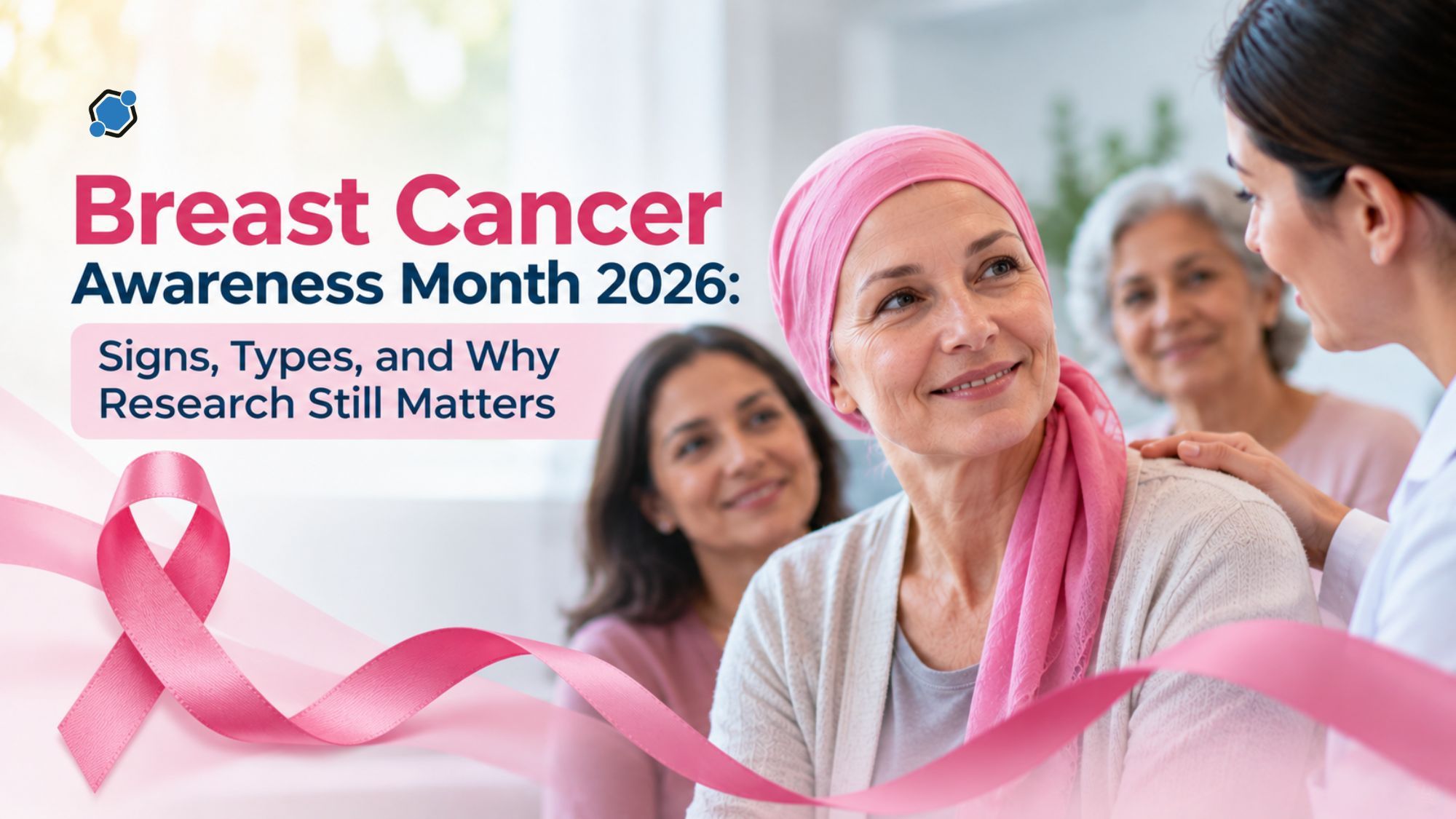
Before the ribbon was pink, it was peach. In the early 1990s, a grandmother in California named Charlotte Haley began tying ribbons by hand, each one carrying a card that asked why so little federal money went to cancer prevention research. Three generations of women in her family had faced breast cancer. The campaign she started grew into Breast Cancer Awareness Month, an observance now entering its fifth decade in the United States. The pink ribbon has become one of the most recognized symbols in American public health. The question Haley raised, however, remains open: how does awareness translate into the research that changes how breast cancer is prevented, found, and treated?
Why October became Breast Cancer Awareness Month
The observance began in October 1985 as a one-week national campaign in the United States. Public conversation about breast cancer had been shifting for more than a decade, driven in part by former First Lady Betty Ford, whose openness about her 1974 mastectomy helped move the diagnosis out of private silence. The one-week campaign grew into a full month and then into a global movement. In 1992, Self magazine and the cosmetics executive Evelyn Lauder adopted a pink version of Haley's ribbon after she declined a formal partnership. The pink ribbon has been the signature of the month ever since.
The World Health Organization's 2026 theme, "Every story is unique, every journey matters," captures how the observance has evolved. Awareness today reaches well beyond screening schedules. It covers prevention, treatment advances, equity in care, and the research gaps that still leave some communities behind. The national cancer organization that helped launch the first campaign now describes the fortieth year of the observance as a call to turn awareness into action. One expression of that shift is the rise of companion research-focused observances that place scientific progress at the center of public attention.
What breast cancer is, and why it is not one disease
Breast cancer begins when cells in the breast develop genetic changes that cause them to grow and divide without the usual controls. Most cases start in the ducts, which are the small tubes that carry milk to the nipple, or in the lobules, which are the glands that produce milk. When abnormal cells remain inside the duct or lobule, the condition is called in situ, meaning non-invasive. When those cells break through into surrounding tissue, the cancer is called invasive and may spread (a process called metastasis) through the lymph system or bloodstream to other parts of the body.
Beyond where it starts, breast cancer is classified by the proteins its cells carry. Tumors are tested for estrogen and progesterone receptors, which are docking points for hormones that can fuel growth, and for a growth-promoting protein called HER2. These results decide which treatments are likely to work. Hormone receptor-positive disease responds to drugs that block or lower estrogen. HER2-positive disease can be treated with antibodies designed to disable the HER2 protein. A separate category, called triple-negative breast cancer, lacks all three of these targets and has historically had fewer treatment options.
The distinction matters because the public conversation often treats breast cancer as a single illness. In practice, two patients with the same stage of disease may receive very different treatment plans based on the biology of their tumors. Research continues to refine these categories, including a newer group sometimes called HER2-low. A dedicated overview of triple-negative disease and why it is harder to treat explains the subtype in greater depth.
Signs of breast cancer that go beyond a lump
A lump is the symptom most commonly associated with breast cancer, but it is far from the only one. Changes that deserve prompt medical evaluation include swelling of all or part of the breast, dimpling or puckering of the skin (sometimes described as resembling an orange peel), redness or scaliness of the skin or nipple, a nipple turning inward, discharge from the nipple other than breast milk (especially if it is bloody), and new, persistent pain in one spot.
Thickening of breast or underarm tissue, a change in size or shape, and any skin change that does not resolve are also worth bringing to a clinician's attention. These signs do not mean cancer is present. Many are caused by benign conditions. The purpose is prompt evaluation, not alarm.
Breast self-awareness has largely replaced the earlier practice of structured monthly self-exams in most clinical guidance. The intent is for a person to notice what is normal and to report changes. The leading national cancer organization in the United States no longer recommends clinical breast exams as a stand-alone screening tool for average-risk women, though many clinicians still perform them during routine visits. A dedicated reference on symptoms other than a lump covers each of these changes in greater detail.
How doctors describe how far breast cancer has progressed
The stage of a breast cancer describes how far it has spread when it is first found. Stage 0 refers to non-invasive disease, often ductal carcinoma in situ, in which abnormal cells remain confined to the milk duct. Stage I describes small tumors confined to the breast, possibly with tiny amounts in nearby lymph nodes. Stage II covers larger tumors or those with more lymph node involvement. Stage III is called locally advanced disease and includes cancers that have reached many lymph nodes or grown into the chest wall or skin. Stage IV, also known as metastatic breast cancer, means the disease has spread to distant organs such as the bone, liver, lung, or brain.
Modern staging now factors in the biology of the tumor, not only its size and spread. Hormone receptor status, HER2 status, and the results of genomic tests can change how a given tumor is classified and treated. The federal cancer surveillance program reports that most invasive breast cancers in the United States are still being diagnosed while confined to the breast, where five-year relative survival is highest. Earlier detection is one of the main reasons the national death rate from breast cancer has fallen substantially over the past three decades, even as the number of new diagnoses has slowly risen. A dedicated explainer walks through stage 0 through stage 4 and how doctors determine stage after biopsy and imaging.
How clinical trials shaped breast cancer care, and where participation stands today
Almost every major advance in breast cancer treatment during the past half-century came out of clinical trials. A long-running national trial that enrolled women in the late 1970s established that breast-conserving surgery followed by radiation produced survival outcomes equal to full mastectomy for many patients. That finding changed surgical practice worldwide. Another program launched in the 1990s tested an antibody designed to block the HER2 protein and led to the first targeted therapy for a solid tumor. A prevention study that enrolled more than thirteen thousand women at higher risk showed that a hormone-blocking pill could substantially reduce the chance of developing invasive disease. A later de-escalation trial used a genomic test to show that most women with the most common subtype of early-stage breast cancer could safely skip chemotherapy altogether.
Each of these advances required people to volunteer. Participation in breast cancer research, however, remains uneven. Black women, older adults, men with breast cancer, and people living far from large research centers continue to be underrepresented in the studies that define standard care. The research pipeline has grown faster than the systems that connect patients to it. Many patients who would qualify never learn a study exists, and many sites run trials they struggle to fill.
DecenTrialz is a United States-based clinical trial recruitment and pre-screening platform that uses AI-assisted participant matching combined with registered nurse-led pre-screening to connect potential participants with research sites. The research site team, not DecenTrialz, handles the study walk-through, final eligibility determination, informed consent, and enrollment. For adults who want to understand what joining a study actually involves before contacting a site, a short primer for first-time trial volunteers outlines the typical steps and what questions to prepare.
Frequently asked questions about Breast Cancer Awareness Month
When did Breast Cancer Awareness Month begin?
The observance began in October 1985 as a one-week national campaign in the United States. It expanded into a month-long observance in the years that followed and now runs through the entire month of October.
Why is the ribbon pink?
The original ribbon handed out by activist Charlotte Haley was peach, and her goal was to push for more federal prevention research funding. In 1992, Self magazine and the cosmetics executive Evelyn Lauder adopted a pink version after Haley declined a formal partnership. Pink has been the symbol of the month ever since.
Is there a 2026 theme?
The World Health Organization's theme for 2026 is "Every story is unique, every journey matters," which emphasizes the differences in each person's diagnosis, treatment, support networks, and access to care. There is no single official national theme in the United States.
Does breast cancer only affect women?
Breast cancer occurs predominantly in women but also affects men. Male cases make up a small share of all diagnoses in the United States each year. Signs in men can include a painless lump or thickening in the breast tissue, changes to the nipple, and skin changes over the chest.
What is the role of clinical trials in Breast Cancer Awareness Month?
Awareness Month is widely associated with screening and fundraising, but research participation is a less visible part of the same cause. Clinical trials have driven most of the treatment advances now considered standard. Looking at who participates, and who does not, is central to making future advances reach every community equally.
Turning awareness into informed action
Breast Cancer Awareness Month began as a call for better prevention research. Forty years later, that call still holds. Awareness becomes useful when it leads somewhere specific: a long-overdue mammogram, a conversation about family history, a question about dense breast tissue, or a decision to learn whether a clinical trial might fit. The pink ribbon is a symbol. Research is what moves the numbers. The two have always belonged together.
Was this article helpful?

Similar Blogs

ADHD Awareness Month 2026: adult diagnosis, the gap in women, and research shaping better care
Millions of adults in the United States are being recognized with Attention-Deficit/Hypera...
 Swaroop ESD
HER2 positive and HER2 negative breast cancer explained: testing, treatment, and what HER2 low means
A breast cancer pathology report contains a great deal of information, and HER2 status is ...
Swaroop ESD
Metabolic syndrome symptoms and diagnosis: what the five warning numbers mean
Metabolic syndrome is a cluster of five measurable risk factors that, when they appear tog...
Vamshi KantojuStay Informed. Stay Connected.
Get updates on verified clinical trials, emerging treatments, and research breakthroughs directly in your inbox. No spam, just science that matters.
