 HIPAA Compliant
 ISO 27001 Certified
Triple Negative Breast Cancer: What Does It Mean, and Why Is It Harder to Treat?
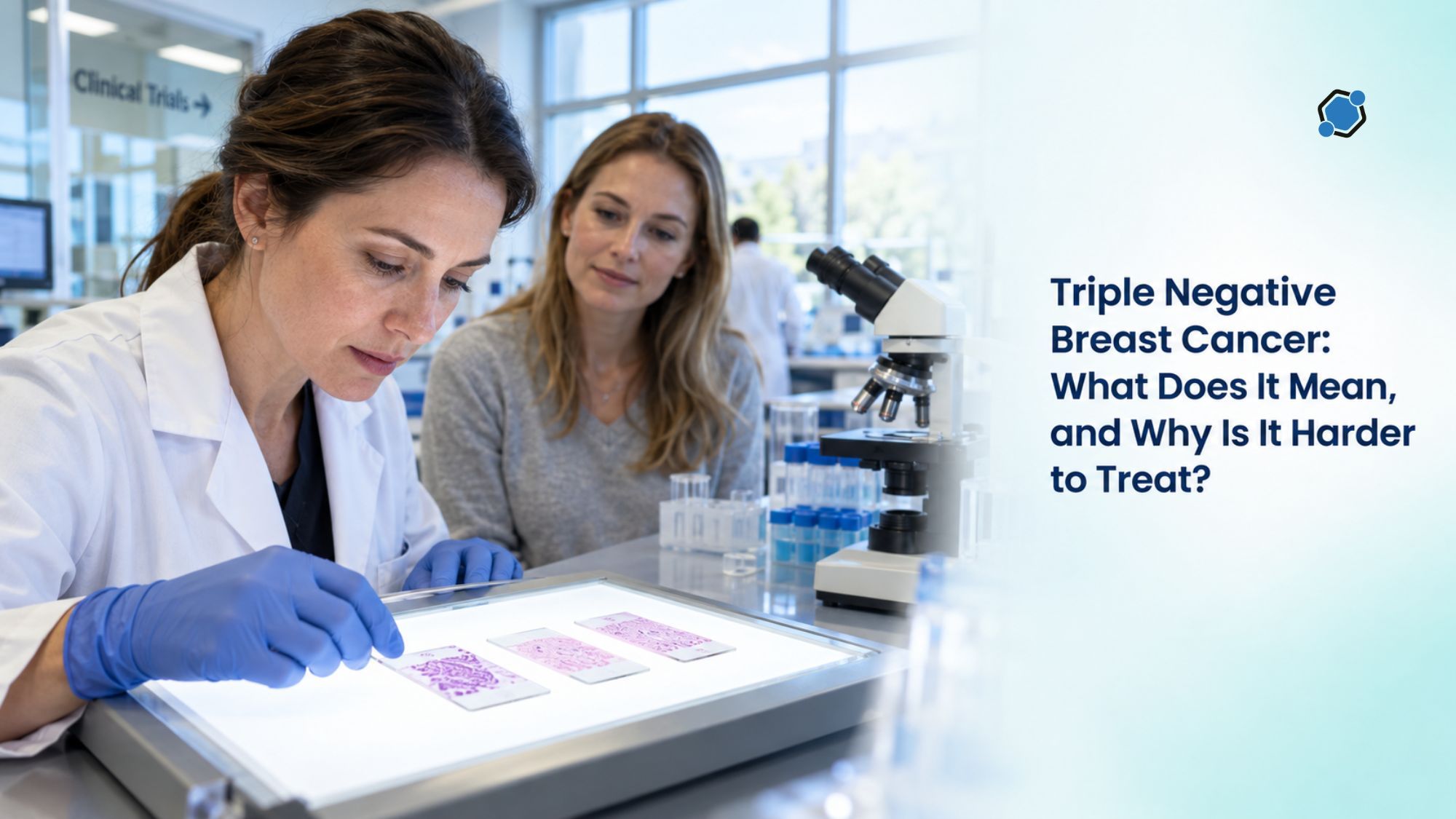
Triple negative breast cancer is a specific subtype of breast cancer defined less by what it does than by what it lacks. Standard laboratory testing on a tumor sample looks for three molecular features that most breast cancers carry: two hormone receptors (estrogen and progesterone) and a growth-signaling protein called HER2. When all three come back essentially absent, the cancer is classified as triple negative. That single feature explains almost everything the reader needs to understand about the disease, from why certain treatments do not work to why clinical research has focused on this subtype so intensively.
Triple negative breast cancer accounts for a meaningful minority of breast cancer diagnoses, tends to appear more often in younger adults, and falls disproportionately on certain groups. It has historically been considered more difficult to treat, though the last several years have brought new options that were not available a decade ago. This article explains what the diagnosis means, who is most affected, how it is identified, how it is treated today, and where clinical research fits into the picture.
What triple negative breast cancer actually means
Most breast cancer cells carry molecular structures on their surface or inside them that act like docking stations. Two of these respond to the hormones estrogen and progesterone, and a third is a protein called HER2 that signals cells to grow and divide. Pathologists check for all three by staining a small tissue sample from a biopsy. When the estrogen receptor, the progesterone receptor, and HER2 are all reported as negative, the cancer is called triple negative.
Understanding why this matters requires one more step. Those same three receptors are the main handles that targeted treatments grab onto. Hormone-blocking therapy works by starving cancers that feed on estrogen or progesterone. HER2-directed therapy works by blocking the HER2 growth signal. Because triple negative tumors have neither the hormone receptors nor extra HER2, those approaches have nothing to lock onto and do not help. The name of the disease describes what the cancer lacks, and what it lacks determines which treatments can and cannot work.
This is the central distinction that separates triple negative disease from other forms of breast cancer. The other major subtypes are hormone-receptor positive (the most common group) and HER2 positive, and each has its own toolkit of targeted therapies. Triple negative disease sits outside those toolkits, which is why it is often described separately and why understanding a person's cancer stage and receptor status together is essential to any treatment conversation.
Who is most likely to be diagnosed with this subtype
Triple negative breast cancer can affect anyone with breast tissue, but it does not distribute evenly across the population. It is diagnosed more often in adults under age 50, more often in Black women, and more often in women of Hispanic ancestry. It is also strongly associated with an inherited change in a gene called BRCA1, which normally helps cells repair damaged DNA.
These patterns reflect a mix of biology and long-standing barriers to timely care, not individual choices. Access to specialized cancer centers, timely follow-up after an abnormal screening, and equitable inclusion in clinical research all shape outcomes at the population level. For that reason, national cancer guidelines recommend that anyone diagnosed with triple negative breast cancer at a younger age be offered genetic counseling and testing, because identifying an inherited change can shape both treatment choices and screening decisions for family members.
Signs, symptoms, and how the diagnosis is made
The warning signs of triple negative breast cancer are the same as those of other breast cancers. A new lump or area of thickening in the breast or underarm is the most familiar, but changes in size or shape, skin dimpling or puckering, nipple changes such as inversion or unusual discharge, and persistent breast pain can all be worth attention. A more detailed review of less familiar warning signs is available for readers who want to understand what to watch for beyond a lump.
Diagnosis begins with imaging, usually a diagnostic mammogram often paired with ultrasound or breast MRI. If an area looks suspicious, a biopsy is performed. A biopsy is a procedure in which a small tissue sample is removed with a needle and examined under a microscope. That tissue is then run through a laboratory test called immunohistochemistry, which uses stains to reveal whether the estrogen, progesterone, and HER2 receptors are present on the cancer cells. If all three come back negative, the cancer is classified as triple negative.
Alongside the receptor result, doctors assign a stage. Staging describes the size of the tumor, whether nearby lymph nodes are involved, and whether the cancer has spread to distant parts of the body. The tumor grade, which describes how abnormal the cells look under the microscope, is also recorded. Receptor status, stage, and grade together form the foundation of the treatment plan.
Why triple negative breast cancer is often described as aggressive
On average, triple negative tumors tend to be higher grade and to grow faster than hormone-driven subtypes. The risk of the cancer returning after initial treatment is concentrated in the first few years after diagnosis, and when the disease does spread it is more likely to travel to organs such as the lungs, liver, and brain. Combined with the fact that this subtype does not respond to hormone or HER2-directed therapies, these features are why clinicians often describe it as aggressive.
It is important to hold that description in context. Outlook depends heavily on the stage at which the cancer is found, on tumor characteristics, and on how completely the cancer responds to treatment. Early detection and a strong response to treatment given before surgery are favorable factors, and the treatment landscape has expanded in recent years. Aggressive as a general label does not predict any individual outcome.
How triple negative breast cancer is treated today
Because triple negative disease does not respond to hormone-blocking or HER2-directed therapy, treatment relies on a different set of tools. Chemotherapy remains the backbone. It is often given before surgery, an approach called neoadjuvant therapy, to shrink the tumor and to show doctors how well the cancer responds. It may also be given after surgery to lower the risk of recurrence.
Over the past several years, several newer classes of treatment have joined the standard approach. Immune checkpoint inhibitors are a class of drugs that help the body's own immune cells recognize and attack cancer, and adding them to chemotherapy before surgery has become part of standard care for higher-risk early triple negative disease. For people whose cancer is driven by an inherited change in a DNA-repair gene, a class of targeted pills that blocks a backup DNA-repair pathway can be effective. A newer class known as antibody-drug conjugates pairs a tumor-seeking antibody with a chemotherapy payload, delivering the drug more directly to cancer cells while sparing more healthy tissue.
Surgery, either lumpectomy or mastectomy, and radiation to the affected area remain central for controlling the cancer locally. The specific combination and sequence of treatments depends on the stage, the tumor's biological features, whether an inherited genetic change is present, and the person's overall health. Reviewing what a first clinical evaluation involves can help readers prepare for that conversation, and what to expect at a first screening or study visit covers many of the same elements that appear in a treatment consultation.
Where clinical research fits into the picture
Because targeted options for triple negative breast cancer have historically been more limited than for other subtypes, clinical trials have played a central role in expanding what is available. Active areas of research include new immunotherapies and treatment vaccines, combinations that pair immunotherapy with antibody-drug conjugates, additional antibody-drug conjugates aimed at different tumor markers, and targeted agents for specific genetic changes. A public, government-run registry of clinical studies lists active trials, and eligibility is determined by the research team at each participating site. For a broader overview of the science, an annual look at breast cancer research progress provides useful context.
Participation in a clinical trial typically involves a screening process to confirm eligibility, an informed-consent conversation with the research team, and close monitoring throughout. Not every person who is interested will qualify for a given study, and why not everyone qualifies for a trial explains how eligibility criteria are set. A persistent gap in this space is that people of color, who carry a disproportionate share of the triple negative breast cancer burden, remain underrepresented in the trials that establish new treatments. Closing that gap is a shared responsibility of sponsors, sites, advocacy groups, and the broader health system.
How DecenTrialz supports people exploring clinical trial options
DecenTrialz is a United States-based clinical trial recruitment and pre-screening platform. It helps people who may be interested in joining a study share their information, get matched with potentially relevant trials through AI-assisted matching, and go through a pre-screening review conducted by a registered nurse before being referred to a research site team. The research site team, not DecenTrialz, owns final eligibility determination, informed consent, study walk-through, and enrollment.
For someone considering a trial in connection with a triple negative breast cancer diagnosis, this workflow is designed to reduce the amount of time spent on early paperwork and unclear next steps. The platform does not replace a person's oncology team, and it does not guarantee a match, enrollment, or a specific medical outcome. What it offers is a structured on-ramp to the research process for people who want to explore it alongside their standard care.
Frequently asked questions about triple negative breast cancer
Is triple negative breast cancer hereditary?
Some cases are linked to an inherited change in a gene such as BRCA1, and guidelines support offering genetic counseling and testing to people diagnosed with this subtype, particularly at younger ages. Most cases, however, are not inherited and arise from a combination of aging, biology, and other factors that are not fully understood.
Can triple negative breast cancer be prevented?
There is no guaranteed way to prevent it. For people with a known high inherited risk, genetic counseling can open the door to closer screening and risk-reducing options. General steps that support overall health, such as regular physical activity, a balanced diet, limiting alcohol, and maintaining a healthy weight, may help lower overall breast cancer risk.
How is triple negative breast cancer different from other breast cancers?
It lacks the three receptors that most breast cancers use to grow: the estrogen receptor, the progesterone receptor, and HER2. Because those receptors are the main targets of hormone-blocking and HER2-directed therapy, those treatments do not work for this subtype, and treatment relies on chemotherapy, immunotherapy, targeted pills for certain genetic profiles, antibody-drug conjugates, surgery, and radiation.
What questions are worth raising with the care team?
Useful questions include what the receptor status and stage of the cancer are, whether genetic counseling and testing are recommended, whether treatment before surgery is an option, whether a clinical trial might be appropriate, and what to expect from each stage of the treatment plan.
Moving forward with clear information
A triple negative diagnosis is a specific medical description, not a fixed forecast. It tells the care team which treatments will not work and points toward the ones that can, and it is the starting point for a plan built around the individual, the stage of the cancer, and the treatments now available. For people who want to explore whether a clinical trial might be part of that plan, structured pre-screening pathways can help make an early inquiry feel less overwhelming. This article is educational and does not replace medical advice from a qualified clinician.
Was this article helpful?

Similar Blogs

How is a clinical trial recruitment platform different from a trial finder website? Inside DecenTrialz's AI matching and RN pre-screening
Public clinical trial finder websites are, at their core, disclosure directories. They exi...
 Swaroop ESD
International Week of Deaf People 2026: how can clinical research become accessible to Deaf participants?
More than seventy million people around the world belong to signing Deaf communities, and ...
Deeksha Gitta
DecenTrialz vs. EMR-based clinical trial recruitment tools: what actually delivers qualified participants for sponsors and CROs?
Clinical trial recruitment technology now divides into two broad philosophies. One prizes ...
Vamshi KantojuStay Informed. Stay Connected.
Get updates on verified clinical trials, emerging treatments, and research breakthroughs directly in your inbox. No spam, just science that matters.
