 HIPAA Compliant
 ISO 27001 Certified
ADHD Awareness Month 2026: adult diagnosis, the gap in women, and research shaping better care
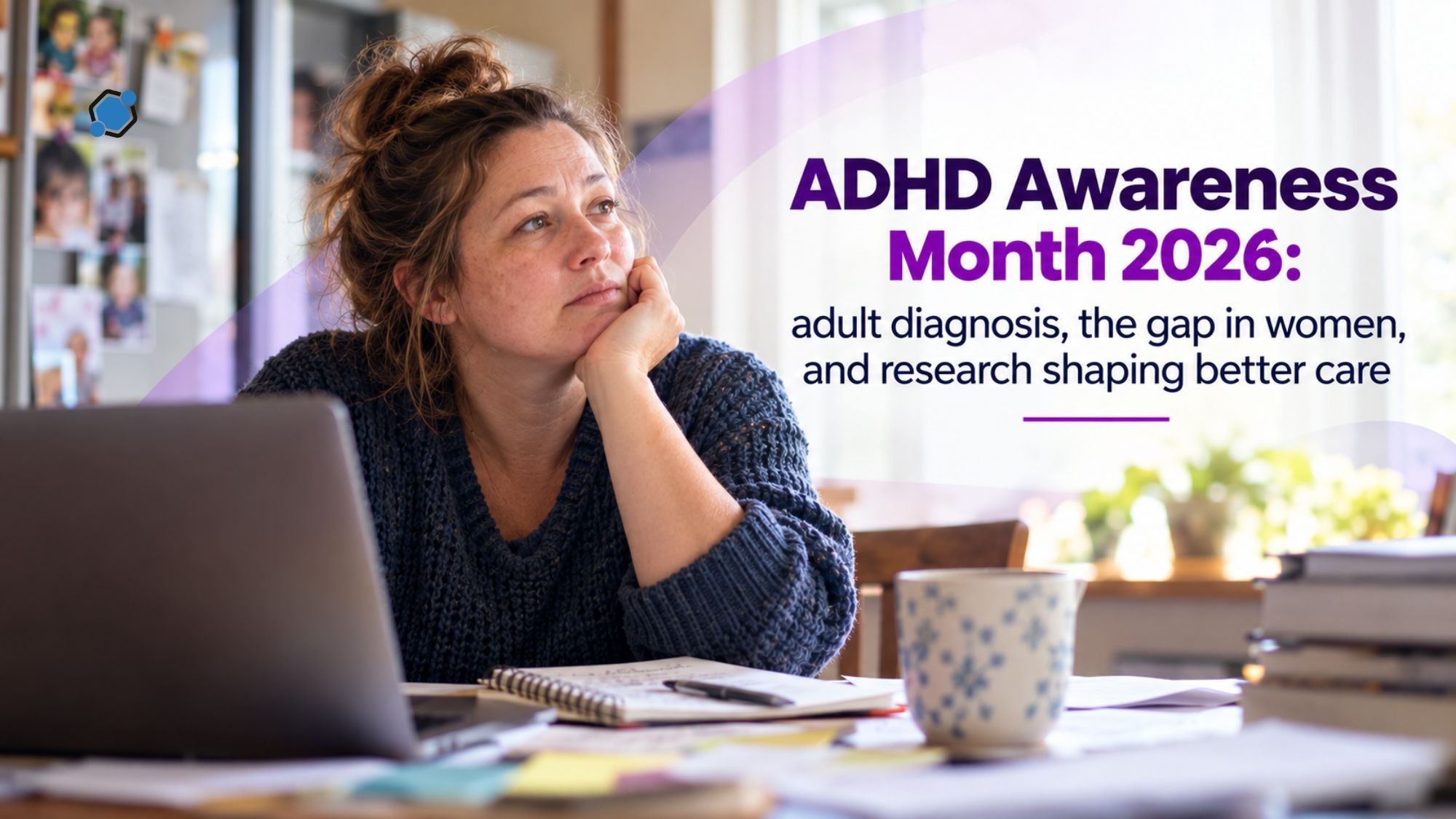
Millions of adults in the United States are being recognized with Attention-Deficit/Hyperactivity Disorder (ADHD) for the first time well into their twenties, thirties, or later. The condition itself started in childhood, but the diagnosis often did not. Each October, ADHD Awareness Month turns attention toward the gap between how long people have lived with ADHD and how long they have been understood to have it, and toward the clinical research that is working to close that gap.
What ADHD Awareness Month is and what the 2026 campaign is about
ADHD Awareness Month is observed every October across the United States and internationally. It began as a single awareness day created through a U.S. Senate resolution in 2004 and grew into a week and then a full month, led by a coalition of three nonprofits: Children and Adults with Attention-Deficit/Hyperactivity Disorder (CHADD), the Attention Deficit Disorder Association (ADDA), and the ADHD Coaches Organization (ACO). International partners now extend the observance across several continents.
The coalition’s 2026 campaign centers on the theme “A Community of Support.” The focus is practical: support means more than understanding, and more than one person or one professional alone can offer. The campaign emphasizes accurate information, lived experience, access to care across the lifespan, and the networks of family, clinicians, teachers, coworkers, and peers that help people with ADHD function and thrive. The observance also draws attention to adjacent brain health topics, in the spirit of events like World Brain Day 2026 earlier in the year.
What ADHD is, and how it shows up across a lifetime
ADHD is a neurodevelopmental condition, meaning it involves differences in how the brain develops and functions. The current clinical reference used in the United States, the DSM-5-TR (Diagnostic and Statistical Manual of Mental Disorders, Fifth Edition, Text Revision), describes three presentations:
- Predominantly inattentive presentation, where difficulty sustaining focus, following through, and staying organized is most prominent.
- Predominantly hyperactive-impulsive presentation, where restlessness, fidgeting, excessive talking, and difficulty waiting one’s turn stand out.
- Combined presentation, where both sets of symptoms are present.
The older label “ADD” (Attention Deficit Disorder) is no longer used clinically. What used to be called ADD generally corresponds to the inattentive presentation.
Symptoms often look different at different ages. In children, hyperactivity and impulsivity tend to be most visible at school. In adolescents, demands on independence and self-management rise sharply, and executive function (the mental skills involved in planning, prioritizing, and following through) can become the dominant challenge. In adults, external hyperactivity often softens into inner restlessness, while inattention, time management, emotional regulation, and difficulty switching tasks tend to persist. ADHD rarely occurs on its own: anxiety, depression, learning differences, and sleep disruption commonly co-occur, which is one reason mental health research increasingly looks at how conditions overlap. Broader context on how studies in this space are advancing care appears in coverage of mental health clinical trials and Mental Health Awareness Month.
Why ADHD is often missed, especially in adults and women
ADHD has been studied for decades, yet many people reach adulthood without a diagnosis. Several system-level factors contribute. Diagnostic criteria were originally built around observations of young boys with highly visible hyperactive behavior. Screening tools, teacher reports, and primary care checklists have historically been tuned to that pattern. Inattentive symptoms, which are less disruptive to a classroom or household, are easier to overlook, and they are more common in girls and women.
Published research consistently reports that women receive an ADHD diagnosis years later than men on average, even when symptoms begin at similar ages. The delay carries consequences: untreated ADHD is associated with greater difficulty in school and work, more emotional strain, and higher rates of co-occurring anxiety and depression. The United States has also lacked formal adult ADHD clinical guidelines, which is beginning to change as professional societies prepare the first such guidelines for publication.
Racial and ethnic differences in diagnosis rates have been documented as well, with some groups diagnosed less often than true prevalence would suggest. These patterns reflect gaps in recognition, access to specialists, and the structure of research itself, rather than differences in who actually has ADHD. Correcting the gap is one reason awareness and inclusive research matter. The broader case for stronger female representation in trials is explored in coverage of why clinical trials need more women.
How ADHD is managed today, and where research is heading
ADHD management is multimodal, meaning more than one approach is usually involved. Clinicians generally consider some combination of medication, behavioral and cognitive strategies, environmental supports, and lifestyle factors. Decisions depend on age, symptom profile, co-occurring conditions, personal preferences, and daily demands.
Medication falls into two broad categories: stimulants and non-stimulants. Behavior therapy and parent training are important components for children, with federal public health guidance recommending behavior therapy first for young children. Cognitive behavioral therapy adapted for adult ADHD helps with planning, procrastination, and emotional regulation. ADHD coaching focuses on practical skills for executive function. School and workplace accommodations, such as individualized education plans or reasonable workplace adjustments, reduce friction in daily environments. Sleep, physical activity, and nutrition contribute to overall function, though they are not standalone treatments.
Research continues to expand the toolkit. Investigators are studying newer non-stimulant mechanisms, prescription digital therapeutics that have received regulatory authorization, and the role of genetics in treatment response. ADHD is one of the most heritable neurodevelopmental conditions, and large genomic studies have mapped many common variants that each contribute a small effect, along with rarer variants that may carry larger risk. Neuroimaging, wearable sensors, and patient-reported outcome measures are being evaluated for their ability to capture real-world functioning rather than only clinic-based symptom counts. Measurable biological signals are a related area of active study, and the general concept is explained in an overview of what a biomarker is. None of these tools diagnose ADHD on their own, and medical decisions belong with a qualified clinician.
Finding clinical trials that study ADHD and related conditions
Clinical research in ADHD depends on participants whose experiences reflect the full population affected: children, adolescents, and adults; women and men; and people from racial, ethnic, and socioeconomic backgrounds that have been underrepresented in trials to date. Historical gaps in trial reporting have made it harder to understand how treatments work across groups, and closing those gaps requires broader participation.
DecenTrialz is a clinical trial recruitment platform that uses AI-assisted participant matching and registered nurse-led pre-screening to help people explore studies they may qualify for. Final eligibility, informed consent, study walk-through, and enrollment remain with the authorized research site and study team. The platform covers studies across many condition areas, including mental health and neurodevelopmental research. For readers interested in exploring beyond a single condition, DecenTrialz offers matching across more than 35 condition areas rather than a single-condition search. Participation in any trial is voluntary, and anyone considering a study should discuss the decision with a clinician they trust. More information is available at decentrialz.com.
Frequently asked questions about ADHD
When is ADHD Awareness Month?
ADHD Awareness Month is observed throughout October each year. In 2026 it runs from October 1 through October 31.
Is ADHD a real medical condition?
Yes. ADHD is defined in the DSM-5-TR and recognized by major medical, psychological, and educational organizations. Decades of research support its validity as a neurodevelopmental disorder.
Can adults have ADHD if they were not diagnosed as children?
Yes. Diagnostic criteria require that symptoms began in childhood, but many people are not identified until adulthood. This is especially common in women and in people whose symptoms are predominantly inattentive.
What is the difference between ADD and ADHD?
“ADD” is an older term that is no longer used clinically. Today everything falls under ADHD, and what was called ADD generally corresponds to the predominantly inattentive presentation.
How is ADHD diagnosed?
Diagnosis is made by a qualified clinician through a structured evaluation. It typically includes a clinical interview, standardized rating scales completed by multiple people who know the individual, a review of childhood history, and screening for other conditions that can mimic or accompany ADHD. A single blood test or brain scan does not confirm the diagnosis.
Does genetics play a role?
Yes. ADHD is highly heritable and tends to run in families. Research points to many genetic variants that each contribute a small effect, combined with environmental factors.
Can ADHD be managed without medication?
Many people combine behavior therapy, cognitive strategies, coaching, environmental accommodations, and lifestyle supports, with or without medication. The right combination depends on the individual and should be guided by a clinician.
A month to look forward through research
ADHD Awareness Month 2026 lands at a moment when adult diagnosis is rising, long-standing gaps in women’s and minority experiences are being named more openly, and the first U.S. adult ADHD clinical guidelines are moving toward publication. Clinical research continues to expand what is known about the condition and how it is managed across a lifetime. For readers who want to understand what trials are available or whether participation might fit their situation, DecenTrialz offers a starting point to explore studies through AI-assisted matching and registered nurse-led pre-screening, with authorized research sites handling eligibility and enrollment. More at decentrialz.com.
Was this article helpful?

Similar Blogs

Breast Cancer Awareness Month 2026: Signs, Types, and Why Research Still Matters
Before the ribbon was pink, it was peach. In the early 1990s, a grandmother in California ...
 Paramraj
HER2 positive and HER2 negative breast cancer explained: testing, treatment, and what HER2 low means
A breast cancer pathology report contains a great deal of information, and HER2 status is ...
Swaroop ESD
Metabolic syndrome symptoms and diagnosis: what the five warning numbers mean
Metabolic syndrome is a cluster of five measurable risk factors that, when they appear tog...
Vamshi KantojuStay Informed. Stay Connected.
Get updates on verified clinical trials, emerging treatments, and research breakthroughs directly in your inbox. No spam, just science that matters.
